
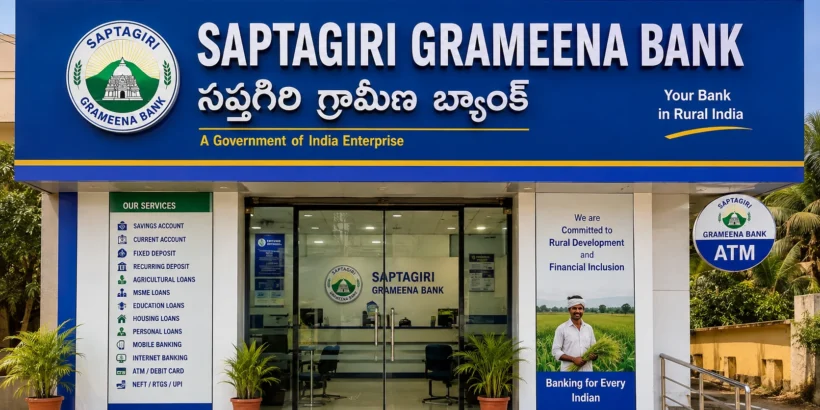
Saptagiri Grameena Bank – Complete Overview
Saptagiri Grameena Bank is part of India’s Regional Rural Bank (RRB) system, which was developed to expand organized banking services into rural and semi-urban communities. Regional Rural Banks occupy an important position in India’s financial system because they combine conventional banking activities with a broader developmental responsibility.
The importance of rural banking becomes clearer when considering the financial requirements of farmers, agricultural workers, artisans, self-help groups, microenterprises, small traders, and households living outside major urban centers. These customers may require relatively small loans, accessible savings facilities, payment services, financial guidance, and banking branches located closer to their communities.
Saptagiri Grameena Bank has therefore been associated with financial inclusion, rural credit delivery, savings mobilization, agricultural finance, small-business support, and the gradual expansion of modern banking technology into rural areas.
Its role extends beyond simply accepting deposits and providing loans. A rural bank can contribute to economic development by connecting people with the formal financial system, encouraging savings, facilitating government-linked financial programs, and providing institutional credit that can reduce dependence on informal borrowing.
The bank’s operations should therefore be understood in the wider context of India’s rural development and financial inclusion objectives.
Mission and Vision
The mission of Saptagiri Grameena Bank is closely connected with financial inclusion, rural development, and the economic empowerment of underserved communities.
Unlike a financial institution concentrating primarily on large corporations or wealthy urban customers, an RRB is designed to ensure that banking facilities reach communities where access to organized financial services may historically have been limited.
One of the bank’s fundamental objectives is to provide affordable and accessible financial services. Farmers, rural households, artisans, small traders, micro and small enterprises, and self-help groups constitute important segments within the rural economy. Providing appropriate banking products to these groups can contribute to both household financial security and broader economic development.
Another important part of the mission is the encouragement of savings. Regular savings can help households build financial resilience and prepare for education expenses, agricultural investment, emergencies, housing requirements, and other future needs.
Credit delivery is equally important. Agricultural production often requires financing before income is generated. Farmers may require funds for seeds, fertilizers, equipment, irrigation, cultivation, livestock, or other agricultural activities. Similarly, rural entrepreneurs and small businesses may need working capital or investment financing.
The bank’s vision can therefore be understood as becoming a trusted, accessible, sustainable, and increasingly technology-enabled rural financial institution.
Digital transformation is becoming particularly important. Customers increasingly expect banking services through ATMs, debit cards, mobile banking, digital payments, UPI, and internet-based platforms. Rural banks consequently face the challenge of preserving personal and branch-based banking relationships while simultaneously adopting modern technology.
Financial literacy also forms an important part of the broader rural banking mission. Access to a bank account alone does not necessarily guarantee meaningful financial inclusion. Customers need to understand savings products, loans, interest, repayment obligations, digital transactions, fraud risks, and other banking concepts.
By improving both accessibility and financial awareness, rural banks can strengthen participation in the formal financial system.
Head Office and Background
Saptagiri Grameena Bank has historically been associated with the Chittoor region of Andhra Pradesh. Its administrative structure was designed to support banking operations serving predominantly rural and semi-urban communities.
A bank’s head office performs functions that are very different from those of an ordinary branch. While branches interact directly with customers, the head office generally coordinates broader administrative and strategic responsibilities.
These can include credit planning, human-resource management, risk management, regulatory compliance, technology implementation, financial reporting, branch supervision, internal control, policy development, and monitoring of business performance.
The background of Saptagiri Grameena Bank needs to be understood within the development of India’s Regional Rural Bank system.
Regional Rural Banks were created to strengthen institutional credit delivery in rural India. The Regional Rural Banks Act, 1976 provided the statutory framework for these institutions.
The RRB model sought to combine the local orientation of rural financial institutions with the banking expertise and organizational support of established commercial banks.
The ownership and institutional framework of RRBs involves participation by the Central Government, the relevant state government, and a sponsor bank.
This arrangement provides RRBs with a distinctive character. They are expected to maintain banking discipline and financial sustainability while also pursuing developmental objectives.
Over time, rural banking has undergone considerable transformation. Manual operations have increasingly been replaced by computerized and core banking systems. Electronic payment systems have expanded. ATMs, debit cards, mobile banking, and digital transactions have become more important.
Saptagiri Grameena Bank’s development reflects this broader transformation of rural banking.
Establishment and Institutional Foundation
Saptagiri Grameena Bank should not be described as the entrepreneurial creation of one individual founder in the same way that a privately established company might be.
Its institutional foundation belongs to the Regional Rural Bank framework created by government policy and legislation.
The Regional Rural Banks Act, 1976 created the framework under which RRBs could operate with a specific rural-development mandate.
The establishment model involves cooperation among three major institutional participants: the Government of India, the relevant state government, and a sponsor bank.
The sponsor bank plays an especially important role because it can provide managerial expertise, banking knowledge, operational guidance, training, and other forms of institutional assistance.
The underlying reason for establishing institutions such as Saptagiri Grameena Bank was the need to strengthen formal credit availability in rural communities.
Agriculture has traditionally been particularly dependent on timely financing. Farmers often incur costs well before receiving income from crops. Without institutional credit, borrowers may become dependent on informal lenders.
RRBs were intended to help address such gaps by creating a more organized rural credit-delivery mechanism.
The institutional model also sought to encourage savings mobilization. Rural deposits are important not only for individual financial security but also for strengthening the overall local banking system.
Role in Rural Economic Development
The contribution of a Regional Rural Bank cannot be measured solely by its profitability. Its broader economic impact is also important.
Agricultural credit is one of the clearest examples.
A farmer may require financing to purchase seeds, fertilizers, pesticides, agricultural machinery, irrigation equipment, livestock, or other inputs. Access to institutional credit can allow agricultural activities to proceed without excessive dependence on informal sources of finance.
Small businesses are another important segment.
Rural and semi-urban economies include grocery shops, workshops, transportation businesses, repair services, food-processing activities, artisans, small manufacturers, and many other enterprises.
When these businesses receive appropriate financing, they can potentially expand production, purchase equipment, maintain inventory, and generate employment.
Self-help groups can also play an important role in rural financial inclusion. Banking relationships involving such groups can encourage collective saving, access to formal credit, and small-scale entrepreneurship.
The economic impact therefore extends beyond individual borrowers. A loan used productively can contribute to income generation, employment, local consumption, and economic circulation.
Governance Structure
Governance is essential to the effective functioning of any banking institution because banks manage public deposits, provide credit, process payments, and operate within a heavily regulated financial environment.
Saptagiri Grameena Bank follows the governance principles associated with the Regional Rural Bank framework.
Its governance structure includes institutional representation connected with the Central Government, state government, and sponsor bank.
The Board of Directors is responsible for important matters involving strategy, oversight, policies, risk, and organizational direction.
Senior management typically includes the Chairman or other chief executive leadership, General Managers, departmental executives, and officers responsible for specialized functions.
Important management areas can include:
- Credit administration
- Agricultural finance
- Retail banking
- Deposits
- Risk management
- Information technology
- Human resources
- Internal audit
- Regulatory compliance
- Recovery and stressed assets
- Financial inclusion
- Branch operations
Effective governance becomes particularly important in rural banking because the institution must balance social objectives with financial discipline.
Lending cannot be sustainable without proper credit assessment, monitoring, recovery, and risk management.
At the same time, excessively restrictive lending practices could undermine the financial-inclusion purpose of an RRB.
Governance must therefore balance accessibility, prudence, development, and sustainability.
Leadership and CEO History
The leadership structure of Regional Rural Banks differs from that of many privately controlled corporations.
Senior executives may be appointed or deputed through institutional arrangements involving sponsor banks and other banking authorities.
Leadership changes can consequently occur periodically.
The source material does not provide a verified chronological list of the last ten CEOs of Saptagiri Grameena Bank. Therefore, specific names and tenures should not be presented as established facts without supporting official records.
Nevertheless, the responsibilities of the bank’s chief leadership can be understood from the nature of RRB operations.
A chief executive is expected to oversee business growth while maintaining asset quality and regulatory compliance.
Major leadership priorities may include expanding agricultural and rural credit, mobilizing deposits, improving loan recovery, controlling non-performing assets, strengthening customer service, expanding financial inclusion, implementing technology, and improving operational efficiency.
Digital transformation has become an increasingly important leadership responsibility.
Modern bank management must also address cybersecurity, digital fraud prevention, payment-system reliability, data protection, and customer education.
Products and Services Overview
Saptagiri Grameena Bank’s products are primarily designed around the requirements of individuals, farmers, households, small enterprises, and rural and semi-urban customers.
The major product categories can broadly be divided into deposits, loans, and retail or digital banking services.
Deposit Products
Deposits are fundamental to commercial banking.
When customers deposit money with a bank, they obtain a secure mechanism for managing savings and transactions while the bank receives an important source of funds.
Savings Accounts
Savings accounts are designed primarily for individuals and households.
They allow customers to deposit money, withdraw funds when required, receive eligible interest, and use other banking facilities connected with their accounts.
For rural customers, a savings account can also serve as an entry point into the formal financial system.
Current Accounts
Current accounts are generally more suitable for businesses and customers requiring frequent transactions.
Small traders and enterprises may use such accounts to manage regular receipts and payments.
Fixed Deposits
Fixed deposits allow customers to place money with the bank for a specified period.
They can be suitable for customers seeking structured savings and interest income while keeping funds invested for an agreed tenure.
Recurring Deposits
Recurring deposits encourage disciplined savings through regular periodic contributions.
They can be particularly useful for households that cannot invest a large amount at once but are able to save smaller amounts every month.
Deposit mobilization also contributes to the bank’s financial strength by providing resources that can support lending activities.
Loan Products
Credit is one of the most important functions of an RRB.
Agricultural Loans
Agricultural finance is central to rural banking.
Farmers may require credit for cultivation, agricultural inputs, irrigation, machinery, livestock, and allied activities.
The seasonal nature of agriculture makes timely credit particularly important.
Crop Loans
Crop loans are intended to support short-term agricultural requirements associated with crop production.
Funds may be needed before sowing and throughout the cultivation cycle, whereas income may not be generated until harvesting and sale.
MSME Loans
Micro, Small and Medium Enterprises contribute significantly to local economic activity and employment.
Financing can help such enterprises obtain machinery, working capital, inventory, equipment, or other productive assets.
Education Loans
Education loans can help eligible students and families finance education-related expenses.
Such lending can have a longer-term developmental effect by contributing to human-capital formation and employment opportunities.
Housing Loans
Housing finance can support eligible customers seeking to purchase, construct, or improve residential property, subject to applicable lending conditions.
Personal Loans
Personal loans may be available for qualifying customers according to the bank’s policies and credit criteria.
Responsible lending remains important because repayment obligations must remain manageable for borrowers.
Retail Banking Services
Retail banking has changed substantially with the spread of digital technology.
Customers increasingly expect convenient access to their accounts without visiting a branch for every transaction.
Saptagiri Grameena Bank’s retail banking framework includes services such as ATM or debit-card access, mobile banking, internet banking, remittance facilities, and digital-payment services.
These facilities are particularly valuable for customers living at significant distances from branches.
Digital services can reduce travel time, improve transaction convenience, and extend banking availability beyond normal branch hours.
Digital Banking and Innovation
Digital transformation represents one of the most important changes affecting rural banking.
Traditional rural banking relied heavily on physical branches, paper documentation, and face-to-face transactions.
Modern customers increasingly use smartphones and electronic payment systems.
Mobile Banking
Mobile banking can allow customers to check account information, initiate transactions, and access banking services through compatible mobile platforms.
Internet Banking
Internet banking enables eligible customers to perform banking activities remotely.
For businesses and individuals, this can reduce the need for repeated branch visits.
UPI and Digital Payments
Unified Payments Interface (UPI) has transformed digital payments in India by enabling fast bank-to-bank transactions.
Integration with modern payment infrastructure can significantly improve the usefulness of rural bank accounts.
Core Banking System
Core Banking Solutions connect branches through centralized technology.
This enables customers to access banking services more efficiently across the network rather than treating each branch as an isolated banking unit.
Digital Challenges
Technology adoption also creates new challenges.
Customers need awareness of PIN security, OTP fraud, phishing, fake applications, suspicious links, social-engineering attacks, and other forms of digital fraud.
Digital financial literacy must therefore develop alongside digital banking adoption.
Financial Performance Overview
A bank’s financial performance can be evaluated using several indicators, including income, profitability, deposits, advances, asset quality, capital strength, and operating efficiency.
The supplied source does not provide detailed year-by-year audited financial figures for Saptagiri Grameena Bank. Therefore, specific revenue, profit, asset, or capital figures should be verified from official annual reports before publication.
Revenue and Operating Income
A bank generally earns a substantial portion of its income from interest on loans and investments.
The difference between interest earned and interest paid is therefore important to banking profitability.
Other sources of income may include eligible fees and service-related income.
Profitability
Profitability is influenced by lending volumes, interest margins, operating expenses, asset quality, and provisions for problematic loans.
RRBs must balance profitability with their developmental mandate.
Asset Quality
Asset quality is particularly important.
When borrowers fail to make repayments according to applicable rules, loans can become non-performing assets.
High NPAs can reduce profitability and require additional provisions.
Capital Adequacy
Capital provides protection against financial risk.
Banks are required to maintain capital according to applicable regulatory standards.
Strong capital adequacy contributes to financial stability and the institution’s ability to absorb losses.
Non-Performing Assets and Credit Risk
Credit risk is one of the most important risks faced by a bank.
Every loan carries the possibility that the borrower may be unable or unwilling to repay according to the agreed schedule.
Agricultural lending can involve additional uncertainties.
Crop production can be affected by rainfall, drought, floods, pests, disease, commodity prices, and other external factors.
Small businesses can similarly experience changes in demand, competition, input prices, and local economic conditions.
Banks therefore need sound credit appraisal and monitoring.
Loan recovery is also important because deposits accepted from customers ultimately represent obligations that the bank must honor.
Managing NPAs is consequently not simply a matter of maximizing profit. It is essential to protecting the institution’s financial sustainability.
Branch Network and Rural Accessibility
Physical branches remain important even as digital banking expands.
In rural communities, customers may still prefer or require direct interaction with bank employees for loans, account opening, documentation, financial guidance, or transactions that cannot conveniently be completed digitally.
Saptagiri Grameena Bank’s branch network has historically served rural and semi-urban communities.
The strategic purpose of an RRB branch network differs somewhat from the branch strategy of a purely urban commercial bank.
The objective is not simply to locate branches in the most commercially profitable areas. Accessibility to underserved communities is also an important consideration.
ATMs and shared banking networks can further extend access to cash and basic transaction services.
Financial Inclusion
Financial inclusion is one of the most important concepts associated with Regional Rural Banks.
It means extending useful and affordable financial services to people who might otherwise remain excluded from formal banking.
Financial inclusion can involve:
- Bank accounts
- Savings products
- Affordable credit
- Payment services
- Remittance facilities
- Digital transactions
- Financial education
- Access to appropriate government-linked financial programs
True financial inclusion requires more than simply opening accounts.
Customers must be able to use those accounts effectively.
This makes accessibility, financial literacy, trust, technology, and customer service equally important.
Support for Agriculture
Agriculture remains a major focus of rural banking.
Agricultural finance can contribute to productivity by enabling farmers to purchase appropriate inputs and productive assets.
Credit can potentially support:
- Seeds and fertilizers
- Crop cultivation
- Irrigation
- Farm machinery
- Livestock
- Dairy activities
- Allied agricultural activities
- Storage and other productive requirements
However, agricultural lending also requires careful risk management because farming income can be volatile.
Banks must therefore balance the objective of expanding rural credit with responsible lending practices.
Support for MSMEs and Rural Entrepreneurship
Rural development depends not only on agriculture.
Small enterprises contribute to economic diversification and can create employment outside traditional farming.
A small enterprise may require funds for equipment, inventory, premises, transportation, technology, or working capital.
Access to formal credit can allow viable businesses to grow.
This has wider economic implications because successful small businesses can employ local workers, purchase from local suppliers, and provide goods and services within the community.
Supporting MSMEs therefore complements the agricultural role of an RRB.
Financial Literacy
Financial literacy is particularly important as banking products become more sophisticated and digital.
Customers need to understand basic concepts such as:
- Interest
- Loan repayment
- Savings
- Deposits
- ATM safety
- Digital-payment security
- Fraud prevention
- Account management
A financially literate customer is better positioned to make informed decisions.
Financial education can also reduce vulnerability to scams and irresponsible borrowing.
For this reason, financial literacy should be viewed as an important complement to financial inclusion.
Annual Report Highlights
An annual report is one of the most useful documents for understanding a bank’s actual financial and operational performance.
Typical areas covered in an RRB annual report may include:
- Deposits
- Loans and advances
- Agricultural lending
- Priority-sector lending
- Profit or loss
- Non-performing assets
- Capital position
- Branch network
- Digital initiatives
- Financial inclusion
- Risk management
- Regulatory compliance
- Development initiatives
Anyone publishing precise current statistics for Saptagiri Grameena Bank should verify them against the relevant official annual report rather than relying on generalized descriptions.
SWOT Analysis of Saptagiri Grameena Bank
Strengths
Rural presence: The bank’s orientation toward rural and semi-urban communities provides strong familiarity with local financial requirements.
Institutional support: The RRB structure provides links with government institutions and a sponsor bank.
Agricultural expertise: Experience with agricultural and rural lending is a significant institutional strength.
Customer relationships: Physical presence and long-term community relationships can create trust.
Financial-inclusion role: The bank serves customer groups that remain strategically important to India’s development.
Weaknesses
Limited urban presence: An RRB naturally has less exposure to major urban banking markets than large commercial banks.
Technology gap: Digital capabilities may require continuous investment to remain competitive.
Operational costs: Maintaining branches in dispersed rural areas can be relatively expensive.
Agricultural credit risk: Dependence on rural and agricultural lending can expose the portfolio to weather and income-related risks.
Opportunities
Digital expansion: Mobile banking, UPI, and other digital services can expand access at relatively low marginal cost.
Rural entrepreneurship: Growth in small businesses creates additional credit opportunities.
Financial literacy: Customer education can encourage greater adoption of formal banking.
Fintech collaboration: Appropriate technological partnerships can improve efficiency and customer experience.
Increasing digitization: Smartphone adoption can accelerate rural digital banking.
Threats
Competition: Private banks, commercial banks, fintech companies, and digital payment platforms increasingly compete for rural customers.
Cybersecurity: Digital expansion increases exposure to cybercrime and fraud.
Asset-quality pressures: Agricultural or economic shocks can affect loan repayment.
Rapid technological change: Failure to modernize quickly enough can reduce competitiveness.
Industry Challenges
The rural banking industry faces a unique combination of developmental and commercial challenges.
Agricultural Uncertainty
Weather and commodity-price movements can affect borrower income and repayment capacity.
Rising Competition
Customers increasingly have access to multiple banking and digital-payment providers.
Technology Costs
Modern banking infrastructure requires continuous investment.
Cybersecurity
Digital fraud and social engineering can particularly affect customers who are relatively new to online banking.
Operational Efficiency
Serving geographically dispersed populations can increase operating costs.
Customer Education
Technology cannot produce full financial inclusion unless customers understand how to use it safely.
Future Outlook
The future of rural banking is likely to combine traditional relationship-based banking with increasingly sophisticated digital services.
Physical branches will continue to have importance, particularly for credit assessment, documentation, complex transactions, and customers requiring personal assistance.
At the same time, routine transactions will increasingly move to digital channels.
Saptagiri Grameena Bank and similar institutions can potentially benefit from several major trends.
First, smartphone penetration creates opportunities for mobile banking.
Second, India’s digital-payment infrastructure makes electronic transactions increasingly accessible.
Third, rural entrepreneurship and MSME development can create new lending opportunities.
Fourth, financial inclusion remains an important national development objective.
The long-term success of rural banks will depend on their ability to combine accessibility with financial discipline, digital innovation, cybersecurity, customer education, and responsible lending.
Frequently Asked Questions
1. What type of bank is Saptagiri Grameena Bank?
Saptagiri Grameena Bank belongs to the Regional Rural Bank framework and has historically focused on rural and semi-urban banking.
2. What is the primary objective of an RRB?
The primary objective is to expand formal banking and credit facilities in rural areas while supporting agriculture, small businesses, and financial inclusion.
3. Does the bank provide agricultural loans?
Agricultural credit is one of the major areas associated with RRB banking.
4. Does it provide deposit facilities?
Yes. The source material identifies products such as savings accounts, current accounts, fixed deposits, and recurring deposits.
5. What is financial inclusion?
Financial inclusion means ensuring that individuals and communities, including underserved populations, can access useful and affordable formal financial services.
6. Why are RRBs important?
They help connect rural communities with institutional savings, credit, payments, and other banking facilities.
7. What does NPA mean?
NPA stands for Non-Performing Asset. In banking, it relates to loans that have stopped performing according to applicable repayment and classification requirements.
8. Why is digital banking important for rural customers?
Digital banking can reduce the need to travel long distances to branches and make routine transactions faster and more convenient.
9. What role does a sponsor bank play?
Sponsor banks can provide managerial, operational, technical, and institutional support to Regional Rural Banks.
10. What is the future of rural banking?
The future is likely to involve a combination of branch-based services, digital banking, mobile payments, financial education, and expanded financing for agriculture and small businesses.
MCQs with Answers and Explanations
1. Saptagiri Grameena Bank is primarily a:
A. Private investment bank
B. Cooperative society
C. Regional Rural Bank
D. Foreign bank
Answer: C
Explanation: The bank belongs to India’s Regional Rural Bank framework.
2. The main focus of Regional Rural Banks is:
A. International investment
B. Rural development
C. Stock trading
D. Corporate mergers
Answer: B
Explanation: RRBs were created primarily to strengthen banking and credit availability in rural areas.
3. RRBs were established under which legislation?
A. Companies Act
B. SEBI Act
C. Regional Rural Banks Act, 1976
D. Insurance Act
Answer: C
Explanation: The Regional Rural Banks Act, 1976 provides the statutory framework for RRBs.
4. Saptagiri Grameena Bank primarily serves:
A. Foreign corporations
B. Rural and semi-urban communities
C. Investment funds
D. International exporters only
Answer: B
Explanation: Rural and semi-urban banking is central to the RRB mandate.
5. Which is an important activity of RRBs?
A. Agricultural lending
B. Cryptocurrency mining
C. International stock trading
D. Venture-capital investment
Answer: A
Explanation: Agricultural credit is one of the central functions of rural banks.
6. Which is a deposit product?
A. Crop loan
B. Fixed deposit
C. Housing loan
D. Education loan
Answer: B
Explanation: A fixed deposit is a savings or deposit instrument rather than a lending product.
7. A recurring deposit generally encourages:
A. Regular savings
B. Stock speculation
C. Borrowing
D. Foreign investment
Answer: A
Explanation: Recurring deposits allow customers to save predetermined amounts periodically.
8. NPA stands for:
A. National Payment Account
B. Non-Performing Asset
C. Net Profit Account
D. National Private Asset
Answer: B
Explanation: The term relates to loans or advances that are no longer performing according to regulatory classification requirements.
9. UPI is associated primarily with:
A. Digital payments
B. Agricultural machinery
C. Insurance underwriting
D. Physical currency printing
Answer: A
Explanation: UPI facilitates digital bank-to-bank payments.
10. MSME loans primarily support:
A. Small and medium enterprises
B. Foreign governments
C. Stock exchanges
D. Central banks
Answer: A
Explanation: MSME financing supports business activities and can contribute to employment and local economic development.
11. Financial inclusion means:
A. Restricting banking to wealthy customers
B. Providing useful financial access to broader sections of society
C. Eliminating bank branches
D. Preventing rural lending
Answer: B
Explanation: Financial inclusion seeks to extend appropriate financial services to underserved groups.
12. Internet banking allows customers to:
A. Access eligible banking services online
B. Print money
C. Avoid all security requirements
D. Eliminate bank accounts
Answer: A
13. ATM stands for:
A. Automatic Tax Management
B. Automated Teller Machine
C. Account Trading Mechanism
D. Automated Transfer Market
Answer: B
14. Core banking technology helps:
A. Connect banking operations across branches
B. Eliminate customer accounts
C. Replace all bank employees
D. Prevent digital transactions
Answer: A
15. Agricultural credit can be used for:
A. Crop-production requirements
B. Stock-market speculation
C. Luxury imports only
D. Foreign exchange trading only
Answer: A
16. Deposits are important to banks because:
A. They are an important source of funds
B. They eliminate lending
C. They have no financial significance
D. They prevent savings
Answer: A
17. Capital adequacy is associated with:
A. A bank’s financial resilience against risk
B. Agricultural rainfall
C. Employee attendance
D. Customer passwords
Answer: A
18. Digital banking creates which additional challenge?
A. Cybersecurity risk
B. Elimination of all financial risk
C. Elimination of fraud
D. Guaranteed profitability
Answer: A
19. Financial literacy helps customers:
A. Understand and use financial services more effectively
B. Avoid all banking services
C. Ignore repayment obligations
D. Eliminate savings
Answer: A
20. Rural branches are important because they:
A. Improve physical access to banking
B. Prevent agricultural lending
C. Serve only large corporations
D. Replace all digital services
Answer: A
21. Which sector is particularly important to RRB lending?
A. Agriculture
B. International aviation only
C. Foreign stock exchanges
D. Cryptocurrency exchanges
Answer: A
22. Which is an important banking risk?
A. Credit risk
B. No repayment risk
C. No operational risk
D. Guaranteed return risk
Answer: A
23. Loan recovery is important because:
A. Banks need to maintain financial sustainability
B. Loans never need to be repaid
C. Deposits have no connection with banking stability
D. Recovery automatically increases NPAs
Answer: A
24. Mobile banking is particularly useful because it can:
A. Provide remote access to banking services
B. Eliminate the need for account security
C. Guarantee loans
D. Replace financial regulation
Answer: A
25. The long-term success of rural banking is likely to depend on:
A. Combining accessibility, responsible lending, and digital transformation
B. Eliminating technology
C. Stopping agricultural credit
D. Serving only urban corporations
Answer: A
Conclusion
Saptagiri Grameena Bank represents the broader purpose and importance of India’s Regional Rural Bank system. Its significance cannot be understood simply by looking at conventional banking measures such as deposits, loans, or profitability. Rural banking has a wider developmental function because access to organized financial services can influence agriculture, entrepreneurship, household savings, employment, and financial security.
The bank’s traditional strengths are connected with its rural orientation, institutional framework, agricultural focus, and ability to maintain relationships with communities that may not always receive the same attention from institutions concentrated primarily on metropolitan markets.
At the same time, the banking environment is changing rapidly.
Customers increasingly expect mobile access, instant digital payments, convenient account services, and secure electronic transactions. Private banks, commercial banks, fintech businesses, and digital-payment providers are also expanding their reach.
This creates both opportunities and challenges for rural banks.
Digital technology can substantially increase accessibility and reduce the inconvenience associated with distance from physical branches. However, technological expansion requires investment, cybersecurity, reliable infrastructure, and customer education.
Credit quality represents another continuing challenge. Agricultural and small-business lending can generate substantial developmental benefits, but borrowers may also be vulnerable to economic shocks, weather conditions, changes in commodity prices, and fluctuations in income.
Strong credit assessment, monitoring, recovery, and risk management therefore remain essential.
The future of institutions such as Saptagiri Grameena Bank will depend on maintaining the fundamental mission of rural financial inclusion while adapting to a rapidly modernizing financial system.
A successful rural bank of the future will not need to choose between traditional community banking and technology. Instead, it will need to combine the two.
Branches and knowledgeable employees can provide trust, advice, credit assessment, and assistance with more complicated banking needs. Digital platforms can provide speed, convenience, accessibility, and lower-cost routine transactions.
When these strengths are combined with responsible lending, effective governance, financial literacy, cybersecurity, and customer-focused innovation, Regional Rural Banks can continue to make an important contribution to inclusive economic development.
Saptagiri Grameena Bank therefore represents more than a conventional financial institution. Within the framework described in the supplied material, it illustrates how rural banking can connect formal finance with agriculture, small businesses, households, and underserved communities while gradually adapting to the technological transformation of modern banking.