

Agent Banking in Bangladesh (2025): Transforming Financial Inclusion and Rural Banking
Introduction
Agent Banking in Bangladesh has emerged as one of the most successful financial inclusion initiatives in South Asia. It has revolutionized the banking landscape by bringing formal financial services to millions of previously unbanked and underbanked citizens living in rural and remote areas. Through a network of authorized banking agents, customers can now access banking services near their homes without visiting traditional bank branches.
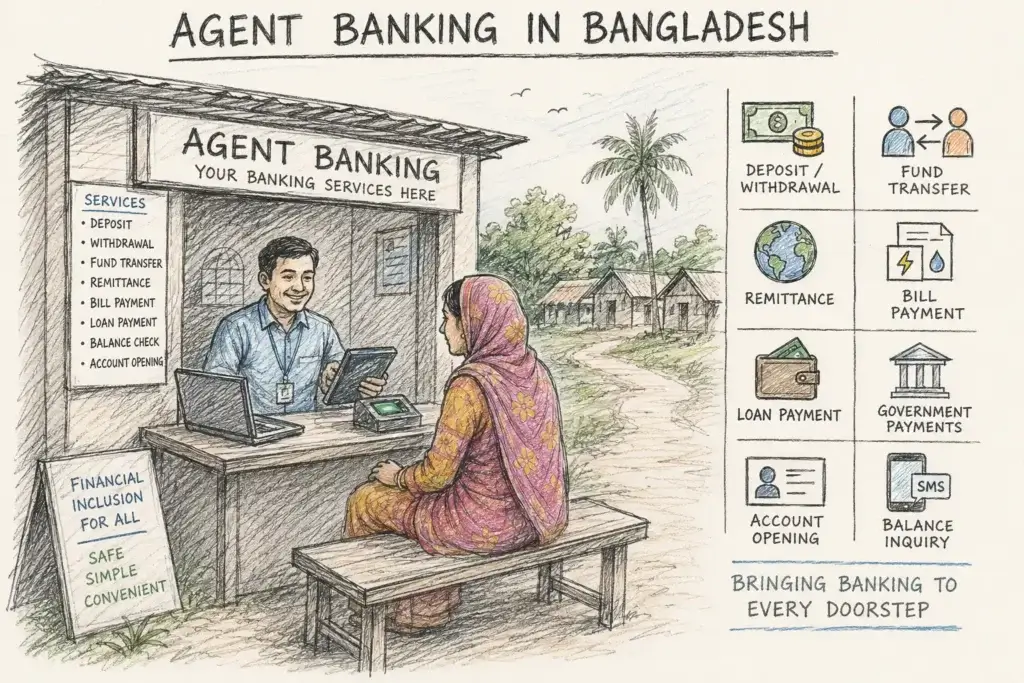
Since the introduction of Agent Banking Guidelines by the Bangladesh Bank on December 9, 2013, the sector has experienced remarkable growth. What started as a pilot initiative to extend banking services to rural communities has now become a critical pillar of Bangladesh’s financial inclusion strategy.
In 2025, agent banking is not only facilitating deposits and withdrawals but also enabling remittance distribution, digital payments, government benefit transfers, agricultural financing, SME loans, savings mobilization, and mobile banking integration. The rapid expansion of agent banking outlets has significantly contributed to economic development, poverty reduction, and financial empowerment across the country.
What is Agent Banking?
Agent Banking is a banking service delivery model where banks provide financial services through authorized agents instead of establishing full-fledged bank branches.
These agents operate on behalf of licensed banks and offer various banking services using modern technology and biometric verification systems.
An agent banking outlet functions as a mini-bank where customers can:
-
Open bank accounts
-
Deposit money
-
Withdraw cash
-
Receive remittances
-
Transfer funds
-
Pay utility bills
-
Receive government allowances
-
Apply for loans
-
Check account balances
-
Make digital payments
The bank remains fully responsible for all transactions conducted through agents.
Historical Background of Agent Banking in Bangladesh
Before 2013, millions of Bangladeshis had limited access to formal banking services. Most commercial bank branches were concentrated in urban areas, making banking inaccessible for rural populations.
Recognizing the need for financial inclusion, the Bangladesh Bank introduced Agent Banking Guidelines on December 9, 2013.
The objectives were:
-
Extend banking services to underserved regions
-
Reduce financial exclusion
-
Promote savings culture
-
Facilitate remittance distribution
-
Support rural economic development
-
Encourage digital financial services
Following the regulatory approval, several banks began deploying agent banking operations throughout the country.
Early Adopters
The pioneer banks included:
-
Bank Asia
-
Dutch-Bangla Bank PLC
-
South Bangla Agriculture and Commerce Bank
-
NRB Commercial Bank
Bank Asia became one of the first institutions to aggressively expand its agent banking network across rural Bangladesh.
Growth of Agent Banking in Bangladesh
The growth trajectory of agent banking has been extraordinary.
Initial Stage (2014–2017)
By June 2017:
-
Deposits exceeded Tk 651 crore.
-
Thousands of rural customers opened accounts.
-
Remittance beneficiaries increasingly adopted agent banking services.
-
Rural savings mobilization accelerated.
The model proved highly successful because customers could access banking services without traveling long distances.
Agent Banking Statistics in Bangladesh (2025)
By 2025, agent banking has become one of the fastest-growing segments of the banking industry.
Key achievements include:
Expansion of Agent Outlets
-
More than 20,000 agent banking outlets operate across Bangladesh.
-
Services are available in nearly every district and upazila.
-
Rural areas account for the majority of agent banking locations.
Customer Base
-
Millions of customers maintain agent banking accounts.
-
Women account holders have increased significantly.
-
Farmers, small business owners, and migrant workers are major beneficiaries.
Deposit Mobilization
Agent banking now manages deposits worth tens of thousands of crores of taka, demonstrating strong public confidence in the system.
Remittance Distribution
A substantial share of inward foreign remittances is now distributed through agent banking outlets, especially in rural regions.
Why Agent Banking Was Necessary in Bangladesh
Traditional banking faced several challenges:
Limited Branch Coverage
Many villages had no bank branches.
High Operational Costs
Opening branches in remote areas required substantial investment.
Low Financial Literacy
Rural populations often lacked familiarity with banking procedures.
Long Travel Distances
Customers frequently traveled several kilometers to reach a bank.
Financial Exclusion
Millions remained outside the formal financial system.
Agent banking effectively addressed these issues.
How Agent Banking Works
The process is straightforward:
Step 1: Appointment of Agents
Banks appoint qualified agents who meet Bangladesh Bank requirements.
Step 2: Technology Integration
Agents are equipped with:
-
Point-of-Sale (POS) devices
-
Computers
-
Internet connectivity
-
Biometric authentication systems
-
Mobile banking applications
Step 3: Customer Verification
Customers complete Know Your Customer (KYC) procedures.
Step 4: Service Delivery
Agents provide banking services on behalf of the bank.
Step 5: Transaction Settlement
Transactions are processed in real time through the bank’s core banking system.
Major Services Offered Through Agent Banking
1. Account Opening
Customers can open:
-
Savings accounts
-
Current accounts
-
Student accounts
-
Special deposit accounts
Biometric verification makes the process simple and secure.
2. Cash Deposits
Customers can deposit money at nearby agent outlets without visiting a branch.
Benefits include:
-
Reduced travel costs
-
Faster transactions
-
Increased savings habits
3. Cash Withdrawals
Customers can withdraw funds using:
-
Biometric authentication
-
Debit cards
-
Mobile verification
4. Domestic Fund Transfers
Agent banking facilitates:
-
Person-to-person transfers
-
Family support payments
-
Business transactions
5. Foreign Remittance Services
This is among the most popular services.
Bangladeshi expatriates send billions of dollars annually from:
-
Saudi Arabia
-
United Arab Emirates
-
Qatar
-
Oman
-
Malaysia
-
Singapore
-
United Kingdom
-
United States
Beneficiaries can conveniently collect remittances from local agent banking outlets.
6. Utility Bill Payments
Customers can pay:
-
Electricity bills
-
Water bills
-
Gas bills
-
Internet bills
-
Telephone bills
7. Government Payments
Agent banking supports:
-
Social safety net payments
-
Old-age allowances
-
Widow allowances
-
Disability benefits
-
Agricultural subsidies
8. Loan Disbursement and Collection
Banks can:
-
Disburse microloans
-
Collect installments
-
Monitor borrowers
This is especially useful in rural areas.
9. Agricultural Financing
Farmers can access:
-
Crop loans
-
Irrigation financing
-
Livestock financing
-
Agricultural equipment loans
Advantages of Agent Banking
1. Financial Inclusion
The biggest achievement is bringing banking services to underserved communities.
2. Poverty Reduction
Access to financial services helps people:
-
Save money
-
Build assets
-
Access credit
-
Improve livelihoods
3. Rural Economic Development
Agent banking stimulates:
-
Local businesses
-
Agricultural productivity
-
Entrepreneurship
4. Employment Generation
Thousands of jobs have been created through:
-
Agent operations
-
Support services
-
Technology management
5. Women’s Financial Empowerment
Women can independently:
-
Open accounts
-
Save money
-
Receive allowances
-
Manage household finances
6. Reduced Banking Costs
Banks save money by:
-
Avoiding branch construction costs
-
Reducing staffing requirements
-
Leveraging existing local businesses
7. Faster Transactions
Most transactions are completed within minutes.
8. Increased Savings Culture
Easy access encourages regular deposits.
Agent Banking and Financial Inclusion
Financial inclusion refers to ensuring that all individuals and businesses have access to useful and affordable financial services.
Agent banking has significantly improved:
Accessibility
Services are available closer to customers.
Affordability
Transaction costs are lower.
Availability
Services operate for extended hours.
Reliability
Transactions occur through regulated banking channels.
Role of Agent Banking in Rural Bangladesh
Agent banking has become a lifeline for rural communities.
Farmers
Farmers use agent banking for:
-
Receiving crop payments
-
Loan repayments
-
Agricultural financing
Small Businesses
Entrepreneurs use it for:
-
Business transactions
-
Supplier payments
-
Working capital management
Migrant Families
Families receive remittances quickly and securely.
Students
Students can maintain savings accounts and receive educational stipends.
Agent Banking vs Traditional Banking
| Feature | Agent Banking | Traditional Banking |
|---|---|---|
| Location Accessibility | Very High | Limited |
| Setup Cost | Low | High |
| Operating Cost | Low | High |
| Customer Reach | Extensive | Moderate |
| Rural Coverage | Excellent | Limited |
| Infrastructure Requirement | Minimal | Significant |
| Convenience | High | Moderate |
Agent Banking vs Mobile Financial Services
Bangladesh is also known for its thriving mobile financial services ecosystem.
Examples include:
-
bKash
-
Nagad
-
Rocket
Key Difference
Mobile financial services operate primarily through mobile wallets.
Agent banking provides full banking services directly linked to bank accounts.
Challenges Facing Agent Banking
Despite impressive success, several challenges remain.
Limited Financial Literacy
Many customers still lack knowledge of banking products.
Connectivity Issues
Remote areas may experience internet disruptions.
Fraud Risks
Customer awareness and cybersecurity must continue improving.
Agent Liquidity Management
Agents need sufficient cash to meet withdrawal demands.
Operational Monitoring
Banks must ensure compliance with regulations.
Regulatory Framework
Bangladesh Bank regulates agent banking operations.
Key requirements include:
-
KYC compliance
-
Anti-money laundering measures
-
Customer protection
-
Risk management
-
Transaction monitoring
-
Data security
Banks remain fully accountable for agent activities.
Digital Transformation of Agent Banking
The future of agent banking is increasingly digital.
Technologies include:
-
Biometric authentication
-
Digital KYC
-
QR payments
-
Mobile banking integration
-
Artificial Intelligence
-
Cloud banking solutions
These innovations improve security and customer experience.
Future Prospects of Agent Banking in Bangladesh
The future looks extremely promising.
Expected developments include:
Expansion into Remote Areas
Coverage will continue growing.
Greater Digital Integration
Agent banking and mobile banking will become more interconnected.
SME Financing Growth
Small businesses will receive greater support.
Agricultural Innovation
Digital agriculture financing will expand.
Government Service Delivery
More public services will be distributed through agent banking channels.
Smart Agent Banking Ecosystem
Artificial intelligence and advanced analytics will improve service delivery.
Lessons from International Experience
India
India has successfully used Business Correspondents (BCs) to extend banking services to rural populations.
Kenya
Kenya’s agent banking network has dramatically increased financial inclusion and deposit mobilization.
Brazil
Brazil remains one of the world’s most successful agent banking markets, serving millions of customers through banking correspondents.
Democratic Republic of Congo
Agent banking has improved customer safety and reduced travel-related risks.
These examples demonstrate the global effectiveness of agent banking.
Contribution to Bangladesh’s Economy
Agent banking contributes significantly to:
-
GDP growth
-
Rural development
-
Financial inclusion
-
Digital transformation
-
Employment creation
-
Poverty reduction
-
Women’s empowerment
-
SME development
-
Agricultural modernization
It aligns closely with Bangladesh’s vision of becoming a smart, inclusive, and digitally connected economy.
Conclusion
Agent Banking in Bangladesh has transformed the country’s banking landscape by bringing secure, affordable, and convenient financial services to millions of people who were previously excluded from the formal financial system. Since the introduction of Bangladesh Bank’s Agent Banking Guidelines in 2013, the sector has grown from a small financial inclusion initiative into a nationwide banking network serving rural households, farmers, migrant families, women entrepreneurs, students, and small businesses.
By 2025, agent banking has become an indispensable component of Bangladesh’s financial ecosystem. Through advanced digital technologies, extensive agent networks, and strong regulatory oversight, it continues to bridge the gap between formal banking institutions and underserved populations. As Bangladesh advances toward a cash-light and digitally inclusive economy, agent banking will remain a key driver of sustainable development, economic growth, and social progress.
Follow us:
http://www.facebook.com/bankingallinfo
http://www.twitter.com/DigitalMakhluk
https://www.linkedin.com/in/md-makhluk-hasan
https://www.pinterest.com/makhluk/
http://www.youtube.com/bdbankingschool