
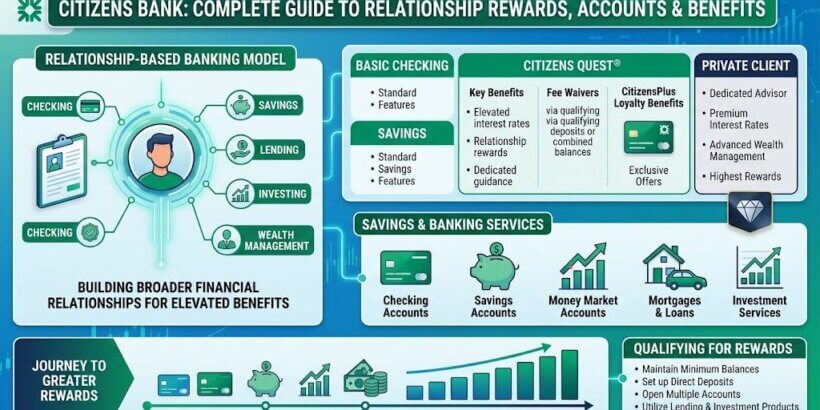
Citizens Bank: Best for Relationship Rewards – Complete Guide to Accounts, Benefits, Fees, Savings and Banking Services
Citizens Bank, commonly known simply as Citizens, is a major U.S. financial institution that offers a broad range of banking products designed for individuals, families, professionals, small businesses and larger organizations. For consumers comparing banks, Citizens stands out particularly for its relationship-based banking model, in which customers can potentially receive additional benefits by maintaining multiple accounts and building a broader financial relationship with the bank. This makes Citizens Bank an especially interesting option for customers who want more than a single checking or savings account and prefer to manage several aspects of their financial life through one institution. Bank rate has highlighted Citizens Bank as a choice for customers interested in relationship rewards, and that positioning is particularly relevant when evaluating Citizens’ Quest and Private Client offerings, where account benefits can be connected to qualifying balances, deposits, investments and other banking relationships.
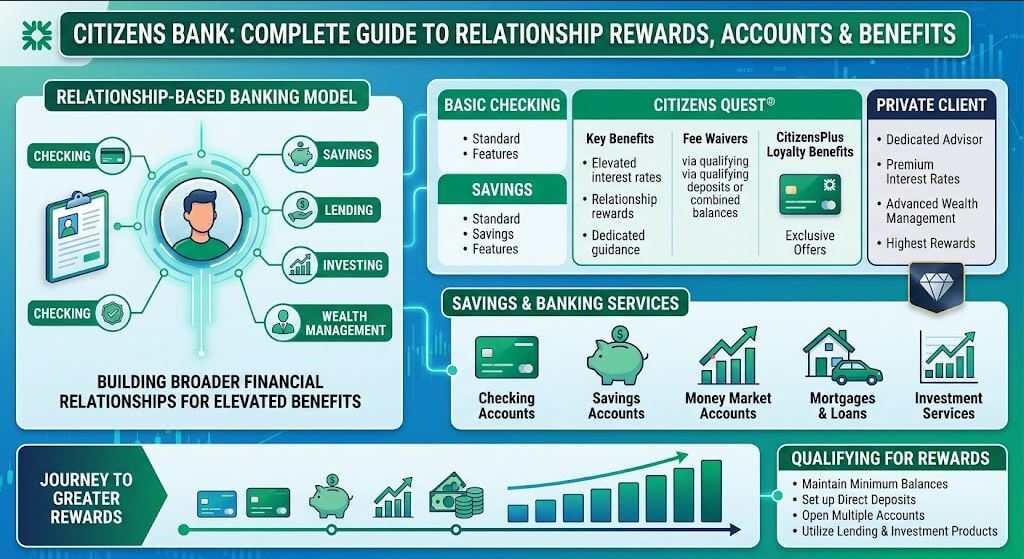
The appeal of relationship banking is straightforward. Instead of treating checking, savings, money market, lending, investing and wealth-management services as completely separate products, a relationship-focused bank attempts to connect those services so that a customer’s overall relationship can influence the benefits available to them. Citizens explicitly describes its Quest relationship as providing elevated benefits, personalized guidance and CitizensPlus loyalty benefits. Its Quest Checking account, for example, can have its monthly maintenance fee waived when customers meet specified deposit or combined relationship-balance requirements. Customers who maintain qualifying Citizens deposit and investment balances may also receive benefits associated with their broader relationship.
For consumers considering Citizens Bank, however, the most important question is not simply whether the bank offers relationship rewards. The more useful question is whether the relationship model fits the way you already manage your money. A customer who keeps checking, savings, investments and other qualifying financial relationships with Citizens may be able to extract substantially more value from the bank than someone who wants only a basic checking account. On the other hand, a customer who prioritizes the highest possible savings yield regardless of the rest of the banking relationship may want to compare Citizens with other banks before moving substantial deposits.
Citizens Bank has a long history in American banking and today operates as a full-service financial institution offering consumer banking, commercial banking, wealth management and related financial services. Its consumer products include checking accounts, savings accounts, money market accounts, certificates of deposit, credit cards, mortgages, home equity products and other financial solutions. The bank also provides digital banking tools designed to help customers manage accounts, transfer money, monitor transactions and pursue savings goals. Its Savings Tracker tool, for example, allows customers to establish personalized savings targets and use automated strategies such as Smart Save, Round Ups and Pay Yourself 1st.
One of the strongest reasons to consider Citizens Bank is the ability to combine everyday banking with savings and longer-term financial planning. A traditional checking account is generally designed for daily transactions such as direct deposit, debit-card purchases, bill payments and cash access, while a savings account is intended to hold money for emergencies, planned expenses and longer-term objectives. Citizens itself explains that combining checking and savings at one institution can make transfers and money management easier and may provide access to additional relationship benefits.
The Citizens One Deposit Savings account is designed for customers who want a relatively straightforward savings option. Citizens says that the account can be opened with any amount and that the standard monthly maintenance fee can be waived by making at least one deposit of any amount during each applicable statement period or by maintaining a $200 minimum daily balance. New accounts also receive a waiver for the first four monthly maintenance fees under the bank’s stated terms.
That structure can be attractive to customers who are beginning to build an emergency fund or who want a simple savings account without needing a large opening deposit. The ability to waive the monthly fee through regular deposits can also reward customers who consistently add money to their savings. Nevertheless, customers should always check the current fee schedule and account disclosures before opening an account because account terms, fees and rates can change.
Citizens also offers relationship-oriented savings products. Citizens Quest Savings is designed for customers who maintain a Citizens Quest Checking relationship, while Citizens Private Client Savings is designed for customers who qualify for the bank’s Private Client relationship. Citizens states that Quest Savings has no monthly maintenance fee and provides access to priority service through dedicated Citizens Quest agents. The Private Client Savings account is positioned as a higher-level relationship product offering higher savings rates, fewer fees and dedicated relationship support.
This relationship structure explains why Citizens Bank can be particularly appealing to customers who want to consolidate their financial activities. Someone who already intends to keep a significant amount of money at the bank may be able to use qualifying balances to unlock benefits that would not necessarily be available through a basic banking relationship. Instead of evaluating each account in isolation, the customer can consider the total value of the banking relationship.
Citizens Quest Checking is at the center of this strategy for many customers. Citizens describes Quest Checking as a relationship account that provides elevated benefits, including personalized guidance, CitizensPlus benefits, competitive interest-related features and access to additional services. The bank currently states that the $25 monthly maintenance fee can be waived by making $5,000 in total deposits to the primary checking account during each statement period or maintaining $25,000 in monthly combined deposit and investment balances across linked qualifying accounts.
The combined-balance concept is important because it changes how customers should think about the cost of the account. Rather than simply asking, “Does this checking account have a monthly fee?” a customer should ask, “Can I naturally meet the requirements to have that fee waived?” If a customer already receives substantial direct deposits or maintains qualifying savings and investment balances, the fee-waiver requirement may be relatively easy to meet. If not, a basic checking product could potentially be more appropriate.
Citizens explains that customers can identify which qualifying Citizens deposit and investment accounts they want included in their relationship. The bank calculates combined balances using the applicable average daily balances for qualifying deposit accounts and market values for certain linked investment accounts. Citizens also states that qualifying Wealth Management and Private Wealth investment balances can contribute toward the relationship requirement, while loans and credit-card balances cannot.
This is one of the central characteristics of Citizens’ relationship-rewards approach. The bank is not simply rewarding customers for opening multiple accounts. Instead, the structure is designed to recognize customers who maintain a broader financial relationship with Citizens.
For higher-net-worth customers, Citizens Private Client is an even more relationship-oriented option. Citizens states that customers seeking Private Client Checking must maintain $200,000 in combined deposit and investment balances to qualify. Private Client customers can receive access to dedicated relationship managers supported by Citizens Wealth Management professionals.
This can be particularly valuable for customers whose financial needs extend beyond routine banking. Someone managing substantial cash balances, investments, retirement planning and major financial goals may prefer having a coordinated relationship with a financial institution instead of dealing with separate providers for every financial service. The value of this arrangement depends heavily on the customer’s circumstances, the services actually used and the quality of the guidance received.
Citizens Bank’s savings lineup also includes money market accounts and certificates of deposit. The bank describes money market accounts as an option for customers who want a combination of savings growth and liquidity, including the ability to write checks in accordance with the account’s terms. CDs, by comparison, can provide fixed returns for customers willing to leave money deposited for a predetermined period.
This makes Citizens potentially suitable for different stages of a customer’s financial life. A young customer beginning to save may prefer a simple savings account. A household building an emergency fund may use a savings account alongside checking. A customer with a larger cash balance may consider a money market account or CD. A higher-net-worth customer may use Quest or Private Client products together with investment and wealth-management services.
The key to getting the most from Citizens Bank is therefore understanding how its products work together. A checking account handles everyday cash flow. A savings account provides a place for emergency funds and planned goals. A money market account can provide a combination of liquidity and potentially higher yield. CDs can be useful for money that does not need to remain immediately accessible. Investment and wealth-management services can address longer-term financial objectives. When these products are coordinated, the relationship-based approach becomes more meaningful.
Citizens Savings Tracker is another part of the bank’s digital savings strategy. The tool is available through the Citizens mobile app and connects with eligible personal Citizens savings accounts. Customers can establish goals and track progress, while certain automatic savings features can help move money into savings. Smart Save analyzes a checking account to identify opportunities to transfer money to savings, Round Ups can transfer the change generated by eligible debit-card purchases, and Pay Yourself 1st can automatically direct a selected amount or percentage of recurring deposits into savings.
Automated savings tools can be valuable because one of the biggest challenges in personal finance is consistency. Many people understand the importance of saving but struggle to transfer money manually every week or month. Automation can turn saving into a routine rather than a decision that must be made repeatedly. A customer who receives a paycheck through Citizens checking could potentially configure recurring transfers so that saving happens automatically.
Another feature available across Citizens banking relationships is Citizens Paid Early. Citizens states that eligible customers with direct deposit may receive qualifying funds up to two days early. This can make a checking account more convenient for customers who rely heavily on predictable paycheck timing.
Citizens also emphasizes digital security and fraud monitoring. Its savings-account information states that customers receive 24/7 fraud monitoring and FDIC insurance, subject to applicable limits and conditions. For consumers choosing a bank, these protections are important considerations, although customers should always understand the applicable FDIC insurance rules and ownership categories.
The FDIC insurance component is particularly important when comparing banks for larger deposits. FDIC insurance generally protects eligible deposits up to applicable legal limits, but customers with substantial balances should understand how ownership categories affect coverage. A customer with deposits significantly above standard insurance limits may want to discuss account ownership and coverage with the bank or review FDIC guidance.
One of the most important considerations when evaluating Citizens Bank is its interest-rate structure. Savings APYs can vary by account type, balance tier, geography and customer relationship. Citizens’ own rate pages state that variable APYs may increase or decrease after account opening and that rates are subject to change. The bank also notes that rates can differ by region.
For this reason, consumers should not rely on a single advertised rate when deciding whether Citizens is the best bank for them. Instead, they should compare the current APY applicable to their ZIP code, balance and account type. A higher headline rate is not necessarily better if it requires maintaining balances that would otherwise be used for investments, debt repayment or other financial priorities.
The same principle applies to monthly fees. A bank account that advertises a fee waiver can be excellent for one customer and expensive for another. If a customer naturally satisfies the waiver requirement every month, the fee may effectively be irrelevant. If meeting the requirement requires moving money unnecessarily or maintaining a balance that could earn more elsewhere, the account may be less attractive.
Citizens One Deposit Savings provides an example of a relatively straightforward fee-waiver structure. Citizens currently states that customers can waive the $4.99 monthly maintenance fee through a qualifying monthly deposit or by maintaining a $200 minimum daily balance. For a customer who deposits money regularly, that requirement may be relatively easy to satisfy.
Citizens Quest Savings takes a different approach. According to Citizens, the account has no monthly maintenance fee, but opening it requires a Citizens Quest Checking relationship. The bank describes Quest Savings as a relationship account offering additional features and priority service.
Citizens Private Client Savings goes further up the relationship ladder. Citizens describes it as an account with higher savings rates, fewer fees and a dedicated relationship manager, and says that Private Client Checking is required when opening the savings account.
This tiered structure gives Citizens a clear customer progression. A person can begin with basic banking products, build a relationship and potentially move toward Quest or Private Client services as financial needs become more complex. However, customers should never upgrade simply because a higher tier sounds better. The correct tier depends on actual financial needs and whether the associated balance or deposit requirements are realistic.
For customers searching for the best bank for relationship rewards, Citizens has several characteristics worth considering. First, the bank offers multiple product categories under one institution. Second, some higher-tier benefits are linked to combined balances. Third, Citizens offers tools designed to help customers save automatically. Fourth, customers can receive personalized support at higher relationship levels. Fifth, the bank offers both consumer and wealth-management services, allowing a relationship to potentially expand as a customer’s financial situation changes.
The relationship-reward concept also has an important behavioral advantage. When checking and savings accounts are connected, customers can more easily monitor their overall cash position. Citizens itself notes that having checking and savings at the same institution can simplify transfers and make it easier to manage everyday spending and long-term goals.
At the same time, keeping all financial accounts at one bank can have disadvantages. Citizens’ educational material acknowledges that customers may miss out on a better interest rate elsewhere if they insist on keeping checking and savings together. It also points out that easy transfers can sometimes make it too easy to spend money that was intended for savings.
This is an important point for anyone considering Citizens Bank. Relationship banking is not automatically the same thing as optimized banking. The best financial arrangement is the one that balances convenience, fees, interest earnings, services, security and long-term goals.
For example, imagine a customer who earns a salary through direct deposit and has $30,000 in qualifying deposits and investments at Citizens. If the customer can naturally meet the Quest Checking relationship requirements, the account may provide considerable value because the customer does not need to make unusual financial moves simply to qualify. The customer could combine checking with Quest Savings and potentially use Citizens’ savings tools to automate transfers. In that scenario, Citizens’ relationship model could be a strong fit.
Now consider another customer who has only $2,000 in savings, rarely uses branch services and primarily wants the highest possible savings APY. That person may find that a relationship-oriented banking structure is less important than comparing rates among online savings providers and local banks. The customer may still like Citizens, but the primary reason for choosing it would be different.
Another example is a household with a large emergency fund, multiple investment accounts and substantial monthly income. For that household, the ability to connect checking, savings, investment balances and wealth-management services could be more important than a small difference in the basic savings APY. This is where Citizens’ Quest and Private Client structure may become particularly relevant.
Relationship rewards can also matter when borrowing. Although eligibility and pricing vary, banks sometimes consider broader customer relationships when determining which services and benefits to offer. Consumers should not assume that having multiple accounts guarantees a better loan rate or approval. Creditworthiness, income, debt, collateral, loan type, market conditions and many other factors remain important. However, having a consolidated relationship can make financial management more convenient.
Citizens offers mortgages and home equity products in addition to deposit accounts. For homeowners, having banking and lending relationships under one institution may simplify account management. But borrowers should always compare loan APRs, fees, closing costs and terms rather than selecting a lender solely because they already have a checking account there.
The same principle applies to credit cards. A bank relationship can make account management easier, but rewards, annual fees, APRs, introductory offers and other credit-card terms should be evaluated independently.
For small-business owners, Citizens’ broader banking capabilities may also be relevant. Business owners often need checking accounts, payment solutions, credit facilities, cash management, merchant services and other financial tools. A relationship-focused bank can potentially provide a centralized platform for those needs. However, business customers should compare pricing, treasury-management capabilities, lending terms and local support before making a decision.
Digital banking is another important part of the Citizens experience. Modern customers increasingly expect to manage accounts without visiting a branch. Mobile and online banking can provide access to balances, transfers, transactions and savings tools. Citizens’ Savings Tracker demonstrates how the bank is incorporating financial-goal functionality into its digital experience.
However, branch availability remains relevant for customers who value face-to-face banking. Citizens maintains a physical branch network, although branch availability depends heavily on geographic location. Customers should check whether a convenient branch and ATM network exists in their area before opening an account if physical access is important to them.
ATM access is another factor. Citizens Quest Checking advertises no ATM fees from Citizens as one of its relationship benefits. Consumers should still review the complete fee schedule, including potential fees associated with out-of-network ATMs and other transactions.
Customer service is particularly relevant to the relationship-banking model. If a bank is marketing personalized service as part of its premium relationship, customers should consider whether that service is genuinely valuable to them. Someone who prefers self-service digital banking may place little value on dedicated assistance. Another customer managing investments, a home purchase, retirement planning and substantial cash balances may value personal guidance considerably more.
Citizens Quest customers can receive priority service from dedicated Citizens Quest agents, according to Citizens’ savings information. Private Client customers can receive support through a dedicated relationship manager and Citizens Wealth Management professionals.
These services may make Citizens more attractive to customers who want a human relationship with their financial institution rather than using an entirely automated banking model.
When comparing Citizens Bank with other banks, consumers should create a personal checklist. The first question should be what type of account is actually needed. If the primary requirement is everyday spending, checking may be sufficient. If the goal is emergency savings, a savings account may be appropriate. If the goal is earning interest while retaining liquidity, a money market account could be worth considering. If the funds will not be needed for a specific period, a CD may be more suitable. If the customer needs coordinated investment guidance, a wealth-management relationship may be relevant.
The second question should be how much money will actually be maintained at the bank. Balance levels matter because certain Citizens relationship products use combined deposit and investment balances as qualification criteria. Quest Checking, for example, has a stated $25,000 combined deposit and investment balance pathway for avoiding its monthly fee, while Private Client Checking requires a substantially larger combined relationship balance.
The third question should be whether direct deposit is available. Direct deposit can make it easier to satisfy certain banking requirements and can also enable features such as Citizens Paid Early, subject to eligibility.
The fourth question should be whether the bank’s current savings rates are competitive for the customer’s specific location and balance. Citizens’ own rate pages make clear that rates vary and can change. Therefore, customers should check current rates immediately before opening an account.
The fifth question should be whether the customer values relationship benefits enough to justify consolidation. Some people value simplicity above everything else. Others prefer to maintain accounts across multiple institutions to maximize rates, rewards or diversification. Neither strategy is universally correct.
The sixth question should be whether the account’s fee requirements can be satisfied naturally. Customers should never maintain an unnecessary balance solely to avoid a fee without calculating the opportunity cost. If keeping $25,000 in a particular account prevents the customer from earning substantially more elsewhere, the fee waiver may not represent the best overall financial decision.
The seventh question should be how frequently the customer expects to interact with the bank. Someone who rarely needs customer service may not care about priority service. Someone who frequently discusses financial goals with a banker may consider relationship service highly valuable.
The eighth question should be whether the customer wants financial tools that support automatic saving. Citizens Savings Tracker offers several approaches to automated savings, including Smart Save, Round Ups and Pay Yourself 1st. Customers who struggle with saving consistently may find these features particularly useful.
The ninth question should be how important physical branches are. A customer who regularly deposits cash, seeks face-to-face assistance or prefers branch-based service should verify local branch availability. Someone who does everything online may care much less about branch density.
The tenth question should be whether the customer expects financial needs to become more complex. A bank that offers basic checking, savings, money markets, CDs, lending and wealth management may be convenient for someone who expects to use several of these services over time.
Citizens Bank can therefore be viewed as more than a checking or savings provider. Its broader value proposition is the possibility of building a connected financial relationship. This is particularly relevant to customers who want a single institution to support everyday banking, saving, borrowing and potentially investing.
The phrase “best for relationship rewards” is useful because it highlights the central differentiator. Citizens may not be the obvious winner for every single banking category. The strongest reason to consider it is the combined value available to customers who use multiple products and meet qualifying relationship requirements.
A customer comparing Citizens Bank should also understand that relationship benefits are not the same as traditional rewards programs. A credit-card rewards program might give points or cash back based on purchases. A relationship banking program can instead provide fee waivers, service enhancements, potentially better account economics and access to additional benefits based on the customer’s overall financial relationship.
This distinction matters when calculating value. Suppose a customer receives a fee waiver worth hundreds of dollars per year, uses free or reduced-cost services, receives personalized assistance and earns a competitive savings rate. The total relationship value could be meaningful even if no traditional points are awarded. Conversely, a customer who does not use these benefits may receive little additional value.
The best approach is to calculate the actual dollar value of every benefit. Customers can estimate annual fees, interest earnings, rewards, ATM costs and other expenses. They can then compare Citizens with competing banks using the same criteria.
Interest-rate comparisons should be performed using APY rather than simply the nominal interest rate whenever possible because APY incorporates the effect of compounding. Citizens provides a savings-interest calculator that allows customers to compare potential savings outcomes based on initial deposits, time periods, contributions and APYs.
For example, if two savings accounts have different APYs, the account with the higher APY will generally produce more interest if all other conditions are equal. But if the higher-rate account has requirements the customer cannot meet, the effective return may be lower than expected. Likewise, fees can reduce the actual economic benefit of an account.
Customers should also consider inflation. Even when a savings account pays interest, the real purchasing power of money depends on the relationship between the account’s return and inflation. Savings accounts are generally designed for liquidity and capital preservation rather than aggressive long-term growth.
An emergency fund is a good example of where a Citizens savings account may fit into a broader financial plan. Many financial educators recommend keeping several months of essential expenses in accessible savings. The exact amount depends on income stability, household expenses, insurance coverage and personal circumstances. The important concept is that emergency savings should be readily available and separate from money intended for everyday spending.
Citizens’ ability to connect checking and savings can make emergency-fund management straightforward. A customer can use checking for routine spending while directing a portion of income into savings. Citizens Savings Tracker can then help track progress toward the emergency-fund goal.
The same structure can be used for short-term goals such as travel, education expenses, a vehicle purchase, home improvements or a future down payment. Instead of viewing savings as one large pool, customers can use goals and automated transfers to create a more disciplined system.
One potential downside of keeping checking and savings together is that money can become too easy to access. Citizens itself notes this behavioral consideration. For customers who frequently transfer savings back into checking, maintaining savings at a separate institution could create useful psychological friction. Therefore, convenience should not automatically be treated as a benefit.
Another issue is concentration risk from a financial-management perspective. Customers may prefer having accounts at multiple institutions for redundancy, rate shopping or access to different services. On the other hand, consolidating accounts can simplify financial tracking. The right balance depends on the customer’s needs.
Citizens Bank’s relationship model is particularly interesting for households rather than individuals alone. A household may have multiple direct deposits, joint accounts, savings balances, investment accounts and borrowing needs. A coordinated relationship can simplify the overall financial picture. But joint account ownership, beneficiary arrangements, tax considerations and estate-planning issues should be reviewed carefully.
For affluent customers, Citizens Private Client may offer a different value proposition from ordinary consumer banking. The bank emphasizes dedicated relationship management and access to wealth-management professionals. Customers considering such services should evaluate the actual advisory services offered, fees, investment choices, conflicts of interest, account minimums and service model.
Customers should also distinguish between bank deposits and investments. Deposit accounts such as checking and savings may receive FDIC insurance within applicable limits, while investment products generally involve market risk and are not insured in the same manner. Customers should understand which assets are deposits and which are investments.
Citizens’ money market products can occupy a middle ground for some customers who want greater yield potential than basic checking while retaining access to funds. The bank describes money markets as suitable for customers seeking higher interest rates while maintaining flexibility, including check-writing capability under the account terms.
CDs may be appropriate for customers who can commit money for a specific period. The main advantage is predictable return under the terms of the CD. The disadvantage is reduced flexibility compared with a liquid savings account. Customers should carefully review maturity dates, early withdrawal provisions and renewal terms before purchasing a CD.
Citizens’ overall product range means that customers do not necessarily have to choose between convenience and sophistication. A single financial institution can potentially provide multiple layers of service as financial needs evolve. The challenge is ensuring that the customer actually benefits from using those services.
The phrase “relationship banking” also implies a long-term perspective. Instead of changing banks every time a competitor offers a slightly better promotional rate, some customers prefer to build a relationship with an institution that understands their financial history and provides a consistent service model. That approach can be valuable for customers who appreciate stability and personal assistance.
However, consumers should remain proactive. Loyalty should not prevent customers from comparing rates, fees and services periodically. Banking products change, and a product that was competitive several years ago may not remain competitive indefinitely.
Citizens’ own disclosures reinforce this point by stating that variable APYs can change after account opening and that other fees may apply. Customers should therefore review current terms rather than relying on old promotional materials or historical rates.
For search-engine users looking for “Citizens Bank review,” “Citizens Bank savings account,” “Citizens Bank checking account,” “Citizens Bank relationship rewards,” “Citizens Quest Checking,” “Citizens Quest Savings,” “Citizens Private Client,” “Citizens Bank fees,” “Citizens Bank interest rates,” or “Citizens Bank best for relationship rewards,” the central takeaway is that Citizens is best understood as a relationship-focused full-service bank rather than simply a place to store cash.
Citizens Bank may be particularly attractive for customers who want checking and savings together, value digital savings tools, maintain qualifying balances, want access to personalized service, or expect to use multiple financial products over time. Customers with higher balances may find Quest or Private Client relationships especially relevant because the benefits are structured around qualifying deposits and investments.
For customers with smaller balances, Citizens still offers basic savings options. One Deposit Savings can be opened with any amount, and the monthly maintenance fee can be waived through the bank’s stated qualifying methods. This makes Citizens accessible to customers who are still building their savings.
For students and younger customers, Citizens also offers specialized checking options. Citizens states that its Student Checking and One Deposit Savings combination can have no monthly maintenance fee while the customer is under 25, subject to applicable terms. This can make the bank relevant to younger consumers beginning their financial journey.
A new customer should approach account opening strategically. First, determine the purpose of the account. Second, estimate expected balances. Third, review the current APY and fees for the customer’s location. Fourth, determine whether direct deposit will be used. Fifth, calculate whether fee-waiver requirements can be satisfied naturally. Sixth, consider whether the relationship benefits justify consolidating accounts.
Customers should also review overdraft policies. Citizens states that its savings accounts can be used with a Savings Overdraft Transfer Plan for checking, subject to the program’s terms. Overdraft protection can be useful, but customers should understand exactly how transfers work and whether any fees or limitations apply.
Security should remain a priority regardless of the bank selected. Customers should use strong passwords, enable available security features, monitor transactions, avoid sharing authentication codes and report suspicious activity promptly. Citizens emphasizes 24/7 fraud monitoring as part of its account-security offering.
Customers should also be cautious about phishing scams. Criminals may impersonate banks through email, text messages or phone calls. A legitimate bank will not need a customer to reveal sensitive authentication information through an unsolicited message. When in doubt, customers should contact the bank using an official phone number or secure banking channel rather than responding directly to a suspicious communication.
Another important consideration is financial goal alignment. If your objective is building an emergency fund, focus on liquidity and safety. If your objective is a future purchase, compare savings rates and account flexibility. If your objective is retirement, a conventional savings account may not be sufficient as the primary long-term investment vehicle. If your objective is managing significant wealth, evaluate the entire wealth-management relationship rather than focusing only on deposit rates.
Citizens Bank can therefore serve different types of customers at different stages of life. A young adult may begin with Student Checking. A working professional may use One Deposit Checking and Savings. A growing household may move into Quest products. A higher-net-worth customer may qualify for Private Client services. The ability to move through these relationship levels is one reason Citizens can appeal to customers looking for a long-term banking partner.
From an SEO perspective, Citizens Bank is a particularly relevant subject because consumers frequently search for specific combinations of account type, fees, APY, relationship requirements and rewards. A useful Citizens Bank review should not simply say that the bank is “good” or “bad.” It should explain who benefits most from the bank’s structure.
The strongest candidate is often someone who values a combination of convenience and relationship benefits. A customer who has regular direct deposits, meaningful savings and qualifying investment balances may have a better opportunity to benefit from Citizens’ relationship model than someone who keeps only a small checking balance.
The phrase “best for relationship rewards” should therefore be interpreted carefully. It does not mean that every Citizens account offers the highest interest rate, lowest fee or greatest rewards in the entire banking market. Instead, it means that Citizens can be especially compelling when the customer’s total relationship is considered.
That distinction is crucial. Banking is rarely about one product. A customer may care about checking fees, savings APY, ATM access, direct deposit, mobile banking, customer service, overdraft protection, loan options and investment support at the same time. A bank that performs reasonably well across all of these categories and provides additional relationship benefits can sometimes be more valuable than a bank that offers an exceptional rate on only one product.
Citizens’ Quest relationship demonstrates this approach. The customer receives a package of benefits connected to qualifying deposits and investments, including fee-waiver opportunities and personalized support.
Citizens Private Client represents an even more personalized model. The bank emphasizes dedicated relationship management and support from wealth-management professionals.
The right choice ultimately comes down to the customer’s financial profile. Someone who values personal banking assistance, maintains meaningful balances and wants to consolidate multiple financial services may find Citizens compelling. Someone who only wants a high-yield savings account may want to compare the current Citizens APY with specialized savings providers. Someone who needs extensive branch access should verify local availability. Someone who values investment advice should compare advisory services and fees carefully.
It is also worth remembering that interest rates are only one part of the banking equation. A customer might earn a slightly higher rate elsewhere but spend more time moving money between institutions, lose access to convenient branch services or give up relationship benefits. Conversely, convenience should not be used to justify paying significantly more in fees or earning materially less interest without a clear reason.
The best financial decision is therefore one based on total value.
Customers evaluating Citizens Bank should periodically review their relationship. Has the account balance changed? Has direct deposit changed? Are the fee-waiver requirements still being met? Is the savings rate still competitive? Are the relationship benefits actually being used? Are there services that could improve the customer’s financial management? These questions can help ensure that the bank relationship continues to provide value.
Citizens’ approach to savings automation is particularly useful in this context. The Savings Tracker can help customers set goals, monitor progress and automate certain contributions. Over a long period, consistent saving can be more important than small differences in short-term interest rates.
For example, someone who automatically saves $300 every month may accumulate a substantial balance over time even if they begin with a small amount. The important habit is consistency. An account that makes saving easier can therefore provide behavioral value in addition to its financial return.
The same principle applies to emergency savings. Establishing a recurring transfer immediately after receiving income can make saving less dependent on willpower. Citizens’ Pay Yourself 1st feature is designed around this concept by allowing customers to specify a recurring amount or percentage to move into savings.
Round Ups provide another behavioral mechanism. Small amounts generated from debit-card purchases may be transferred into savings. While individual transfers may be small, they can help customers develop a savings habit.
Smart Save takes a more adaptive approach by analyzing checking activity to identify opportunities for transfers into savings. Customers should understand the feature’s eligibility, terms and transfer behavior before enabling it, but the concept can be useful for people who want automation without setting a fixed transfer amount.
Citizens’ combination of relationship banking and savings automation creates a potentially strong ecosystem. The relationship component rewards broader engagement, while the digital tools encourage regular saving. Customers who use both may get more value than customers who use only one account.
Nevertheless, consumers should remain aware of opportunity costs. Money kept in a checking account may earn little or no interest compared with a suitable savings or money market account. Money kept in a savings account may have a lower expected long-term return than diversified investments. Money placed in a CD may have less liquidity. The correct location for money depends on when it is needed and what role it plays in the financial plan.
A simple way to think about the Citizens ecosystem is to divide money according to purpose. Everyday money belongs in checking. Emergency and near-term goal money may belong in savings or an appropriate money market account. Money with a defined time horizon may potentially be placed in CDs. Long-term wealth-building money may require investment accounts and appropriate risk management. Citizens offers products across several of these categories, allowing customers to coordinate them if that is their preference.
This structure is one of the strongest arguments for considering Citizens as a relationship bank.
There are also practical questions about account opening. Citizens may require customers to provide identification and personal information as part of the account-opening process. Applicants should provide accurate information and review all account agreements before accepting the terms. Account eligibility can depend on the specific product, location and customer circumstances.
Customers should also check whether promotional offers are available at the time they apply. Promotional bonuses and special rates can change frequently, and eligibility requirements may include minimum deposits, qualifying direct deposits, account-opening periods and minimum holding periods. Never assume that an offer seen in an older article is still available.
The same caution applies to APYs. Citizens’ rate pages state that rates are variable and subject to change. Therefore, an article published months earlier may not accurately represent today’s rate.
This is why a good Citizens Bank review should focus on the structure and value proposition rather than making permanent claims about temporary rates.
In summary, Citizens Bank is a compelling option for consumers who value relationship banking and want to combine everyday banking with savings, money management and potentially wealth-management services. Its Quest products are particularly relevant for customers who can meet qualifying deposit or combined relationship-balance requirements, while Private Client products are designed for customers with substantially larger financial relationships.
The bank’s One Deposit Savings account provides a simpler entry point, with no minimum opening deposit and stated methods for waiving the monthly maintenance fee. Citizens Quest Savings provides a relationship-based savings option with no monthly maintenance fee according to Citizens’ current product information, while Private Client Savings provides a higher-tier relationship experience.
Citizens also provides digital savings tools through Savings Tracker, including goal tracking and several automated savings mechanisms. These features can be especially useful for customers who want to make saving a regular part of their financial routine.
The biggest advantage of Citizens Bank is therefore not necessarily one particular account. It is the possibility of building a connected financial relationship where multiple products work together. Customers who use checking, savings, investments and other services may benefit more from the relationship model than customers who use only a single basic account.
The biggest potential drawback is equally clear: customers should not assume that relationship benefits automatically make Citizens the best choice for every financial need. Rates, fees, requirements and services should be compared with alternatives. Customers should calculate the actual value of fee waivers and relationship benefits and determine whether the bank’s current products match their goals.
For someone specifically searching for a bank that is “best for relationship rewards,” Citizens deserves serious consideration. Its Quest and Private Client structures demonstrate a deliberate effort to reward broader customer relationships through fee benefits, personalized service and additional banking features. Its savings tools provide a practical way to connect banking with financial goals. Its range of consumer and wealth-management services can support customers as their financial lives become more complex.
Ultimately, the best bank is the one that fits the customer’s actual financial behavior. If you value convenience, maintain qualifying balances, receive regular deposits, want personalized banking support and prefer to consolidate financial services, Citizens Bank may be a strong match. If your only priority is obtaining the highest possible savings APY, you should compare current rates across multiple institutions. If you need premium financial guidance, compare the specific services and costs of Citizens Private Client and competing wealth-management providers.
Citizens Bank’s relationship-rewards model is therefore best understood as a long-term value proposition. Instead of focusing solely on one rate or one fee, customers can evaluate the combined benefits of checking, savings, money management, digital tools, customer service and wealth-management access. For the right customer, that broader relationship can provide meaningful convenience and financial value.
Before opening any Citizens Bank account, prospective customers should review the current official account disclosures, fees, APYs, eligibility requirements and terms applicable to their location and account type. Rates and terms can change, and Citizens specifically states that variable APYs may change after account opening.
In conclusion, Citizens Bank is a strong candidate for consumers seeking relationship-focused banking rather than a single stand-alone financial product. Its One Deposit Savings account can serve customers looking for straightforward savings, while Quest products provide additional benefits for customers who build qualifying relationships. Private Client services extend the relationship model to customers with more substantial financial resources and a need for personalized support. Citizens Savings Tracker adds digital tools that can help customers set goals and automate saving. Together, these features explain why Citizens Bank can be particularly attractive for customers who value relationship rewards and want their bank to play a larger role in their overall financial life.
For anyone comparing Citizens Bank with other U.S. banks, the smartest approach is to look beyond advertising headlines. Compare the current APY, minimum balances, monthly fees, fee-waiver requirements, ATM policies, direct-deposit features, digital banking tools, customer-service options and relationship benefits. Then calculate the total value based on your own balances and banking habits. If the relationship benefits naturally fit your financial life, Citizens may provide considerably more value than a basic account comparison suggests.
Citizens Bank is not necessarily the perfect bank for every consumer, but its relationship-centered model makes it a noteworthy option for customers who want to combine banking, saving and broader financial services. That is ultimately the reason the bank can stand out as a choice for relationship rewards: the more meaningful and coordinated the customer relationship becomes, the more relevant Citizens’ higher-tier benefits can become.
For consumers seeking a modern banking relationship with access to everyday checking, savings, money market products, CDs, digital savings tools, personalized service and higher-tier relationship options, Citizens Bank provides a broad platform worth evaluating. As with any financial decision, consumers should review current terms directly with the bank and compare alternatives before opening an account or moving substantial funds.
SEO keywords: Citizens Bank, Citizens Bank review, Citizens Bank savings account, Citizens Bank checking account, Citizens Bank relationship rewards, Citizens Bank best for relationship rewards, Citizens Quest Checking, Citizens Quest Savings, Citizens Private Client, Citizens Bank interest rates, Citizens Bank savings rates, Citizens Bank fees, Citizens Bank account, Citizens Bank online banking, Citizens Bank mobile banking, Citizens Bank Savings Tracker, Citizens Bank money market, Citizens Bank CD, Citizens Bank relationship banking, best bank for relationship rewards, Citizens Bank benefits, Citizens Bank account requirements, Citizens Bank monthly fee, Citizens Bank fee waiver, Citizens Bank direct deposit, Citizens Paid Early, Citizens Bank financial services, Citizens Bank wealth management.