

M&T Bank: Complete Guide to M&T Bank, Accounts, Services, History, Banking Products, Benefits, and Financial Strength
M&T Bank is one of the major regional banking institutions in the United States, with a long history of serving consumers, businesses, professionals, institutions, and communities across the Northeast and Mid-Atlantic regions. Officially known as Manufacturers and Traders Trust Company, M&T Bank traces its banking heritage to 1856 and operates today as the principal banking subsidiary of M&T Bank Corporation. Headquartered in Buffalo, New York, M&T has developed a reputation for relationship-oriented banking while maintaining the scale, technology, and financial capabilities expected from a large U.S. banking organization.
For consumers researching where to keep checking or savings accounts, M&T Bank is particularly relevant because it combines traditional branch banking with online and mobile banking services. Its product range includes checking accounts, savings accounts, money market accounts, certificates of deposit, credit cards, mortgages, personal loans, lines of credit, investment services, insurance-related services, and other financial products. For businesses, M&T provides commercial banking, business lending, treasury management, merchant services, investment banking, institutional services, and specialized financial solutions.
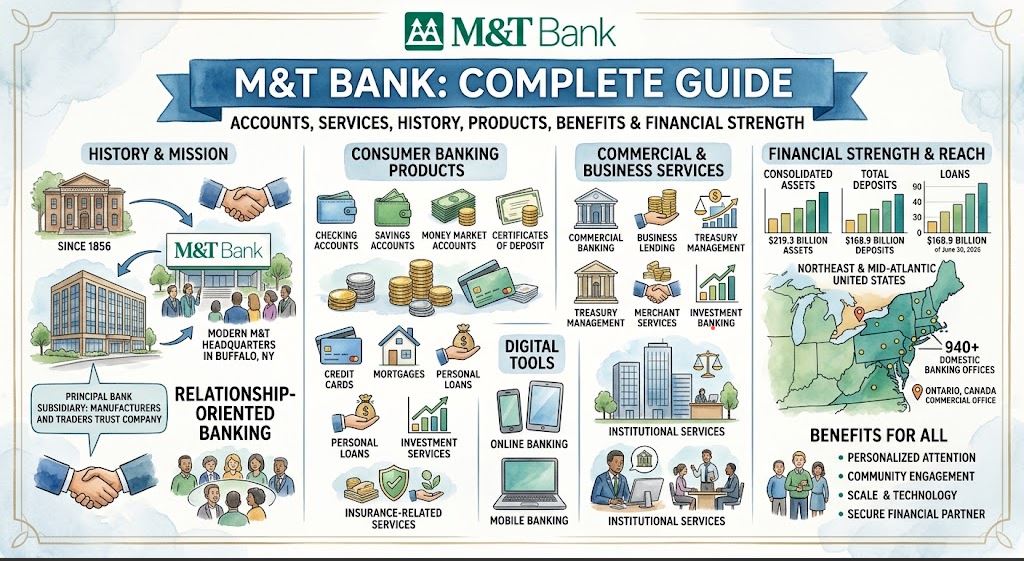
M&T Bank is also significant from a broader banking-industry perspective. At December 31, 2025, M&T Bank Corporation reported approximately $213.5 billion in consolidated assets and $166.9 billion in deposits. M&T Bank itself represented approximately 99% of the corporation’s consolidated assets, while the organization also included Wilmington Trust, N.A. as a wholly owned bank subsidiary. M&T Bank had 942 domestic banking offices at the end of 2025, primarily serving the Northeastern and Mid-Atlantic United States, along with a full-service commercial banking office in Ontario, Canada.
As of June 30, 2026, M&T’s consolidated assets had increased to approximately $219.3 billion, while total deposits stood at approximately $168.9 billion. Loans reached approximately $143.2 billion before the allowance for credit losses, demonstrating the scale of M&T’s lending operations.
The bank’s combination of regional presence, substantial assets, extensive branch network, digital banking capabilities, commercial expertise, and relationship-focused approach makes it an important institution for anyone researching U.S. banks. Consumers comparing M&T Bank with other financial institutions may be interested in its checking accounts, savings products, money market offerings, CDs, mortgage services, personal loans, credit cards, mobile banking, branch access, fees, customer service, and overall financial strength.
M&T Bank’s history is one of the most important parts of understanding the institution. The banking business traces its roots to Manufacturers and Traders Bank, organized in 1856. M&T Bank operates under a New York state banking charter dating to 1892, while the modern M&T Bank Corporation was incorporated in 1969. Over the decades, the organization expanded through organic growth and acquisitions, developing from a regional banking institution into a large diversified financial-services company.
The bank’s long operating history is particularly important for customers who value stability and established banking relationships. Unlike newer digital-only financial companies that entered the market primarily through online platforms, M&T has a traditional banking heritage supported by physical offices and long-standing relationships with communities and businesses. At the same time, M&T has invested heavily in digital services so that customers can manage many everyday financial activities electronically.
M&T Bank’s business model is broader than simply accepting deposits and making consumer loans. The company serves multiple customer categories, including individuals, families, small businesses, middle-market companies, large corporations, government entities, institutions, professional clients, and wealth-management customers. This diversified customer base helps M&T generate revenue from several sources rather than relying exclusively on consumer banking.
For an individual customer, M&T Bank can provide a financial relationship beginning with an everyday checking account and potentially expanding into savings, CDs, credit cards, home loans, personal borrowing, investments, and other financial services. For a business owner, the relationship can include business checking, commercial loans, payment services, cash-management tools, treasury management, merchant services, and other specialized solutions.
One of the most recognizable aspects of M&T Bank is its regional concentration. Rather than attempting to maintain an equally large retail footprint across every state in the United States, M&T has historically focused its resources on selected markets in the Northeast and Mid-Atlantic regions. This strategy allows the bank to develop local knowledge and relationships while still achieving substantial scale.
The bank’s geographic footprint has historically included markets such as New York, Pennsylvania, Maryland, Delaware, New Jersey, Virginia, West Virginia, Washington, D.C., and other communities within its operating network. The exact availability of individual products, branch services, fees, interest rates, and account features can vary by market and may change over time, so prospective customers should verify current terms directly with M&T before opening an account.
For people searching online for “M&T Bank near me,” branch availability can be an important factor. M&T’s hundreds of domestic banking offices provide customers with access to traditional banking services, although its physical footprint is concentrated rather than nationwide. Customers outside M&T’s primary markets may find that another bank or a national digital bank provides more convenient branch access.
M&T Bank also provides digital banking. Its official personal banking website promotes checking accounts, mortgages, personal loans and lines of credit, credit cards, savings and CDs, investments and insurance, financial education, and digital banking. M&T’s mobile banking platform allows customers to perform everyday banking activities such as sending and receiving money and depositing checks through a mobile device.
Digital banking has become increasingly important because customers now expect to perform many banking tasks without visiting a branch. Mobile check deposit, electronic transfers, account monitoring, bill payment, transaction alerts, and other digital features can make everyday banking more convenient. M&T’s digital strategy therefore complements its traditional branch model rather than replacing it.
When evaluating M&T Bank checking accounts, consumers should consider the account’s monthly maintenance fee, minimum balance requirements, direct-deposit requirements, transaction features, ATM access, overdraft policies, digital banking capabilities, and opportunities to avoid fees. Checking accounts are generally designed for everyday spending, bill payments, direct deposits, debit-card transactions, transfers, and cash management.
M&T offers multiple checking options designed around different customer needs. Because account names, pricing, qualification requirements, and promotional offers can change, consumers should examine the current account disclosure before opening an account. A checking account that looks attractive based on a promotional advertisement may have different ongoing requirements once the introductory period ends.
For customers who maintain qualifying balances or use multiple products, relationship-based banking may also be relevant. Some financial institutions offer additional benefits when customers maintain certain balances, receive direct deposits, or establish multiple relationships with the bank. Customers should compare the actual dollar value of these benefits against any fees or requirements.
Savings accounts are another important component of M&T Bank’s consumer banking offering. A savings account can be used to build an emergency fund, save for a major purchase, set aside money for future expenses, or gradually build financial reserves. When comparing savings accounts, customers should look beyond the advertised annual percentage yield and examine minimum balances, monthly fees, withdrawal restrictions, introductory rates, eligibility requirements, and whether the rate is variable.
M&T has also introduced money market products intended to provide customers with an opportunity to earn interest while maintaining access to their funds. The bank’s website currently highlights the M&T Preferred Money Market product, describing it as offering higher earning potential as balances grow and an opportunity to earn more with new money.
Money market accounts can be useful for customers who want a combination of savings and liquidity. However, the appropriate account depends on the individual’s financial goals. Someone building a long-term emergency fund may prioritize yield, while someone managing frequent transfers may prioritize accessibility. Customers should review current terms before making a decision.
Certificates of deposit, commonly known as CDs, are another savings option available through banks. A CD generally requires the customer to keep money deposited for a specified term in exchange for an agreed interest rate. CDs may be appropriate for people who do not need immediate access to their funds and want greater predictability than a variable-rate savings account. However, early-withdrawal penalties can apply, so consumers should understand the terms before depositing money.
M&T Bank’s lending operations are another major part of its business. The bank provides mortgages, home equity products, personal loans, lines of credit, credit cards, and commercial lending solutions. Lending products allow the institution to serve customers at different stages of their financial lives.
Mortgage lending is particularly important because buying a home is one of the largest financial decisions many consumers make. M&T provides mortgage-related services through its consumer banking operation. Customers considering an M&T mortgage should compare the annual percentage rate, interest rate, loan term, closing costs, origination fees, down-payment requirements, private mortgage insurance requirements, property eligibility, and other costs against competing lenders.
Mortgage borrowers should not select a lender solely because of a promotional rate. The total cost of borrowing is more important than the headline interest rate. A slightly lower advertised rate may not produce the lowest overall cost if it is accompanied by higher fees or points. Conversely, a lender with a competitive combination of rate, fees, customer service, closing efficiency, and local expertise may provide greater value.
Home equity products can also be useful for homeowners who have accumulated equity in their property. A home equity loan or line of credit can allow a homeowner to borrow against available equity, although using home equity as collateral creates additional risk. Borrowers should carefully evaluate repayment requirements and interest-rate exposure before using home equity for discretionary expenses.
M&T Bank also serves personal borrowing needs. Personal loans and lines of credit can provide financing for qualifying expenses, depending on creditworthiness and the bank’s underwriting criteria. As with all borrowing, customers should evaluate the annual percentage rate, repayment term, monthly payment, fees, and total interest cost before accepting an offer.
Credit cards represent another part of M&T’s consumer financial-services portfolio. Credit cards can provide convenience and may offer rewards or other features depending on the product. However, customers should pay particular attention to the purchase APR, balance-transfer terms, cash-advance APR, annual fee, late-payment fee, foreign transaction fee, and rewards conditions.
Using a credit card responsibly means treating it as a payment and financial-management tool rather than a substitute for income. Paying the statement balance in full when possible can help reduce interest expenses. Customers carrying balances should understand how interest compounds and compare the total cost of different credit products.
M&T’s commercial banking business is one of the defining characteristics of the institution. Large regional banks such as M&T often compete by combining the resources of a major financial institution with a relationship-oriented approach to businesses. M&T provides financial services to businesses ranging from smaller enterprises to large corporations.
Business banking services can include checking accounts, savings products, credit facilities, equipment financing, commercial real estate lending, treasury management, payment processing, merchant services, foreign exchange, capital markets, and other financial solutions. The precise services available can depend on the size and nature of the business.
Small businesses often need more than a basic checking account. They may require access to working capital, payment processing, payroll support, cash management, business credit cards, equipment financing, and a lender who understands the local economy. M&T’s regional presence can be an advantage for businesses operating in its core markets because relationship managers may have knowledge of local industries and economic conditions.
Commercial real estate is another important area for M&T. Regional banks frequently have substantial expertise in financing office buildings, multifamily properties, retail properties, industrial facilities, healthcare properties, hospitality assets, and other forms of commercial real estate. Such lending can create significant relationships but also requires disciplined risk management because commercial real estate markets can be sensitive to interest rates, property valuations, vacancies, and broader economic conditions.
M&T’s corporate and institutional banking operations further diversify its business. Larger companies and institutions may need sophisticated financial services involving liquidity management, treasury services, capital markets, investment banking, institutional custody, trust services, and other specialized areas.
M&T’s connection with Wilmington Trust is especially relevant when discussing wealth management and institutional services. Wilmington Trust, N.A. is a wholly owned national bank subsidiary of M&T and provides various institutional and wealth-management services.
Wealth management can encompass investment management, financial planning, trust administration, estate planning support, fiduciary services, and other specialized services. These products are generally designed for customers with more complex financial needs rather than ordinary day-to-day banking requirements.
One of M&T Bank’s most important competitive characteristics is its relationship-banking model. The company describes itself as combining local bank service with the scale of a large banking organization. Its 2026 proxy materials emphasize its relationship-driven community-bank model alongside national capabilities and specialty businesses.
This positioning is important because the banking market has become increasingly divided between massive national banks, regional banks, credit unions, and digital-only institutions. M&T occupies a middle ground. It is substantially larger than a typical community bank but remains geographically concentrated compared with nationwide institutions.
For consumers, the primary benefit of a regional bank can be the balance between personal service and broad financial capabilities. A large national bank may have thousands of locations and an enormous technology budget, while a small community bank may offer very personalized service but a narrower range of products. M&T attempts to combine aspects of both models.
Technology is increasingly central to M&T Bank’s strategy. Customers expect secure online access, mobile banking, electronic payments, mobile check deposit, account alerts, digital transfers, and other technology-enabled services. M&T’s mobile banking offering includes features such as sending and receiving money and depositing checks through a mobile device.
Security is an essential part of digital banking. Customers should use strong, unique passwords, enable available multi-factor authentication, avoid sharing account credentials, monitor transaction alerts, and contact the bank immediately if suspicious activity appears. Consumers should also be cautious about phishing emails, fraudulent text messages, fake bank websites, and telephone scams impersonating bank representatives.
M&T Bank deposits are insured by the Federal Deposit Insurance Corporation, or FDIC, subject to applicable limits and requirements. The FDIC insurance system is an important source of confidence for eligible depositors because it protects covered deposits up to applicable legal limits if an insured bank fails. Customers with large balances should understand how FDIC coverage works, including ownership categories and applicable limits.
M&T Bank is also a member of the Federal Reserve System and the Federal Home Loan Bank System. These institutional relationships are part of the regulatory and funding framework within which the bank operates.
The financial size of M&T is another reason the institution attracts attention from banking customers, investors, businesses, and analysts. At December 31, 2025, M&T Bank Corporation reported $213.5 billion in total assets, $166.9 billion in deposits, and $29.2 billion in shareholders’ equity.
The bank’s loan portfolio was also substantial. M&T reported approximately $138.7 billion in loans at December 31, 2025 before the allowance for loan losses. Its investment securities totaled approximately $36.6 billion.
By June 30, 2026, total assets had grown to approximately $219.3 billion and total deposits had risen to approximately $168.9 billion. Loans reached approximately $143.2 billion before the allowance for credit losses. These figures illustrate the continued scale of M&T’s balance sheet.
M&T’s deposit base is particularly important because deposits are a major source of funding for banking operations. At the end of 2025, the company reported $153.3 billion of core deposits, compared with $147.5 billion at the end of 2024. The increase was driven in part by higher savings and interest-checking deposits.
The bank’s financial performance is influenced by interest rates, credit conditions, deposit costs, loan demand, economic activity, securities-market conditions, and other factors. Like other banks, M&T earns a significant portion of its income from the difference between interest earned on assets such as loans and securities and interest paid on deposits and other funding sources.
This difference is commonly discussed as net interest income and net interest margin. Changes in the Federal Reserve’s monetary policy can therefore affect M&T’s business. When interest rates rise, banks may initially benefit from higher yields on certain assets, but they can also face higher deposit costs. When rates decline, funding costs may fall, but yields on new loans and securities can also decline.
M&T reported a 3.67% full-year 2025 net interest margin, which its proxy materials described as being in the top quartile of its peer group.
Banking customers generally do not need to understand every aspect of net interest margin to choose an account, but understanding the concept can help explain why banks change savings rates, CD rates, loan rates, and other pricing over time.
For customers searching for the “best M&T Bank savings account,” the answer depends on individual circumstances. There is no universally best account. A customer with a small emergency fund may prioritize no monthly fee and easy access. A customer with a larger balance may prioritize interest earnings. Someone saving for a specific future date may prefer a CD. Someone who wants liquidity combined with interest may consider a money market account.
The annual percentage yield, commonly abbreviated APY, is one of the most important factors when comparing deposit accounts. APY reflects the annualized return including the effect of compounding under the applicable assumptions. However, customers should never evaluate APY in isolation. Fees, minimum balance requirements, withdrawal restrictions, introductory periods, and account conditions can materially affect the actual value of a deposit account.
Customers searching for “M&T Bank CD rates” should likewise verify the current rate and term directly with M&T. CD rates can change frequently as market conditions change. A CD advertised at a particular rate today may not offer the same rate tomorrow.
The same principle applies to mortgage and personal-loan rates. Interest rates are market-sensitive and can depend on creditworthiness, loan amount, term, collateral, location, and other underwriting factors.
M&T Bank’s branch network is another major consideration. At the end of 2025, M&T Bank had 942 domestic banking offices. For customers living or working in the bank’s core markets, physical branches can provide a significant convenience. Branches can be particularly useful for complex transactions, business banking, cash deposits, safe-deposit services where available, mortgage discussions, and customers who prefer face-to-face assistance.
However, customers outside M&T’s footprint may find the bank less convenient. This is one of the most important limitations to consider. M&T is not a universal nationwide branch bank in the same sense as the largest national banking institutions.
ATM access is therefore another consideration. Customers should review the current ATM network, fee policies, and available surcharge-free options before opening an account. Digital banking can reduce the need for branch visits, but people who frequently use cash may still care strongly about physical ATM access.
Customer service is an important component of any banking relationship. M&T provides customer support through traditional channels and digital banking tools, although the availability and hours of individual support services can vary. Customers should evaluate whether they prefer telephone banking, branch assistance, online support, mobile banking, or a combination of these methods.
M&T Bank also provides financial education resources. Financial education can help consumers understand budgeting, saving, credit, homeownership, borrowing, fraud prevention, and other financial topics. Financial literacy is increasingly important because consumers face a wide variety of financial products and digital payment options.
One advantage of establishing a broader relationship with a bank is convenience. A customer may be able to manage checking, savings, borrowing, credit cards, mortgage payments, and other financial activities through a single institution. However, convenience should not automatically outweigh price. Consumers should periodically compare rates, fees, rewards, service quality, and features with competing institutions.
M&T Bank can be a particularly strong candidate for consumers who value physical branches, established regional banking relationships, integrated financial products, and a large-bank infrastructure without necessarily requiring a nationwide branch network.
The bank can also be attractive to business customers who want a regional financial partner. M&T’s long history of commercial banking and its substantial lending operation provide it with significant experience serving business clients.
For investors and banking-industry researchers, M&T is interesting because it represents the regional-bank business model at considerable scale. Regional banks face competition from national banks, community banks, credit unions, fintech companies, online banks, payment companies, and investment firms.
The future of M&T Bank will likely involve continued investment in technology, cybersecurity, digital banking, data analytics, customer experience, and specialized financial services. At the same time, physical branches and relationship managers remain important parts of the company’s identity.
The bank has also demonstrated a commitment to community development. According to M&T’s 2026 proxy materials, the company contributed more than $54 million to nearly 3,800 nonprofit organizations through charitable foundation grants, community sponsorships, and tax-credit programs during 2025.
Community involvement is particularly relevant to regional banks because their success is closely connected with the economic health of the markets they serve. Supporting nonprofits, small businesses, affordable housing initiatives, community organizations, and local economic development can strengthen the communities that provide the bank with customers and business opportunities.
M&T’s long history also provides an example of how regional banks evolve. The organization began with a much smaller geographic footprint in the nineteenth century and gradually expanded its services and market presence. The acquisition of businesses and expansion into new markets allowed M&T to grow while retaining a strong regional identity.
The bank’s heritage is often presented as an important part of its brand. Customers who prefer institutions with a long operating history may find this appealing. Nevertheless, history alone should never be used as proof that a particular financial product is the best option. Consumers should still compare current rates, fees, terms, technology, and customer service.
When deciding whether M&T Bank is right for you, the first question should be where you live and whether M&T has a convenient branch or ATM network in your area. If you live within one of M&T’s core markets, the bank may offer much greater practical value than it would to someone living hundreds of miles away from its operating footprint.
The second question is what type of account you need. Someone looking for a simple checking account should focus on monthly fees, minimum balance requirements, overdraft policies, ATM access, direct deposit, mobile banking, and bill-pay features. Someone looking for a savings account should emphasize APY, fees, minimum balances, and withdrawal access. A CD customer should compare terms, rates, and early-withdrawal penalties. A borrower should compare APR, fees, repayment period, and total borrowing cost.
The third question is whether you value a broader banking relationship. Customers who want checking, savings, mortgage, credit card, investments, and other services under one institution may appreciate M&T’s broad product portfolio.
The fourth question is whether you prioritize branch access over maximizing deposit yield. Online banks sometimes compete aggressively on savings rates because they have different cost structures. A customer who rarely visits branches may find a digital bank more attractive if its APY is materially higher and its service meets the customer’s needs. A customer who frequently visits a branch may consider M&T’s physical presence more valuable.
The fifth question is customer service. Banking is a long-term relationship, and problems can arise involving payments, fraud, loans, account access, or other issues. Customers should consider how easy it is to communicate with the institution and whether local branch support is important.
The sixth question is financial strength. M&T is a large, established banking organization with more than $200 billion in consolidated assets and a substantial deposit base. Its scale does not eliminate banking risk, but it is an important factor when evaluating the institution’s overall position.
M&T’s 2025 financial data show a significant balance sheet with $213.5 billion in assets, $166.9 billion in deposits, and $29.2 billion in shareholders’ equity. By June 2026, assets had risen to $219.3 billion and deposits to $168.9 billion.
The institution also reported more than 22,000 employees in its 2025 proxy materials, emphasizing the scale of its workforce and service organization.
For someone searching “Is M&T Bank a good bank?”, the answer depends on personal requirements. M&T has several notable strengths: a long history, substantial financial scale, a large regional branch network, broad consumer and commercial product offerings, digital banking services, and a relationship-oriented approach. Its main potential disadvantages include its regional footprint, the possibility that another bank offers higher savings rates or lower fees, and the fact that account terms can vary and change.
For someone searching “Is M&T Bank FDIC insured?”, eligible deposits at M&T Bank are FDIC insured up to applicable limits. Customers should understand that FDIC insurance applies according to legal ownership categories and limits rather than simply giving every customer unlimited coverage.
For someone searching “Where is M&T Bank headquartered?”, M&T’s principal executive offices are located in Buffalo, New York.
For someone searching “How old is M&T Bank?”, its banking heritage traces to 1856, while the current M&T Bank Corporation was incorporated in 1969 and M&T Bank operates under a New York charter dating to 1892.
For someone searching “How many branches does M&T Bank have?”, M&T Bank had 942 domestic banking offices at December 31, 2025, primarily in the Northeast and Mid-Atlantic regions.
For someone searching “What states does M&T Bank operate in?”, the institution’s branch network is concentrated in the Northeast and Mid-Atlantic, with the precise branch footprint subject to ongoing changes. Customers should use M&T’s current branch locator to confirm whether a nearby office serves their location.
For someone searching “Does M&T Bank have online banking?”, yes. M&T provides online and mobile banking services, and its official website highlights mobile features including money transfers and mobile check deposits.
For someone searching “Does M&T Bank have a mobile app?”, M&T provides mobile banking for customers using supported Apple and Android devices.
For someone searching “Does M&T Bank offer savings accounts?”, yes. Savings products are part of M&T’s consumer banking offering, alongside CDs and money market products.
For someone searching “Does M&T Bank offer mortgages?”, yes. Mortgages are among the personal banking products offered by M&T.
For someone searching “Does M&T Bank offer personal loans?”, M&T lists personal loans and lines of credit among its personal banking products.
For someone searching “Does M&T Bank offer credit cards?”, credit cards are also included among the bank’s consumer financial products.
For someone searching “Does M&T Bank offer business banking?”, business and commercial banking are major parts of the institution’s operations. M&T serves businesses ranging from smaller enterprises to larger corporate and institutional clients.
M&T Bank’s commercial orientation is also visible in its loan portfolio. At the end of 2025, the company’s loans totaled approximately $138.7 billion before the allowance for loan losses. By June 30, 2026, loans had increased to approximately $143.2 billion before the allowance for credit losses.
A major consideration for any bank is credit risk. Banks earn income by lending money, but borrowers may experience financial difficulties. M&T therefore maintains an allowance for credit losses to account for expected losses within its loan portfolio. At June 30, 2026, the allowance for credit losses was approximately $2.176 billion.
Banking regulation also plays an important role in protecting customers and maintaining financial stability. M&T Bank operates within the U.S. banking regulatory system and is a member of the Federal Reserve System. Its deposits are insured by the FDIC subject to applicable limits.
Customers should still take responsibility for managing their accounts. FDIC insurance is not a substitute for financial planning. Consumers should maintain appropriate emergency savings, avoid unnecessary debt, monitor accounts, protect passwords, and review statements regularly.
A practical M&T Bank comparison should therefore consider five broad areas: products, pricing, convenience, technology, and relationship quality. Product breadth is one of M&T’s strengths. Pricing must be evaluated account by account. Convenience is strongest within its regional footprint. Technology provides customers with online and mobile options. Relationship quality may be particularly important for customers who value branch access and personal service.
One reason consumers may encounter M&T Bank while researching the “best savings accounts” is that financial comparison websites periodically include M&T products in their banking evaluations. However, rankings and recommendations can change based on interest rates, account requirements, promotions, editorial methodology, and market conditions. A bank that is attractive today may not have the same pricing tomorrow.
This is why consumers should verify current account terms before opening an account. M&T’s official website is the most appropriate place to confirm current rates, fees, product eligibility, branch information, and application requirements.
M&T’s official personal banking platform currently presents checking, mortgages, personal loans and lines of credit, credit cards, savings and CDs, investments and insurance, and digital banking as major areas of its consumer offering.
The bank’s financial education resources can also be useful for customers who want to improve their understanding of money management. Financial education becomes especially valuable when consumers are considering mortgages, credit cards, investment products, retirement planning, or other complicated financial decisions.
M&T Bank’s future competitive position will depend on how effectively it balances traditional relationship banking with modern technology. Consumers increasingly expect fast digital experiences, while businesses and high-value customers may still value human expertise. The most successful regional banks are likely to be those that can provide both.
Artificial intelligence, automation, cybersecurity, real-time payments, open banking, mobile payments, digital identity, and advanced analytics are changing the banking industry. M&T, like other large financial institutions, will need to continue investing in technology while maintaining strong controls around security, privacy, regulatory compliance, and operational resilience.
Cybersecurity is particularly important because banks hold sensitive financial information. Customers should never provide their online banking username, password, one-time authentication code, debit-card PIN, or other confidential information to someone who contacts them unexpectedly. Legitimate banks will have established procedures for fraud investigations and account verification.
Customers should also watch for fake M&T websites. When logging into online banking, it is safer to navigate through a trusted bookmark or the official website rather than clicking unknown links in emails or text messages.
M&T Bank’s scale also means that its performance matters beyond individual customers. Regional banks play an important role in financing homes, small businesses, commercial properties, municipal activities, and regional economic development. A bank such as M&T can therefore influence the availability of credit across the communities it serves.
For small-business owners, the availability of credit can be especially important. Working capital loans can help businesses manage cash-flow fluctuations, while equipment financing can support expansion. Commercial real estate lending can enable businesses and developers to acquire or improve properties. Treasury-management services can help larger businesses manage receivables, payments, liquidity, and fraud controls.
A business choosing M&T should evaluate not only loan pricing but also the quality of the relationship team, responsiveness, digital treasury tools, credit capacity, branch network, payment services, and industry expertise.
Individuals should approach banking decisions somewhat differently. The most important issues are usually fees, interest rates, access, security, customer service, digital functionality, and suitability for personal goals.
M&T can therefore be viewed as a comprehensive financial-services institution rather than simply a place to store money. Its range of consumer, commercial, wealth-management, trust, and institutional services allows customers with increasingly complex needs to potentially maintain a long-term relationship with the organization.
The phrase “M&T Bank Corporation” refers to the parent company, while “M&T Bank” generally refers to the principal banking subsidiary. This distinction is important when reading financial reports because the corporation includes more than the bank itself. M&T Bank accounted for approximately 99% of consolidated assets at the end of 2025, while Wilmington Trust, N.A. was another wholly owned banking subsidiary.
M&T Bank’s relationship with Wilmington Trust strengthens its capabilities in wealth management and institutional services. This allows the broader organization to address needs extending beyond traditional retail and commercial banking.
The bank’s balance sheet also demonstrates the importance of deposits to its business. At December 31, 2025, total deposits were $166.9 billion, consisting of noninterest-bearing deposits, savings and interest-checking deposits, and time deposits.
At June 30, 2026, total deposits had increased to $168.9 billion, with noninterest-bearing deposits of approximately $48.3 billion, savings and interest-checking deposits of approximately $105.6 billion, and time deposits of approximately $15.0 billion.
These numbers illustrate the central role of deposits in M&T’s business model. Deposits provide funding that banks can use to support lending and investment activities, subject to liquidity, capital, regulatory, and risk-management requirements.
Capital is another critical consideration. Banks must maintain sufficient capital to absorb losses and support ongoing operations. M&T’s 2026 proxy materials reported a 10.84% Common Equity Tier 1 capital ratio at December 31, 2025.
Consumers generally do not need to monitor capital ratios every day, but investors, analysts, and banking professionals often use capital ratios to evaluate financial resilience.
M&T’s strong regional presence also gives it an opportunity to understand local economic trends. Local knowledge can matter when evaluating small businesses, commercial borrowers, real estate markets, and regional industries.
However, regional concentration can also create exposure to specific local economic conditions. If a bank has a significant concentration of loans in particular geographic markets or industries, downturns in those markets can affect credit quality. Effective diversification and risk management are therefore essential.
M&T’s diversified business model helps mitigate some of this concentration risk by serving consumers, businesses, institutions, and wealth-management customers across multiple markets and product categories.
The bank’s long-term history demonstrates its ability to adapt to changes in the financial system. Banking has transformed dramatically since 1856. The institution has moved from traditional branch-based banking to a model that includes online banking, mobile applications, electronic payments, sophisticated commercial services, wealth management, and technology-driven customer experiences.
The next phase of banking will likely be even more digital. Customers may increasingly expect instant payments, personalized financial recommendations, automated savings, real-time fraud detection, digital lending decisions, and integrated financial-management tools. M&T’s ability to maintain customer trust while adopting new technologies will be an important factor in its future.
For consumers, choosing M&T Bank should ultimately come down to fit. If you live in an M&T market, value branch banking, want a broad range of financial services, and prefer an established regional institution, M&T may be worth considering. If you live outside its footprint or prioritize the highest possible online savings yield, a different institution may be more appropriate.
For businesses, M&T may be attractive when local relationship management, commercial lending capabilities, treasury services, and regional expertise are important.
For wealth-management clients, the combination of M&T and Wilmington Trust can provide access to more specialized services than a basic retail banking relationship.
For everyday customers, the key is to compare actual account terms. Monthly fees, minimum balances, APYs, ATM policies, overdraft practices, digital tools, and customer-service options can vary substantially between products.
Consumers should also periodically review their banking relationships. Financial circumstances change. A checking account opened years ago may no longer be the most economical option. A savings account may have a less competitive yield than newer products. A mortgage may be refinanced when market conditions change. A credit card may no longer match spending habits.
M&T Bank’s broad product lineup makes it possible for customers to consolidate some of these services, but consolidation is not automatically the best financial strategy. Some consumers benefit from using one institution for convenience, while others maximize value by combining a local bank, online savings account, credit union, brokerage account, and specialized financial products.
The most important lesson is to compare the complete financial relationship rather than focusing on a single advertised rate.
M&T Bank has developed into one of the largest regional banking organizations in the United States, supported by more than a century and a half of banking heritage, a substantial branch network, a large deposit base, commercial lending expertise, consumer financial products, wealth-management capabilities, and digital banking services. Its identity is closely associated with relationship banking and regional economic development.
The institution’s reported 2025 financial results demonstrate significant scale, with approximately $213.5 billion of consolidated assets and $166.9 billion of deposits at year-end. By June 30, 2026, those figures had increased to approximately $219.3 billion and $168.9 billion respectively.
For people searching for information about M&T Bank savings accounts, checking accounts, CDs, mortgages, personal loans, credit cards, business banking, mobile banking, branches, FDIC insurance, or the bank’s overall financial strength, M&T offers a broad range of services worth evaluating.
The bank’s biggest advantages are its scale, history, regional branch presence, broad financial-services portfolio, commercial banking capabilities, relationship-oriented model, and continuing investment in digital banking. Potential drawbacks include its geographically concentrated branch footprint and the possibility that another bank may provide a better rate, lower fee, or more suitable product for a particular customer.
In the end, whether M&T Bank is the right bank depends on what the customer values most. A person who wants local access and a full-service financial relationship may find M&T especially appealing. A customer who wants only the highest savings yield and does not need branches may prefer an online bank. A business owner may value M&T’s commercial expertise more than a small difference in account pricing. A wealth-management customer may value specialized trust and investment services.
M&T Bank therefore occupies an important position in the U.S. banking industry: large enough to provide sophisticated national-level capabilities, yet strongly rooted in the communities and regional markets it serves. Its history, financial scale, branch network, digital capabilities, commercial expertise, and diversified financial-services platform make it one of the most significant regional banking organizations in the United States.
Anyone considering M&T Bank should review current product disclosures, interest rates, fees, eligibility requirements, FDIC coverage rules, and service availability before making a financial decision. Because banking products and pricing can change, current information should always take precedence over older reviews or comparison articles.
For official product information, customers can visit M&T Bank’s official website.
For independent comparisons, consumers can also review current banking evaluations such as the Bankrate listing referenced in the topic, but they should confirm the underlying M&T Bank terms directly with the institution before opening an account.
Overall, M&T Bank remains a major U.S. regional bank with a distinctive combination of traditional relationship banking and modern financial technology. Its deep history, substantial assets, extensive deposit base, commercial lending capabilities, consumer banking products, wealth-management services, physical branch network, and mobile banking platform give it a broad competitive foundation. As banking continues to evolve, M&T’s ability to preserve customer trust while improving digital experiences and maintaining disciplined financial management will remain central to its long-term success.
For consumers, the best approach is not simply to ask whether M&T Bank is a “good bank.” Instead, ask whether the specific M&T Bank account, loan, credit card, mortgage, savings product, CD, or business service meets your financial goals better than the alternatives available to you. Compare the APY, APR, fees, minimum balances, access, technology, customer service, convenience, and long-term value. That approach will produce a more useful answer than any generic bank ranking.
M&T Bank’s continuing growth demonstrates why it remains an important institution to watch. With more than $219 billion in consolidated assets by June 2026 and nearly $169 billion in deposits, it has substantial resources to serve customers and invest in its future. Its challenge will be to maintain the personal, community-oriented character that distinguishes it while competing against national banks, credit unions, online banks, fintech companies, and rapidly evolving digital financial platforms.
For customers who value a combination of local relationships, physical banking access, comprehensive financial products, commercial expertise, and modern digital services, M&T Bank can be a compelling option. For others, particularly those focused primarily on the highest savings yields or nationwide branch availability, comparison shopping may reveal alternatives that better match their needs.
That is ultimately the strength of today’s U.S. banking market: consumers have more choices than ever before. M&T Bank’s long history and current scale make it an important choice to consider, but the best banking decision is always the one that aligns the institution’s products and pricing with the customer’s actual financial needs.
M&T Bank at a Glance
M&T Bank is headquartered in Buffalo, New York, and its banking heritage traces to 1856. M&T Bank Corporation was incorporated in 1969, while M&T Bank operates under a New York charter dating to 1892. At December 31, 2025, M&T Bank Corporation reported approximately $213.5 billion in consolidated assets and $166.9 billion in deposits. M&T Bank had 942 domestic banking offices, primarily in the Northeast and Mid-Atlantic regions. By June 30, 2026, consolidated assets had reached approximately $219.3 billion and deposits approximately $168.9 billion.
Its consumer banking services include checking, savings, CDs, money market products, mortgages, personal loans and lines of credit, credit cards, investments, insurance, and digital banking. Its commercial operations serve businesses and institutions, while Wilmington Trust provides additional wealth-management and institutional capabilities.
M&T Bank is therefore not simply a traditional branch bank. It is a diversified financial-services organization with a strong regional identity and a large U.S. banking presence. For customers researching M&T Bank, understanding this combination of history, scale, products, technology, geographic reach, and relationship-based service provides the clearest picture of what the institution represents in the modern American banking system.