
Automatic Teller Machine (ATM): Complete Guide, History, Functions, Benefits, Features, Security, and Future of ATM Banking
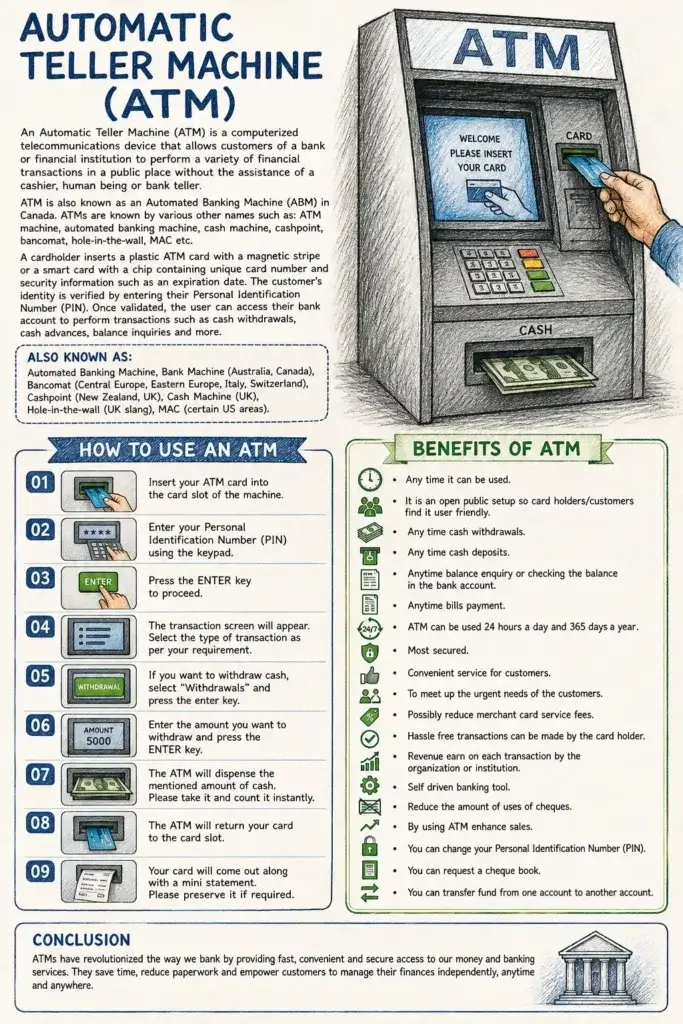
An Automatic Teller Machine (ATM) is one of the most important innovations in modern banking. It allows customers to perform various banking transactions without visiting a bank branch or interacting with a bank employee. ATMs provide quick, convenient, and secure access to banking services at any time of the day or night.
In today’s fast-paced world, people expect banking services to be available whenever they need them. The ATM fulfills this expectation by allowing customers to withdraw cash, check account balances, transfer funds, deposit money, pay bills, and perform many other banking functions 24 hours a day, 365 days a year.
The invention of the ATM revolutionized the banking industry by reducing customer waiting times, decreasing operational costs for banks, and improving customer satisfaction. Today, millions of ATMs operate worldwide, serving billions of transactions annually.
This article provides a comprehensive overview of ATMs, including their history, components, functions, benefits, security features, operating procedures, advantages, disadvantages, and future developments.
What is an Automatic Teller Machine (ATM)?
An Automatic Teller Machine (ATM) is a computerized electronic banking device that enables customers of financial institutions to conduct financial transactions without the assistance of a bank teller or cashier.
Customers access ATM services using a debit card, ATM card, credit card, or smart card. Authentication is typically completed by entering a Personal Identification Number (PIN), ensuring that only authorized users can access the account.
The ATM is connected to the bank’s central computer system through a secure telecommunications network. This connection allows the machine to verify customer information and process transactions instantly.
Meaning of ATM
ATM stands for:
A – Automatic
T – Teller
M – Machine
The term “Automatic Teller Machine” refers to a machine that performs many of the functions traditionally carried out by a human bank teller.
Other Names of ATM Around the World
ATMs are known by different names in different countries:
-
Automated Banking Machine (ABM) – Canada
-
Bank Machine – Australia and Canada
-
Cash Machine – United Kingdom
-
Cashpoint – United Kingdom and New Zealand
-
Bancomat – Italy and several European countries
-
Hole-in-the-Wall – Informal British term
-
MAC (Money Access Center) – Certain areas of the United States
Although the names differ, the purpose remains the same: providing convenient self-service banking.
History of the ATM
The ATM is considered one of the greatest technological innovations in banking.
Early Development
The idea of automated banking emerged during the 1960s when banks sought ways to provide customer services beyond normal business hours.
The world’s first modern ATM was installed in London, United Kingdom, in 1967 by Barclays Bank. The machine was developed by John Shepherd-Barron, who is often credited as one of the inventors of the ATM.
Initially, ATMs used paper vouchers rather than plastic cards. As technology evolved, magnetic stripe cards and PIN-based authentication became standard.
Global Expansion
During the 1970s and 1980s, ATMs spread rapidly across Europe, North America, and Asia. Banks recognized that ATM networks could significantly reduce operational costs while improving customer convenience.
Today, ATMs are available in:
-
Banks
-
Shopping malls
-
Airports
-
Railway stations
-
Universities
-
Hospitals
-
Hotels
-
Supermarkets
-
Fuel stations
Modern ATMs now support advanced functions beyond simple cash withdrawal.
Main Components of an ATM
An ATM consists of several hardware and software components.
1. Card Reader
The card reader reads information stored on the ATM card’s magnetic stripe or chip.
2. Display Screen
The screen provides instructions and displays transaction information.
3. Keypad
The keypad allows customers to enter their PIN and transaction details.
4. Cash Dispenser
This component stores and dispenses cash to customers.
5. Receipt Printer
The printer provides transaction receipts and mini statements.
6. Deposit Slot
Some ATMs include a deposit slot for cash and cheque deposits.
7. Security Camera
CCTV cameras monitor ATM activity to enhance security.
8. Communication System
The ATM communicates with the bank’s central server through secure telecommunications networks.
How Does an ATM Work?
ATMs work through a secure connection between the machine and the bank’s central database.
The process typically involves:
-
Card insertion
-
PIN verification
-
Transaction selection
-
Bank authorization
-
Transaction processing
-
Cash dispensing or service completion
-
Receipt generation
-
Card return
The entire process usually takes less than one minute.
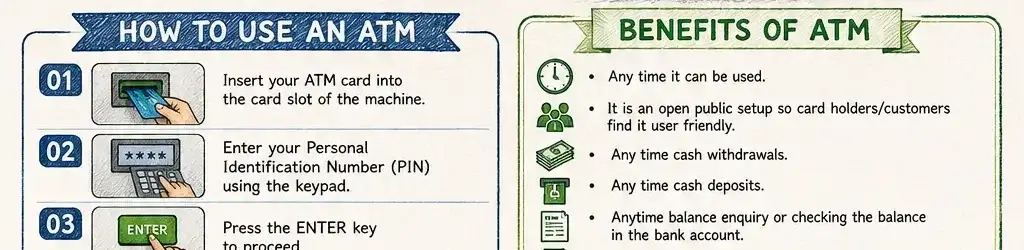
How to Use an ATM
Using an ATM is simple and convenient.
Step 1: Insert Your ATM Card
Insert your ATM card into the card slot according to the instructions displayed on the machine.
Step 2: Select Language
Choose your preferred language from the available options.
Step 3: Enter PIN
Carefully enter your Personal Identification Number (PIN).
Step 4: Press Enter
Press the “Enter” button to continue.
Step 5: Choose Transaction Type
Select the service you require:
-
Cash Withdrawal
-
Balance Inquiry
-
Cash Deposit
-
Fund Transfer
-
Mini Statement
-
PIN Change
Step 6: Enter Amount
If withdrawing cash, enter the desired amount.
Step 7: Confirm Transaction
Review the transaction details and confirm.
Step 8: Collect Cash
Take the cash dispensed by the ATM.
Step 9: Take Receipt
Collect the transaction receipt if required.
Step 10: Remove Card
Always remove your ATM card before leaving.
Types of ATM Transactions
Modern ATMs support various banking services.
Cash Withdrawal
The most common ATM service allows customers to withdraw money from their accounts.
Balance Inquiry
Customers can instantly check account balances.
Mini Statement
ATMs can provide summaries of recent transactions.
Cash Deposit
Many modern ATMs accept cash deposits directly.
Cheque Deposit
Some ATMs allow customers to deposit cheques.
Fund Transfer
Customers can transfer funds between accounts.
PIN Change
Users can update their ATM PIN for security purposes.
Bill Payment
Utility bills and other payments can be made through ATMs.
Mobile Recharge
Many ATMs support mobile phone top-ups.
Benefits of ATM
ATMs provide numerous benefits for customers and financial institutions.
1. 24/7 Availability
ATMs operate twenty-four hours a day and seven days a week.
2. Convenience
Customers can perform banking transactions anytime.
3. Faster Service
Transactions take only a few minutes.
4. Reduced Waiting Time
Customers avoid long queues at bank branches.
5. Easy Cash Access
Cash is available whenever needed.
6. Enhanced Customer Satisfaction
Convenient banking improves customer experience.
7. Secure Transactions
PIN verification and encryption enhance security.
8. Multiple Banking Services
ATMs provide various financial services in one place.
9. Lower Banking Costs
Banks save money by reducing dependence on human tellers.
10. Global Accessibility
International ATM networks allow access to funds worldwide.
Advantages of ATM for Banks
Banks also benefit significantly from ATM technology.
Reduced Operating Costs
ATMs reduce staffing requirements and administrative expenses.
Increased Efficiency
Routine transactions are automated.
Improved Customer Service
Banks can serve customers beyond normal business hours.
Higher Transaction Volume
ATMs handle large numbers of transactions efficiently.
Expanded Market Reach
Banks can provide services in remote areas.
ATM Security Features
Security is a critical aspect of ATM operations.
Personal Identification Number (PIN)
The PIN acts as the primary authentication method.
Chip Technology
EMV chip cards provide stronger protection than magnetic stripe cards.
Encryption
Sensitive information is encrypted during transmission.
CCTV Surveillance
Most ATMs are monitored by security cameras.
Transaction Monitoring
Banks continuously monitor suspicious activities.
Card Blocking
Lost or stolen cards can be blocked immediately.
ATM Safety Tips
Customers should follow these safety guidelines:
-
Keep your PIN confidential.
-
Never share your ATM card.
-
Cover the keypad while entering your PIN.
-
Avoid suspicious ATMs.
-
Check for card skimming devices.
-
Use well-lit ATM locations.
-
Collect your card and receipt.
-
Monitor account statements regularly.
-
Report suspicious transactions immediately.
Common ATM Frauds
Although ATMs are generally secure, fraud can occur.
Card Skimming
Criminals install devices that steal card information.
Shoulder Surfing
Fraudsters observe customers entering PINs.
Card Trapping
Devices trap cards inside the ATM.
Fake Keypads
Fake keypads record PIN entries.
Phishing Attacks
Customers may be tricked into revealing banking details.
Awareness and vigilance help prevent ATM fraud.
Limitations of ATM
Despite many advantages, ATMs have certain limitations.
-
Cash withdrawal limits
-
Technical failures
-
Network outages
-
Security risks
-
Limited complex banking services
-
Maintenance costs
These limitations are generally outweighed by the convenience provided.
Future of ATM Technology
ATM technology continues to evolve.
Future innovations include:
-
Biometric authentication
-
Facial recognition
-
Cardless withdrawals
-
Mobile wallet integration
-
Artificial Intelligence support
-
Contactless transactions
-
Enhanced cybersecurity
-
Voice-assisted ATM services
These developments will make ATM banking even more secure and convenient.
Conclusion
The Automatic Teller Machine (ATM) has transformed the banking industry by providing customers with convenient, fast, and secure access to financial services. From simple cash withdrawals to advanced banking transactions, ATMs have become an essential part of modern financial infrastructure.
Their ability to operate 24 hours a day, 365 days a year makes them invaluable to customers worldwide. Despite challenges such as fraud and technical issues, ongoing technological advancements continue to improve ATM security and functionality.
As digital banking evolves, ATMs will remain a critical bridge between traditional banking and modern financial technology, offering customers reliable access to banking services whenever and wherever they are needed.