Ria Money Transfer: Complete Guide to Services, Sending Money, Tracking, Locations, Fees, and International Remittance
Introduction to Ria Money Transfer
RIA
RIA means Registered Investment Advisor. International money transfer services have become an important part of the global financial system. Millions of people live, work, study, and conduct business outside their home countries, creating a constant need for reliable ways to send money across borders. Migrant workers may send financial support to their families, businesses may need to make international payments, and individuals may need to transfer money for education, healthcare, travel, emergencies, or other personal purposes.
Ria Money Transfer is one of the established companies operating in the international remittance industry. Through its digital services and network of participating agents and payout locations, Ria helps customers send and receive money in numerous markets around the world.
This guide explains what Ria Money Transfer is, how Ria works, its major services, how to send money, how recipients can receive funds, how to track a Ria transfer, how to find Ria locations, payment and delivery options, fees, exchange rates, security considerations, and frequently asked questions.
Important clarification: In the investment industry, the abbreviation RIA can mean Registered Investment Adviser/Advisor. However, Ria Money Transfer is a money-transfer and remittance brand and should not be confused with a Registered Investment Adviser. When discussing international remittances, “Ria” generally refers to Ria Money Transfer.
Ria Money Transfer
What Is Ria Money Transfer?
Ria Money Transfer is an international money-transfer service that allows customers to send funds to recipients in supported countries and territories.
Depending on the sender’s country, recipient’s country, transaction type, and available local services, money may be delivered through options such as:
Cash pickup
Bank deposit
Digital or mobile delivery where supported
Other locally available payout methods
Customers may be able to initiate transactions online, through a mobile application, or at participating physical agent locations. Availability varies by country.
Ria has operated in the remittance industry since 1987. Over the years, the company has expanded internationally and become part of the broader global payments ecosystem.
Ria is associated with Euronet Worldwide, Inc., a publicly traded electronic payments company. Euronet operates in areas that include electronic financial transactions, payments, money transfers, and related financial technology services.
Because international remittance networks change over time, customers should always check Ria’s official website or app for the latest information about supported countries, locations, fees, exchange rates, payment methods, and payout options.
History of Ria Money Transfer
Ria began operations in 1987 and gradually expanded from a traditional money-transfer business into an international remittance provider.
The global remittance industry has changed significantly since the late 1980s. Traditionally, customers often had to visit a physical money-transfer location, provide cash, and arrange for a recipient to collect money from another physical location.
Technology has transformed this process.
Today, international money transfers may involve:
Websites
Mobile applications
Bank accounts
Debit cards
Credit cards where permitted
Digital identity verification
Electronic bank deposits
Automated transaction tracking
Large international payout networks
Ria has developed alongside these changes, combining traditional agent-based remittance services with digital money-transfer options in supported markets.
Its connection with Euronet Worldwide has also placed the Ria brand within a larger international electronic-payments organization.
Ria Money Transfer and Euronet Worldwide
Ria operates as part of Euronet Worldwide, Inc.
Euronet Worldwide is involved in electronic payments and financial transaction processing. Its activities have included areas such as electronic funds transfer, payment processing, ATM-related services, prepaid products, and international money transfer.
This relationship gives Ria access to a broader international payments infrastructure.
For customers, however, the most important consideration is usually straightforward: whether Ria supports the required sending country, receiving country, payment method, delivery option, and transfer amount.
What Does RIA Mean?
The meaning of RIA depends on the context.
RIA in the Investment Industry
In financial advisory terminology, RIA commonly means:
Registered Investment Adviser or Registered Investment Advisor
A Registered Investment Adviser provides investment-related advice and is subject to applicable financial regulations.
Ria in International Money Transfer
Ria Money Transfer, on the other hand, is a remittance and money-transfer service.
Therefore, someone searching for:
RIA investment adviser
Registered Investment Adviser
RIA financial adviser
may be looking for something entirely different from a person searching for:
Ria Money Transfer
Ria international money transfer
Ria remittance
Ria cash pickup
Ria transfer tracking
Understanding this difference is important.
Ria Money Transfer is not the same thing as a Registered Investment Adviser.
What Services Does Ria Offer?
Ria’s available services can differ significantly between countries and locations. International regulations, partnerships, banking systems, payment infrastructure, and local demand can all affect which products are available.
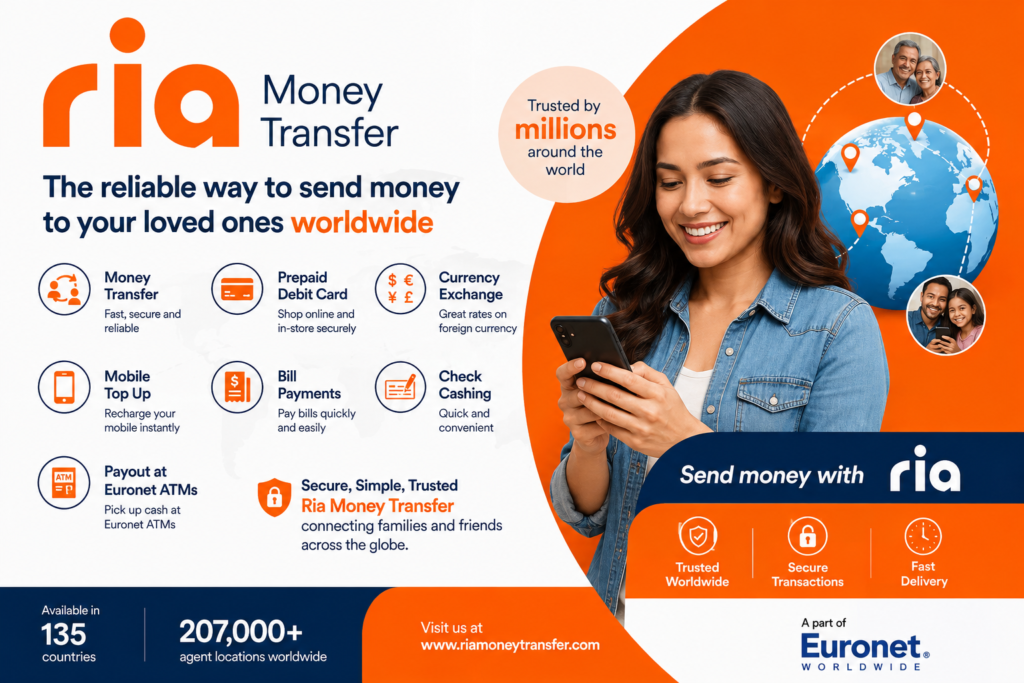
Services associated with Ria and its broader distribution network may include the following.
1. International Money Transfer
International money transfer is Ria’s primary service.
Customers can send money from supported countries to recipients in other supported destinations.
Depending on the transfer corridor, recipients may receive funds through:
Cash pickup
Bank account deposit
Other supported digital delivery methods
The exact options shown to a customer depend on the selected destination and local availability.
2. Cash Pickup
Cash pickup is one of the traditional methods of receiving an international remittance.
With this method, the sender initiates a transfer and selects cash pickup as the delivery method. Once the transaction is ready, the recipient visits an eligible payout location.
The recipient will generally need information such as:
Transfer or order details
Sender’s information
Expected transfer amount
Government-issued identification where required
The exact documentation and procedures vary by country.
Recipients should make sure that their identification details match the information entered by the sender.
Even a small difference in spelling may sometimes delay payment if additional verification is required.
3. Bank Deposit
In supported markets, Ria may allow money to be deposited directly into a recipient’s bank account.
Bank deposit can be convenient because the recipient may not need to visit a cash pickup location.
The sender may need to provide information such as:
Recipient’s full legal name
Bank name
Account number
Routing information
Branch information
IBAN, where applicable
SWIFT/BIC information in some circumstances
Other locally required banking details
The information required depends on the destination country’s banking system.
Incorrect bank details can result in delays, rejection, or other problems. Senders should carefully review the recipient’s banking information before confirming a transfer.
4. Mobile and Digital Delivery
Some remittance markets support transfers to mobile wallets or other digital financial accounts.
Where Ria provides or supports such an option, the sender may be able to transfer funds directly to an eligible recipient’s digital account.
Availability depends on factors including:
Destination country
Mobile network
Financial institution
Local regulations
Ria’s local partnerships
Customers should not assume that mobile-wallet transfers are available everywhere.
5. Currency Exchange
Foreign currency exchange services may be available through certain Ria-related or participating locations.
Currency exchange involves converting one currency into another based on an applicable exchange rate.
For example, a traveler might exchange:
US dollars for euros
Euros for British pounds
Other supported currency combinations
Exchange rates can change frequently.
Customers should therefore check the actual rate offered at the time of the transaction rather than relying on an old published rate.
6. Bill Payment Services
Bill payment services may be available through selected locations or markets.
Depending on the local system, customers may be able to make payments toward eligible services or accounts.
Because bill-payment availability varies considerably, customers should check whether the specific biller they need is supported before visiting a location.
7. Mobile Top-Up
Mobile top-up allows customers in supported markets to add prepaid credit to an eligible mobile telephone account.
This can be particularly useful for families living in different countries.
For example, someone living abroad may want to add mobile credit to a family member’s prepaid phone in another country.
The customer typically needs to provide the correct:
Country
Mobile network
Telephone number
Top-up amount
Mobile top-up should be distinguished from a cash remittance because the recipient normally receives mobile credit rather than withdrawable cash.
8. Prepaid Products
Prepaid financial products may be available through selected markets or associated locations.
These products can vary significantly depending on the country and local provider.
Customers should check:
Activation fees
Usage fees
Withdrawal fees
Reloading options
Expiration rules
Transaction limits
Terms and conditions
before purchasing or using a prepaid financial product.
9. Check Cashing and Money Orders
Historically, certain Ria-related agent environments and markets have offered services such as check cashing or money orders.
These services are not necessarily available at every Ria location.
A Ria agent offering international transfers should therefore not automatically be assumed to provide check cashing, bill payment, prepaid cards, money orders, or currency exchange.
Always check the services of the individual location.
How Does Ria Money Transfer Work?
The basic concept behind Ria Money Transfer is simple.
A sender provides money to Ria using an accepted payment method. Ria processes the transaction through its remittance network, and the recipient receives the funds through the delivery method selected by the sender.
A typical transfer involves five main stages:
Registration or identification
Selecting the destination and transfer amount
Choosing a delivery method
Selecting and completing payment
Tracking and receiving the transfer
Let’s examine each stage in detail.
Step 1: Register or Provide Your Information
For online or mobile transfers, new customers will generally need to create an account.
The registration process may require information such as:
Full name
Residential address
Date of birth
Telephone number
Email address
Other identity information
Additional verification may be required depending on:
Country
Transfer amount
Payment method
Transaction history
Applicable regulations
At a physical agent location, the registration process may be different.
The purpose of collecting customer information is partly related to financial regulations, fraud prevention, anti-money-laundering requirements, and other compliance obligations.
Customers should provide accurate information.
Step 2: Select the Receiving Country and Amount
Next, choose the country where the recipient will receive the money.
Then enter the amount you want to send.
The transfer interface may show information such as:
Amount being sent
Transfer fee
Exchange rate
Estimated amount the recipient will receive
Available delivery methods
Estimated delivery time
Review these details carefully.
The amount paid by the sender is not necessarily identical to the amount received after currency conversion because international transfers may involve an exchange rate and transfer fee.
Step 3: Choose a Delivery Method
Available delivery methods depend on the destination.
Common options may include:
Cash Pickup
The recipient collects cash from an eligible Ria or partner payout location.
Bank Deposit
Funds are sent to the recipient’s eligible bank account.
Digital Delivery
In selected markets, funds may be delivered through supported digital channels.
The fastest or cheapest method is not necessarily the same for every transfer.
A sender should compare the available choices before confirming the transaction.
Step 4: Enter Recipient Information
The sender will need to provide information about the person receiving the money.
This may include:
Recipient’s first name
Middle name, where applicable
Last name
Country
Address
Telephone number
Bank details for bank deposits
The recipient’s name should normally correspond with their official identification.
This is particularly important for cash pickup.
Suppose the recipient’s legal name is:
Mohammad Rahman
but the transfer is accidentally entered as:
Mohamed Rehman
The difference could potentially create a verification problem.
Always double-check spelling before sending.
Step 5: Select a Payment Method
Depending on the sender’s country and transfer channel, payment options may include:
Bank account
Debit card
Credit card
Cash at an agent location
Other locally supported methods
Not every payment method is available in every market.
The selected payment method can affect:
Transfer cost
Processing time
Transaction limits
Verification requirements
For example, a bank-funded transfer may have a different processing time or fee from a card-funded transaction.
Step 6: Review the Transfer
Before submitting the transaction, carefully review all information.
Check:
Sender information
Recipient name
Destination country
Transfer amount
Currency
Exchange rate
Transfer fee
Delivery method
Bank details, if applicable
Payment method
This review step can prevent many common transfer problems.
Step 7: Confirm and Pay
Once the information is correct, confirm the transaction and complete payment.
After submission, Ria should provide transaction information such as an order number, reference number, PIN, or other tracking information depending on the service and country.
Keep this information secure.
Step 8: Track the Transfer
After sending money, customers can monitor the transaction’s progress.
The tracking system may indicate whether a transfer is:
Being processed
Under review
Ready for pickup
Deposited
Completed
Delayed
Cancelled
The terminology may differ depending on the transaction.
How to Track a Ria Money Transfer
Transfer tracking is useful because international transactions do not always arrive immediately.
Processing times can vary according to:
Sending country
Receiving country
Payment method
Delivery method
Banking hours
Weekends
Public holidays
Compliance checks
Identity verification
Technical processing
To track a transaction, use Ria’s official transfer-tracking functionality.
You will generally need your transaction’s identifying information, such as the order number or PIN/reference number, depending on the transfer.
Enter the required information into the tracking tool to check the current status.
Why Is My Ria Transfer Pending?
A pending transfer does not automatically mean that something is wrong.
Possible reasons include:
Payment Processing
The payment may still be clearing.
Identity Verification
Ria may need additional information from the sender.
Security Review
A transaction may be reviewed as part of fraud-prevention or compliance procedures.
Bank Processing
Bank deposits can depend on the receiving bank’s operating schedule.
Weekend or Holiday
Banks and other financial institutions may have limited processing during weekends or public holidays.
Incorrect Information
Incorrect recipient or banking information can delay a transfer.
If a transaction remains pending longer than expected, contact Ria through its official customer-support channels.
How to Find a Ria Money Transfer Location
Customers who want to send or receive cash may need to locate a nearby participating Ria location.
The easiest method is generally to use Ria’s official location finder.
Depending on the country, you may search by:
Country
State
Province
City
Postal code
Address
Current location
A typical search process may look like:
Select Country → Enter City/Postcode → Search → Choose a Location
Before traveling to a location, check its current details.
These may include:
Address
Business hours
Available services
Cash pickup availability
Sending services
Contact information
Agent locations can change, so an old directory should not be treated as permanently accurate.
Ria Money Transfer in Africa
International remittances play a particularly important role in many African economies.
Ria has historically provided remittance services involving numerous African countries through local financial institutions, banks, agents, and payment partners.
Depending on current availability, African markets associated with international remittance networks may include countries such as:
Benin
Burkina Faso
Cameroon
Cape Verde
Côte d’Ivoire
Egypt
Ethiopia
Gambia
Ghana
Kenya
Morocco
Nigeria
Senegal
Uganda
Other supported destinations
This list should not be considered a definitive or permanent list of Ria-supported countries.
Money-transfer coverage changes.
For the current list, use Ria’s official website or application.
Ria Money Transfer to Asia
Asia is another major remittance market because millions of Asian workers and professionals live overseas.
Ria services may support transfers to a variety of Asian destinations depending on the sender’s location.
Potential delivery methods can include:
Bank deposits
Cash pickup
Digital delivery where supported
Countries across South Asia and Southeast Asia receive substantial volumes of international remittances every year.
Customers sending money to Asia should compare the available delivery methods because bank deposits and cash pickup can have different fees, exchange rates, and processing times.
Ria Money Transfer to Bangladesh
People living abroad frequently send money to Bangladesh to support family members and meet household expenses.
International remittances may be used for:
Food
Housing
Education
Healthcare
Family expenses
Savings
Business expenses
Emergency needs
When sending money to Bangladesh through Ria, customers should check the currently available payout options.
Depending on the service arrangement, these could include eligible bank deposits, cash payout partners, or other authorized channels.
The sender should carefully confirm:
Recipient’s legal name
Bank account details where applicable
Transfer amount
Exchange rate
Transfer fee
Expected payout amount
For Bangladesh-specific transfer rules and current availability, always rely on the official Ria service and authorized local financial institutions.
Ria Money Transfer Fees
One of the most common questions is:
How much does Ria charge to send money?
There is no single fee that applies to every Ria transfer.
The cost can depend on:
Amount being sent
Sending country
Receiving country
Payment method
Delivery method
Currency
Transfer channel
Promotions, where applicable
The best way to determine the cost is to create a transfer quote before paying.
A quote may show:
Send Amount + Transfer Fee = Amount Charged
It should also show the expected amount the recipient will receive, subject to the terms of the transaction.
Understanding Ria Exchange Rates
Transfer fees are only one component of the cost of an international money transfer.
The exchange rate is also important.
Suppose you send US dollars and the recipient receives Bangladeshi taka.
The provider must convert:
USD → BDT
The rate applied to this conversion affects how much the recipient receives.
For this reason, customers should compare the recipient amount, not just the advertised transfer fee.
A service with a lower fee could potentially offer a different exchange rate, while another service with a higher fee might provide a more favorable recipient amount.
The overall value of the transaction should therefore be evaluated as a whole.
Transfer Fee vs. Exchange Rate
Consider a simplified example.
Provider A
Transfer fee: $2
Recipient receives: 11,800 units of local currency
Provider B
Transfer fee: $5
Recipient receives: 12,050 units
If you look only at the transfer fee, Provider A appears cheaper.
However, if your priority is maximizing the amount received, the exchange rate and final payout must also be considered.
This illustrates why international money-transfer comparisons should consider:
Transfer fee
Exchange rate
Recipient amount
Delivery time
Payment method
Convenience
Reliability
rather than a single number.
How Long Does a Ria Money Transfer Take?
Transfer speed varies.
Some eligible transactions can be processed quickly, while others may take longer.
Factors affecting delivery speed include:
Payment method
Destination country
Delivery method
Bank processing
Verification
Transfer amount
Compliance review
Weekend
Holiday
Local operating hours
A cash pickup transaction funded by one method might be available relatively quickly, while a bank-funded international transfer could require additional processing.
The estimated delivery time displayed for the actual transaction is more useful than a general estimate.
Can Ria Money Transfers Be Instant?
Some transactions may become available very quickly, but customers should avoid assuming that every transfer is instant.
Even when a service advertises fast transfers, an individual transaction can be delayed because of:
Verification
Payment authorization
Security screening
Bank processing
Recipient information problems
Technical issues
If money is urgently required, check the estimated delivery time before paying.
How to Receive Money Through Ria
Receiving procedures depend on the delivery method.
Receiving Through Cash Pickup
The recipient generally needs to:
Confirm that the transfer is ready.
Find an eligible payout location.
Bring required identification.
Provide required transfer information.
Complete any necessary verification.
Collect the funds.
The recipient should verify the amount before leaving the location.
Receiving Money Through Bank Deposit
For a bank deposit, the sender provides the recipient’s banking information when creating the transfer.
After successful processing, the money is deposited into the eligible account.
The recipient usually does not need to visit a Ria agent for a bank-deposit transaction.
However, processing times depend on the banks and payment systems involved.
Identification Requirements for Ria Cash Pickup
Identification requirements vary by jurisdiction.
A recipient may be required to present an accepted government-issued identity document.
Examples may include:
Passport
National identity card
Driver’s license
Residence permit
Other approved identification
The identification should generally be:
Valid
Unexpired where required
Legible
Consistent with the recipient details on the transfer
Local regulations determine which documents are acceptable.
Why the Recipient’s Name Is Important
One of the most important details in a money transfer is the recipient’s legal name.
For example, imagine the recipient’s passport states:
Abdul Karim Hassan
but the sender enters:
Abdul Hassan
Depending on the local verification requirements, this difference could cause difficulties.
Whenever possible, ask the recipient to provide the exact name shown on the identification they plan to use.
This simple step can prevent unnecessary delays.
Ria Online Money Transfer
Digital money transfer allows eligible customers to initiate transactions without visiting a physical agent.
The general process is:
Visit Ria’s official website or open the official application.
Sign in or register.
Choose the receiving country.
Enter the amount.
Review the exchange rate.
Review the transfer fee.
Choose the delivery method.
Enter recipient information.
Choose a payment method.
Review and submit the transaction.
Track the transfer.
Digital availability depends on the sender’s location.
Ria Mobile App
Where available, Ria’s mobile application can provide a convenient way to manage money transfers.
Features may include:
Creating transfers
Checking transfer estimates
Viewing transaction history
Tracking transfers
Managing recipients
Finding locations
Reviewing transaction information
Features can differ by country and application version.
For security, customers should obtain the app through an official app marketplace and verify that it is the legitimate Ria application.
Advantages of Using Ria Money Transfer
Ria can offer several practical advantages depending on the transfer route.
International Reach
A large remittance network can help senders reach recipients in many destinations.
Cash Pickup
Cash pickup remains valuable in areas where recipients prefer cash or have limited access to traditional banking.
Bank Deposit
Direct bank deposits can provide additional convenience where available.
Digital Access
Online and mobile transfer options can reduce the need to visit an agent.
Transfer Tracking
Tracking allows senders and recipients to monitor transaction progress.
Multiple Payment Options
Different funding methods may be available depending on the country.
Established Remittance Brand
Ria has operated in international money transfer for decades.
Potential Limitations of Ria
No money-transfer provider is ideal for every transaction.
Possible limitations can include:
Service Availability
Certain sending or receiving countries may not support every transfer option.
Variable Fees
Fees can change depending on the transaction.
Exchange Rate Differences
Exchange rates may differ from wholesale or market-reference rates.
Transfer Limits
Maximum and minimum transaction amounts can apply.
Verification Requirements
Additional verification may delay some transactions.
Agent Differences
Services and opening hours can differ between individual agent locations.
Banking Delays
Bank deposits can be affected by bank processing schedules.
These factors make it important to review each transfer before payment.
Is Ria Money Transfer Safe?
Ria is an established international remittance provider, but customers should still follow standard financial-security practices.
The security of a transfer does not depend only on the money-transfer company’s systems. It also depends on how the customer uses the service.
Send money only to people or organizations you trust.
How to Protect Yourself When Using Money Transfer Services
Never Send Money to Unknown People
Be cautious if someone you have never met asks for a money transfer.
Verify Emergency Requests
Scammers may impersonate relatives and claim they urgently need money.
Contact the person through a known telephone number before sending funds.
Protect Transaction Numbers
Do not publicly share transfer reference numbers, PINs, passwords, or account credentials.
Use Official Websites and Apps
Avoid links sent through suspicious emails, text messages, or social-media accounts.
Check Recipient Information
Confirm the recipient’s identity before sending money.
Be Suspicious of Prize Scams
A legitimate prize should not normally require you to send money to an unknown person simply to claim winnings.
Be Careful With Online Purchases
Money transfers can provide fewer purchase protections than payment methods specifically designed for online shopping.
Common Money Transfer Scams
International money-transfer services can be targeted by scammers.
Common scams include:
Romance Scams
A person develops an online relationship and eventually asks for money.
Family Emergency Scams
A criminal pretends to be a relative in trouble.
Lottery Scams
The victim is told they won money but must pay a fee first.
Employment Scams
A fake employer requests payment for equipment, processing, visas, or training.
Rental Scams
A criminal advertises a property they do not own and asks for an advance payment.
Investment Scams
Someone promises unusually high returns and requests a money transfer.
Marketplace Scams
A fraudulent buyer or seller manipulates the victim into transferring money outside a protected payment platform.
Never allow urgency to replace verification.
What to Do If You Enter the Wrong Recipient Information
If you notice an error after submitting a transfer, contact Ria as soon as possible.
Do not simply create another transaction unless you understand what has happened to the first one.
Depending on the transfer’s status, it may be possible to correct or cancel certain information, but this is not guaranteed.
If funds have already been paid to the designated recipient, recovery may be difficult or impossible.
Prevention is therefore important.
Review every detail before clicking the final confirmation button.
Can You Cancel a Ria Money Transfer?
Cancellation possibilities depend on the transaction status and applicable terms.
A transaction that has not yet been paid or completed may potentially be eligible for cancellation.
A transfer that has already been collected or deposited generally presents a very different situation.
Customers who need to cancel should contact Ria promptly through an official support channel.
Do not rely on unofficial social-media accounts or third-party websites for sensitive transaction assistance.
Ria Refunds
If a transfer is cancelled successfully, refund timing may depend on the original payment method.
For example, a refund involving a card or bank account may require processing by financial institutions outside Ria.
Customers should check:
Whether the transfer was successfully cancelled
Refund amount
Refund method
Expected processing period
Keep the transaction confirmation until the matter is fully resolved.
Ria Customer Service
Customers may need assistance with issues such as:
Pending transfers
Cancelled transactions
Recipient name problems
Payment failures
Account verification
Refunds
Cash pickup problems
Bank deposit delays
Transaction tracking
Account access
Use contact details listed on Ria’s official website or application.
Avoid telephone numbers posted on unverified websites because scammers sometimes create fake customer-service listings.
Ria Money Transfer Limits
Transfer limits can depend on several factors.
These may include:
Sender’s country
Recipient’s country
Account verification status
Payment method
Transfer frequency
Regulatory requirements
Agent policies
Transaction history
There may be:
Per-transaction limits
Daily limits
Monthly limits
Other cumulative limits
Customers planning to send a large amount should check their specific limit before beginning the transaction.
Why Does Ria Ask for Identification?
Money-transfer providers operate under financial regulations.
Identity verification can help companies:
Confirm customer identity
Prevent fraud
Detect suspicious transactions
Comply with anti-money-laundering requirements
Meet legal and regulatory obligations
Protect customer accounts
Verification requirements may increase for certain transactions.
Being asked for identification does not necessarily mean that the transaction has a problem.
Why Might Ria Ask for Additional Documents?
In some circumstances, additional documentation may be necessary.
Examples can include documents used to verify:
Identity
Address
Payment method
Source of funds
Purpose of transfer
Requirements vary according to local law and the individual transaction.
Customers should submit sensitive information only through legitimate Ria channels.
Ria Money Transfer vs. Bank Transfer
Traditional banks and remittance companies both provide ways to send money internationally, but the experience can differ.
Ria
May offer:
Cash pickup
Remittance-focused services
Agent locations
Digital transfer options
Multiple payout methods
Traditional Bank
May offer:
International wire transfers
Direct bank-to-bank payments
Business banking integration
Transfers involving SWIFT or other banking networks
The best option depends on:
Cost
Speed
Recipient needs
Destination
Transfer amount
Banking access
Ria vs. Other Money Transfer Providers
Customers often compare Ria with other remittance companies.
Instead of asking which company is universally “best,” compare the actual transaction you need to make.
Consider:
Transfer fee
Exchange rate
Recipient amount
Delivery speed
Cash pickup availability
Bank deposit availability
Payment methods
Transfer limits
Customer support
Convenience
A provider that is attractive for one country may be less competitive for another.
How to Compare International Money Transfer Services
Before sending money, obtain quotes from reputable providers.
Suppose you want to send the equivalent of $500 internationally.
Compare:
Factor
Provider A
Provider B
Provider C
Send amount
$500
$500
$500
Transfer fee
Check quote
Check quote
Check quote
Exchange rate
Check quote
Check quote
Check quote
Recipient receives
Compare
Compare
Compare
Delivery time
Compare
Compare
Compare
Delivery method
Compare
Compare
Compare
The recipient receives figure can be particularly useful because it reflects the combined effect of the exchange rate and transfer structure.
Tips for Getting Better Value on International Transfers
Compare the Total Cost
Do not focus exclusively on a “zero fee” or low-fee advertisement.
Compare Exchange Rates
A small exchange-rate difference can matter, especially for larger transfers.
Check the Recipient Amount
Compare how much money actually reaches the recipient.
Consider Delivery Speed
The cheapest option may take longer.
Choose the Right Payment Method
Different funding methods may carry different fees.
Avoid Unnecessary Urgency
When possible, planning transfers in advance gives you more options.
Sending Money for Family Support
Family remittances are among the most common uses of international money-transfer services.
People may send money for:
Food
Rent
Utilities
Education
Medical expenses
Family celebrations
Home construction
Savings
Emergency expenses
When sending regular family support, keep records of transactions.
Transaction history can help with budgeting and resolving future questions.
Sending Money for Education
International students may need money for:
Tuition
Accommodation
Books
Food
Transportation
Other living expenses
Before sending a large educational payment, confirm whether the institution accepts personal remittance transfers.
Some universities require tuition payments through specific banking or payment channels.
Sending Money for Medical Expenses
Money transfers can help families cover urgent healthcare expenses.
However, urgency can increase the risk of mistakes.
Before sending:
Verify the recipient.
Confirm the amount.
Check the recipient’s legal name.
Confirm the delivery method.
Review the exchange rate.
Check the expected arrival time.
If paying a hospital directly, verify the institution’s official payment instructions.
Sending Money to a Bank Account
For bank deposits, accuracy is critical.
Before submitting the transaction, confirm:
Account holder’s name
Account number
Bank name
Branch information
Routing number
IBAN where applicable
SWIFT/BIC where applicable
Local banking codes
Never guess banking information.
Ask the recipient to obtain the correct details directly from their bank if necessary.
Cash Pickup vs. Bank Deposit
Which option should you choose?
Cash Pickup May Be Better When:
The recipient does not have a bank account.
Cash is urgently needed.
A convenient payout location is available.
The recipient prefers cash.
Bank Deposit May Be Better When:
The recipient has an eligible bank account.
Traveling to an agent is inconvenient.
The money should go directly into an account.
Cash handling is undesirable.
The best method depends on the recipient’s circumstances.
How to Prepare for a Cash Pickup
Recipients can reduce delays by preparing before visiting a location.
They should:
Confirm the transfer is ready.
Confirm the location offers payout services.
Check opening hours.
Bring acceptable identification.
Know the sender’s name.
Have the required transaction information.
Know approximately how much they expect to receive.
For large cash pickups, it can also be sensible to confirm availability with the location where appropriate.
Ria Agent Locations
Ria’s physical presence relies partly on participating agent and partner networks.
An agent location may be:
A financial-services shop
A retail store
A currency-exchange business
A bank
Another authorized financial-services location
Not all agents provide identical services.
One location might offer sending and receiving, while another may only support particular transactions.
Always check before visiting.
How to Become a Ria Agent
Businesses interested in offering money-transfer services may investigate opportunities to become authorized agents where Ria supports agent partnerships.
The process can involve evaluation of:
Business type
Location
Regulatory eligibility
Compliance procedures
Customer demand
Financial-services experience
Required documentation
Interested businesses should contact Ria through official business or agent-partnership channels.
Never pay an unknown intermediary claiming to guarantee Ria agency approval.
International Remittances and the Global Economy
Remittances are more than individual transactions.
Collectively, they form an important flow of money between countries.
Workers living abroad often send part of their income home.
These funds can support:
Household consumption
Education
Healthcare
Housing
Small businesses
Savings
Community development
For many families, remittances provide an important source of financial support.
Companies such as Ria form part of the infrastructure that makes these cross-border transfers possible.
Digital Transformation of Money Transfers
The remittance industry has changed dramatically.
Traditional international money transfers often required both sender and recipient to visit physical locations.
Modern services increasingly combine:
Mobile apps
Websites
Electronic identity verification
Debit-card payments
Bank transfers
Digital wallets
Automated transaction updates
Physical locations remain important, especially for cash-dependent communities, but digital services continue to expand.
Ria’s combination of digital and agent-based channels reflects this broader industry trend.
Ria Money Transfer for Frequent Senders
People who regularly send money abroad can benefit from developing a simple transfer routine.
Before every transfer:
Confirm the recipient’s details.
Check the current exchange rate.
Review the fee.
Check the recipient amount.
Confirm the delivery method.
Review the estimated delivery time.
Save the transaction confirmation.
Do not assume that the price or exchange rate from your previous transaction still applies.
Currency markets and provider pricing can change.
How Exchange Rates Affect Remittances
Exchange rates determine how much one currency is worth in another currency.
For example:
1 USD = X BDT
If the exchange rate changes, the recipient amount can change even when the sender sends exactly the same number of dollars.
Suppose someone sends $1,000.
At one hypothetical rate:
$1,000 × 115 = 115,000 BDT
At another hypothetical rate:
$1,000 × 118 = 118,000 BDT
That is a difference of 3,000 BDT before considering fees or any provider-specific exchange-rate margin.
This is why exchange rates matter.
Understanding the Recipient Amount
For many customers, the most useful number on the transfer screen is:
Recipient Gets
This represents the expected payout according to the quoted transaction.
Review this figure before confirming.
If the recipient needs an exact amount—for example, to pay a bill—you may need to adjust the send amount accordingly.
Ria Transfer Receipt
Keep your transfer receipt or electronic confirmation until the transaction is complete.
A receipt may contain:
Transaction number
Date
Sender information
Recipient information
Amount
Fee
Exchange rate
Payment method
Delivery information
This documentation can be useful if you need customer support.
What Information Should You Never Share Publicly?
Protect your financial information.
Do not publicly post:
Passwords
One-time verification codes
Full payment-card information
Bank login details
Sensitive identification documents
Transfer PINs or reference information when it could enable unauthorized access
If someone contacts you claiming to be Ria support and asks for sensitive information, verify the request using Ria’s official contact channels.
How to Identify a Fake Ria Website
Phishing websites may imitate financial companies.
Warning signs can include:
Misspelled domain names
Strange web addresses
Poor grammar
Unexpected requests for passwords
Requests for unusual payments
Urgent threats
Links from unknown messages
Rather than following a suspicious link, navigate independently to Ria’s official website or use its official application.
Frequently Asked Questions About Ria Money Transfer
What is Ria Money Transfer?
Ria Money Transfer is an international remittance service that enables customers to send money to recipients in supported destinations using available delivery methods such as cash pickup and bank deposit.
When was Ria founded?
Ria began operations in 1987.
Who owns Ria Money Transfer?
Ria operates as part of Euronet Worldwide, Inc.
Is RIA the same as Registered Investment Advisor?
No.
RIA can mean Registered Investment Adviser/Advisor in the investment industry, but Ria Money Transfer is an international money-transfer business.
Can I send money online with Ria?
Online transfers are available in supported sending markets. Availability depends on your country.
Can I use the Ria mobile app?
Ria provides mobile services in supported markets. Check the official app availability for your location.
Can the recipient collect cash?
Cash pickup is available for eligible transfers and destinations.
Can Ria deposit money into a bank account?
Bank deposit is available on supported transfer routes.
How do I track my Ria transfer?
Use Ria’s official transaction-tracking service and enter the requested order, PIN, or reference information.
How long does a Ria transfer take?
Delivery times vary according to payment method, destination, payout method, verification, bank processing, weekends, holidays, and other factors.
How much does Ria charge?
Fees vary by transaction. Obtain a current quote for the exact sending amount, destination, payment method, and delivery method.
What exchange rate does Ria use?
Exchange rates vary by currency pair and transaction. Review the quoted exchange rate before confirming payment.
Does the recipient need identification?
Identification is commonly required for cash pickup, subject to local rules.
Can someone else collect my Ria transfer?
The transfer should be collected only by the eligible recipient according to Ria’s requirements and applicable local rules.
Can I cancel a Ria transaction?
Some incomplete transfers may be eligible for cancellation. Contact Ria promptly and review the transaction’s applicable terms.
Can I get a refund?
Refund eligibility and timing depend on the transaction status, payment method, and applicable policies.
Why is my transfer delayed?
Possible causes include payment processing, verification, compliance review, banking schedules, incorrect information, weekends, or holidays.
Does Ria offer cash pickup everywhere?
No. Delivery methods vary by country and transfer route.
Can I send money using a debit card?
Debit-card funding may be available in supported markets.
Can I use a credit card?
Credit-card availability depends on the country and transaction. Your card issuer may also have its own rules or charges.
Can I pay through my bank account?
Bank-account funding may be available for eligible transfers.
Can I send cash from a Ria agent?
Participating physical locations may accept eligible cash-funded transactions.
Does every Ria agent offer the same services?
No. Services can vary by location.
How do I find a Ria agent near me?
Use Ria’s official location-search tool and enter your location information.
Can I send money internationally for business purposes?
The permitted use of a service depends on Ria’s product terms and the type of transaction. Businesses should use appropriate payment solutions and review applicable rules.
Is Ria available 24 hours a day?
Digital services may be accessible at various times, but physical agent hours and banking processing schedules vary.
Can transfers be processed on weekends?
Transactions may be initiated at certain times, but processing and payout can be affected by weekends, agent opening hours, banking schedules, and local holidays.
What should I do if I entered the wrong name?
Contact Ria as soon as possible. Do not wait until the recipient attempts pickup if you already know the information is incorrect.
What happens if my recipient cannot collect the money?
Check the transaction status and confirm that the recipient has appropriate identification and transfer details. If the issue continues, contact official Ria customer support.Ria Money Transfer Checklist for Senders
Before submitting an international transfer, use this checklist:
Confirm the recipient’s legal name.
Confirm the destination country.
Enter the correct amount.
Review the transfer fee.
Review the exchange rate.
Check how much the recipient will receive.
Choose the correct delivery method.
Verify bank details if using bank deposit.
Review the estimated delivery time.
Check your payment method.
Review all information before confirming.
Save your receipt or confirmation.
Track the transfer until completion.
Ria Cash Pickup Checklist for Recipients
Before going to collect a transfer:
Confirm that the transfer is ready.
Find an authorized payout location.
Check the location’s opening hours.
Bring acceptable identification.
Ensure your name matches the transfer details.
Bring the required transfer information.
Know the sender’s name.
Know the expected amount.
Count or verify funds according to local procedures.
Mistakes to Avoid When Sending Money Through Ria
Mistake 1: Misspelling the Recipient’s Name
Always copy the recipient’s legal name accurately.
Mistake 2: Entering the Wrong Bank Account
Double-check every digit.
Mistake 3: Looking Only at the Fee
The exchange rate and recipient amount matter too.
Mistake 4: Sending Money to a Stranger
Money transfers should not be used casually to pay unknown individuals.
Mistake 5: Sharing Transaction Information Publicly
Keep financial information private.
Mistake 6: Using an Unofficial Website
Use official Ria channels.
Mistake 7: Assuming Every Transfer Is Instant
Always review the estimated delivery time.
Mistake 8: Waiting Too Long to Report an Error
Contact support promptly when you identify a problem.
Why Ria Remains Relevant in International Remittance
The international money-transfer market has become increasingly competitive.
Customers can now choose from:
Banks
Traditional remittance companies
Mobile payment platforms
Fintech companies
Digital wallets
International payment applications
Despite these changes, services combining physical agent networks with digital transfers continue to serve an important purpose.
Not every recipient has:
A bank account
A credit card
Reliable digital banking
Access to the same payment applications
Cash pickup therefore remains important in many communities.
At the same time, customers with banking access increasingly prefer direct deposits and digital transfers.
A provider capable of supporting different delivery methods can serve both groups.
Ria for Migrant Workers
Migrant workers are major users of international remittance services.
A worker living abroad may regularly send part of their income to parents, a spouse, children, or other relatives.
For these customers, important considerations include:
Affordable fees
Competitive exchange rates
Convenient payout locations
Reliable processing
Accessible customer support
Bank deposit options
Transfer tracking
Even a small difference in transfer cost can become significant when money is sent every month.
Frequent senders should periodically compare providers instead of assuming that one company always offers the best value.
Ria and Financial Inclusion
International remittance networks can contribute to financial inclusion by helping people receive funds even when access to conventional banking is limited.
Cash pickup can be particularly relevant for recipients who:
Do not maintain bank accounts
Live in cash-based communities
Need immediate access to physical currency
Have limited digital financial access
Meanwhile, bank deposits and digital delivery can support customers who prefer electronic financial services.
The coexistence of physical and digital channels is therefore an important characteristic of the modern remittance market.
Choosing the Right Ria Delivery Method
Before choosing a payout option, talk to the recipient.
Ask:
Do you prefer cash or a bank deposit?
Is there a Ria payout location close to you?
Do you have an eligible bank account?
How quickly do you need the money?
Can you easily travel to a pickup location?
A delivery method that is convenient for the sender may not be convenient for the recipient.
The recipient’s circumstances should therefore influence the decision.
What to Check Before Sending a Large Transfer
Larger transfers deserve additional attention.
Before sending:
Confirm your transaction limit.
Verify the recipient.
Confirm all banking details.
Review the exchange rate.
Review the total fee.
Understand verification requirements.
Confirm the expected delivery period.
Keep documentation regarding the purpose of the payment where appropriate.
For substantial financial transactions, other methods such as a regulated bank transfer may sometimes be more suitable depending on the circumstances.
Ria Money Transfer and Compliance
International money transfers are regulated financial activities.
Money-transfer companies may have obligations relating to:
Customer identification
Anti-money-laundering controls
Countering financial crime
Sanctions compliance
Fraud prevention
Transaction monitoring
Record keeping
As a result, customers may occasionally experience additional questions or verification.
Although these procedures can increase processing time, they form part of operating within regulated financial systems.
Why a Transfer Might Be Declined
A transaction can potentially be declined for various reasons, including:
Payment authorization failure
Incorrect information
Verification problems
Transaction limits
Compliance requirements
Unsupported payment method
Unsupported destination
Security concerns
A declined transaction does not necessarily mean that the customer’s account has a permanent problem.
Check the error information and contact official support if necessary.
How to Contact Ria Safely
When you need assistance:
Open Ria’s official website or official app.
Navigate to the customer-support section.
Use the listed contact methods.
Have your transaction information available.
Never disclose passwords or one-time authentication codes unnecessarily.
Be cautious about customer-service telephone numbers obtained through random search results, social-media comments, or online forums.
Fraudsters sometimes impersonate financial-company support representatives.
Official Ria Money Transfer Information
For current information about Ria, customers should rely primarily on the company’s official channels.
From the official site, customers can generally find information related to:
Sending money
Transfer tracking
Locations
Supported countries
Help and support
Current services
Fees and exchange-rate quotes
Account access
Because website addresses and page structures can change, navigating from the official homepage is preferable to relying on outdated deep links.
Final Thoughts
Ria Money Transfer has been part of the international remittance industry since 1987 and operates as part of Euronet Worldwide. Its services are designed to help customers move money internationally through supported physical and digital channels.
Depending on the countries involved, customers may have access to services such as international money transfers, cash pickup, bank deposits, mobile or digital delivery, and other locally available financial services.
The basic process of sending money through Ria typically involves registering or providing identification, choosing the receiving country and amount, selecting a delivery method, entering the recipient’s information, choosing a payment method, reviewing the transaction, making payment, and tracking the transfer until completion.
For a successful international transfer, accuracy is essential. Always check the recipient’s name, account details, destination, transfer fee, exchange rate, recipient amount, delivery method, and estimated processing time before confirming payment.
Customers should also remember that RIA as an investment-industry abbreviation for “Registered Investment Adviser/Advisor” is different from Ria Money Transfer. The two should not be confused.
Finally, international money-transfer conditions are constantly changing. Agent networks expand or contract, supported countries change, fees and exchange rates fluctuate, and payment methods evolve. For that reason, current transaction details should always be verified directly through Ria Money Transfer’s official website, mobile application, or authorized customer-support channels before sending money.
Learn how Ria Money Transfer works, including international money transfers, cash pickup, bank deposits, fees, exchange rates, transfer tracking, Ria locations, payment methods, security tips, and FAQs.
Suggested URL Slug
/ria-money-transfer-guide/
Primary SEO Keywords
Ria Money Transfer, Ria money transfer online, Ria international money transfer, Ria transfer tracking, Ria Money Transfer locations, Ria money transfer fees, Ria exchange rate, send money with Ria, Ria cash pickup, Ria bank deposit
Secondary and Long-Tail Keywords
how to send money through Ria, how to track Ria Money Transfer, find Ria Money Transfer location, Ria international remittance, how long does Ria Money Transfer take, Ria transfer fees, Ria recipient requirements, Ria cash pickup requirements, Ria Money Transfer bank deposit, Ria mobile money transfer, Ria transfer pending, Ria transfer cancellation, Ria Money Transfer refund, Ria customer service, Ria Money Transfer Bangladesh, Ria Money Transfer Africa, Ria remittance services, Ria exchange rates, Euronet Worldwide Ria
Suggested Article Schema
For search-engine optimization, the page can use appropriate Article, BreadcrumbList, and—where the questions are visibly presented on the published page and current search-engine guidelines permit it—FAQ structured data. All structured data should accurately represent content visible to visitors and should be updated whenever the article changes.
Content Update Notice
Last reviewed: August 2026. Money-transfer fees, exchange rates, supported countries, payout partners, agent locations, transfer limits, delivery methods, and regulatory requirements can change. Readers should verify transaction-specific information through Ria’s official channels before sending money.