

BMO Bank: Complete Guide to BMO Banking, Checking, Savings, CDs, Fees, Online Banking and Financial Services
BMO Bank is one of the largest and most established banking institutions serving consumers, families, professionals and businesses in North America. With a history stretching back more than two centuries, BMO combines traditional branch banking with online and mobile banking, checking and savings accounts, money market accounts, certificates of deposit, mortgages, home equity products, credit cards, personal loans, wealth management and commercial banking services. In the United States, the institution operates under the BMO brand, following the transition from the BMO Harris Bank name to simply BMO.
For consumers searching for a bank that offers both physical branches and digital banking capabilities, BMO Bank can be an important institution to consider. It provides access to thousands of financial services and products while maintaining a substantial U.S. branch network and access to more than 40,000 fee-free ATMs through BMO and Allpoint networks. BMO also provides digital tools for checking balances, transferring money, depositing checks, paying bills, sending money through Zelle and monitoring spending.
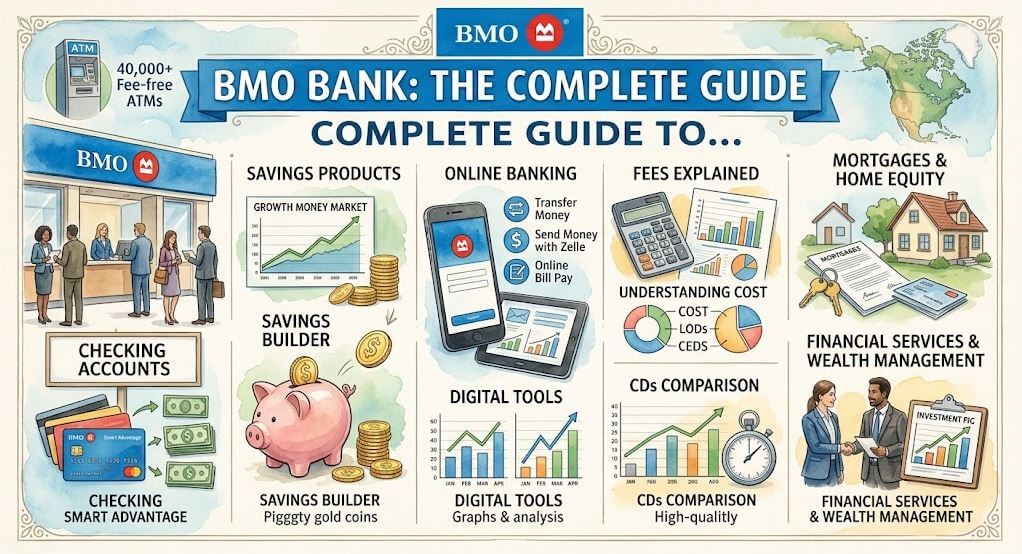
BMO is particularly interesting because its product lineup includes both basic banking products designed for everyday customers and relationship-oriented products designed to provide additional benefits when customers maintain multiple accounts or larger balances. Its checking lineup includes Smart Advantage Checking, Smart Money Checking and Relationship Checking, while its savings lineup includes Savings Builder, Growth Money Market and certificates of deposit. The bank also offers mortgages, home equity financing, credit cards and investment-related services.
According to BMO, the institution traces its history to 1817 and is part of BMO Financial Group. BMO Financial Group reported total assets of approximately C$1.5 trillion as of January 31, 2026, making it the eighth-largest bank in North America by assets according to the company’s description. BMO says it serves millions of customers across North America through personal and commercial banking, wealth management, global markets and investment banking. (BMO)
For U.S. consumers, however, the most important question is not simply how large BMO is. The more useful question is whether BMO’s individual products, fees, interest rates, branch access, digital tools and customer service fit a particular financial situation. This detailed guide examines BMO Bank from those perspectives, explaining how its checking accounts work, what its savings products offer, how its CDs compare conceptually with alternatives, what customers should know about fees, how BMO online banking works and what factors should be considered before opening an account.
What Is BMO Bank?
BMO Bank is the U.S. banking operation associated with BMO Financial Group, a major North American financial institution headquartered in Canada. The bank provides a broad selection of consumer and business financial products, including deposit accounts, loans, mortgages, credit cards, investment services and wealth management.
U.S. customers may still encounter references to “BMO Harris Bank” when searching online because that was the institution’s previous U.S. brand name. BMO officially shortened the brand from BMO Harris Bank to BMO and changed its primary website address to BMO.com. The transition was designed to simplify the brand and create a more unified identity. (BMO)
This distinction is important for people researching older reviews, financial articles and account information. A search for “BMO Harris Bank” may produce historical information that still applies to BMO, but customers should verify current fees, rates, eligibility rules and product terms directly with BMO because banking products can change.
BMO’s U.S. business combines physical banking locations with online and mobile services. This hybrid model is attractive to consumers who want the convenience of digital banking but still value access to financial professionals in a branch.
The bank’s consumer offerings cover many stages of personal finance. A customer could potentially use BMO for an everyday checking account, maintain emergency savings in a savings or money market account, purchase a certificate of deposit, obtain a mortgage, use a credit card and eventually work with wealth management services.
That broad product ecosystem is one of BMO’s primary advantages.
BMO Bank History
BMO’s history is one of its defining characteristics. BMO Financial Group traces its origins to 1817, giving the institution a history of more than 200 years.
The bank began as the Bank of Montreal and gradually expanded its operations across Canada and eventually into the United States and other financial markets. Over time, BMO developed from a traditional banking institution into a diversified financial services organization.
The company’s long history does not mean every product has remained unchanged. Banking has evolved significantly through technological innovation, regulatory changes, digital payments, mobile applications and changing consumer expectations.
BMO’s U.S. presence has also developed through acquisitions and expansion. One of the most important developments was the acquisition of Bank of the West, which significantly expanded BMO’s U.S. footprint and strengthened its presence in western and central U.S. markets.
Today, BMO describes itself as a major North American financial institution serving approximately 13 million customers through its various business lines. (BMO)
For consumers, the significance of this history is mainly related to scale, product breadth and institutional resources. A large financial institution can provide a wider range of products than a small community bank, although larger institutions can also have more complex fee schedules and product structures.
BMO Bank in the United States
BMO has a substantial U.S. presence and serves customers through branches, financial centers, ATMs, telephone support and digital banking platforms.
Bankrate’s review describes BMO as having approximately 1,000 branches across 23 states and notes that many of its deposit accounts can be opened online. Bankrate also highlights BMO’s access to more than 40,000 fee-free ATMs nationwide. (Bankrate)
The combination of branch banking and a large ATM network is useful for consumers who regularly need cash or prefer face-to-face banking.
At the same time, customers who live outside BMO’s strongest geographic markets should consider whether there is a convenient branch nearby. A large national ATM network can solve many everyday access issues, but branch availability matters for situations involving complex financial transactions, mortgage discussions, business banking or other services that may benefit from in-person support.
Is BMO Bank FDIC Insured?
Deposits held in eligible BMO Bank deposit accounts are insured by the Federal Deposit Insurance Corporation, subject to applicable FDIC rules and limits.
FDIC insurance is an important consideration when comparing banks because it protects qualifying deposits against bank failure up to applicable coverage limits. It does not protect consumers against investment losses, changes in interest rates or declines in the market value of securities.
BMO’s consumer banking pages explicitly state that eligible deposits are FDIC insured. (BMO)
Customers with substantial deposits should understand how FDIC insurance limits apply across ownership categories and institutions. Someone holding significant balances across checking, savings, money market and CD accounts should not simply assume that every dollar is separately insured.
BMO Checking Accounts
Checking accounts are one of BMO’s strongest consumer banking categories. Bankrate gave BMO’s checking products a 4.5 out of 5 rating in its December 2025 review, reflecting factors such as fees, minimum opening deposits, account accessibility and overdraft policies. (Bankrate)
BMO offers multiple checking products rather than forcing every customer into the same account.
The three important consumer checking products include Smart Advantage Checking, Smart Money Checking and Relationship Checking.
Each account is designed for a somewhat different customer.
Smart Advantage Checking is oriented toward everyday banking and is particularly attractive to customers who want a checking account without a monthly maintenance fee.
Smart Money Checking is designed around simpler banking and includes overdraft-related features that may appeal to customers who want additional protection against overdraft charges.
Relationship Checking is designed for customers who maintain larger balances or broader relationships with BMO and want access to enhanced benefits.
BMO Smart Advantage Checking
BMO Smart Advantage Checking is one of the bank’s most prominent consumer checking products.
BMO currently advertises the account with a $0 monthly maintenance fee and no minimum monthly balance requirement. The minimum opening deposit is $25. The bank also advertises access to more than 40,000 fee-free ATMs through BMO and Allpoint. (BMO)
These features make Smart Advantage Checking particularly appealing for consumers who want a straightforward checking account without the traditional monthly maintenance fee found on many large-bank checking accounts.
The account supports common digital banking functions, including online banking, mobile banking, mobile check deposit, bill payment and Zelle transfers. Customers can also use BMO Total Look to connect and view financial accounts in one place and monitor spending. (BMO)
However, “no monthly maintenance fee” does not mean the account is completely fee-free.
For example, BMO’s current disclosure lists a $3 fee for non-BMO ATM transactions, along with other possible charges such as paper statements and certain overdraft-related fees. (BMO)
Customers should therefore review the current fee schedule before opening an account.
BMO Smart Money Checking
BMO Smart Money Checking is designed for consumers who prefer a more controlled approach to everyday banking.
The account has a monthly maintenance fee under standard terms, although BMO says the fee can be waived for customers under age 25. The account also does not require a minimum balance.
One of the key characteristics of Smart Money Checking is its overdraft policy. BMO markets the account as offering no overdraft fees, which can make it appealing to consumers who want to reduce the risk associated with accidentally spending more money than is available.
This account can be especially relevant for younger consumers, students and people who are developing their first banking habits.
The best checking account is not necessarily the account with the most features. For many people, predictable fees and strong spending controls are more important than premium banking benefits.
BMO Relationship Checking
BMO Relationship Checking takes a different approach.
Instead of focusing primarily on basic free checking, the account is designed to reward customers who maintain a broader financial relationship with BMO.
The account can be opened with $25, but its standard monthly maintenance fee is $25. BMO says the fee can be waived when customers meet qualifying balance requirements, including maintaining at least $10,000 in the account’s minimum daily ledger balance for the previous calendar month or a qualifying $25,000 monthly combined balance. (BMO)
Relationship Checking can also earn interest.
Customers are placed into BMO Relationship Packages based on their quarterly combined balances in eligible deposit and investment accounts. BMO currently identifies Silver, Gold, Platinum and Premier relationship tiers. (BMO)
The relationship model is important because it changes how customers should evaluate the account.
A person with only a small checking balance may find the monthly fee difficult to justify if the waiver requirements are not met. A customer who already maintains substantial savings, investments or other eligible balances with BMO may receive more value from the relationship benefits.
Relationship benefits can include interest on checking balances, certain ATM benefits, wire-transfer benefits and other banking services, depending on the customer’s relationship package and applicable terms. (BMO)
BMO Savings Accounts
Savings accounts are designed to help consumers set money aside for emergencies, planned expenses, major purchases and long-term financial goals.
BMO offers multiple savings-oriented products rather than relying on a single account.
Its major consumer savings products include Savings Builder, Growth Money Market and certificates of deposit.
BMO’s Savings Builder is designed around a savings-reward concept, while Growth Money Market is designed for customers who want access to funds while potentially earning a higher rate depending on balance and relationship qualifications. CDs are designed for consumers willing to keep money deposited for a predetermined period in exchange for a fixed interest rate.
Bankrate’s assessment of BMO’s savings products has been more mixed than its checking assessment. In its current review, Bankrate gives BMO’s Savings Builder a 2.9 out of 5 score and notes that the standard yield is relatively low. (Bankrate)
That illustrates an important principle when evaluating BMO: the bank’s overall reputation and product breadth should not be confused with the competitiveness of every individual account.
BMO Savings Builder
BMO Savings Builder is one of the bank’s best-known savings products.
BMO currently advertises no monthly maintenance fee and a $25 minimum opening deposit. One of the account’s distinctive features is a reward for consistent savings growth.
BMO says customers can receive an additional $5 for each month in which they increase their balance by at least $200 during the first year. (BMO)
This approach makes Savings Builder different from a conventional high-yield savings account.
Instead of focusing entirely on the annual percentage yield, the account encourages customers to develop a regular savings habit.
For example, someone who is building an emergency fund may benefit psychologically from having a measurable monthly savings target.
However, customers should compare the account’s total potential benefit with the interest they could earn from competing savings accounts.
Bankrate currently describes the Savings Builder yield as extremely low relative to competitive savings products. Its analysis notes that the $5 monthly reward can provide a useful incentive for customers who consistently grow the account, but the underlying yield is a major weakness. (Bankrate)
Therefore, the account may make more sense for customers who value BMO’s banking ecosystem and savings incentives than for customers whose primary goal is maximizing interest income.
BMO Growth Money Market Account
The BMO Growth Money Market account is intended for customers who want a combination of savings growth and relatively convenient access to their money.
BMO currently advertises a $10 monthly maintenance fee, which can be waived by maintaining a $5,000 minimum daily balance. (BMO)
This is an important consideration.
A money market account can look attractive based on its interest rate, but the effective return may be reduced if the account holder does not meet the balance requirement necessary to avoid the monthly fee.
Bankrate’s current review notes that BMO’s Growth Money Market account can offer better yields at higher balances, but the highest advertised yield requires a much larger deposit. Bankrate specifically notes that the top rate can require a balance of at least $250,000. (Bankrate)
This means customers should not evaluate the account based only on its headline rate.
A better approach is to calculate the actual dollar interest earned after considering the balance requirement and monthly fee.
The Growth Money Market account may be particularly interesting to customers who already have a substantial BMO relationship because qualifying Relationship Checking activity can increase the applicable rate. (BMO)
BMO Certificates of Deposit
Certificates of deposit, commonly called CDs, are another component of BMO’s deposit portfolio.
A CD generally allows customers to deposit money for a specified term in exchange for a fixed interest rate. The advantage is predictability. The disadvantage is reduced liquidity and potential early-withdrawal penalties.
BMO offers multiple CD terms, and its consumer banking site emphasizes that CDs do not have monthly maintenance fees and can provide fixed rates for the selected term. (BMO)
Bankrate’s review gives BMO’s CD offering a 2.7 out of 5 rating and notes that BMO offers CD terms ranging from several months to multiple years, with a $1,000 minimum deposit. Bankrate also describes the yields as relatively low compared with more competitive CD offerings. (Bankrate)
This does not necessarily mean BMO CDs are unsuitable.
A CD can still make sense when the customer values the convenience of keeping deposits within the same banking relationship.
But rate-sensitive customers should compare BMO’s current CD rates with online banks, credit unions and other financial institutions before locking in funds.
BMO Interest Rates and APYs
Interest rates are among the most important considerations when choosing a bank.
An annual percentage yield, or APY, measures the effective annual return on a deposit account while incorporating the effects of compounding. The APY is usually more useful for comparison than the nominal interest rate.
BMO’s rates vary by account type, balance, customer relationship and market conditions.
One important lesson from BMO’s current product structure is that the highest potential return is not necessarily available to every customer.
For example, the Growth Money Market account can have balance-based pricing, while Relationship Checking can provide different benefits depending on the customer’s relationship package.
Consumers should therefore avoid comparing only the best advertised rate.
Instead, they should ask:
How much money will I deposit?
How long will I keep it there?
Do I qualify for the advertised rate?
Will I have to maintain another account?
Is there a monthly fee?
Can I easily withdraw the money?
What happens if the bank changes the variable rate?
These questions provide a much more accurate picture of the actual value of a bank account.
BMO Fees
Bank fees can significantly affect the value of a banking relationship.
BMO offers some accounts with no monthly maintenance fee, but other accounts have fees that can be waived under specific conditions.
Smart Advantage Checking, for example, currently has no monthly maintenance fee and requires a $25 minimum opening deposit. However, BMO lists fees for certain non-BMO ATM transactions and other services. (BMO)
Growth Money Market currently has a $10 monthly fee unless the customer maintains the required minimum daily balance. (BMO)
Relationship Checking has a higher standard monthly fee, but qualifying balances can waive it. (BMO)
This is why consumers should distinguish between a bank that has “fees” and a bank that has “unavoidable fees.”
Many banking fees can be avoided by meeting account requirements.
The important task is to understand those requirements before opening the account.
BMO Overdraft Fees
Overdraft policies can be particularly important for consumers who maintain relatively small checking balances.
BMO’s overdraft policies vary by account.
Smart Advantage Checking currently lists a $20 overdraft fee under applicable circumstances, while BMO also provides certain grace periods or overdraft-service options designed to help customers avoid or reduce fees. (BMO)
Bankrate noted that BMO changed the amount associated with its overdraft protection threshold in 2026, illustrating why customers should verify current terms rather than relying on older reviews. (Bankrate)
Smart Money Checking is structured differently and is marketed with no overdraft fees.
Consumers who are particularly concerned about overdrafts should compare the actual account agreement, not simply the advertising summary.
BMO ATM Access
ATM access is one of BMO’s strongest practical advantages.
BMO advertises access to more than 40,000 fee-free ATMs across the United States through BMO and Allpoint. (BMO)
This is valuable for customers who frequently withdraw cash.
BMO Relationship Checking also provides enhanced non-BMO ATM benefits under its relationship package structure, including unlimited non-BMO ATM transactions in the U.S. and potential rebates of ATM surcharge fees, subject to applicable terms and package requirements. (BMO)
Customers who travel internationally should pay close attention to foreign ATM and foreign transaction fees because domestic fee-free ATM access does not necessarily mean international transactions are free.
BMO Online Banking
Online banking is a central part of the BMO customer experience.
Customers can manage accounts through BMO Digital Banking, which allows users to review balances, transfer funds, pay bills and perform other everyday banking tasks.
Digital banking is especially useful for customers who do not live near a branch.
BMO also provides mobile check deposit, allowing customers to deposit eligible checks using a smartphone rather than visiting a physical location. (BMO)
The bank’s digital platform also integrates financial-management tools.
BMO Total Look allows customers to connect accounts and view financial information in one place, including accounts that may be held at other institutions. This can help customers monitor spending and organize their overall financial picture. (BMO)
BMO Mobile Banking App
Mobile banking has become an essential part of modern personal finance.
The BMO mobile experience provides customers with the ability to manage accounts while away from a computer.
Common functions include checking balances, reviewing transactions, transferring money, depositing checks, paying bills and sending or receiving money through Zelle.
The advantage of mobile banking is not merely convenience. It can also help customers identify suspicious transactions quickly.
Account alerts can notify customers about activity, balances and other events, allowing them to respond more quickly to potential fraud or unauthorized transactions.
BMO and Zelle
BMO supports Zelle for sending and receiving money.
Zelle is commonly used for person-to-person payments between participating U.S. financial institutions.
BMO’s Smart Advantage Checking information specifically highlights Zelle as a digital payment feature. (BMO)
Customers should remember that person-to-person payment systems are designed for transactions with people they know and trust. Consumers should be cautious about sending money to unfamiliar individuals because authorized payments can be difficult to reverse.
BMO Customer Service
Customer service is another area where BMO has some notable strengths.
Bankrate’s current review gave BMO a 4.8 out of 5 customer experience rating. Bankrate noted that BMO provides extended telephone support hours and multiple channels for assistance. (Bankrate)
BMO provides support through branches, telephone banking and digital channels.
The ability to visit a branch can be particularly valuable when dealing with complicated financial matters.
For straightforward transactions, digital banking can be faster.
For customers who prefer personal interaction, branch access can be an important factor when selecting a bank.
BMO Branch Network
BMO maintains a substantial U.S. branch network.
Bank rate estimates approximately 1,000 branches across 23 states. (Bank rate)
This gives BMO a meaningful physical presence, although its branch network is not evenly distributed throughout the United States.
Consumers should search for nearby branches before opening an account if branch access matters to them.
Someone living near multiple BMO branches may have a very different experience from someone living hundreds of miles from the nearest financial center.
This geographic consideration is particularly important for customers who prefer to deposit cash frequently or need regular access to bankers.
BMO Security and Fraud Protection
Security is a major concern in modern banking.
BMO states that it uses teams focused on cybersecurity, fraud prevention, physical security and crisis management. (BMO)
Digital banking customers should still follow standard security practices.
Customers should use strong, unique passwords, enable available security features, avoid clicking suspicious links and monitor account alerts.
Banking security is a shared responsibility. Banks invest heavily in fraud detection, but consumers also play an important role in protecting credentials and recognizing scams.
BMO Credit Cards
BMO also offers credit cards to consumers.
Credit card products can complement a BMO checking relationship by allowing customers to consolidate some aspects of their financial management.
Depending on the specific card, customers may receive rewards, cash back or other benefits.
However, consumers should evaluate credit cards separately from deposit accounts.
A checking account can be judged primarily on fees, access and banking functionality, while a credit card should be evaluated based on APR, annual fee, rewards structure, redemption rules, introductory offers and other terms.
BMO Personal Loans
BMO offers personal lending products for qualifying consumers.
Personal loans can be used for a variety of purposes, depending on the lender’s underwriting requirements and applicable product terms.
Borrowers should compare APR rather than simply focusing on the monthly payment.
A lower monthly payment can sometimes result from a longer loan term, which may increase total interest paid.
BMO Mortgage Services
Mortgage banking is an important part of BMO’s broader financial services ecosystem.
BMO provides home financing services for consumers purchasing homes or refinancing existing mortgages.
A major advantage of using a large financial institution for mortgage services is the potential integration between deposit accounts, lending and financial advice.
However, borrowers should still compare mortgage rates and closing costs across multiple lenders.
The best mortgage lender is not automatically the same institution where someone maintains a checking account.
BMO Home Equity Products
Homeowners may also consider BMO for home equity financing.
Home equity products can provide access to borrowing based on the equity accumulated in a property.
Home equity borrowing should be approached carefully because the home is typically used as collateral.
Consumers should consider interest rates, fees, repayment terms and the potential consequences of failing to make payments.
BMO Wealth Management
BMO’s business extends beyond traditional consumer banking.
BMO Financial Group also operates wealth management services.
This can be valuable for customers whose financial needs become more complex over time.
Someone may begin with a checking account and later need retirement planning, investment management, estate planning or private banking services.
A large financial organization can potentially provide these services within the same broader institution.
However, investment and wealth-management services involve different risks and costs from ordinary FDIC-insured deposit accounts.
Consumers should understand whether their money is held as a bank deposit or invested in securities.
BMO Business Banking
BMO also serves businesses ranging from small enterprises to large commercial organizations.
Business banking services can include business checking, commercial lending, cash management, payment solutions and other financial services.
For business owners, the advantage of a full-service bank is that multiple financial needs can potentially be handled through one institution.
A business owner may need checking, payroll services, merchant services, business credit cards, lending and treasury management.
The right provider depends on business size, transaction volume, industry and financial requirements.
BMO for Small Businesses
Small businesses often need banking services that are different from individual consumers.
A business account should provide easy access to operating funds while separating business transactions from personal finances.
BMO’s commercial and small-business banking capabilities make it a potential option for entrepreneurs who want a traditional financial institution with both branch and digital services.
Business owners should evaluate monthly fees, transaction limits, cash-deposit capabilities, ACH services, wire fees, merchant services and lending availability.
BMO Digital Banking Features
BMO’s digital ecosystem includes several tools designed to simplify financial management.
These tools can help customers:
- Check account balances
- Review transactions
- Transfer money
- Pay bills
- Deposit checks
- Send and receive money through Zelle
- Monitor spending
- Create savings goals
- Connect accounts
- Receive account alerts
- Manage cards
- Access statements
Digital functionality is increasingly important because many customers now perform most banking tasks without visiting a branch.
BMO Total Look
BMO Total Look is one of the bank’s financial-management tools.
It is designed to give customers a broader view of their finances by allowing them to connect eligible accounts and track financial information.
For consumers who maintain accounts at several banks, this type of aggregation can make budgeting easier.
Instead of manually checking multiple institutions, customers can potentially see a broader financial picture from one interface.
BMO Savings Goals
Saving money is easier when goals are specific.
BMO’s digital tools include savings and financial-management features that can help customers monitor progress toward financial objectives.
A savings goal could be an emergency fund, vacation, home down payment, education expense, vehicle purchase or annual insurance bill.
The underlying principle is simple: money assigned to a specific goal is often less likely to be spent casually.
Is BMO a Good Bank?
Whether BMO is a good bank depends on what the customer values.
There is no universally best bank.
BMO has several notable strengths.
Its checking products are competitive in areas such as fees and ATM access. Its branch network provides physical banking access. Its digital tools cover most everyday banking functions. It offers a broad range of consumer and business products. Its long history and large financial-services platform provide scale.
At the same time, BMO has weaknesses.
Some savings yields are relatively low compared with competitive online savings accounts. Some products have fees that require customers to meet balance requirements to avoid. CD rates may not always be among the highest available. Branch access depends heavily on geography.
Bankrate’s current review illustrates this mixed picture: it gives BMO a 4.5 out of 5 checking score, but only 2.9 for savings and 2.7 for CDs. (Bankrate)
This suggests that BMO may be more compelling for certain customers as an everyday banking relationship than as a pure rate-maximization bank.
BMO Bank Pros
BMO offers several advantages.
One major advantage is product variety.
Customers can access checking, savings, money market accounts, CDs, credit cards, mortgages, home equity products, personal lending and investment services.
Another advantage is ATM access.
BMO advertises more than 40,000 fee-free ATMs nationwide through BMO and Allpoint. (BMO)
Another benefit is the availability of physical branches.
For consumers who prefer face-to-face banking, this can be more convenient than a purely online institution.
BMO also offers a strong digital banking experience, including mobile check deposit, bill payment, money transfers and account aggregation.
Its checking lineup provides options for different financial needs.
Finally, BMO has a long institutional history and significant North American scale.
BMO Bank Cons
BMO also has disadvantages.
The most important concern for many savers is interest rates.
Bankrate’s current review identifies low yields as a weakness of several BMO deposit products. (Bankrate)
This can matter significantly over time.
For example, a difference of several percentage points in APY can result in hundreds or thousands of dollars of additional interest on larger balances.
Another potential disadvantage is fee complexity.
Some accounts have monthly fees that can be waived only if customers meet specific balance requirements.
Customers must therefore read the account disclosure carefully.
Another limitation is branch geography.
BMO has a substantial branch network, but it is not available everywhere.
BMO vs. Online Banks
BMO and online banks appeal to somewhat different consumer priorities.
Online banks frequently compete aggressively on interest rates and low fees because they do not maintain large physical branch networks.
BMO, by contrast, invests in branches, ATMs, personal banking services and a broader financial ecosystem.
A customer who wants the highest possible savings rate may prefer to compare BMO with online savings providers.
A customer who wants branch access, ATM convenience and a broader relationship may value BMO more highly.
Some consumers also use a hybrid strategy.
They may maintain checking with a traditional bank such as BMO while keeping savings at an online bank with a higher APY.
There is nothing inherently wrong with using multiple financial institutions.
The key is to understand account ownership, FDIC insurance, transfer times and fee structures.
BMO vs. Large National Banks
BMO competes with large institutions such as Chase, Bank of America, Wells Fargo and U.S. Bank.
The largest national banks often have larger branch networks and extensive product offerings.
BMO’s competitive strengths include its checking products, ATM access and relationship-oriented banking structure.
Bankrate’s current comparison gives BMO’s Smart Advantage Checking account a stronger checking score than the Chase account it compares against, although individual customer circumstances can produce different results. (Bankrate)
Consumers should compare actual fees and benefits rather than choosing based solely on bank size.
BMO vs. Credit Unions
Credit unions are another alternative.
Credit unions are member-owned financial cooperatives and sometimes offer competitive deposit rates and loan terms.
However, credit union membership requirements can apply.
BMO provides a conventional bank model with a broader national financial-services structure.
Consumers deciding between BMO and a credit union should compare rates, fees, ATM access, branch locations, digital tools and loan terms.
BMO for Students and Young Adults
Young adults often need simple banking rather than premium financial services.
A good student or first checking account should have low fees, convenient ATM access, mobile banking and reasonable overdraft protection.
BMO’s Smart Money Checking can be relevant for customers who prioritize overdraft protection and simple account management.
Smart Advantage Checking can also be useful for young adults who want no monthly maintenance fee and broad ATM access.
Consumers under 25 should check whether age-based fee waivers apply and whether those benefits change automatically when they reach the applicable age.
BMO for Families
Families often need more than one financial product.
A household may have checking for bills, savings for emergencies, CDs for medium-term goals, credit cards for spending and mortgage financing for a home.
BMO’s broad product range can make it convenient to maintain multiple financial relationships under one institution.
Families should nevertheless compare the cost and return of each individual account.
Convenience is valuable, but it should not automatically override financial considerations.
BMO for High-Balance Customers
Customers with significant deposits may benefit from BMO’s relationship banking structure.
Relationship Checking provides tiered benefits based on combined eligible balances.
BMO’s relationship packages range from Silver to Premier, with higher tiers corresponding to higher qualifying balances. (BMO)
For customers with substantial assets, this structure can potentially provide additional benefits.
However, high-balance customers should also pay close attention to FDIC insurance coverage.
If deposits exceed applicable insurance limits, spreading funds across institutions or ownership categories may be worth considering depending on the customer’s circumstances.
BMO for Retirees
Retirees often prioritize accessibility, safety, predictable income and customer service.
BMO’s branch network can be helpful for retirees who prefer face-to-face service.
The bank’s checking accounts can provide convenient access to Social Security payments, pension income and regular expenses.
Savings accounts, money market accounts and CDs can also be used for different portions of a retirement cash-management strategy.
However, retirees should not automatically place all retirement assets into bank deposits.
A retirement portfolio may involve a combination of cash, deposits and investments depending on risk tolerance, income needs and financial objectives.
BMO and Emergency Funds
An emergency fund should generally be liquid and accessible.
A BMO savings account can be used for this purpose, but customers should compare the interest rate with competing high-yield savings accounts.
The ideal emergency-fund account generally combines:
- Safety
- Liquidity
- Competitive yield
- Low or no fees
- Easy transfers
- Reliable access
BMO performs well in access and banking infrastructure, but its standard savings yield may not always be competitive with the highest-yielding alternatives.
BMO for Short-Term Savings
Short-term savings could include money for a vacation, vehicle purchase, insurance premium or planned home repair.
A savings account or money market account may be suitable when the money must remain accessible.
A CD may be more appropriate when the spending date is known and the customer can commit the funds for a specific term.
The right choice depends on liquidity requirements and the difference between available interest rates.
BMO for Long-Term Savings
Long-term savings require a different strategy.
For money that will not be needed for several years, consumers may consider CDs or investments depending on their goals and risk tolerance.
A CD offers a predictable interest rate but may not provide sufficient long-term growth compared with diversified investments.
Bank deposits and investments serve different purposes and should not be treated as interchangeable.
How to Open a BMO Bank Account
Opening a BMO account can generally be completed online for eligible products.
For Smart Advantage Checking, BMO says online applicants need information such as a phone number, email address, U.S. residential address, date of birth and Social Security number or ITIN. BMO also indicates that customers may need information from another bank if they want to fund the new account through an external account. (BMO)
BMO says eligible customers can open the Smart Advantage account online in approximately five minutes.
The exact application process can vary by account type and eligibility.
Customers should always use BMO’s official website rather than links from unknown third parties.
What You Need to Open a BMO Account
Common information may include:
- Full legal name
- Date of birth
- U.S. residential address
- Social Security number or qualifying tax identification information
- Email address
- Phone number
- Government-issued identification when applicable
- Funding information
Requirements can vary depending on the account.
Customers should also understand that opening an account does not necessarily guarantee approval.
Banks may use identity verification, fraud-prevention systems and other eligibility criteria.
How to Switch to BMO
Switching banks requires more than opening a new checking account.
Customers should identify all automatic payments and deposits associated with their existing bank account.
These may include:
- Employer direct deposit
- Government benefits
- Mortgage payments
- Rent
- Utilities
- Insurance
- Streaming subscriptions
- Credit card payments
- Loan payments
- Investment transfers
- Digital payment services
The safest strategy is to open and fund the new account before closing the old one.
Customers should allow sufficient time for recurring transactions to transition.
BMO provides resources designed to help customers switch banking relationships. (BMO)
BMO Account Bonuses
BMO periodically offers promotional bonuses for eligible new checking customers.
For example, BMO currently advertises a $400 cash bonus for qualifying new personal checking customers who open an eligible account and complete specified activities. (BMO)
Promotional offers are generally subject to eligibility requirements, deadlines, direct-deposit requirements or other qualifying activities.
Consumers should never choose a bank solely because of a temporary bonus.
A bonus may be valuable, but the long-term costs of the account matter more.
Before pursuing a banking bonus, calculate:
Bonus value minus fees minus opportunity cost.
Also check whether the promotion is available in the applicant’s state and whether existing or former customers are excluded.
BMO and Financial Planning
A bank can play a role in a broader financial plan.
For many consumers, the basic financial structure includes:
Checking for daily spending.
Savings for emergency funds.
Money market accounts for accessible larger balances.
CDs for fixed-term savings.
Credit cards for payment and rewards.
Loans for major purchases.
Investments for long-term growth.
Insurance for risk management.
Retirement accounts for long-term financial independence.
BMO’s broad product portfolio means customers can potentially build several parts of this structure within one institution.
However, concentration can create disadvantages if a customer stops comparing rates and fees.
How to Evaluate BMO Before Opening an Account
Consumers considering BMO should evaluate five major areas.
First, check the current APY.
Interest rates change, and a rate shown in an old article may no longer be accurate.
Second, examine monthly fees.
Determine whether the fee can be waived and whether you can realistically meet the waiver requirement.
Third, examine ATM access.
If you regularly use cash, verify that BMO or Allpoint ATMs are convenient in your area.
Fourth, consider branch access.
If personal banking matters to you, make sure there is a suitable financial center nearby.
Fifth, examine digital banking.
Make sure the mobile and online features meet your needs.
BMO Bank and Consumer Convenience
Convenience is one of BMO’s strongest selling points.
Customers can combine branch access, ATM access and digital banking.
That hybrid structure can be particularly valuable for customers whose banking needs change over time.
Someone may deposit a check through mobile banking most weeks but visit a branch when applying for a mortgage.
A business owner may use online banking for routine transactions but meet a banker for commercial financing.
A retiree may use mobile alerts while still preferring branch visits for major financial decisions.
BMO’s model supports all of these banking behaviors.
BMO Bank and Technology
Modern banking increasingly depends on technology.
BMO has invested in digital banking and says it is also using artificial intelligence to improve customer experiences and meet customer needs. (BMO)
Technology can make banking faster, but it also introduces new security risks.
Consumers should therefore use device security, multifactor authentication where available and account alerts.
They should also avoid conducting sensitive banking activity over unsecured public networks.
BMO Bank and Artificial Intelligence
Artificial intelligence is becoming an increasingly important part of financial services.
BMO says it is harnessing AI and technology to better meet customer needs. (BMO)
AI can potentially help financial institutions with fraud detection, customer service, personalization, risk analysis and operational efficiency.
However, consumers should remain aware that automated systems can make mistakes.
Important financial decisions should still be reviewed carefully.
BMO Bank Customer Experience
Customer experience includes much more than a mobile application.
It includes:
- Branch accessibility
- Telephone support
- ATM access
- Digital banking
- Account alerts
- Problem resolution
- Fraud support
- Product availability
- Transparency of fees
Bankrate’s current review gives BMO a relatively high customer-experience rating of 4.8 out of 5. (Bankrate)
This indicates that BMO’s overall service infrastructure is considered a strength in Bankrate’s assessment.
Still, individual experiences vary.
A customer’s experience can depend on the branch, employee, issue being resolved and account type.
Is BMO Good for Savings?
BMO can be useful for savings, particularly for customers who value convenience and already use BMO for checking.
However, customers who prioritize maximum interest income should compare BMO’s savings rates with competing institutions.
Bankrate currently identifies BMO’s standard Savings Builder yield as a weakness. (Bankrate)
This does not make the account useless.
The Savings Builder reward can encourage regular saving, and the account has no monthly maintenance fee.
But consumers should calculate the total return rather than focusing on the reward alone.
Is BMO Good for Checking?
BMO’s checking products are among its strongest consumer offerings.
Bankrate currently gives BMO checking a 4.5 out of 5 rating. (Bankrate)
Smart Advantage Checking is especially notable because it combines a $0 monthly maintenance fee, a $25 opening deposit and access to more than 40,000 fee-free ATMs. (BMO)
For consumers who want traditional bank infrastructure combined with modern digital tools, this can be a compelling combination.
Is BMO Good for CDs?
BMO CDs may be useful for customers who want predictable returns and prefer to maintain their money with a familiar institution.
However, Bankrate’s current review rates BMO’s CD offering only 2.7 out of 5 and describes its yields as relatively low. (Bankrate)
Therefore, consumers interested in CDs should compare BMO’s current rates with other banks and credit unions before committing money.
Is BMO Good for Money Market Accounts?
The answer depends heavily on the customer’s balance.
BMO’s Growth Money Market account has a monthly fee unless the customer maintains the required minimum daily balance.
The account’s rate can also improve with qualifying BMO relationship activity.
Customers with large balances may therefore receive more value than customers with small balances.
Again, the most important calculation is the effective annual return after fees.
What Makes BMO Different?
BMO’s primary differentiation is not a single extraordinarily high savings rate.
Instead, its strength is the combination of:
- Long institutional history
- Branch banking
- Digital banking
- Extensive ATM access
- Checking products
- Savings products
- Money market accounts
- CDs
- Mortgages
- Credit cards
- Wealth management
- Business banking
- Relationship banking
This makes BMO more of a full-service financial institution than a specialized high-yield savings provider.
BMO Bank Reputation
Large banks inevitably receive a mixture of positive and negative customer feedback.
BMO has a long operating history and substantial institutional scale, but individual customer reviews can vary significantly.
Consumers should distinguish between complaints about a specific transaction and broader evidence about a product’s value.
For example, a customer-service complaint does not necessarily mean a savings account has an uncompetitive APY.
Similarly, a high APY does not guarantee excellent customer service.
The best assessment considers multiple dimensions.
BMO Bank and Transparency
Transparency is particularly important when evaluating bank accounts.
Consumers should look for:
- APY
- Interest rate
- Minimum opening deposit
- Minimum balance
- Monthly service fee
- Fee-waiver conditions
- ATM fees
- Overdraft fees
- Early withdrawal penalties
- Transaction limits
- Promotional requirements
BMO publishes product disclosures and fee schedules alongside its account information.
Customers should read these documents before opening an account.
BMO Bank for Cash Management
Cash management is one area where a large bank can be useful.
A customer can maintain enough money in checking for everyday expenses while keeping additional funds in savings or a money market account.
For example, a household might keep one month’s expenses in checking, several months of expenses in savings and additional short-term funds in a money market account or CD.
The exact structure depends on the household’s financial circumstances.
The goal is to balance liquidity and return.
How to Maximize the Value of a BMO Account
Customers can potentially improve their BMO experience by using the account strategically.
First, choose an account that matches actual behavior.
Second, avoid unnecessary fees.
Third, use fee-free ATMs whenever possible.
Fourth, automate savings.
Fifth, monitor account alerts.
Sixth, periodically compare interest rates.
Seventh, take advantage of relationship benefits only when they genuinely provide value.
Eighth, review promotional offers carefully.
Ninth, keep enough money available to prevent overdrafts.
Tenth, review account terms whenever BMO changes its pricing or disclosures.
BMO and Automatic Savings
Automatic savings can be one of the easiest ways to build financial discipline.
Instead of waiting to see how much money remains at the end of the month, customers can schedule recurring transfers from checking to savings.
For example, a customer could transfer $100 every payday.
Over one year, that would amount to $2,600 before interest if the transfers occur twice monthly.
Increasing the amount gradually can make the habit even more powerful.
BMO and Emergency Savings
A common financial target is an emergency fund covering several months of essential expenses.
The exact amount depends on income stability, household responsibilities, debt, insurance and other circumstances.
BMO’s savings accounts can provide convenient access to emergency funds.
However, consumers should compare APYs before deciding where to keep larger balances.
An emergency fund should prioritize safety and liquidity, but earning a competitive rate can increase its purchasing power over time.
BMO and CDs Laddering
CD laddering is another strategy available to customers using certificates of deposit.
Instead of putting all money into one long-term CD, a customer can divide the money among CDs with different maturity dates.
For example, someone could use several CDs maturing at regular intervals.
This can provide periodic access to funds while still allowing some money to earn potentially higher fixed rates.
The exact structure should reflect the customer’s cash-flow needs and the current rate environment.
BMO and Money Market Accounts
Money market accounts occupy a middle ground between checking and savings.
They may offer higher yields than basic checking while retaining relatively convenient access to funds.
BMO’s Growth Money Market account is designed around this concept.
However, customers should examine the balance requirements and transaction rules before opening one.
BMO Bank for Digital-First Customers
Customers who rarely visit branches may still find BMO useful.
The bank’s digital tools support online account management, mobile deposits, transfers, bill payments and money transfers.
However, digital-first customers should compare BMO with online-only banks because those institutions often compete aggressively on APYs.
The tradeoff is usually between broader physical infrastructure and potentially higher digital-bank rates.
BMO Bank for Branch-Oriented Customers
Customers who value branches may find BMO more attractive.
Branches can be useful for:
- Large cash transactions
- Account-opening assistance
- Mortgage discussions
- Financial consultations
- Identity verification
- Complex account problems
- Safe deposit services
The availability of a nearby branch should therefore be part of the decision.
BMO Bank for International Banking Needs
BMO’s North American footprint can be relevant for customers who have financial connections to both Canada and the United States.
However, international banking services can involve different account requirements, foreign exchange rates and fees.
Customers with cross-border needs should ask BMO specifically about the services available for their situation rather than assuming that ordinary U.S. checking automatically provides cross-border banking benefits.
BMO Bank and Financial Inclusion
Large banks increasingly focus on financial inclusion and access to banking.
BMO describes its broader purpose as “Boldly Grow the Good” and says its strategy emphasizes economic progress, a sustainable future and an inclusive society. (BMO)
Consumers evaluating a financial institution may consider these corporate commitments alongside practical factors such as account fees, product access and customer service.
BMO Bank and Community Banking
BMO operates as a major financial institution while maintaining community-oriented banking initiatives.
Its U.S. operations include branches and financial centers serving local markets.
Community presence can be especially important for small businesses and individuals who prefer relationship banking.
BMO Bank Financial Education
Financial education can help customers make better decisions about saving, borrowing and managing money.
BMO provides educational resources related to checking accounts, savings, money markets, CDs and personal finance.
Customers should use these resources as educational material but should still compare independent sources when evaluating financial products.
How BMO Makes Money
Like other banks, BMO generates revenue from multiple sources.
Banks generally earn money by lending funds at interest rates higher than what they pay on certain deposits, while also generating revenue through fees, investment banking, wealth management, payment services and other financial activities.
The difference between interest earned on assets and interest paid on deposits is commonly associated with a bank’s net interest margin.
A diversified institution such as BMO has multiple revenue streams beyond traditional consumer deposits.
BMO Bank and Economic Conditions
Banking products are influenced by broader economic conditions.
When interest rates rise, savings and CD rates may increase as banks compete for deposits.
When interest rates fall, deposit rates can decline.
Inflation also affects the real value of savings.
If a savings account earns 2% while inflation is 3%, the nominal balance increases but purchasing power may decline.
Therefore, consumers should evaluate both nominal interest rates and broader economic conditions.
Why BMO Rates Can Differ by Balance
Banks sometimes offer different rates depending on account balance.
This can reflect the economics of attracting larger deposits.
BMO’s Growth Money Market structure is an example where larger balances can qualify for better rates. Bankrate notes that BMO’s highest money market yield can require a balance of at least $250,000. (Bankrate)
Consumers should therefore determine their actual qualifying balance before comparing products.
BMO Relationship Banking Explained
Relationship banking means that the bank evaluates a customer’s overall relationship rather than viewing each account in isolation.
At BMO, Relationship Checking can qualify customers for relationship packages based on combined eligible deposit and investment balances.
The packages include Silver, Gold, Platinum and Premier levels. (BMO)
Potential benefits can increase with higher relationship tiers.
This structure can be useful for affluent customers who already have several financial products with BMO.
For a customer with only a small checking account, however, relationship banking may provide less value.
BMO Bank and Financial Goals
Banking should support financial goals rather than become a goal itself.
A customer might have the following objectives:
Build an emergency fund.
Pay off high-interest debt.
Save for a home.
Build retirement savings.
Create an education fund.
Save for a business.
Prepare for major annual expenses.
BMO can provide accounts for several of these objectives, but the appropriate product depends on time horizon and liquidity needs.
Should You Keep All Your Money at BMO?
Not necessarily.
Some consumers prefer a single-bank relationship for simplicity.
Others benefit from using multiple institutions.
For example, a person might use BMO for checking and a separate online bank for high-yield savings.
Another person might use BMO for a mortgage but maintain deposits elsewhere.
There is no universal rule requiring all financial products to be held at one bank.
The key is to balance convenience, fees, rates, access and insurance coverage.
Important Questions Before Opening BMO Bank Account
Before opening an account, consumers should ask:
What is the current APY?
Is the APY variable or fixed?
What is the minimum opening deposit?
Is there a monthly maintenance fee?
Can the fee be waived?
What balance is required?
What are the ATM fees?
Are overdraft fees charged?
What digital features are included?
Are branches available near me?
Does the account qualify for a promotional bonus?
Are there transaction limits?
Is the deposit FDIC insured?
What happens if I close the account shortly after opening?
These questions can prevent many unpleasant surprises.
BMO Bank SEO Summary
BMO Bank is a major U.S. banking institution offering checking accounts, savings accounts, money market accounts, CDs, mortgages, home equity products, credit cards, loans, wealth management and business banking services. The bank combines traditional branch banking with digital banking and provides access to more than 40,000 fee-free ATMs through BMO and Allpoint networks.
BMO’s Smart Advantage Checking account is particularly notable for its $0 monthly maintenance fee, $25 minimum opening deposit and broad ATM access. (BMO)
BMO’s Savings Builder account offers a no-monthly-fee structure and a savings-growth reward, although its underlying APY has been rated as relatively low by Bankrate. (Bankrate)
BMO’s Growth Money Market account provides another savings option, but customers should pay attention to the $5,000 balance requirement for avoiding its monthly maintenance fee and the balance-based rate structure. (BMO)
BMO’s CD products provide fixed-rate savings for selected terms, but consumers should compare current BMO rates against competing banks and credit unions before locking in their money. (Bankrate)
Overall, BMO’s greatest strengths are its broad financial-services ecosystem, checking products, ATM access, branch network, digital banking capabilities and relationship-oriented account structure. Its most important weaknesses for rate-sensitive consumers are the relatively low yields on certain deposit products and the presence of fees on some accounts unless customers meet specific requirements.
Frequently Asked Questions About BMO Bank
Is BMO Bank the same as BMO Harris Bank?
Yes. BMO Harris Bank was the previous U.S. brand name. BMO officially shortened the name to BMO and transitioned its website and branding accordingly. (BMO)
Is BMO Bank safe?
Eligible BMO deposits are FDIC insured, subject to applicable coverage limits. BMO also maintains security and fraud-prevention programs for its digital and physical banking operations. (BMO)
Does BMO have free checking?
Yes. BMO Smart Advantage Checking currently has a $0 monthly maintenance fee and no minimum monthly balance requirement. A $25 minimum opening deposit applies. (BMO)
How much money do I need to open a BMO checking account?
The minimum opening deposit for BMO Smart Advantage Checking is currently $25. Other account types can have different requirements. (BMO)
Does BMO have a savings account?
Yes. BMO offers Savings Builder, Growth Money Market and CDs among its consumer savings products. (BMO)
Does BMO have a high-yield savings account?
BMO offers interest-bearing savings products, but its standard Savings Builder yield has been described by Bankrate as relatively low compared with competitive high-yield savings accounts. Consumers interested primarily in maximizing APY should compare current BMO rates with other institutions. (Bankrate)
Does BMO charge monthly fees?
Some BMO accounts have no monthly maintenance fee, while others have fees that can be waived if customers meet specified requirements. For example, Growth Money Market has a $10 monthly fee that BMO says can be waived with a $5,000 minimum daily balance. (BMO)
Does BMO have physical branches?
Yes. Bankrate estimates that BMO has approximately 1,000 branches across 23 states. (Bankrate)
How many ATMs does BMO have?
BMO advertises access to more than 40,000 fee-free ATMs nationwide through BMO and Allpoint. (BMO)
Does BMO have mobile banking?
Yes. BMO provides online and mobile banking, including mobile check deposit, transfers, bill payment and Zelle functionality. (BMO)
Does BMO offer CDs?
Yes. BMO offers certificates of deposit with different terms and fixed rates for the selected term. (BMO)
What is the BMO Savings Builder account?
Savings Builder is a BMO savings account designed to encourage regular savings. BMO currently advertises no monthly maintenance fee and an additional $5 reward for each month in which customers increase their balance by at least $200 during the first year. (BMO)
What is BMO Relationship Checking?
Relationship Checking is a BMO checking account designed to provide enhanced benefits to customers with qualifying balances and broader relationships with BMO. It has a standard monthly maintenance fee that can be waived under qualifying conditions. (BMO)
Does BMO pay interest on checking accounts?
Certain BMO checking products, including Relationship Checking, can earn interest. The applicable rate can depend on balance and relationship package. (BMO)
Does BMO offer mortgage loans?
Yes. BMO provides mortgage and home-financing services as part of its broader consumer banking platform.
Does BMO offer home equity products?
Yes. BMO provides home equity financing products for eligible homeowners.
Does BMO offer business banking?
Yes. BMO provides banking and financial services for businesses, including small businesses and commercial clients.
Is BMO a Canadian bank?
BMO Financial Group originated in Canada and operates across North America. BMO also has a major U.S. banking operation serving American consumers and businesses.
What is BMO’s history?
BMO traces its history to 1817. The institution has evolved over more than two centuries into a diversified North American financial services organization. (BMO)
Does BMO offer a checking account bonus?
BMO periodically offers promotional checking bonuses. At the time of this article’s research, BMO was advertising a $400 cash bonus for qualifying new personal checking customers who meet specified requirements. Promotional eligibility and terms can change, so consumers should verify the current offer before applying. (BMO)
Should I choose BMO for savings?
That depends on your priorities. BMO can be attractive if you value branch access, ATM availability, digital banking and an integrated financial relationship. If your main objective is maximizing savings interest, compare BMO’s current APYs against high-yield savings accounts from other banks.
Should I choose BMO for checking?
BMO’s checking products are among its stronger offerings. Smart Advantage Checking combines no monthly maintenance fee with broad ATM access, while Relationship Checking provides additional benefits for customers who maintain qualifying balances. (BMO)
What is the biggest advantage of BMO?
BMO’s biggest advantage is its combination of traditional branch banking, digital banking, broad ATM access and a wide range of financial products.
What is the biggest disadvantage of BMO?
For rate-sensitive customers, the biggest disadvantage can be the relatively low yield on some deposit products compared with higher-paying competitors. Bankrate’s current assessment specifically identifies low savings and CD yields as weaknesses. (Bankrate)
Final Thoughts on BMO Bank
BMO Bank is a large, established financial institution that combines more than two centuries of banking history with modern digital financial services. Its U.S. operation provides checking accounts, savings accounts, money market accounts, CDs, credit cards, loans, mortgages, home equity products, wealth management and business banking.
The bank’s strongest areas include everyday checking, ATM accessibility, branch availability, digital banking and relationship-oriented financial services. BMO Smart Advantage Checking stands out for consumers looking for a checking account with no monthly maintenance fee and a relatively modest opening deposit. (BMO)
BMO’s savings products require more careful comparison. Savings Builder provides a unique savings incentive and no monthly maintenance fee, but the account’s underlying yield may not be competitive with the best high-yield savings accounts available elsewhere. (Bankrate)
The Growth Money Market account can be more attractive for customers with larger balances or qualifying BMO relationships, but customers should understand its balance requirements and monthly fee structure. (BMO)
BMO CDs can provide predictable fixed returns, but consumers should compare current CD rates before committing funds. Rates change frequently across the banking industry, and a competitive rate at one point in time can become less attractive later.
Ultimately, the right way to evaluate BMO is to look beyond the bank’s name and examine the specific account that matches your financial objective. Someone seeking a no-monthly-fee checking account may find Smart Advantage Checking more relevant than BMO’s savings products. Someone with significant balances may benefit from Relationship Checking and its tiered relationship benefits. Someone focused entirely on maximizing savings interest may want to compare BMO with online banks and credit unions.
The most important principle is to compare actual costs and benefits based on your own balance, banking habits and financial goals.
BMO’s long history, extensive product portfolio, physical banking infrastructure and digital capabilities make it an important participant in the U.S. banking market. Its products can be particularly useful for consumers who value having multiple financial services available under one institution. At the same time, consumers should continue to compare interest rates, fees and account terms because no bank is necessarily the best choice for every financial need.
As with any bank account, rates, bonuses, fees, eligibility requirements and product terms can change. Before opening a BMO account, review the latest official BMO disclosures and confirm the current terms that apply to your location and account type. This is especially important when evaluating promotional bonuses, APYs, overdraft policies, CD rates and relationship benefits.
For consumers searching for a bank that combines traditional branch banking with modern online services, BMO Bank remains a significant option. For customers who prioritize convenience, ATM access and a broad banking ecosystem, BMO’s strengths can be substantial. For customers who prioritize the highest possible deposit yield, however, comparing BMO with other institutions remains essential.
In other words, BMO Bank is best understood not as simply a savings bank or checking bank, but as a full-service financial institution. Its value comes from the combination of accounts, services, technology, branches, ATMs and relationship banking. By selecting the right BMO product and carefully managing fees, customers can use the bank as part of a broader strategy for spending, saving, borrowing and building long-term financial stability.
SEO title: BMO Bank Review: Checking, Savings, CDs, Fees, Online Banking and More
Suggested meta description: Discover everything about BMO Bank, including checking and savings accounts, CDs, money market accounts, fees, ATM access, online banking, bonuses, branches, customer service and BMO’s advantages and disadvantages.
Suggested URL slug: bmo-bank-review
Primary keyword: BMO Bank
Secondary keywords: BMO Bank review, BMO checking account, BMO savings account, BMO Bank USA, BMO Harris Bank, BMO online banking, BMO CD rates, BMO money market account, BMO Smart Advantage Checking, BMO Relationship Checking, BMO Savings Builder, BMO Bank fees, BMO Bank branches, BMO Bank ATM, BMO Bank customer service, BMO Bank account opening, BMO Bank bonus