
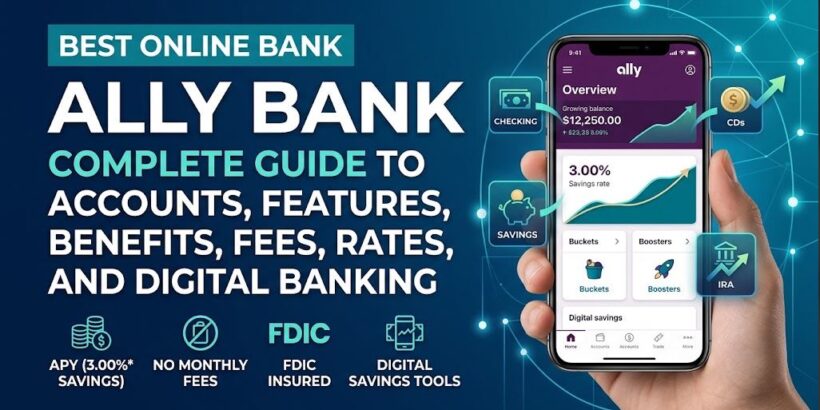
Best Online Bank: Ally Bank – Complete Guide to Accounts, Features, Benefits, Fees, Rates, and Digital Banking
Ally Bank has established itself as one of the best-known online banks in the United States, particularly for customers who want competitive deposit rates, low fees, convenient digital banking, and useful savings tools without relying on a traditional branch network. As an online-focused bank, Ally Bank is designed around the idea that customers should be able to manage their money from a computer or smartphone rather than visiting a physical branch.
For consumers comparing the best online banks, Ally Bank is especially interesting because it combines checking, savings, money market accounts, certificates of deposit, IRA deposit products, mobile banking, ATM access, and automated savings features in one digital banking platform. Ally Bank currently advertises no minimum opening deposit and no monthly maintenance fee on several of its major deposit products, while its savings products offer variable interest rates and its CDs provide fixed-rate options for customers willing to commit their money for a specific term. (Ally)
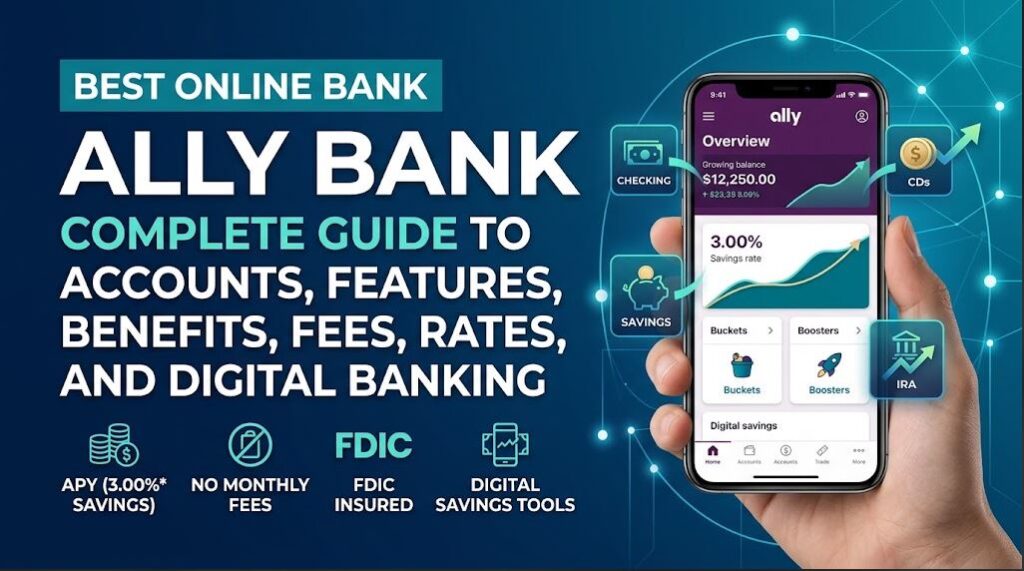
As of September 2026, Ally Bank lists a 3.00% APY on its Savings Account and Money Market Account, while its Spending Account lists a variable APY of 0.10% for balances below $15,000 and 0.25% for balances of at least $15,000. Its CD lineup includes multiple terms, including an 11-month No Penalty CD and traditional fixed-rate CDs. Rates can change, so consumers should always verify current rates directly with the bank before opening an account. (Ally)
Ally Bank is also an FDIC-member bank. Eligible deposits are insured up to the applicable legal limit, generally $250,000 per depositor, per qualifying ownership category. (Ally)
This makes Ally Bank a strong candidate for people who are comfortable with digital-only banking and want to focus on earning interest, avoiding unnecessary banking fees, and managing their finances through online and mobile tools.
What Is Ally Bank?
Ally Bank is a U.S. digital bank that provides personal banking products primarily through online and mobile channels. Unlike traditional banks that operate extensive branch networks, Ally Bank’s model is centered on digital access.
The bank is part of Ally Financial, a diversified financial services company. Ally Financial reported that it had approximately $200 billion in assets and 9.6 million customers as of June 30, 2026. The company operates Ally Bank alongside other financial services businesses, including auto finance and investment services. (MediaRoom)
The digital banking model allows Ally Bank to focus resources on online infrastructure, mobile applications, electronic transfers, customer support, automated savings tools, and competitive deposit products rather than maintaining a large network of traditional branches.
For customers, this can create several advantages.
There may be fewer traditional banking fees, digital account management can be available around the clock, and customers can generally move money, deposit checks, monitor balances, pay bills, and manage savings through the website or mobile app.
However, an online-only model also means that customers who strongly prefer face-to-face banking may find Ally less convenient than a traditional bank with nearby branches.
That trade-off is central to understanding whether Ally Bank is the best online bank for a particular customer.
Why Ally Bank Is Considered One of the Best Online Banks
The phrase “best online bank” can mean different things depending on what a customer values.
Someone looking for the highest possible savings rate may rank banks differently from someone who prioritizes ATM access. A customer who wants a large branch network may not consider an online-only bank suitable, while a customer who rarely visits branches may prefer an online bank precisely because of its digital-first structure.
Ally Bank has several characteristics that make it attractive to online banking customers.
These include competitive deposit rates, no minimum opening deposit on major products, no monthly maintenance fee on its Savings Account, savings organization tools, mobile check deposit, online transfers, bill pay, Zelle, ATM access, 24/7 support, and multiple CD choices. (Ally)
Another important factor is simplicity.
Ally’s banking platform brings multiple deposit products together under one online banking relationship. A customer can potentially use one bank for everyday spending, emergency savings, short-term savings goals, and longer-term CD deposits.
The bank’s Savings Account also includes tools called Savings Buckets and Boosters, which are designed to help customers organize money according to specific goals and automate parts of their savings strategy. (Ally)
For someone who wants a modern online banking experience without opening numerous accounts at different institutions, this integrated approach can be appealing.
Ally Bank Checking Account: Spending Account
Ally Bank calls its primary checking product the Spending Account.
The account is designed for everyday banking rather than long-term savings. Customers can use it for direct deposit, purchases, bill payments, transfers, debit-card transactions, and other ordinary financial activities.
Ally currently advertises no monthly maintenance fee and no minimum opening deposit for the Spending Account. The account also provides access to bill pay, Zelle, spending buckets, checks, and a debit card. (Ally)
One of the major benefits of an online checking account is convenience.
Instead of visiting a branch to check balances or move money between accounts, customers can use the Ally website or mobile application.
This can be especially useful for people who already conduct most of their financial activities digitally.
The Spending Account also provides access to Allpoint and MoneyPass ATMs in the United States without an Ally fee. Ally says it will reimburse up to $10 per statement cycle for fees charged by other ATMs nationwide. (Ally)
This is important because ATM access is one of the biggest concerns consumers sometimes have when considering online-only banks.
A customer does not necessarily need to find an Ally-branded ATM because Ally participates in larger ATM networks.
Ally Bank Savings Account
The Ally Bank Savings Account is one of the institution’s most prominent products.
It is designed for customers who want to earn interest while keeping their money relatively accessible.
As of September 2026, Ally lists a 3.00% APY for the Savings Account. The rate is variable, meaning the bank can change it after the account is opened. Ally also states that there is no minimum balance required to open the account or earn the advertised APY. (Ally)
The absence of a minimum balance is particularly useful for new savers.
A customer can start with a relatively small amount and gradually increase the balance without needing to maintain a large deposit.
The account also has no monthly maintenance fee according to Ally’s current product information. (Ally)
Interest is compounded daily.
Daily compounding can help savings grow more efficiently over time because interest earned can itself begin earning interest.
Of course, the actual amount earned depends on the account balance, APY, and how long the money remains deposited.
Ally Savings Buckets
One of Ally Bank’s more distinctive savings features is its Savings Buckets system.
Instead of opening separate savings accounts for every goal, customers can organize their money inside their Savings Account into different buckets.
For example, a customer could create buckets for:
- Emergency fund
- Vacation
- Home purchase
- Car expenses
- Education
- Annual insurance
- Holiday spending
- Medical expenses
- Technology purchases
- General savings
This approach can make financial planning easier because the customer can see how much money has been allocated toward each goal.
Suppose someone has $10,000 in a savings account.
Without organizational tools, the entire balance might simply appear as $10,000.
With savings buckets, the same balance could be mentally or digitally organized as $5,000 for emergencies, $2,000 for travel, $1,500 for a car, $1,000 for annual expenses, and $500 for another goal.
The total remains $10,000, but the purpose of the money becomes clearer.
That distinction can improve financial discipline.
Ally Savings Boosters
Ally also provides Savings Boosters designed to automate or accelerate saving.
According to Ally, its Savings Account includes several boosters, including recurring transfers and Surprise Savings. Surprise Savings analyzes a linked checking account to identify money that may be available to transfer into savings. (Ally)
Automated saving can be useful because many people struggle to save consistently when saving requires a manual decision every week or month.
A recurring transfer can make saving part of a routine.
For example, a customer could arrange for $100 to move into savings every payday.
Over one year, ignoring interest, that would result in:
$100 × 26 pay periods = $2,600
The amount could be higher if interest is earned.
The important principle is not the particular amount but the automation.
Saving becomes a process rather than an occasional decision.
Ally Money Market Account
Ally Bank also offers a Money Market Account.
This account is designed for people who want competitive interest while maintaining convenient access to their money.
As of September 2026, Ally lists a 3.00% APY on its Money Market Account. The rate is variable and may change after the account is opened. (Ally)
The Money Market Account provides a combination of savings and spending access.
Customers can access funds through checks and a debit card, while also earning interest on the account balance.
Ally states that customers can make unlimited ATM withdrawals at participating Allpoint and MoneyPass ATMs and receive up to $10 per statement-cycle reimbursement for fees charged by other ATMs nationwide. (Ally)
This can make the Money Market Account useful for customers who want their savings to remain relatively accessible.
For example, someone building an emergency fund may appreciate being able to earn interest while retaining access to funds through a debit card or checks.
Savings Account vs. Money Market Account
The difference between the two accounts is primarily about how the customer wants to access and organize their money.
The Savings Account is particularly focused on savings organization and tools such as buckets and boosters.
The Money Market Account combines interest earning with more direct access through checks and a debit card.
Both can be useful, but they serve somewhat different purposes.
A person building an emergency fund might prefer the Money Market Account if easy access is important.
Someone saving toward several specific goals may prefer the Savings Account because of its organizational features.
Both products currently have no minimum deposit requirement to open or earn the advertised APY. (Ally)
Ally Certificates of Deposit
Certificates of deposit, commonly called CDs, are another important part of Ally Bank’s product lineup.
A CD allows customers to deposit money for a predetermined period in exchange for a fixed interest rate.
Unlike a variable-rate savings account, a traditional CD’s APY is generally fixed during its term.
This can provide predictability.
If a customer deposits $10,000 into a fixed-rate CD, the customer generally knows the interest rate that will apply during the CD term.
The trade-off is liquidity.
Traditional CDs may charge an early withdrawal penalty if the customer removes funds before maturity.
Ally offers multiple CD structures designed for different financial needs.
These include High Yield CDs, No Penalty CDs, and Raise Your Rate CDs. (Ally)
Ally No Penalty CD
The No Penalty CD is designed for customers who want a CD structure but do not want to be locked into the same withdrawal restrictions as a traditional CD.
Ally currently lists an 11-month No Penalty CD with a 2.70% APY as of September 2, 2026.
The bank states that customers can withdraw all their money after the first six days following funding without an early withdrawal penalty, while keeping interest earned. (Ally)
This feature can be useful for money that is not needed immediately but may become necessary unexpectedly.
For example, someone might have $15,000 that they expect to leave untouched for several months but want available if an opportunity or emergency arises.
A No Penalty CD can potentially provide a compromise between liquidity and fixed-term savings.
Ally High Yield CDs
Ally’s High Yield CDs are traditional fixed-rate certificates of deposit.
As of September 2026, Ally lists several available terms, including 9-month, 18-month, and 5-year CDs, with current advertised rates around 2.70% for those listed products. (Ally)
The rate is fixed during the CD term, subject to the bank’s terms.
Early withdrawal penalties can apply.
That means customers should not place money into a traditional CD if they believe they may need the funds unexpectedly.
CDs are generally best suited for money with a defined time horizon.
For example, if someone knows they will not need $20,000 for two years, a fixed-rate CD could be considered as part of a savings strategy.
Ally Raise Your Rate CD
Ally also offers a Raise Your Rate CD.
This product is designed to provide some flexibility if interest rates rise during the CD term.
Ally currently advertises a 2-year Raise Your Rate CD and a 4-year option. The bank states that the customer can increase the rate once during the 2-year term or twice during the 4-year term if the applicable rate rises. (Ally)
This feature addresses a common concern with traditional CDs.
Imagine depositing money into a CD and then seeing market rates rise significantly afterward.
With a standard fixed-rate CD, the original rate generally remains in place.
A Raise Your Rate CD provides an opportunity to adjust the rate according to the product’s rules.
Ally CD Ladder Strategy
Another strategy worth considering is a CD ladder.
A CD ladder involves spreading money across CDs with different maturity dates.
For example, instead of putting $20,000 into one five-year CD, a customer could divide the money across multiple CDs with staggered maturities.
The purpose is to balance yield and liquidity.
As each CD matures, the customer can decide whether to reinvest it, use the money, or move it into another savings product.
Ally’s range of CD terms can make this type of strategy possible, although customers should compare current rates, penalties, and terms before making a decision.
Ally IRA Savings and IRA CDs
Ally also offers retirement-oriented deposit products.
Its banking platform lists IRA Savings and IRA High Yield CDs, including Traditional IRA and Roth IRA options depending on the product. Ally’s current product information also lists SEP IRA availability for certain CD products. (Ally)
An IRA can provide tax advantages that ordinary taxable savings accounts generally do not.
However, retirement accounts have specific tax rules and withdrawal restrictions.
Therefore, customers should evaluate IRA products based on their overall retirement strategy rather than simply selecting the account with the highest advertised APY.
An IRA CD can be useful for a conservative investor who wants a fixed-income deposit product inside a retirement account.
Ally Bank Fees
One of the strongest reasons consumers consider online banks is lower fees.
Ally Bank currently promotes several accounts with no monthly maintenance fee and no minimum opening deposit.
The bank’s current rate pages emphasize:
- No account minimums
- No monthly maintenance fees
- Competitive rates
(Ally)
However, customers should never assume that an account has absolutely no possible fees.
Banking products can have transaction-specific fees, third-party ATM fees, wire-related charges, or other costs depending on the service used and the applicable account agreement.
Customers should review Ally’s current fee disclosures before opening an account.
Ally Bank and ATM Access
ATM access is one of the biggest practical questions for online bank customers.
Ally does not operate a traditional nationwide branch network, so ATM availability matters.
The bank currently provides access to participating Allpoint and MoneyPass ATMs. Ally says customers can use those ATMs in the United States without an Ally fee, and it offers reimbursement of up to $10 per statement cycle for fees charged by other ATMs nationwide. (Ally)
For people who primarily use debit cards and electronic payments, this may provide sufficient access.
For customers who frequently need branch services or cash deposits, however, a traditional bank may be more suitable.
Ally Mobile Banking
Mobile banking is central to Ally’s overall customer experience.
The Ally mobile application allows customers to manage many common banking activities without visiting a physical location.
The bank lists mobile features including:
- Account transfers
- Mobile check deposits
- Bill Pay
- Zelle
- Savings Buckets
- Spending Buckets
- CD management
- ATM locator
- Ally Assist
- Biometric verification
(Ally)
This creates a banking environment in which most everyday tasks can be completed through a smartphone.
For digitally comfortable customers, that can be significantly more convenient than traditional branch banking.
Mobile Check Deposit
Although Ally is a digital bank, customers can deposit paper checks remotely.
Ally’s eCheck Deposit feature allows eligible customers to deposit checks using a smartphone by taking a photograph of the check. The feature is available for Spending, Savings, and Money Market Accounts, subject to applicable conditions. (Ally)
This is important because check deposits remain relevant for many customers.
Instead of finding a physical branch, the customer can use the mobile application.
Online Transfers
Ally supports online transfers between Ally accounts and external accounts.
The bank states that online transfers between accounts held with Ally or elsewhere are free. (Ally)
This makes Ally particularly suitable for customers who maintain multiple financial relationships.
For example, a customer could maintain a checking account at another bank and use Ally primarily as a high-yield savings institution.
Money can then be transferred electronically between the institutions.
This strategy can be useful when a customer wants to separate daily spending from savings.
Ally Bill Pay
Bill Pay is another feature available through Ally’s digital banking platform.
Customers can use online banking to manage recurring payments rather than sending checks or visiting individual company websites.
Digital bill payment can reduce administrative work and make it easier to track outgoing transactions.
For people who prefer centralized financial management, this is another advantage of online banking.
Ally and Zelle
Ally’s Spending Account supports Zelle.
Zelle can be useful for sending money to eligible people directly from a bank account.
This is particularly convenient for splitting bills, sending money to family members, or handling everyday person-to-person payments.
Customers should follow Zelle’s applicable rules and safety guidance because electronic transfers can be difficult to reverse when money is sent to the wrong person or in response to a scam.
Ally Customer Service
A common concern about online banking is whether customers can receive human support.
Ally emphasizes 24/7 customer service.
Its current Savings Account information says customers can contact the bank by phone, chat, or email at any time. (Ally)
The bank’s online banking page also says the service is available 24/7. (Ally)
This is important because an online bank’s customer service infrastructure effectively replaces many functions traditionally performed by branches.
For customers who prefer to solve problems by phone or online chat, 24/7 availability can be a major advantage.
Ally Bank Security
Security is an essential consideration when selecting an online bank.
Ally provides online and mobile banking security features, including biometric verification options and fraud protection features associated with its banking products. (Ally)
Customers should nevertheless follow basic digital-security practices.
These include using a strong and unique password, enabling available multi-factor authentication or biometric security, avoiding suspicious links, monitoring account alerts, and never sharing one-time verification codes.
Bank security is a shared responsibility between the financial institution and the customer.
Even a highly secure banking platform can be compromised if a customer voluntarily provides credentials to a scammer.
Is Ally Bank FDIC Insured?
Yes.
Ally Bank is a member of the Federal Deposit Insurance Corporation.
Eligible deposits are generally insured up to $250,000 per depositor for each qualifying account ownership category. (Ally)
FDIC insurance covers eligible deposit products such as checking, savings, money market accounts, and CDs.
This is one of the most important factors when evaluating an online bank.
Customers should understand that FDIC insurance protects eligible deposits within applicable limits; it is not the same thing as insurance against investment losses in securities.
The amount of FDIC coverage can also vary depending on ownership category.
Therefore, people with large deposits should understand the applicable FDIC rules before concentrating significant amounts of money at any one insured institution.
Who Should Consider Ally Bank?
Ally Bank may be particularly attractive to several types of customers.
The first group is people who primarily bank online.
If you rarely visit branches and are comfortable using mobile applications, online transfers, electronic payments, and remote check deposits, Ally’s digital model may suit you well.
The second group is people focused on savings.
Customers who want a competitive savings rate and useful savings-organization tools may find Ally attractive.
The third group is customers who dislike monthly banking fees.
Ally’s major deposit products emphasize no monthly maintenance fees and no minimum opening deposit requirements. (Ally)
The fourth group is people who want multiple deposit products under one digital banking relationship.
A customer can potentially use a Spending Account for everyday transactions, a Savings Account for goal-based saving, a Money Market Account for accessible savings, and CDs for money intended for defined periods.
Who May Not Benefit From Ally Bank?
Ally is not necessarily the perfect bank for everyone.
Customers who strongly prefer physical branches may be better served by a traditional bank.
People who regularly deposit large amounts of cash may also prefer an institution with convenient cash-deposit facilities.
Business banking customers should carefully examine whether Ally’s available products meet their business requirements rather than assuming that a personal online banking platform is sufficient.
People who need specialized branch services, safe-deposit boxes, extensive in-person financial services, or other physical-bank features should compare alternatives.
Ally Bank vs. Traditional Banks
Traditional banks and online banks operate under different business models.
A traditional bank may spend significant resources maintaining branches, branch employees, physical infrastructure, and local facilities.
An online bank can concentrate more heavily on digital infrastructure and electronic customer service.
This difference can affect pricing and product design.
Online banks often compete aggressively on savings rates and fees because they are targeting customers who value digital convenience.
Traditional banks may compete through physical accessibility, local relationships, business services, cash handling, and branch-based customer support.
Neither model is automatically superior.
The better choice depends on how a customer actually uses banking services.
Ally Bank vs. Credit Unions
Credit unions can also be strong alternatives to Ally.
Credit unions are member-owned financial institutions and sometimes offer competitive rates and lower fees.
However, membership eligibility varies, and branch or shared-branch access differs by institution.
Ally’s advantage is broad digital accessibility without requiring customers to belong to a specific local organization.
A customer comparing Ally with a credit union should evaluate savings rates, checking fees, ATM access, digital banking, customer service, insurance coverage, and any membership requirements.
Ally Bank vs. Other Online Banks
The online banking market is highly competitive.
Ally competes with institutions such as Capital One, Discover, Marcus, SoFi, American Express National Bank, Synchrony Bank, and numerous other online-focused financial institutions.
The best choice can change depending on current interest rates and product features.
For that reason, consumers should avoid selecting a bank solely because an article describes it as the “best.”
A better approach is to compare several factors.
These include:
- APY
- Monthly fees
- Minimum balance
- ATM access
- ATM reimbursements
- Mobile app quality
- Customer support
- Transfer availability
- Cash deposit options
- CD terms
- FDIC insurance
- Overdraft policies
- Account features
- Savings automation
- Financial goals
Ally’s strength is not necessarily that it wins every category.
Its strength is the combination of competitive deposit products and digital features.
Ally Bank for Emergency Funds
An emergency fund is one of the most appropriate uses for a high-yield savings account.
The purpose of an emergency fund is not maximum investment return.
The purpose is liquidity and financial security.
A person might keep three to six months of essential expenses in an accessible savings account.
For example, if essential monthly expenses are $3,000, a six-month emergency fund would be:
$3,000 × 6 = $18,000
Keeping that money in an interest-bearing savings account can allow it to earn interest while remaining relatively accessible.
Ally’s Savings and Money Market Accounts can both be considered for this type of goal, depending on how the customer wants to access the money.
Ally Bank for Short-Term Goals
Ally can also be useful for short-term financial goals.
Examples include:
- Vacation
- Wedding
- New vehicle
- Home renovation
- Education
- Insurance payments
- Holiday expenses
- Technology purchases
Savings Buckets can help organize these goals.
Instead of treating all savings as one balance, customers can mentally separate funds by purpose.
This can reduce the temptation to spend money intended for another objective.
Ally Bank for Long-Term Savings
Long-term savings require a different strategy.
If money will not be needed for years, a savings account may not always be the most appropriate financial vehicle.
Depending on the individual’s goals, risk tolerance, tax situation, and time horizon, long-term funds could potentially involve retirement accounts, diversified investments, bonds, CDs, or other assets.
Ally’s IRA deposit products can be part of a conservative retirement strategy.
However, customers should distinguish between banking products and investment products.
A deposit account generally provides different risk and return characteristics than stocks or mutual funds.
Understanding APY
When comparing online banks, customers should pay attention to APY rather than simply the nominal interest rate.
APY stands for Annual Percentage Yield.
It incorporates the effect of compounding and helps consumers compare deposit accounts.
Suppose one bank advertises a nominal interest rate while another advertises an APY.
The APY generally provides a more useful comparison for what a customer may earn over a year, assuming the rate remains unchanged and the stated conditions are met.
Ally’s current Savings Account APY is variable and therefore can change over time. (Ally)
This distinction is important.
A 3.00% APY today does not guarantee that the account will continue paying 3.00% indefinitely.
Example of Ally Savings Growth
Suppose a customer deposits $10,000 into an account earning a hypothetical 3.00% APY and the APY remains unchanged for one year.
Ignoring taxes and assuming the stated APY accurately reflects the compounding structure, the balance could grow to approximately:
$10,000 × 1.03 = $10,300
The approximate interest would therefore be $300.
If the customer added money throughout the year, the final balance would be higher.
This illustrates why regular contributions can be as important as the initial deposit.
The Power of Consistent Saving
Suppose a customer starts with $5,000 and adds $300 every month.
Over one year, the contributions alone would equal:
$300 × 12 = $3,600
Combined with the original $5,000, the customer would have contributed $8,600 before interest.
If the account earns interest, the actual balance could be higher.
This is why automated saving features can be valuable.
A high interest rate helps, but the habit of regularly contributing money can have an even greater effect on long-term savings.
Ally Bank and Overdraft Protection
Ally has historically emphasized consumer-friendly overdraft policies.
Ally Financial’s 2026 corporate materials state that Ally Bank was the first major U.S. bank to eliminate overdraft fees. (MediaRoom)
Customers should still understand the bank’s current overdraft and CoverDraft policies because account terms can change.
Avoiding overdraft fees is valuable because small recurring fees can significantly reduce the financial benefit of an otherwise attractive checking account.
For example, a $35 fee paid repeatedly can become hundreds of dollars over a year.
Ally Bank for Direct Deposit
Direct deposit can simplify banking.
Employees can have salary payments deposited directly into their bank account rather than receiving paper checks.
Ally supports direct deposit and provides online tools for setting it up. (Ally)
Direct deposit can also make automated savings easier.
A customer might direct income into a Spending Account and then automatically transfer a predetermined amount to Savings.
This creates a simple financial system:
Income → Spending → Automated Savings → Long-Term Goals
Such a structure can help customers save before spending the remainder of their income.
Ally Bank for Financial Organization
One of the strongest arguments for Ally is financial organization.
Modern banking is not simply about storing money.
It is also about understanding where money is going.
Tools such as Savings Buckets and Spending Buckets can make financial categories more visible.
For example, instead of seeing one checking balance of $4,000, a customer might mentally allocate:
$2,000 for regular expenses
$800 for upcoming bills
$500 for discretionary spending
$400 for travel
$300 as a buffer
The exact numbers are not important.
The concept is.
Money becomes assigned a purpose.
Ally Bank Digital Banking Experience
The digital-first design of Ally means the customer relationship is largely based on the website and mobile app.
The bank’s online banking platform provides access to account information, transfers, deposits, savings tools, bill payments, ATM information, and CD management. (Ally)
This approach is increasingly common in U.S. banking.
Consumers expect to be able to perform most routine banking tasks from a smartphone.
For younger customers and digitally experienced users, this can feel natural.
For customers who are less comfortable with technology, the experience may require a learning curve.
Ally Bank Accessibility
Another advantage of online banking is that the customer is not restricted by branch hours.
Ally advertises 24/7 availability for its online banking and customer support. (Ally)
This can be valuable for people who work unusual schedules.
Someone working overnight does not have to wait until the next business day to check account information or contact support.
Digital banking effectively makes the account available around the clock.
Ally Bank for Young Adults
Young adults beginning their financial lives may find an online bank attractive because they often already rely heavily on smartphones.
A young adult could use Ally for:
- Direct deposit
- Everyday spending
- Emergency savings
- Vacation savings
- Automated transfers
- CDs
- Financial organization
The lack of a minimum opening deposit on major accounts can also reduce the barrier to getting started. (Ally)
However, young customers should also learn basic financial principles such as budgeting, credit management, debt control, emergency savings, and retirement planning.
The bank is a tool.
Financial success depends on how the tool is used.
Ally Bank for Families
Families can also use online banking to organize multiple financial goals.
For example, parents might create separate savings goals for:
- School expenses
- Family vacation
- Emergency reserves
- Home repairs
- Children’s activities
- Annual insurance
Savings Buckets can provide a visual structure for these objectives.
Joint account arrangements may also be available depending on the product.
Customers should review the current account-opening requirements and ownership rules before opening joint accounts.
Ally Bank for Retirement Savers
Retirement planning often involves multiple account types.
Ally offers IRA deposit products, including IRA Savings and IRA CDs. (Ally)
These products may appeal to conservative savers who want deposit-based retirement assets.
However, retirement planning should consider inflation.
If the long-term return on savings is below inflation for extended periods, purchasing power may decline.
Therefore, a retirement strategy should be based on the customer’s age, time horizon, income needs, risk tolerance, and overall portfolio rather than simply selecting a high-yield deposit account.
Ally Bank and Inflation
Inflation is an important consideration when evaluating savings accounts.
Suppose an account earns 3% but inflation is also 3%.
The nominal balance increases, but purchasing power may not increase substantially after considering inflation and taxes.
This does not make savings accounts useless.
Emergency funds and short-term savings still need stability and liquidity.
But it highlights why different types of money should have different purposes.
Cash is generally appropriate for liquidity.
Long-term investments may be needed for long-term growth.
Advantages of Ally Bank
There are many reasons Ally Bank can be attractive.
No monthly maintenance fees on key deposit products: This can reduce routine banking costs. (Ally)
No minimum opening deposit: Customers can begin saving without a large initial balance. (Ally)
Competitive savings APY: Ally currently advertises a 3.00% APY on its Savings Account as of early September 2026. (Ally)
Savings organization tools: Buckets and Boosters can make goal-based saving easier. (Ally)
Multiple CD options: Customers can choose from several CD structures. (Ally)
ATM access: Allpoint and MoneyPass networks provide broad ATM access. (Ally)
ATM fee reimbursement: Ally offers up to $10 per statement cycle for fees charged by other ATMs nationwide, according to its current product information. (Ally)
24/7 customer support: This is valuable for customers who do not want to wait for branch hours. (Ally)
FDIC insurance: Eligible deposits receive federal deposit insurance within applicable limits. (Ally)
Potential Disadvantages of Ally Bank
No financial institution is perfect.
Ally’s biggest limitation is its online-only structure.
Customers who need branches may find it inconvenient.
Cash deposits can also be more complicated than at traditional banks.
Another consideration is that savings rates are variable.
Even if Ally offers an attractive APY today, the rate may decline in the future.
Similarly, competitors may offer higher rates at different times.
ATM access is broad but not identical to having a branch network.
Finally, consumers who want a single institution for every possible financial product should compare Ally with full-service banks offering extensive branch and wealth-management services.
Is Ally Bank Safe?
For eligible deposits, Ally Bank provides FDIC insurance up to applicable limits.
This is an important safety feature.
The FDIC states that insured deposits are protected up to the statutory limit, and Ally confirms that it is an FDIC member. (Ally)
However, consumers should understand the distinction between bank deposits and investments.
FDIC insurance does not mean every financial product associated with a financial-services company is insured.
Customers should verify the specific product before assuming it receives FDIC coverage.
How to Open an Ally Bank Account
Opening an Ally account is designed to be completed online.
Ally’s current account-opening process requires personal information and allows customers to select the desired deposit product.
The bank explains that customers can provide information, choose applicable joint owners, submit the application, and fund the account. (Ally)
A typical process looks like this:
Step 1: Visit Ally’s official website.
Go to Ally Bank’s official website.
Step 2: Choose the account.
Select Spending, Savings, Money Market, CD, or another applicable deposit product.
Step 3: Provide required information.
Applicants generally need personal identifying information.
Step 4: Verify identity.
The bank may require information to confirm identity and comply with legal requirements.
Step 5: Fund the account.
Depending on the product, customers can fund accounts through available electronic deposit methods.
Step 6: Set up digital banking.
Once the account is established, customers can use online or mobile banking.
How to Choose the Right Ally Account
Choosing the correct Ally account depends on the purpose of the money.
For everyday spending, the Spending Account is generally the logical choice.
For goal-based savings, the Savings Account may be more appropriate.
For accessible savings with checks and a debit card, the Money Market Account may be attractive.
For money that can remain untouched for a specific period, a CD may make sense.
For retirement-oriented deposits, an IRA product may be appropriate.
The key question should always be:
What job does this money need to perform?
Once that question is answered, choosing an account becomes easier.
Ally Bank for Emergency Savings
If your goal is an emergency fund, liquidity should usually be more important than maximizing yield by locking funds away.
An emergency fund should be accessible when something unexpected happens.
Potential emergencies include:
- Job loss
- Major car repair
- Home repair
- Medical expenses
- Family emergencies
- Unexpected travel
- Large insurance deductibles
A savings or money market account can provide a useful combination of accessibility and interest earning.
Ally Bank for CDs
If you have money that you know you will not need for a specific period, a CD may be worth considering.
However, before opening a CD, ask:
- When will I need this money?
- Could I need it earlier?
- What is the early withdrawal penalty?
- Is the rate fixed?
- What happens at maturity?
- Will the CD automatically renew?
- What rate will apply at renewal?
Ally’s CD products include automatic renewal features according to its current product information. (Ally)
Automatic renewal can be convenient but should not be ignored.
Customers should review the maturity date and renewal terms so that money does not automatically roll into an unwanted term.
Ally Bank and Compound Interest
Compound interest is one of the fundamental concepts behind savings.
If you deposit $10,000 and earn interest, the interest can become part of the balance.
Future interest can then be calculated based on the increased balance.
The longer the money remains invested or deposited, the more significant compounding can become.
Ally states that interest on its Savings Account and several other deposit products is compounded daily. (Ally)
However, customers should remember that the APY is the more useful figure for comparing annual deposit earnings because it accounts for compounding.
A Practical Ally Bank Strategy
A customer could potentially organize banking like this:
Spending Account: salary deposits and daily expenses.
Savings Account: emergency fund and short-term goals.
Money Market Account: accessible savings that may need checks or debit-card access.
CDs: money with defined time horizons.
IRA: qualifying retirement savings.
This approach creates a simple hierarchy.
Money needed today stays liquid.
Money needed soon remains in savings.
Money that can remain untouched can potentially move into CDs.
Retirement money can be separated into appropriate retirement accounts.
The exact structure depends on the individual’s financial situation.
Is Ally Bank the Best Online Bank?
There is no universal answer.
However, Ally Bank has a strong claim to being one of the best online banks because of its combination of competitive deposit products, low-fee structure, digital tools, ATM access, 24/7 support, and FDIC insurance.
The bank is especially compelling for customers who prioritize online convenience and savings.
Its current Savings Account offers a 3.00% APY as of September 2026, while its Money Market Account also lists 3.00% APY. The bank also provides multiple CD options and a Spending Account for everyday banking. (Ally)
But the word “best” should always be interpreted in relation to the customer’s needs.
Someone who requires branches might choose a different bank.
Someone who wants the absolute highest savings rate available at a particular moment should compare current rates.
Someone who wants sophisticated wealth management may prefer a full-service financial institution.
Someone who values savings automation and digital simplicity may find Ally particularly attractive.
Final Verdict on Ally Bank
Ally Bank is one of the strongest options for consumers searching for a modern online bank in the United States.
Its biggest strengths are its digital-first experience, competitive deposit products, no monthly maintenance fees on key accounts, no minimum opening deposits on major products, savings organization tools, ATM access, mobile check deposit, 24/7 support, and FDIC insurance. (Ally)
The bank’s Savings Account is particularly noteworthy for customers who want to combine competitive interest with automated savings tools. Its Money Market Account provides another option for people who want interest combined with convenient access. CDs give customers opportunities to lock in fixed rates for defined periods, while the Spending Account provides everyday banking functionality.
Ally’s digital-only structure is both its greatest strength and its most important limitation.
Customers who are comfortable managing money through a smartphone or computer may appreciate the convenience.
Customers who depend on physical branches may prefer a traditional bank.
Ultimately, the best online bank is not necessarily the bank with the highest advertised rate on a particular day. It is the bank whose combination of rates, fees, features, security, accessibility, and customer service fits the way you actually manage your money.
For consumers seeking a straightforward digital banking relationship with competitive savings options and useful financial organization tools, Ally Bank deserves serious consideration as one of the best online banks.
Important: Interest rates, APYs, fees, product availability, transaction limits, and account terms can change. The rates mentioned in this article reflect Ally Bank information available in early September 2026 and should be verified directly with the bank before making a financial decision. This article is for educational and informational purposes and is not personalized financial advice. (Ally)