
MULTILATERAL INVESTMENT GUARANTEE AGENCY (MIGA)
The Complete Guide to Political Risk Insurance, Foreign Investment Protection, and Global Development
| Parts 1-9 History • Governance • Guarantees • Global Operations • Climate Finance • Future Strategy • FAQs • References • SEO Resources |
Document Information
| Element | Details |
| Primary topic | Multilateral Investment Guarantee Agency (MIGA) |
| Document type | Comprehensive SEO-friendly reference article |
| Coverage | Institutional history, political risk insurance, governance, projects, sustainability, comparisons, future outlook, FAQs, references, and structured data |
| Recommended audience | Investors, bankers, researchers, students, development professionals, policymakers, and general readers |
| Suggested slug | multilateral-investment-guarantee-agency-miga-complete-guide |
| Primary keyword | Multilateral Investment Guarantee Agency (MIGA) |
Part 1: Introduction, Definition, History, and Overview
The Multilateral Investment Guarantee Agency, commonly known as MIGA, is an international financial institution within the World Bank Group. Its principal purpose is to encourage foreign direct investment into developing member countries by providing guarantees against specified political and non-commercial risks. Instead of financing most projects directly, MIGA helps investors and lenders manage risks that arise from government actions, political instability, restrictions on currency transfers, conflict, or the non-honoring of certain financial obligations.
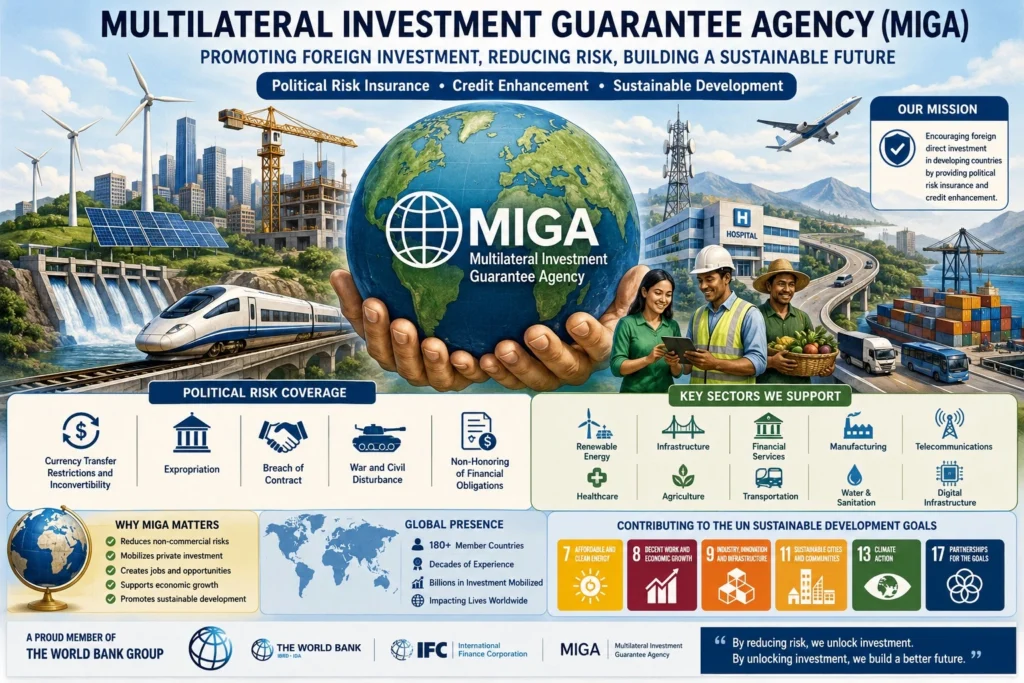
MIGA occupies a distinctive position in international development finance. It connects investors seeking commercially viable opportunities with countries that need private capital for infrastructure, energy, manufacturing, finance, healthcare, telecommunications, agriculture, and other productive sectors. Its guarantees can make projects more bankable, support longer financing tenors, and provide investors with greater confidence in unfamiliar or higher-risk markets.
Why MIGA Matters
Developing economies often possess strong growth potential but face barriers that discourage cross-border investment. Political uncertainty, weak institutions, contract enforcement concerns, foreign-exchange restrictions, and civil disturbance can raise the perceived risk of otherwise viable projects. MIGA helps reduce these barriers by transferring eligible political risks from investors and lenders to a multilateral institution backed by its member countries.
- Encourages foreign direct investment in developing economies.
- Protects eligible investors and lenders against defined political risks.
- Supports infrastructure, private-sector growth, and essential services.
- Helps mobilize private capital beyond the capacity of public budgets.
- Promotes environmental, social, and development standards.
- Uses dispute prevention and mediation to help preserve investments.
Quick Facts
| Category | Key information |
| Full name | Multilateral Investment Guarantee Agency |
| Abbreviation | MIGA |
| Established | 1988 |
| Headquarters | Washington, D.C., United States |
| Institutional family | World Bank Group |
| Core product | Political risk insurance and credit enhancement guarantees |
| Primary beneficiaries | Eligible investors and lenders undertaking projects in developing member countries |
| Development focus | Foreign investment, infrastructure, employment, sustainability, climate action, and private-sector development |
Historical Background
The creation of MIGA reflected a long-standing challenge in development finance: many countries needed foreign capital, but investors feared political risks that commercial insurance markets could not always cover at sufficient scale or duration. In the 1970s and early 1980s, debt crises, nationalizations, exchange controls, and political instability highlighted the need for a multilateral mechanism that could facilitate investment while encouraging constructive relationships between investors and host governments.
The Convention Establishing the Multilateral Investment Guarantee Agency was opened for signature in 1985. After sufficient ratifications and subscriptions, MIGA began operations on April 12, 1988. Its establishment completed the World Bank Group’s institutional framework by adding a specialized guarantee agency focused on investment protection and private capital mobilization.
Why MIGA Was Created
- To reduce investor concerns about expropriation and discriminatory government action.
- To address currency inconvertibility and restrictions on transferring funds.
- To protect against war, terrorism, civil disturbance, and politically motivated damage.
- To support contract stability in markets where legal enforcement may be uncertain.
- To complement official development assistance with private investment.
- To promote productive, responsible, and development-oriented cross-border projects.
MIGA and the World Bank Group
| Institution | Primary role |
| IBRD | Provides loans, guarantees, risk-management products, and advisory services mainly to middle-income and creditworthy countries. |
| IDA | Provides concessional financing and grants to the world’s poorest countries. |
| IFC | Invests in private-sector projects through loans, equity, mobilization, and advisory services. |
| MIGA | Provides political risk insurance and credit enhancement guarantees for eligible investments. |
| ICSID | Provides facilities for conciliation and arbitration of international investment disputes. |
Core Purpose
MIGA’s core purpose is not merely to insure investors. Its broader development mandate is to encourage investment that is economically sound, environmentally and socially responsible, and beneficial to host countries. The agency evaluates project eligibility, commercial viability, political risk, environmental and social impacts, integrity considerations, and expected development results before issuing a guarantee.
Early-to-Modern Timeline
| Period | Milestone |
| 1985 | The MIGA Convention is adopted and opened for signature. |
| 1988 | MIGA begins operations on April 12. |
| 1990s | Guarantee operations expand across infrastructure, finance, manufacturing, and privatization. |
| 2000s | Environmental and social safeguards, conflict-affected markets, and development impact receive greater emphasis. |
| 2008-2010 | Guarantees help sustain investment during and after the global financial crisis. |
| 2010s | Climate finance, renewable energy, and private capital mobilization become increasingly important. |
| 2020s | MIGA supports pandemic recovery, resilient infrastructure, digital connectivity, climate action, and projects in fragile situations. |
Part 2: Mission, Functions, Political Risk Insurance, and How MIGA Works
Mission and Vision
MIGA’s mission is to promote foreign direct investment into developing countries to support economic growth, reduce poverty, and improve people’s lives. Its vision is a world in which responsible private investment contributes to sustainable, inclusive, and resilient development, including in markets that investors might otherwise avoid because of political uncertainty.
Core Values
- Integrity and accountability in underwriting and institutional decisions.
- Sustainable development and measurable impact.
- Partnership with governments, investors, lenders, communities, and development institutions.
- Environmental and social responsibility.
- Innovation in guarantee products and risk-sharing structures.
- Special attention to low-income, fragile, and conflict-affected markets.
Main Objectives
- Promote productive foreign direct investment.
- Reduce political and non-commercial risk.
- Mobilize private capital for development.
- Support infrastructure and essential services.
- Strengthen private-sector activity and job creation.
- Facilitate climate finance and resilient investment.
- Encourage responsible business practices and stakeholder engagement.
Main Functions of MIGA
Political Risk Insurance
MIGA’s best-known function is political risk insurance. A guarantee contract identifies the eligible investment, covered risks, coverage amount, duration, premium, exclusions, investor obligations, and claims procedures. Coverage is tailored to the transaction and may protect equity investors, shareholder loans, commercial lenders, or other eligible forms of investment.
Credit Enhancement
Credit enhancement products can protect lenders against the failure of a sovereign, sub-sovereign, or state-owned entity to honor certain unconditional financial obligations. This can improve the credit profile of a transaction, expand the lender base, reduce financing costs, or extend maturities.
Dispute Prevention and Resolution
MIGA’s multilateral status and relationships with member governments may help prevent disputes from escalating. When problems arise, the agency can support dialogue among investors, lenders, and public authorities. This preventive role is valuable because preserving a viable project is often preferable to paying a claim after an investment has failed.
Knowledge, Technical Support, and Capacity Building
Through the World Bank Group and its own transaction experience, MIGA contributes knowledge on investment climates, political risk, environmental and social management, project preparation, and private capital mobilization. It may also work with host governments to clarify policy issues that affect investment.
How MIGA Works: Step by Step
- An investor or lender identifies an eligible cross-border project in a developing member country.
- The applicant submits a preliminary inquiry or formal guarantee application.
- MIGA screens the investor, host country, investment structure, sector, and proposed coverage.
- The agency performs financial, legal, integrity, political-risk, environmental, social, and development-impact due diligence.
- MIGA and the applicant negotiate the guarantee structure, amount, duration, premium, exclusions, and obligations.
- The project is submitted for the required internal and institutional approvals.
- Following approval and documentation, MIGA issues the guarantee contract.
- The project is monitored for compliance and development results.
- If a covered event occurs, MIGA may support dispute resolution and evaluate any claim according to the contract.
Eligible Investors and Investments
Eligibility depends on MIGA’s Convention, operational policies, and transaction-specific requirements. In general, an investor must be a national of a MIGA member country other than the host country, although eligible locally incorporated companies may sometimes qualify when foreign-owned or when the investment is transferred abroad. The investment must typically be new, expansion-related, modernization-oriented, or otherwise developmentally additional.
- Equity and quasi-equity investments.
- Shareholder loans and loan guarantees.
- Commercial bank lending for eligible projects.
- Certain capital-market and structured-finance transactions.
- Management contracts, leases, franchising, and other forms when they involve a meaningful investment commitment.
- Projects in infrastructure, energy, manufacturing, finance, telecommunications, healthcare, agriculture, water, and related sectors.
How MIGA Encourages FDI
A MIGA guarantee can alter the risk-return calculation of an investment. It may enable lenders to approve financing that would otherwise exceed country-risk limits, allow investors to commit capital for longer periods, and reassure project sponsors that defined political events will not leave them entirely unprotected. The presence of MIGA may also signal that a project has undergone rigorous due diligence and must comply with applicable environmental and social requirements.
Part 3: Covered Risks, Environmental and Social Standards, Due Diligence, Applications, and Claims
Understanding Political Risk
Political risk refers to the possibility that government action, political instability, conflict, or restrictions imposed by public authorities will negatively affect an investment. It differs from ordinary commercial risk, such as lower demand, poor management, cost overruns, technical failure, or competition. MIGA covers only risks expressly included in the guarantee contract.
Major Risks Covered by MIGA
Currency Inconvertibility and Transfer Restriction
This coverage can protect against losses arising when an investor cannot legally convert local currency into a freely usable currency or transfer funds outside the host country because of government-imposed restrictions. It generally does not protect against currency depreciation or normal market fluctuations.
Expropriation
Expropriation coverage addresses certain government actions that deprive an investor of ownership, control, or substantial benefits of an investment. Direct expropriation may involve formal nationalization or seizure. Indirect expropriation may involve a series of measures that effectively eliminate the investment’s value or the investor’s control, subject to contractual definitions and exclusions for legitimate, non-discriminatory regulation.
Breach of Contract
Breach-of-contract coverage may apply when a government or public entity violates a contractual obligation and the investor cannot obtain or enforce a favorable arbitral or judicial decision within the conditions stated in the guarantee. The precise requirements are transaction-specific.
War and Civil Disturbance
This coverage can protect against physical damage, destruction, disappearance of assets, or business interruption caused by politically motivated war, revolution, insurrection, coup, sabotage, terrorism, or civil disturbance, depending on the contract.
Non-Honoring of Financial Obligations
For eligible transactions, MIGA may cover the failure of a sovereign, sub-sovereign, or state-owned enterprise to make an unconditional payment when due. Coverage may not require the investor to obtain an arbitral award before filing a claim, depending on the product and contract.
Risks Generally Not Covered
- Ordinary commercial failure or weak demand.
- Poor management, fraud, or operational negligence by the investor.
- Normal exchange-rate depreciation.
- Contractual disputes that do not satisfy coverage requirements.
- Events known before the guarantee became effective.
- Sanctions, prohibited activities, or losses resulting from non-compliance by the guarantee holder.
Environmental and Social Sustainability
MIGA-supported projects are subject to environmental and social review. The intensity of review depends on the project’s potential impacts. Projects may be required to conduct assessments, consult affected communities, prepare management plans, monitor performance, disclose information, and remedy adverse impacts.
- Environmental protection, pollution prevention, and efficient resource use.
- Labor rights, occupational health, and worker safety.
- Community health, safety, and security.
- Land acquisition, resettlement, and livelihood restoration.
- Biodiversity conservation and sustainable management of natural resources.
- Protection of Indigenous Peoples and cultural heritage.
- Climate risk, greenhouse-gas emissions, and resilience where relevant.
Due Diligence Process
- Preliminary eligibility and reputational screening.
- Review of the investor, ownership, integrity, and financing structure.
- Commercial and financial viability analysis.
- Political-risk and country-context assessment.
- Legal review of contracts, permits, concessions, and dispute mechanisms.
- Environmental and social categorization and assessment.
- Evaluation of development impact and additionality.
- Negotiation of covenants, monitoring requirements, and corrective action plans.
Application and Approval Process
| Stage | Typical activities |
| Initial inquiry | Applicant provides basic information on the investor, host country, project, investment amount, and desired coverage. |
| Formal application | Detailed financial, legal, technical, environmental, social, and ownership information is submitted. |
| Due diligence | MIGA evaluates eligibility, risks, development impact, integrity, and compliance. |
| Structuring | Coverage, tenor, premium, deductibles, exclusions, and obligations are negotiated. |
| Approval | The transaction receives the required institutional approvals. |
| Contracting | Guarantee documents are executed and coverage becomes effective under agreed conditions. |
| Monitoring | The project provides reports and remains subject to contractual and sustainability obligations. |
Premiums, Fees, and Duration
Pricing is determined case by case. Premiums reflect the country, covered risks, sector, project structure, tenor, claims exposure, and other factors. Application, processing, or commitment fees may apply. Guarantees can be long-term, which is particularly important for infrastructure and project-finance transactions whose economic lives extend well beyond the coverage typically available in short-term commercial markets.
Claims and Recovery
When a covered event occurs, the guarantee holder must follow the notification, loss-mitigation, evidence, waiting-period, and claims procedures in the contract. MIGA investigates whether the event is covered and whether contractual obligations were satisfied. After paying a valid claim, MIGA may acquire rights to pursue recovery from the responsible party through subrogation. Its multilateral relationships can support negotiated solutions before or after payment.
Part 4: Organizational Structure, Governance, Membership, Capital, and Financial Management
Governance Framework
MIGA is governed by the Convention Establishing the Multilateral Investment Guarantee Agency. Its governance structure reflects its status as a member-owned international organization. Member countries exercise authority through the Council of Governors and the Board of Directors, while management oversees day-to-day operations.
Council of Governors
Each member country appoints a governor and an alternate, typically senior officials such as finance ministers, central bank governors, or development ministers. The Council of Governors holds ultimate authority over major institutional matters, including membership, capital, amendments, and other powers reserved under the Convention.
Board of Directors
The Board of Directors represents member countries and oversees policies, strategies, budgets, and guarantee operations that require Board consideration. MIGA’s directors are associated with the World Bank Group governance system, enabling coordination across institutions.
Voting System
Voting power reflects a combination of membership votes and capital subscriptions. This gives all members a voice while recognizing their financial contributions. Institutional decisions follow the rules established by the Convention and applicable governance procedures.
Executive Leadership and Departments
- Executive Vice President and senior management.
- Guarantee operations and business origination.
- Underwriting and portfolio management.
- Legal affairs and claims.
- Economics, development impact, and strategy.
- Environmental and social sustainability.
- Risk, finance, treasury, accounting, and internal controls.
- Communications, partnerships, human resources, and administrative functions.
Membership
MIGA’s membership includes developed and developing countries. Membership allows countries to participate in governance, support eligible outward investment by their nationals, and host MIGA-supported projects when they meet applicable requirements. A broad membership base strengthens the agency’s legitimacy, diversification, and capacity to mediate across borders.
Benefits of Membership
- Greater access to political risk insurance for eligible cross-border investors.
- Potential to attract private investment into the member country.
- Participation in institutional governance and strategic direction.
- Access to World Bank Group knowledge and collaboration.
- Improved investor confidence and support for project bankability.
Capital Structure and Financial Resources
MIGA’s financial strength is supported by subscribed capital, retained earnings, premium income, investment income, reserves, and prudent risk management. Like an insurer, it must maintain sufficient capacity to meet potential claims while preserving the ability to issue new guarantees. Its portfolio is diversified by country, region, sector, investor, risk type, and transaction structure.
Revenue Model
- Guarantee premiums paid by investors and lenders.
- Fees associated with applications, processing, commitment, or amendments.
- Investment income earned on liquid financial assets.
- Recoveries associated with claims and subrogation when applicable.
Accountability, Transparency, and Reporting
MIGA publishes annual reports, project summaries, financial statements, and institutional information. It operates within World Bank Group systems for integrity, audit, evaluation, accountability, and access to information. Project disclosure and stakeholder engagement requirements depend on the environmental and social characteristics of the operation.
Performance Indicators
- Guarantee volume and outstanding exposure.
- Private capital mobilized or facilitated.
- Projects in low-income and fragile situations.
- Climate-finance commitments.
- Jobs supported and services delivered.
- Energy generated, people connected, patients served, or loans extended.
- Environmental and social performance.
- Portfolio quality, claims, recoveries, and financial sustainability.
Collaboration Across the World Bank Group
MIGA often collaborates with IBRD, IDA, IFC, and other partners. A public-sector reform or infrastructure program may involve World Bank financing, an IFC investment, and a MIGA guarantee for commercial lenders or sponsors. This coordinated approach can address policy, financing, risk, and implementation constraints in a single development program.
Part 5: Regional Operations, Infrastructure, Sectoral Investments, and Illustrative Projects
Global Operational Reach
MIGA supports eligible projects across developing member countries. Its regional portfolio changes over time in response to investment demand, strategic priorities, market conditions, and project readiness. The agency places particular emphasis on countries and sectors where its guarantee creates additionality by enabling investment that would otherwise be delayed, scaled back, or abandoned.
Africa
Africa is a priority region because of its large infrastructure gap, rapidly growing population, urbanization, and need for electricity, transport, digital connectivity, finance, healthcare, and agricultural value chains. Political risk insurance is especially relevant in fragile markets and projects requiring long-term foreign-currency financing.
Asia and the Pacific
Asia and the Pacific contain both fast-growing emerging markets and small, climate-vulnerable economies. MIGA’s potential areas of support include renewable energy, power transmission, transport, digital infrastructure, manufacturing, financial services, healthcare, and climate-resilient urban development.
Europe and Central Asia
Operations in Europe and Central Asia may support banking, manufacturing, energy diversification, renewables, logistics, municipal services, and infrastructure modernization. Political and geopolitical uncertainty can heighten the value of multilateral risk mitigation.
Latin America and the Caribbean
The region offers investment opportunities in clean energy, transport, water, telecommunications, finance, agribusiness, and sustainable cities. MIGA guarantees can support public-private partnerships and projects exposed to regulatory, contractual, or currency-transfer concerns.
Middle East and North Africa
MIGA can support energy transition, solar and wind power, water desalination, transport, healthcare, finance, and reconstruction. In conflict-affected markets, carefully structured guarantees may help preserve private-sector activity and essential services.
Support for Fragile and Conflict-Affected Situations
Fragile and conflict-affected situations face the greatest investment needs and the least risk appetite. MIGA can help investors manage risks related to conflict, government instability, and contract uncertainty. Projects must still be commercially viable and meet integrity, environmental, social, and development requirements.
Major Sectors
| Sector | Typical development contribution |
| Energy | Reliable electricity, renewable generation, transmission, storage, and energy security. |
| Transport | Roads, ports, airports, rail, logistics, and regional connectivity. |
| Telecommunications | Mobile networks, fiber, broadband, towers, and data infrastructure. |
| Manufacturing | Jobs, exports, technology transfer, local supply chains, and diversification. |
| Financial services | Bank capital, trade finance, SME lending, housing finance, and financial inclusion. |
| Healthcare | Hospitals, diagnostics, pharmaceutical production, and medical supply chains. |
| Agriculture | Food processing, storage, logistics, irrigation, and rural livelihoods. |
| Water and sanitation | Treatment plants, distribution systems, wastewater management, and public health. |
Public-Private Partnerships
Public-private partnerships combine public objectives with private capital and expertise. Because PPPs often rely on long-term contracts, tariffs, availability payments, concessions, or government undertakings, political risk can be a decisive financing concern. MIGA guarantees can help protect investors and lenders against eligible contract, transfer, expropriation, and non-honoring risks.
Illustrative Project: Solar Energy
A private consortium develops a utility-scale solar project in a country with growing electricity demand. International lenders are concerned about the state utility’s payment obligations, currency transfer restrictions, and potential political instability. A MIGA guarantee helps secure long-term financing. The project adds clean generation capacity, supports construction and operational jobs, and reduces dependence on imported fuel.
Illustrative Project: Regional Hospital
An international healthcare operator invests in a hospital under a long-term public-private partnership. Political risk coverage supports financing and protects against defined government-related risks. The hospital expands access to diagnostics, surgery, maternal care, and specialist treatment while training local medical staff.
Illustrative Project: Broadband Expansion
A telecommunications company extends fiber and mobile infrastructure to underserved communities. MIGA coverage addresses eligible expropriation, transfer, and political-violence risks. Better connectivity enables online education, e-commerce, digital payments, remote work, and public-service delivery.
Part 6: South Asia, Bangladesh, Climate Finance, SDGs, and Private Capital Mobilization
MIGA’s Role in Sustainable Development
MIGA advances sustainable development by mobilizing private investment into sectors that improve economic opportunity and quality of life. Public budgets and development-bank resources alone cannot close the global infrastructure and financing gap. By reducing political risk, MIGA helps attract capital into projects that might otherwise be considered too uncertain.
- Economic growth and employment.
- Poverty reduction and financial inclusion.
- Climate mitigation and resilience.
- Infrastructure modernization.
- Energy access and digital transformation.
- Healthcare, water, sanitation, and sustainable urban development.
MIGA in Bangladesh
Bangladesh has experienced significant economic transformation through manufacturing, exports, infrastructure, and digital services. As a MIGA member country, it can host eligible projects supported by political risk guarantees. MIGA’s potential role is to encourage responsible foreign investment in areas where long-term capital, technology, and operational expertise can contribute to national development.
Investment Opportunities in Bangladesh
- Power generation, renewable energy, transmission, and energy efficiency.
- Ports, logistics, highways, bridges, industrial zones, and urban transport.
- Garments, pharmaceuticals, electronics, consumer products, and agro-processing.
- Commercial banking, housing finance, SME lending, green finance, and digital payments.
- Mobile infrastructure, fiber networks, broadband, data centers, and cloud services.
- Climate resilience, water management, and sustainable urban services.
Why Bangladesh Is Important to Investors
Bangladesh offers a large consumer market, strategic location in South Asia, a strong export manufacturing base, rising digital adoption, and long-term infrastructure needs. At the same time, investors may assess regulatory change, contract implementation, foreign-exchange availability, land, infrastructure constraints, and climate exposure. MIGA can mitigate certain non-commercial risks but does not replace sound project preparation or commercial due diligence.
MIGA in India and Pakistan
India attracts investment across renewable energy, manufacturing, transport, finance, digital infrastructure, and urban development. MIGA support can complement large-scale financing when political risk or credit enhancement is needed. Pakistan presents opportunities in hydropower, solar and wind energy, transport, manufacturing, telecommunications, and financial services, where risk mitigation can support long-term capital formation.
MIGA Across Africa
Africa remains a high-priority region because of its infrastructure needs and growth potential. Projects in electricity, transport, water, agriculture, finance, digital connectivity, healthcare, and manufacturing can produce substantial development impact. In lower-income and fragile markets, MIGA can fill gaps left by commercial insurers with limited risk appetite.
Climate Finance
Climate change intensifies floods, cyclones, droughts, heat, sea-level rise, food insecurity, and water stress. Developing countries require significant investment in both mitigation and adaptation. MIGA supports eligible projects that reduce emissions, improve energy efficiency, expand renewable energy, strengthen resilience, and modernize infrastructure.
Examples of Climate-Related Investments
- Solar, wind, hydropower, battery storage, and smart grids.
- Urban mass transit, rail, and electric-mobility infrastructure.
- Energy-efficient buildings and industrial facilities.
- Flood protection, coastal resilience, irrigation, and water management.
- Climate-smart agriculture and resilient supply chains.
Contribution to the Sustainable Development Goals
| SDG | Illustrative contribution |
| SDG 1: No Poverty | Employment, enterprise growth, essential services, and economic opportunity. |
| SDG 3: Good Health | Hospitals, diagnostics, medical supply chains, water, and sanitation. |
| SDG 5: Gender Equality | Women’s employment, leadership, workplace safety, and access to finance. |
| SDG 7: Clean Energy | Renewable generation, transmission, storage, and energy access. |
| SDG 8: Decent Work | Private investment, productivity, jobs, and skills. |
| SDG 9: Industry and Infrastructure | Transport, digital networks, manufacturing, and innovation. |
| SDG 11: Sustainable Cities | Urban transport, water, housing, waste, and resilient infrastructure. |
| SDG 13: Climate Action | Mitigation, adaptation, and low-carbon development. |
| SDG 17: Partnerships | Collaboration among governments, investors, lenders, and development institutions. |
SMEs, Financial Inclusion, and Gender
Although guarantees often support large projects or financial institutions, development benefits can reach small and medium-sized enterprises through supply chains, local procurement, bank lending, digital payments, and improved infrastructure. Projects can also advance gender equality through fair employment, skills development, safe workplaces, women-owned business financing, and inclusive service design.
Mobilizing Private Capital
MIGA’s catalytic function is central to its development model. A guarantee can encourage commercial banks, pension funds, insurers, sovereign wealth funds, infrastructure funds, private equity investors, and multinational companies to commit capital. By improving project bankability and reducing defined political risks, MIGA may facilitate investment volumes greater than its own guarantee exposure.
Blended Finance
Many development projects combine commercial loans, sponsor equity, development finance, concessional resources, government support, and risk mitigation. MIGA’s guarantee can occupy a targeted layer within this structure, addressing risks that other financiers are unable or unwilling to assume. Blended structures must be transparent and designed to avoid unnecessary subsidies or market distortion.
Measuring Development Impact
- Jobs created or supported.
- People gaining electricity, digital connectivity, water, healthcare, or finance.
- Renewable capacity installed and emissions avoided.
- Private capital mobilized.
- Taxes, exports, local procurement, and technology transfer.
- Benefits delivered in low-income, fragile, or conflict-affected markets.
Part 7: Advantages, Criticisms, Institutional Challenges, and Comparisons
Major Advantages of MIGA
- Reduces defined political and non-commercial risks.
- Encourages foreign direct investment in markets perceived as difficult.
- Supports long-term infrastructure and project finance.
- Mobilizes private capital rather than relying only on public funds.
- Benefits from World Bank Group credibility and country knowledge.
- Promotes environmental, social, and development standards.
- Can support fragile and conflict-affected situations.
- Helps prevent and resolve disputes through dialogue.
- May improve financing terms, lender participation, and project bankability.
- Supports climate investment and the energy transition.
Criticisms and Limitations
Limited Scale
MIGA’s guarantee capacity is substantial but small relative to the trillions of dollars needed for global infrastructure, climate action, and the Sustainable Development Goals. It must therefore prioritize transactions where its participation is additional and catalytic.
Complex Approval Process
Rigorous financial, legal, environmental, social, and integrity due diligence can take time and increase transaction costs. These requirements protect stakeholders and institutional resources, but smaller investors may find the process demanding.
Concentration in Large Projects
Political risk insurance is often most economical for large infrastructure, finance, and industrial transactions. Critics argue that smaller enterprises may receive fewer direct benefits. MIGA can address this concern indirectly through guarantees supporting banks, funds, and platforms that finance SMEs.
Environmental and Social Concerns
Large energy, mining, transport, and land-intensive projects can affect communities, biodiversity, water resources, livelihoods, and cultural heritage. Civil society organizations often scrutinize whether consultation, compensation, monitoring, and remedy are adequate. Strong disclosure, independent accountability, and effective management plans remain essential.
Institutional Challenges
- Rising geopolitical tension and fragmentation of trade and investment.
- Climate change, physical risk, and transition risk.
- Cybersecurity and operational resilience of digital infrastructure.
- Debt stress and limited fiscal space in host countries.
- Foreign-exchange shortages and currency volatility.
- Food, energy, and water security.
- Maintaining development impact while preserving financial sustainability.
MIGA Compared with Other Institutions
| Institution | Primary product | Main clients | Distinct role |
| MIGA | Political risk insurance and credit enhancement | Private investors and lenders | Mitigates defined political risks for eligible cross-border investment. |
| IBRD/IDA | Loans, credits, grants, guarantees, and advice | Governments | Finances public development and policy programs. |
| IFC | Loans, equity, mobilization, and advisory services | Private companies and financial institutions | Provides direct private-sector financing and expertise. |
| ADB | Public and private financing, grants, guarantees, and technical assistance | Asian and Pacific members | Regional development bank for Asia and the Pacific. |
| AIIB | Infrastructure loans and investments | Public and private borrowers | Multilateral infrastructure financing. |
| Export credit agencies | Export credits, insurance, and guarantees | National exporters and lenders | Promote exports and overseas business tied to the home country. |
MIGA During Global Crises
During the 2008 global financial crisis, risk aversion and cross-border lending declined. Political risk insurance helped maintain selected investments and banking flows. During the COVID-19 pandemic, guarantees supported economic resilience, finance, healthcare, infrastructure, and recovery. Energy-market volatility and geopolitical shocks have since increased demand for renewable energy, energy security, resilient supply chains, and long-term risk mitigation.
Emerging Risks and Opportunities
- Climate-related disruption and adaptation investment.
- Digital infrastructure, data centers, cloud services, and cybersecurity.
- Supply-chain relocation and diversification.
- Green hydrogen, storage, grids, and low-carbon industry.
- Urbanization, affordable housing, water, and waste management.
- Healthcare resilience and regional pharmaceutical production.
Part 8: Future Strategy, Climate and Nature Finance, Digital Transformation, and Historical Timeline
Strategic Direction Toward 2030
MIGA’s future direction aligns with the broader World Bank Group emphasis on ending poverty on a livable planet, mobilizing private capital, addressing global challenges, and delivering measurable results. Its priorities are expected to include climate action, resilient infrastructure, low-income countries, fragile situations, digital connectivity, sustainable finance, and stronger partnerships with other insurers and development institutions.
Mobilizing Private Capital at Scale
The development financing gap cannot be closed through public lending alone. MIGA can increase impact by sharing risk with commercial insurers, reinsurers, multilateral institutions, and institutional investors; standardizing guarantee structures; supporting capital-market transactions; and using portfolio approaches that cover multiple projects or financing facilities.
Climate and Nature Finance
Climate mitigation includes renewable energy, storage, transmission, efficient industry, green buildings, and low-carbon transportation. Adaptation includes flood protection, water security, resilient agriculture, coastal defenses, and disaster-resistant infrastructure. Nature-positive investments may support biodiversity, sustainable forestry, watershed management, ecosystem restoration, and responsible land use.
Renewable Energy and Energy Transition
- Utility-scale and distributed solar power.
- Onshore and offshore wind where eligible.
- Hydropower rehabilitation and responsible new capacity.
- Battery storage and grid stabilization.
- Transmission, interconnection, and smart grids.
- Energy efficiency and industrial decarbonization.
- Emerging green hydrogen and low-carbon fuels when commercially and environmentally sound.
Digital Transformation and Artificial Intelligence
Digital infrastructure supports education, healthcare, finance, trade, public administration, and innovation. MIGA can facilitate investment in broadband, mobile networks, fiber, towers, data centers, cloud infrastructure, and advanced manufacturing. Artificial intelligence depends on reliable connectivity, computing capacity, power, data governance, skills, and cybersecurity; guarantees may indirectly enable these foundations.
Sustainable Infrastructure and Cities
- Climate-resilient roads, bridges, ports, airports, and railways.
- Urban mass transit and transit-oriented development.
- Water supply, wastewater, desalination, and waste management.
- Affordable and efficient housing.
- Digital public infrastructure and smart-city systems.
Food Security and Agricultural Investment
Climate change, water scarcity, conflict, and supply-chain disruption increase food-security risks. Private investment can improve irrigation, farm inputs, storage, cold chains, processing, logistics, traceability, and sustainable production. Political risk guarantees may support cross-border investment in these value chains when development benefits and environmental safeguards are strong.
Future Trends in Political Risk Insurance
- Greater demand for climate and transition-risk solutions.
- Increased use of co-insurance, reinsurance, and portfolio guarantees.
- More attention to sub-sovereign and state-owned enterprise payment risk.
- Growth in digital, logistics, and supply-chain infrastructure.
- Integration of ESG, climate, integrity, and human-rights considerations.
- Expanded use of data and analytics for underwriting and monitoring.
Interesting Facts About MIGA
- MIGA began operations on April 12, 1988.
- It is one of the five institutions of the World Bank Group.
- Its headquarters are in Washington, D.C.
- It specializes in political risk insurance rather than ordinary commercial insurance.
- It can support both equity investors and lenders.
- Its guarantees can facilitate financing with longer maturities.
- The agency combines underwriting with a development mandate.
- Projects undergo environmental and social review.
- MIGA can work with public and private insurers to expand capacity.
- Its dispute-prevention role can be as valuable as claims payment.
Historical Timeline: 1985-2026
| Year or period | Milestone |
| 1985 | Convention Establishing MIGA is adopted. |
| 1988 | MIGA officially begins operations on April 12. |
| 1989-1995 | Early guarantee portfolio expands across manufacturing, finance, and infrastructure. |
| 1996-2000 | Support grows for privatization and cross-border infrastructure investment. |
| 2001-2005 | Environmental and social sustainability and fragile-market concerns gain importance. |
| 2006-2010 | MIGA responds to heightened risk during the global financial crisis. |
| 2011-2015 | Renewable energy, climate finance, and sustainable development become more prominent. |
| 2015 | The UN Sustainable Development Goals reinforce focus on development impact. |
| 2016-2019 | Private capital mobilization and fragile and conflict-affected situations receive greater emphasis. |
| 2020 | MIGA supports investment and resilience during the COVID-19 pandemic. |
| 2021-2024 | Climate action, digital infrastructure, resilient finance, and green investment expand. |
| 2025-2026 | Strategic focus continues on mobilization, climate, fragile markets, energy transition, and sustainable infrastructure. |
Part 9: Frequently Asked Questions, Conclusion, References, SEO, and Structured Data
Frequently Asked Questions
What is MIGA?
MIGA is the Multilateral Investment Guarantee Agency, a World Bank Group institution that promotes foreign direct investment in developing countries through political risk insurance and credit enhancement.
When was MIGA established?
MIGA began operations on April 12, 1988.
Where is MIGA headquartered?
Its headquarters are in Washington, D.C., United States.
Is MIGA part of the World Bank?
Yes. It is one of the five institutions of the World Bank Group.
What is MIGA’s main objective?
Its principal objective is to encourage productive foreign investment in developing member countries by mitigating eligible political risks.
What is political risk insurance?
It is insurance against specified losses caused by government action, political instability, conflict, transfer restrictions, and other covered non-commercial events.
What risks does MIGA cover?
Products may cover currency inconvertibility and transfer restriction, expropriation, breach of contract, war and civil disturbance, and non-honoring of certain financial obligations.
Who can apply for a MIGA guarantee?
Eligible foreign investors, commercial lenders, financial institutions, infrastructure sponsors, funds, and multinational companies may apply, subject to MIGA policies.
Which countries can host MIGA-supported projects?
Eligible developing member countries can host projects when the investor, transaction, and project satisfy MIGA requirements.
Does MIGA provide loans?
MIGA generally does not provide direct project loans. It provides guarantees and political risk insurance.
Which sectors does MIGA support?
Common sectors include energy, transport, finance, telecommunications, manufacturing, healthcare, agriculture, water, and urban infrastructure.
Does MIGA support renewable energy?
Yes. Renewable energy and climate finance are important strategic areas.
What is credit enhancement?
Credit enhancement improves the risk profile of a financing transaction and can help attract lenders or obtain longer maturities and better terms.
Does MIGA operate in Bangladesh?
Bangladesh is a MIGA member country, and eligible investments may receive support.
How does MIGA help investors?
It mitigates defined political risks, can improve project bankability, supports dispute prevention, and may facilitate long-term financing.
How is MIGA different from IFC?
IFC typically provides loans, equity, mobilization, and advisory services, while MIGA primarily provides guarantees.
Does MIGA finance governments?
Its principal focus is private investment, although guarantees may cover obligations of public entities in eligible transactions.
Why is MIGA important?
It helps unlock private capital for jobs, infrastructure, services, technology transfer, climate action, and sustainable development.
Does MIGA support public-private partnerships?
Yes. PPPs are a common use case for political risk insurance and credit enhancement.
What are non-commercial risks?
They are risks arising from political or government-related events rather than ordinary business performance.
Can MIGA operate in fragile states?
Yes. Fragile and conflict-affected situations are a strategic priority, subject to project viability and safeguards.
Does MIGA help reduce poverty?
Indirectly, through investments that create jobs, improve infrastructure, expand finance, and deliver essential services.
Is MIGA a commercial insurer?
No. It is a multilateral development institution with an insurance and guarantee mandate.
How many countries belong to MIGA?
MIGA has a broad membership of more than 180 countries; the exact number should be checked against the latest official membership list before publication.
How does MIGA contribute to the SDGs?
It supports investments related to energy, jobs, infrastructure, health, cities, climate action, and partnerships.
Does MIGA support SMEs?
It may support SMEs indirectly through financial institutions, supply chains, local procurement, and infrastructure that expands market access.
What makes MIGA unique?
Its combination of long-term political risk insurance, World Bank Group backing, development expertise, and government relationships.
How long can a MIGA guarantee last?
Tenor varies by transaction and may extend for many years, particularly for infrastructure and project finance.
Can MIGA prevent disputes?
Its involvement and relationships with member governments can support dialogue and early resolution.
What is the future of MIGA?
Its role is expected to grow in climate finance, digital infrastructure, sustainable cities, supply-chain investment, and fragile markets.
Comprehensive Conclusion
The Multilateral Investment Guarantee Agency has become a central institution in the global architecture of development finance. Since 1988, it has helped connect private investors and lenders with projects in developing countries by mitigating political risks that commercial markets may be unable or unwilling to assume. Its guarantees can improve project bankability, support longer-term financing, and create space for investment in infrastructure, energy, finance, manufacturing, telecommunications, healthcare, agriculture, water, and other sectors.
MIGA’s value extends beyond claims protection. Its multilateral status, government relationships, environmental and social standards, dispute-prevention capacity, and World Bank Group expertise can improve the quality and resilience of investments. At the same time, the agency faces legitimate scrutiny over project impacts, additionality, transparency, accessibility for smaller investors, and the scale of its contribution relative to global needs.
As the world confronts climate change, geopolitical fragmentation, debt stress, digital transformation, energy transition, and persistent infrastructure gaps, demand for credible political risk mitigation is likely to remain strong. MIGA cannot solve these challenges alone, but it can help mobilize responsible private capital and create partnerships that advance sustainable, inclusive, and resilient development.
Glossary of Key Terms
| Term | Definition |
| MIGA | Multilateral Investment Guarantee Agency. |
| FDI | Foreign direct investment. |
| Political risk insurance | Coverage against specified political and non-commercial risks. |
| Credit enhancement | A guarantee or structure that improves the credit profile of a financing. |
| PPP | Public-private partnership. |
| World Bank Group | The institutional group comprising IBRD, IDA, IFC, MIGA, and ICSID. |
| IBRD | International Bank for Reconstruction and Development. |
| IDA | International Development Association. |
| IFC | International Finance Corporation. |
| ICSID | International Centre for Settlement of Investment Disputes. |
| SDGs | United Nations Sustainable Development Goals. |
| ESG | Environmental, social, and governance considerations. |
| FCS | Fragile and conflict-affected situations. |
| Expropriation | Government action that deprives an investor of ownership, control, or substantial benefits, subject to policy and contract definitions. |
| Inconvertibility | Inability to convert local currency into a freely usable currency due to covered restrictions. |
References and Further Reading
Multilateral Investment Guarantee Agency. (1985). Convention Establishing the Multilateral Investment Guarantee Agency. World Bank Group.
Multilateral Investment Guarantee Agency. (2024). Annual report 2024. World Bank Group.
Multilateral Investment Guarantee Agency. (n.d.). Environmental and social sustainability policies and project disclosure resources. World Bank Group.
Multilateral Investment Guarantee Agency. (n.d.). Guarantee products: Political risk insurance and credit enhancement. World Bank Group.
Multilateral Investment Guarantee Agency. (n.d.). Projects and impact. World Bank Group.
World Bank. (2024). World development report 2024: The middle-income trap. World Bank.
World Bank Group. (2024). Annual report 2024. World Bank Group.
International Finance Corporation. (2024). Annual report 2024. World Bank Group.
International Centre for Settlement of Investment Disputes. (2024). Annual report 2024. World Bank Group.
United Nations. (2015). Transforming our world: The 2030 Agenda for Sustainable Development.
United Nations Conference on Trade and Development. (2024). World investment report 2024. United Nations.
United Nations Development Programme. (2024). Human development report 2023/2024.
International Monetary Fund. (2024). World economic outlook: Steady but slow – resilience amid divergence.
Organisation for Economic Co-operation and Development. (2024). FDI in figures.
Asian Development Bank. (2024). Asian development outlook 2024.
Asian Infrastructure Investment Bank. (2024). Annual report and financial statements 2024.
African Development Bank Group. (2024). Annual development effectiveness review 2024.
Alfaro, L., Chanda, A., Kalemli-Ozcan, S., & Sayek, S. (2004). FDI and economic growth: The role of local financial markets. Journal of International Economics, 64(1), 89-112.
Borensztein, E., De Gregorio, J., & Lee, J.-W. (1998). How does foreign direct investment affect economic growth? Journal of International Economics, 45(1), 115-135.
Busse, M., & Hefeker, C. (2007). Political risk, institutions and foreign direct investment. European Journal of Political Economy, 23(2), 397-415.
Collier, P. (2007). The bottom billion: Why the poorest countries are failing and what can be done about it. Oxford University Press.
Moran, T. H. (2011). Foreign direct investment and development. Peterson Institute for International Economics.
Sornarajah, M. (2021). The international law on foreign investment (5th ed.). Cambridge University Press.
Todaro, M. P., & Smith, S. C. (2021). Economic development (13th ed.). Pearson.