
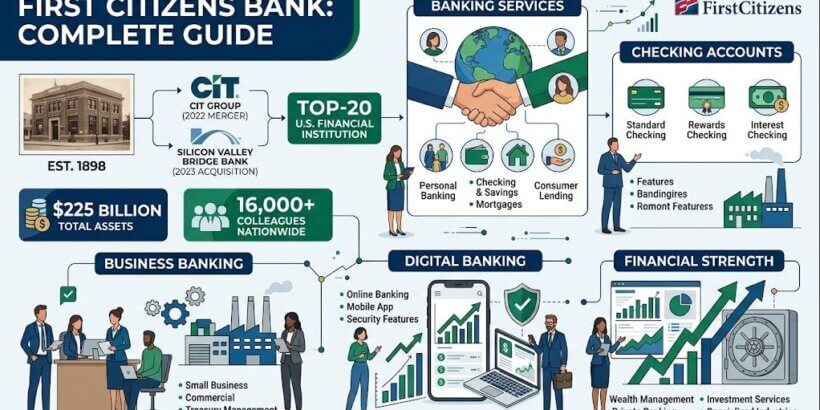
First Citizens Bank: Complete Guide to History, Banking Services, Checking Accounts, Business Banking, Digital Banking and Financial Strength
First Citizens Bank: The Complete Guide to History, Accounts, Business Banking, and Financial Strength
First Citizens Bank is a top-20 U.S. financial institution that pairs a century-old community banking heritage with a modern, national financial platform. Headquartered in Raleigh, North Carolina, it operates primarily via First-Citizens Bank & Trust Company, the principal subsidiary of the publicly traded First Citizens BancShares, Inc. (NASDAQ: FCNCA).
With over $236 billion in assets and more than 16,000 employees nationwide, First Citizens has evolved far beyond its regional roots through strategic acquisitions—most notably CIT Group and Silicon Valley Bank.
At a Glance: Key Financials & Corporate Profile
Data as of Q2 2026 financial reporting:
| Metric | Figure / Status |
| Total Assets | ~$236 billion |
| Total Deposits | ~$173.43 billion (84.3% of total funding) |
| Loans & Leases | ~$151.03 billion |
| Net Income (Q2 2026) | $672 million ($55.52 per common share) |
| Common Equity Tier 1 (CET1) | 10.77% |
| Tier 1 Leverage Ratio | 9.22% |
| Total Liquid Assets | ~$59.14 billion |
| FDIC Insurance | Member FDIC (Cert #11063) / Equal Housing Lender |
History and Transformational Acquisitions
First Citizens was established in 1898 as the Bank of Smithfield in Johnston County, North Carolina, with $10,000 in initial capital. Guided across generations by the Holding family, the bank moved its headquarters to Raleigh in 1974 after crossing $1 billion in assets, making its first out-of-state push into West Virginia in 1994.
Three major transactions define its contemporary national footprint:
-
CIT Group Merger (2022): Greatly expanded commercial capabilities, middle-market lending, equipment financing, leasing, and factoring.
-
Silicon Valley Bridge Bank Acquisition (2023): Assumed from the FDIC, this purchase added premier relationships across venture capital, private equity, life sciences, and tech startups, creating a dedicated innovation economy arm.
-
BMO Bank Branch Acquisition (2026): Added 138 physical branches across the Midwest, Great Plains, and Western states (including North Dakota, Wyoming, Nebraska, and Idaho), assuming roughly $5.3 billion in deposits and $700 million in loans.
Personal Banking Services
Consumer Checking Accounts
First Citizens structures its checking lineup around relationship depth, offering fee waivers tied to direct deposits, balances, or lending relationships:
-
Primary Checking: An everyday account featuring a $50 minimum opening deposit and no minimum balance requirement. The monthly maintenance fee is easily waived by enrolling in paperless statements within the introductory period. Includes a contactless Visa debit card and digital banking access.
-
Premier Checking: An interest-bearing tier requiring a $100 opening deposit. The $18 monthly fee can be waived via qualifying combined balances, regular monthly ACH direct deposits, or linked consumer loan products (e.g., EquityLine).
-
Prestige Checking: A relationship-tier checking account paying tiered interest for clients maintaining higher balances and utilizing multiple First Citizens product lines.
Savings, Money Market, and CDs
-
Online Savings Account: Requires a $50 minimum opening deposit with no ongoing minimum balance requirement; managed directly through web and mobile apps.
-
Money Market Account: Built for liquid savings with tiered APYs. It requires a $500 initial deposit; the $10 monthly maintenance fee is waived by maintaining a $1,000 minimum daily balance.
-
Certificates of Deposit (CDs): Fixed-rate time deposits starting at $500 for standard branch terms, with promotional terms and rates offered periodically online.
Digital Banking & Security Features
-
Digital Ecosystem: Mobile check deposit, online bill pay, external transfers, biometric sign-in, and account-monitoring dashboards.
-
P2P Payments: Integrated with Zelle for direct person-to-person payments.
-
Overdraft Relief: No overdraft fees for transactions resulting in a negative balance of $5 or less, and zero fees assessed for items returned unpaid.
Business, Commercial, and Innovation Banking
First Citizens supports enterprises ranging from solo practices to global private equity funds:
-
Small Business Banking: Business checking, merchant payment processing, payroll integrations, business credit cards, and SBA lending solutions.
-
Commercial Treasury Management: Liquidity sweeps, wire services, automated receivables/payables processing, fraud mitigation, and international trade finance (letters of credit, foreign exchange).
-
Specialized Corporate Finance: Asset-based lending, equipment leasing, and commercial factoring across retail, apparel, logistics, and electronics manufacturing.
-
Innovation & Fund Banking: Dedicated teams supporting early-stage startups to late-stage venture funds with specialized venture debt, capital call lines, and cross-border fund administration.
Is First Citizens Bank Right for You?
Pros
-
Broad ecosystem combining retail branches with specialized commercial and wealth services.
-
Overdraft leniency on small transactions ($5 buffer, no NSF charges).
-
Deep sector-specific expertise for startups, tech firms, and investment funds.
-
Capital ratios and liquidity reserves consistently track above standard regulatory minimums.
Cons
-
Standard savings and money market APYs generally lag behind specialized digital-only neobanks.
-
Physical branch footprint remains regionalized, though actively expanding through acquisitions.
-
Premium checking accounts carry higher fee-waiver thresholds for lower-balance accounts.
Frequently Asked Questions
What is the routing number for First Citizens Bank?
Routing numbers vary by region and account origin. Find your specific 9-digit ABA routing number at the bottom left of your paper checks or in the account details screen of the First Citizens Digital Banking app.
Is Silicon Valley Bank still operating?
Yes. Silicon Valley Bank operates as a division of First Citizens Bank, continuing its focus on venture capital, life sciences, and technology enterprises.
Are deposits at First Citizens Bank FDIC-insured?
Yes. First-Citizens Bank & Trust Company is an FDIC member. Eligible deposits are insured up to $250,000 per depositor, per ownership category.
First Citizens Bank is one of the most established and rapidly expanding banking institutions in the United States, combining more than a century of banking history with a modern national financial-services platform. Headquartered in Raleigh, North Carolina, First Citizens Bank has evolved from a small community bank founded in 1898 into a top-20 U.S. financial institution serving individuals, families, entrepreneurs, businesses, commercial clients, investors and specialized industries. The bank operates through First-Citizens Bank & Trust Company, which is the principal banking subsidiary of First Citizens BancShares, Inc. The parent company trades on Nasdaq under the ticker symbol FCNCA. According to the bank’s current corporate profile, First Citizens has more than $225 billion in total assets and more than 16,000 colleagues nationwide. (First Citizens Bank)
For consumers searching online for information about First Citizens Bank, one of the most important things to understand is that the organization is much larger and more diversified than a traditional regional bank. Its business now includes personal banking, checking and savings accounts, mortgages, consumer lending, commercial banking, treasury management, wealth management, private banking, investment services, specialized industry banking and innovation-focused banking. Its expansion accelerated significantly through the 2022 merger with CIT Group and the 2023 acquisition of substantially all loans and certain other assets of Silicon Valley Bridge Bank, which allowed First Citizens to build a much larger national platform while continuing to maintain a relationship-oriented banking model. (First Citizens Bank)
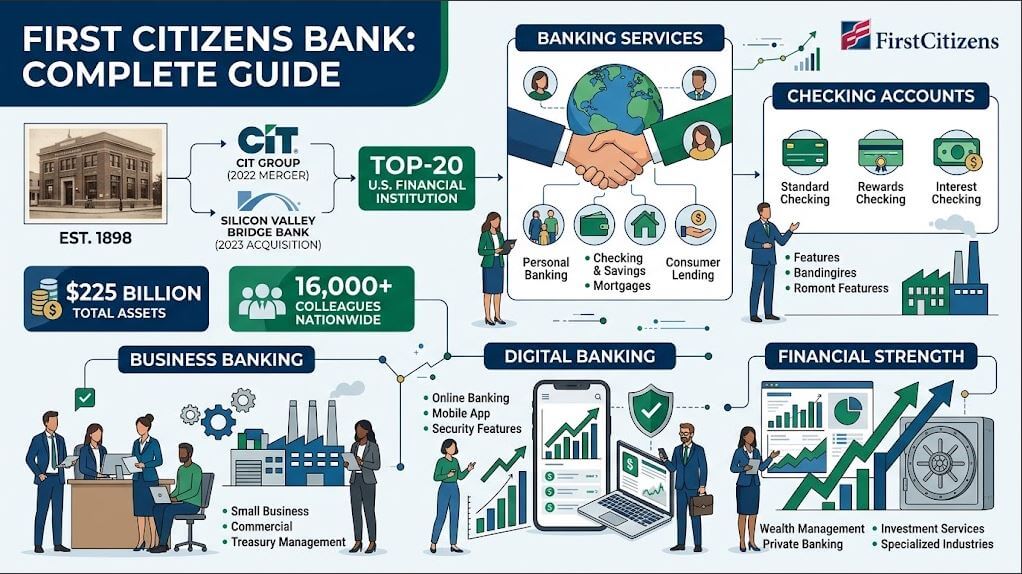
The history of First Citizens Bank begins in 1898, when the institution was established in Smithfield, North Carolina, as the Bank of Smithfield. The original bank began with $10,000 in capital and primarily served agricultural customers in Johnston County. Over the following decades, the institution expanded beyond its original community, developed a growing branch network and eventually became First-Citizens Bank & Trust Company. The bank’s history is closely associated with the Holding family, whose leadership played an important role in shaping its long-term strategy and culture. By 1974, First Citizens had moved its headquarters from Smithfield to Raleigh and its assets had surpassed $1 billion. In 1994, the bank expanded outside North Carolina through an acquisition in West Virginia, beginning a broader geographic expansion that eventually contributed to its nationwide presence. (First Citizens Bank)
The bank’s growth strategy has historically combined organic branch expansion with acquisitions. This approach has allowed First Citizens to enter new markets, add specialized financial capabilities and broaden its customer base. One of the most important transactions in its modern history was the merger with CIT Group, completed on January 3, 2022. The transaction significantly increased the scale of First Citizens and established the combined organization as one of the largest U.S. banking institutions by assets. First Citizens continued to maintain the CIT brand as CIT Group, a division of First Citizens Bank. (SEC)
Another transformational moment came in March 2023, when First Citizens Bank acquired substantially all loans and certain other assets and assumed customer deposits and certain other liabilities of Silicon Valley Bridge Bank from the Federal Deposit Insurance Corporation. Silicon Valley Bridge Bank had been established after the failure of the former Silicon Valley Bank. Following the transaction, First Citizens retained the Silicon Valley Bank brand as Silicon Valley Bank, a division of First Citizens Bank. This transaction gave First Citizens a much stronger presence in technology, venture capital, private equity and innovation-focused banking. (SEC)
The Silicon Valley Bank transaction was particularly significant because it added specialized capabilities that were complementary to First Citizens’ existing commercial banking platform. Silicon Valley Bank had decades of experience working with technology companies, venture capital firms, private equity firms, life sciences companies and other innovation-oriented businesses. First Citizens was therefore able to combine its longstanding relationship-based banking philosophy with a specialized national platform focused on the innovation economy. The bank’s current corporate profile states that it has served the innovation economy for more than 40 years through purpose-built banking for high-growth companies and investors. (First Citizens Bank)
First Citizens’ current scale demonstrates how dramatically the organization has changed since its origins as a small North Carolina community bank. Its 2025 annual report reported approximately $229.70 billion in consolidated assets at December 31, 2025. The company described an extensive branch and office network concentrated in the Southeast, Mid-Atlantic, Midwest and Western United States. (SEC) By the second quarter of 2026, First Citizens reported total assets of approximately $236 billion, deposits of approximately $173.43 billion and loans and leases of approximately $151.03 billion at June 30, 2026. (First Citizens Newsroom)
These numbers help explain why First Citizens Bank is increasingly relevant to customers looking for a national financial institution that still emphasizes personal relationships. The bank describes its approach as banking on a first-name basis, combining sector expertise with high-touch service. Its current corporate profile identifies First Citizens as a top-20 U.S. financial institution with more than 16,000 employees and more than $225 billion in assets. (First Citizens Bank)
For individual customers, First Citizens Bank provides several types of checking accounts designed for different financial needs. Its personal checking lineup includes Primary Checking, Premier Checking and Prestige Checking. Primary Checking is positioned as the bank’s straightforward checking option, while Premier Checking provides interest-earning capabilities and additional relationship benefits. Prestige Checking is designed for customers seeking a more premium interest-bearing checking experience. (First Citizens Bank)
The First Citizens Primary Checking account is intended for everyday financial management. According to the bank, it has a minimum opening deposit of $50, no minimum balance requirement and access to Digital Banking, online bill payment and mobile deposit services. Customers can also receive a First Citizens Visa debit card for everyday purchases. The bank states that customers can avoid the applicable monthly maintenance fee by enrolling in paperless statements within the specified period after opening the account. (First Citizens Bank)
Premier Checking is designed for customers who want an interest-bearing checking account. First Citizens states that the account requires a $100 minimum opening deposit and has an $18 monthly fee unless the customer meets one of the qualifying conditions. Qualifying conditions can include maintaining specified combined balances, receiving a specified amount of monthly ACH direct deposits, having an eligible EquityLine or meeting certain consumer loan requirements. Because account pricing and qualifying requirements can change, customers should always review the bank’s current disclosures before opening an account. (First Citizens Bank)
Prestige Checking is the bank’s premium checking option and is designed for customers who want additional relationship benefits and interest on their balances. First Citizens describes it as a VIP-style interest-bearing checking account. The account can be particularly relevant to customers who maintain larger balances or use multiple First Citizens financial products. (First Citizens Bank)
One of the advantages of First Citizens Bank’s relationship-banking model is that customers may be able to combine several products to obtain additional benefits or qualify for fee waivers. This can make the bank more attractive to customers who want to consolidate checking, savings, lending, mortgage, investment or wealth-management relationships under one institution. However, consumers should compare the total cost of the relationship with alternatives, particularly if they maintain relatively small balances.
Savings is another major part of First Citizens Bank’s consumer banking offering. The bank provides online savings, money market savings and certificates of deposit. Its savings products are designed for different objectives, including emergency savings, short-term goals, medium-term savings and longer-term deposits. (First Citizens Bank)
The First Citizens Online Savings Account is designed for customers who want a simple interest-bearing savings account with online access. The bank currently lists a $50 minimum opening deposit and no minimum balance requirement. Customers can manage the account through First Citizens Digital Banking. (First Citizens Bank)
The First Citizens Money Market Account is intended for customers who want savings growth while retaining convenient access to their funds. The bank describes its money market account as a tiered-rate savings product. Its published information currently shows APYs ranging from 0.05% to 0.15%, depending on balance, although rates can change and should be verified directly with the bank before opening an account. The bank lists a $500 minimum opening deposit and states that maintaining a $1,000 daily balance can waive the $10 monthly maintenance fee. (First Citizens Bank)
The bank’s money market account also offers digital banking, bill payment, mobile deposits, alerts and money-management tools. First Citizens says customers can use Zelle, transfer money between accounts and monitor spending trends through its digital banking platform. (First Citizens Bank)
Certificates of deposit, commonly called CDs, are another important savings option. CDs generally allow customers to deposit money for a specified period in exchange for a fixed interest rate. First Citizens offers flexible-term certificates of deposit, and its current consumer savings information lists a $500 minimum opening deposit for branch CDs while promotional online CDs can have different requirements. (First Citizens Bank)
A major consideration for anyone comparing First Citizens Bank with other banks is the difference between relationship-focused banking and rate-focused banking. A customer primarily interested in the highest possible savings APY may find specialized online banks offering different rates. On the other hand, a customer who values branches, relationship banking, access to lending, wealth management and a broader financial-services ecosystem may find First Citizens more attractive.
First Citizens Bank also provides digital banking services that allow customers to manage accounts without visiting a branch. Digital banking capabilities include account monitoring, transfers, bill payment, mobile deposit and payment features. The bank’s checking and savings pages emphasize the ability to manage accounts from virtually any device. (First Citizens Bank)
Mobile deposit can be especially useful for customers who receive paper checks but do not want to visit a branch. By using a compatible smartphone or mobile device, customers can generally photograph eligible checks and submit them electronically through the bank’s mobile application, subject to applicable terms and limits.
First Citizens also supports Zelle for eligible customers. Zelle allows users to send money to people they know using participating banking applications. Customers should understand that Zelle transactions are generally intended for people they know and trust rather than purchases from unknown sellers. First Citizens identifies Zelle as part of its payment and transfer capabilities. (First Citizens Bank)
Debit cards are another important part of First Citizens consumer banking. Customers with eligible checking accounts can use their First Citizens Visa debit card for purchases and ATM transactions. The bank promotes contactless payment capabilities as part of its debit-card services. (First Citizens Bank)
Security is an important consideration when choosing a bank. First Citizens Bank is an FDIC-insured institution, meaning eligible deposit accounts are generally insured up to the applicable legal limits. The bank’s consumer disclosures identify First-Citizens Bank as Member FDIC and an Equal Housing Lender. (First Citizens Bank) Customers should understand FDIC insurance rules, including ownership categories and coverage limits, particularly when maintaining large balances.
First Citizens Bank also provides overdraft-related options for eligible consumer accounts. Its current checking information explains that customers can choose an overdraft protection level, and certain transaction conditions can affect whether an item is paid or returned. The bank currently states that it does not charge overdraft fees for overdrafts caused by transactions of $5 or less and does not charge fees for items returned unpaid, while eligible accounts can be subject to other overdraft charges under the bank’s published terms. (First Citizens Bank)
Customers should never rely solely on a general description of overdraft policy because account-specific terms can vary. First Citizens publishes state-specific personal account disclosures, and those disclosures contain detailed information about fees and account terms. (First Citizens Bank)
Mortgages are another important part of the First Citizens consumer banking business. A mortgage allows eligible customers to borrow money to purchase, refinance or otherwise finance residential property. First Citizens’ broader banking platform includes residential mortgage lending, making it possible for customers to potentially maintain checking, savings, lending and mortgage relationships with the same financial institution. (SEC)
Consumer lending also forms part of First Citizens’ overall product offering. Depending on eligibility and market availability, customers may access loans for automobiles, personal needs and other purposes. The bank’s checking-account relationship qualifications also reference consumer loans, including new or used automobiles, trucks, boats, aircraft, unsecured personal loans and certain mortgages. (First Citizens Bank)
For customers with significant assets or more complex financial requirements, First Citizens offers wealth-management and private-banking services. Wealth management can include investment management, financial planning and other advisory services depending on the customer’s circumstances. First Citizens’ larger corporate platform includes investment-management businesses and specialized wealth capabilities that became more significant following its acquisition activities. (SEC)
Private banking is designed for individuals and families with more complex financial needs. Such clients may require customized lending, liquidity management, investment management, estate-related planning coordination and specialized banking support. First Citizens’ emphasis on relationship banking is particularly relevant in this segment because affluent customers often value access to a dedicated financial team.
First Citizens Bank is also highly significant in business banking. Small businesses, middle-market companies, corporations, professional practices and specialized industries can access a range of banking solutions. The bank’s annual report describes its General Bank as serving individuals and businesses through branches and digital channels while providing deposits, loans, wealth management, private banking and fee-based services. (SEC)
Commercial banking is one of First Citizens’ most important areas of growth. The bank provides commercial loans, treasury and liquidity-management services, international banking and specialized financing. Its commercial banking platform has become increasingly national following the CIT and Silicon Valley Bank transactions. First Citizens’ 2026 announcement regarding its planned brand alignment also emphasized commercial capabilities such as treasury and liquidity management, international banking and specialized commercial lending. (First Citizens BancShares)
Small-business customers often need more than a checking account. They may need merchant services, payroll solutions, business credit, working capital, equipment financing, cash management and deposit services. First Citizens’ broader commercial platform enables the bank to support businesses as they grow from smaller operations into larger companies.
First Citizens also has a strong presence in specialized finance. The company’s history and acquisitions have given it expertise in areas including factoring, leasing, commercial finance and industry-specific lending. Its 2025 SEC filing describes commercial factoring, receivables management and secured financing services for businesses operating in industries such as apparel, textiles, furniture, home furnishings and consumer electronics.
Leasing is another specialized business. Companies may use equipment financing or leasing to obtain productive assets without making the same type of upfront capital expenditure required for an outright purchase. Specialized finance can be particularly useful for companies whose equipment needs are closely tied to business cycles and operating cash flow.
The bank’s innovation-banking operations are another major differentiator. Through its Silicon Valley Bank division, First Citizens serves companies and investors in the technology and innovation economy. The platform is relevant to startups, venture capital firms, private equity firms, life sciences businesses and other high-growth companies. (First Citizens Bank)
The acquisition of Silicon Valley Bridge Bank was particularly important because it expanded First Citizens’ exposure to the venture capital and technology ecosystems. Rather than simply adding conventional deposits and loans, the transaction brought specialized relationships and expertise into the First Citizens organization. The bank has subsequently focused on integrating those capabilities while maintaining specialized service for innovation-oriented clients. (SEC)
First Citizens has also been investing in technology and operational modernization. Its 2025 shareholder materials said the company had largely completed material integration work associated with the SVB acquisition and was shifting greater attention toward simplifying and modernizing technology platforms and improving capabilities for customers. (SEC)
The bank’s national expansion is continuing. In October 2025, First Citizens announced an agreement to acquire 138 branches from BMO Bank N.A. across parts of the Midwest, Great Plains and Western United States. The transaction is expected to expand First Citizens’ physical presence in states including North Dakota, South Dakota, Wyoming, Nebraska, Kansas, Missouri, Oklahoma and Idaho, along with selected locations in Minnesota, Oregon and Illinois.
As reported in First Citizens’ second-quarter 2026 earnings release, the BMO branch acquisition was expected to be completed during the third quarter of 2026. The bank expected to assume approximately $5.3 billion in deposits and acquire approximately $700 million in loans through the transaction, with the exact transaction subject to applicable conditions and approvals. (First Citizens Newsroom)
This planned expansion is strategically important because physical branches remain valuable in markets where customers want face-to-face banking. Branches can support account opening, mortgage discussions, business relationships, cash services, financial advice and local community engagement. At the same time, First Citizens is investing in digital banking so customers can perform routine transactions without visiting a branch.
First Citizens’ financial performance is another reason the bank attracts attention from investors, customers and financial analysts. In the second quarter of 2026, First Citizens BancShares reported net income of $672 million, compared with $534 million in the first quarter. Net income available to common stockholders was $640 million, or $55.52 per common share, during the quarter. (First Citizens Newsroom)
During the same quarter, net interest income was approximately $1.66 billion. Loans and leases reached approximately $151.03 billion at June 30, 2026, while deposits reached approximately $173.43 billion. These figures illustrate the scale of the bank’s core lending and deposit franchise. (First Citizens Newsroom)
The bank reported a 3.10% net interest margin in the second quarter of 2026. Net interest margin is an important banking metric because it measures the difference between interest earned on assets such as loans and securities and interest paid on liabilities such as deposits and borrowings, relative to earning assets. Changes in interest rates, loan mix, deposit pricing and funding costs can significantly affect this metric. (First Citizens Newsroom)
First Citizens also reported strong capital ratios in the second quarter of 2026. Its estimated common equity Tier 1 ratio was 10.77%, while its estimated Tier 1 leverage ratio was 9.22%. The bank reported that its capital ratios remained above regulatory requirements. (First Citizens Newsroom)
Liquidity is equally important for a bank. First Citizens reported approximately $59.14 billion in liquid assets at June 30, 2026. A strong liquidity position can help a financial institution manage unexpected deposit movements, market volatility and funding requirements, although no bank is completely immune to financial-system risks. (First Citizens Newsroom)
First Citizens’ deposit base is an important source of funding. At June 30, 2026, deposits were approximately $173.43 billion. Deposits increased by approximately $2.59 billion from March 31, 2026, primarily due to growth in corporate deposits, including direct-bank and brokered deposits. (First Citizens Newsroom)
The bank’s direct banking capabilities have become increasingly important as consumers and businesses become more comfortable opening and managing accounts digitally. Direct banking can allow financial institutions to reach customers beyond traditional branch footprints and can support deposit growth without requiring a physical location in every market.
For ordinary consumers, the question is often much simpler: Is First Citizens Bank a good bank? The answer depends on what a customer values. First Citizens can be attractive for people who want a combination of physical branches, digital banking, checking accounts, savings, lending and access to a broad financial-services organization. Its scale and product range can also be valuable for customers whose financial needs become more complex over time.
However, no bank is ideal for every customer. Someone whose only priority is maximizing savings interest may want to compare First Citizens’ current APYs with online savings banks and credit unions. Someone who wants a completely fee-free banking experience should examine account disclosures carefully. Customers should also consider branch availability in their state and local area.
First Citizens’ checking accounts may be especially attractive to customers who can satisfy relationship requirements. Customers who maintain larger balances, receive direct deposits or use multiple First Citizens products may have opportunities to reduce or eliminate certain monthly maintenance fees on qualifying accounts. (First Citizens Bank)
On the other hand, customers with low balances and limited use of other First Citizens products should pay close attention to monthly fees and waiver requirements. A checking account that looks attractive because of its features may not be the most economical option if a customer cannot meet the requirements for avoiding fees.
Another factor to consider is geographic availability. First Citizens has a national presence, but its branch network is not uniformly distributed across every state. The bank’s planned BMO branch acquisition is designed to expand its footprint further into the Midwest, Great Plains and Western United States.
Customers who prefer branch banking should therefore check the current First Citizens branch locator before opening an account. Customers who primarily bank online may be less concerned about branch proximity and may instead focus on digital features, ATM access, fees, interest rates and customer service.
Customer service is a central part of First Citizens’ brand identity. The company emphasizes long-term relationships and personalized service, describing its approach as client-centered and relationship-based. (First Citizens Bank) For consumers who dislike dealing exclusively with automated systems, the availability of branches and relationship bankers can be a meaningful advantage.
First Citizens also has a long record of community involvement. Its corporate profile describes support for affordable housing, financial education and economic development. The company also highlights its longstanding partnership with Teen Cancer America and other community initiatives. (First Citizens Bank)
The bank’s community-oriented history dates back to its origins as a local institution in North Carolina. Although First Citizens has grown into a national financial organization, its public identity continues to emphasize the idea that financial institutions should contribute to the communities where they operate.
The First Citizens brand is also built around the concept of long-term thinking. Its historical timeline explains that the Forever First brand was introduced in 2013 to reinforce the idea that the bank’s principles and relationships should continue across generations. (First Citizens Bank)
The bank’s history through periods of economic stress is often cited as part of its identity. During the Great Recession, First Citizens emphasized safety and stability and continued entering new markets. (First Citizens Bank) More recently, its acquisition of Silicon Valley Bridge Bank demonstrated its willingness to take on substantial strategic opportunities during periods of financial-market disruption.
The Silicon Valley Bank transaction also changed how many Americans perceive First Citizens. Before the acquisition, First Citizens was already a large and respected bank, but the SVB transaction brought national attention to the company. It became associated with one of the most important bank transactions following the 2023 U.S. banking crisis. The transaction also dramatically expanded its technology and innovation-banking capabilities. (SEC)
For businesses, First Citizens Bank can provide a broad spectrum of financial services. A company might begin with a business checking account, then add treasury management, commercial lending, equipment financing, cash management, wealth services for owners and specialized financing as the organization grows. This ability to support clients at different stages is one of the strongest arguments for a relationship-oriented bank.
Treasury management is particularly important for medium-sized and large companies. Businesses need to manage incoming payments, outgoing payments, liquidity, working capital and fraud risk. A strong treasury platform can help businesses automate cash-management processes and improve visibility into their financial position.
International banking is another area of First Citizens’ commercial capabilities. Companies operating across borders may need foreign-exchange services, international payments, trade-related services and other banking support. The bank’s commercial platform has increasingly emphasized specialized capabilities for companies with sophisticated financial requirements. (First Citizens BancShares)
Private equity and venture capital clients can also benefit from specialized banking relationships. First Citizens’ innovation-banking business has deep experience in these sectors, and the acquisition of Silicon Valley Bank’s operations gave the bank access to a large network of technology and investment-industry relationships.
For entrepreneurs, banking needs can change quickly. A startup might begin with a simple operating account and eventually need venture debt, credit facilities, treasury management, foreign exchange, acquisition financing and personal wealth management for founders. A bank with specialized commercial and innovation expertise can therefore offer value beyond ordinary checking accounts.
First Citizens has also developed capabilities around commercial real estate and other lending sectors. Like every large bank, it manages credit risk across a diversified loan portfolio. Investors and customers should recognize that bank performance can be affected by interest rates, real estate conditions, economic cycles, borrower defaults and regulatory changes.
The bank’s second-quarter 2026 results showed nonaccrual loans of approximately $1.45 billion, representing 0.96% of loans, while net charge-offs were approximately $108 million, or 0.29% of average loans, during the quarter. These figures are useful for understanding credit quality, although a single quarter should not be interpreted as a complete prediction of future performance. (First Citizens Newsroom)
First Citizens reported an allowance for loan and lease losses of approximately $1.48 billion at June 30, 2026. Banks maintain such allowances to absorb expected credit losses in their loan portfolios. Credit quality can change as economic conditions change, so investors should monitor these measures over multiple reporting periods rather than relying on one figure. (First Citizens Newsroom)
Another important development is the bank’s technology modernization program. As financial institutions grow through mergers and acquisitions, integrating multiple technology systems can become a major challenge. First Citizens has indicated that it is simplifying and modernizing technology platforms after substantial progress integrating the SVB acquisition. (SEC)
Technology modernization can benefit customers through faster digital services, better account-management tools, improved security and more consistent experiences across channels. However, major technology transformations can also involve temporary service disruptions or operational complexity. Customers should monitor official bank communications during major platform changes.
First Citizens Bank also operates a global capability center in India. The bank’s historical timeline states that First Citizens India opened as a Global Capability Center with more than 850 associates supporting more than 130 enterprise-wide processes. (First Citizens Bank) This illustrates how a historically regional U.S. bank has developed international operational capabilities as it has grown.
For investors, First Citizens BancShares is publicly traded under the ticker FCNCA. The distinction between First Citizens Bank and First Citizens BancShares is important. First Citizens Bank is the banking subsidiary that provides banking services, while First Citizens BancShares is the financial holding company. The parent company owns the bank and other subsidiaries and is the publicly traded entity.
The bank’s ownership and leadership structure has historically been influenced by the Holding family. The company’s history identifies multiple generations of Holding family leadership, and this continuity has contributed to its long-term strategic identity. (First Citizens Bank)
For SEO searches such as “First Citizens Bank,” “First Citizens Bank checking account,” “First Citizens Bank near me,” “First Citizens Bank routing number,” “First Citizens Bank online banking,” “First Citizens Bank savings account,” “First Citizens Bank mortgage,” “First Citizens Bank business banking,” “First Citizens Bank locations,” “First Citizens Bank customer service,” and “First Citizens Bank reviews,” it is important to distinguish between information that changes frequently and information that is relatively stable. Account fees, APYs, branch locations and certain eligibility requirements can change, while the bank’s history and corporate structure are more stable.
Customers searching for First Citizens Bank hours or locations should use the official branch locator because individual branches can have different schedules. Similarly, customers searching for First Citizens Bank savings rates should check the current official rate page because interest rates are variable and can change at any time.
The bank’s current consumer disclosures also demonstrate why customers should read state-specific terms. First Citizens provides personal account disclosures for numerous states, including Arizona, California, Colorado, Florida, Georgia, Kansas, Maryland, Massachusetts, Missouri, Nebraska, Nevada, New Mexico, North Carolina, Oklahoma, Oregon, South Carolina, Tennessee, Texas, Virginia, Washington, West Virginia and Wisconsin. (First Citizens Bank)
The FDIC insurance feature is particularly important for depositors. Eligible First Citizens deposit accounts are generally insured up to the maximum amount permitted under federal law. Consumers with large balances should understand how FDIC ownership categories work and should not assume that simply having multiple accounts automatically creates unlimited coverage.
When comparing First Citizens Bank with another bank, consumers should evaluate several factors: monthly account fees, fee-waiver requirements, minimum opening deposits, savings APYs, CD rates, ATM access, branch availability, digital banking functionality, overdraft policies, customer support, lending options, wealth-management services and FDIC insurance coverage.
For someone looking for a basic checking account, Primary Checking may be a logical starting point. For customers who want interest-bearing checking, Premier or Prestige may be more relevant. For savings, customers can compare online savings, money market and CD products based on liquidity requirements and expected return. (First Citizens Bank)
For customers saving for an emergency fund, liquidity is usually more important than maximizing the term of the deposit. A savings or money market account may provide more convenient access than a CD. For money that will not be needed for a predetermined period, a CD may provide more certainty because the rate can be fixed for the selected term.
For everyday spending, checking accounts should be evaluated primarily on accessibility, fees, payment functionality, overdraft policies and convenience rather than interest rate. If a customer maintains a substantial balance in checking, an interest-bearing checking account may become more attractive.
For businesses, the evaluation should focus on transaction volume, treasury capabilities, payment needs, lending requirements, merchant services, cash management, deposit pricing and relationship support. A business with complex needs may value specialized banking services more than a small difference in account fees.
First Citizens Bank’s greatest competitive advantage may be the breadth of its platform. The organization now combines traditional community-bank heritage, national commercial banking, wealth management, private banking, specialized finance and innovation banking. Its acquisition strategy has allowed it to build capabilities that would have taken decades to develop organically.
Its greatest challenge may be managing complexity. A bank that grows through major acquisitions must integrate people, technology, systems, risk-management frameworks and corporate cultures. First Citizens has acknowledged the importance of strengthening risk capabilities and modernizing technology following the expansion associated with SVB. (SEC)
Scale can create significant benefits, but it also increases regulatory and operational responsibilities. As a top-20 U.S. financial institution, First Citizens operates in an environment where capital, liquidity, cybersecurity, credit risk, consumer protection and regulatory compliance receive substantial attention.
The bank’s balance sheet provides another indicator of its transformation. In 2025, First Citizens BancShares reported approximately $229.70 billion in consolidated assets. By June 30, 2026, the bank reported approximately $236 billion in total assets. (SEC) The growth reflects both acquisitions and ongoing organic business activity.
First Citizens’ deposit growth is particularly important because deposits are a central funding source for banks. The bank reported approximately $173.43 billion of deposits at the end of the second quarter of 2026. Its funding mix improved during the quarter, with deposits representing 84.3% of total funding at June 30, 2026. (First Citizens Newsroom)
The bank’s loan portfolio was approximately $151.03 billion at June 30, 2026. Commercial lending accounted for a significant portion of recent growth, particularly within global fund banking. (First Citizens Newsroom) This reflects the bank’s increasing focus on institutional and commercial relationships.
Global fund banking is a specialized area that can involve financing arrangements for private equity and investment funds. Such services require specialized underwriting, relationship management and knowledge of the investment industry.
First Citizens’ strategic expansion therefore goes beyond simply adding branches. The organization is building a financial-services platform that can serve consumers, entrepreneurs, corporations, investment professionals and specialized industries.
The planned acquisition of 138 BMO branches further demonstrates the bank’s national ambitions. The transaction is expected to bring additional deposits, loans and wealth assets while expanding physical presence in regions where First Citizens wants to establish deeper relationships.
For customers in the affected regions, the acquisition can create an opportunity to gain access to First Citizens products and services. However, customers should follow official transition communications regarding account numbers, debit cards, online banking access, direct deposits, automatic payments and other operational changes when a branch acquisition is completed.
First Citizens has also announced plans to align some of its commercial brand names during the fourth quarter of 2026. According to the bank, Silicon Valley Bank is planned to rebrand as First Citizens Innovation Banking and First Citizens Fund Banking, while CIT Commercial Services and the Silicon Valley Bank Wine division are planned to adopt First Citizens Bank branding. (First Citizens BancShares) These changes are intended to create a more unified brand structure while preserving specialized capabilities.
The future of First Citizens Bank will likely be shaped by several factors: continued national expansion, technology modernization, deposit growth, commercial banking demand, interest rates, credit conditions, regulatory requirements and the successful integration of acquired businesses.
For consumers, the bank’s future expansion could mean more branches and more product availability. For businesses, it could mean greater access to specialized financing and national banking services. For investors, the key question will be whether the bank can maintain strong returns and credit quality while managing the complexity associated with its larger scale.
One of the most notable characteristics of First Citizens Bank is its ability to combine old and new. The institution began in 1898 as a small agricultural bank in North Carolina, but today it supports nationwide consumer and commercial clients, technology companies, investors and sophisticated financial institutions. (First Citizens Bank)
The bank’s more than 125-year history provides a foundation for its brand, while its acquisitions provide the scale necessary to compete with much larger national financial institutions. This combination of heritage and expansion is central to understanding First Citizens Bank in 2026.
Consumers researching First Citizens Bank should therefore look beyond simple questions such as “Is First Citizens Bank good?” A better question is whether its products, pricing, locations, digital services and relationship model fit the customer’s financial situation. Someone who wants a nationwide bank with extensive business and wealth capabilities may find First Citizens appealing. Someone seeking the highest online savings yield may prefer to compare several institutions. Someone who values personal branch service may find First Citizens’ approach more compelling.
Business owners should similarly evaluate the bank according to their stage of growth. A very small business may need only basic checking and payment services, while a growing company may need treasury management and lending. A large corporation may need sophisticated liquidity management, international banking and capital-markets-related solutions. First Citizens has developed capabilities across these different levels of complexity.
For entrepreneurs and technology companies, the bank’s innovation-banking capabilities can be particularly significant. The former Silicon Valley Bank platform gives First Citizens specialized expertise that distinguishes it from many traditional regional banks. (First Citizens Bank)
For wealthy individuals, the combination of private banking and wealth-management services can provide an integrated relationship. Customers with substantial assets may be able to coordinate banking, lending, investment and financial-planning needs through one organization, although independent professional advice can still be valuable when making major financial decisions.
For ordinary households, the most practical First Citizens products remain checking, savings, money market accounts, CDs, mortgages and consumer loans. These products cover the core financial needs of many families.
A person opening a First Citizens checking account should prepare basic personal information and an initial deposit. The bank’s online account-opening process may request information such as name, address, email address and Social Security number, depending on the product. (First Citizens Bank) Account approval and eligibility requirements apply.
Customers should also activate digital banking and security alerts after opening an account. Monitoring account activity regularly is one of the simplest ways to detect unauthorized transactions quickly. Customers should never share online-banking passwords, one-time authentication codes or other security credentials with people claiming to represent the bank.
Phishing remains an important risk for banking customers. Fraudsters may impersonate banks through email, text messages or telephone calls. Customers should use official First Citizens contact information rather than clicking suspicious links or calling numbers contained in unexpected messages.
Another important security principle is to avoid sending money through Zelle or other instant-payment systems to unknown individuals. Payment systems can be convenient, but customers should verify the recipient before authorizing a transfer.
First Citizens Bank’s official website should be treated as the primary source for current account rates, fees, branch information, application requirements and security notices. Third-party comparison websites can be useful for research, but financial products should ultimately be verified against the bank’s current disclosures.
For people searching for First Citizens Bank reviews, online reviews can provide useful information about customer experiences but should be interpreted carefully. Individual reviews may reflect a single branch, employee interaction, transaction problem or unusual circumstance. A more reliable evaluation should consider multiple sources and official product information.
The bank’s long history and current financial scale provide meaningful context. It is not a newly created fintech or small local institution. It is a major U.S. financial organization with a long operating history, a large deposit base, a substantial loan portfolio and significant regulatory oversight. (SEC)
First Citizens Bank is also different from other companies with similar names. Consumers should make sure they are researching First-Citizens Bank & Trust Company, the banking subsidiary of First Citizens BancShares, Inc., rather than another institution using “First Citizens” in its name. The official First Citizens website and FDIC information can help confirm the institution.
In conclusion, First Citizens Bank represents one of the most interesting banking growth stories in the United States. Founded in North Carolina in 1898 as the Bank of Smithfield, it gradually expanded through generations of relationship banking, branch growth and strategic acquisitions. Its 2022 CIT merger and 2023 acquisition of Silicon Valley Bridge Bank transformed its scale and capabilities, making it a top-20 U.S. financial institution with a national presence and specialized expertise across consumer, commercial, wealth and innovation banking. (First Citizens Bank)
As of 2026, First Citizens Bank combines traditional banking services with sophisticated financial capabilities. Consumers can access checking, savings, money market accounts, CDs, mortgages and digital banking. Businesses can access commercial lending, treasury management, leasing, factoring, cash management and specialized finance. Wealth and private-banking customers can access more sophisticated financial services, while technology companies, venture capital firms and private equity clients can benefit from the bank’s innovation-banking expertise.
The bank’s latest financial results demonstrate substantial scale, with approximately $236 billion in assets, $173.43 billion in deposits and $151.03 billion in loans and leases at June 30, 2026. The institution also reported strong capital and liquidity positions during the second quarter. (First Citizens Newsroom) Its planned acquisition of 138 BMO branches represents another major step in its national expansion strategy.
For consumers, the best way to determine whether First Citizens Bank is right for them is to compare the bank’s current checking and savings fees, APYs, minimum deposits, branch availability, digital-banking capabilities, overdraft policies and customer-service options with competing banks and credit unions. For businesses, the evaluation should include treasury services, credit products, payment capabilities, industry expertise and relationship support.
Ultimately, First Citizens Bank’s story is about transformation without abandoning its original emphasis on relationships. From a $10,000 community bank in Smithfield in 1898 to a national institution with hundreds of billions of dollars in assets and specialized banking capabilities, First Citizens has undergone extraordinary change. Its challenge for the future will be to preserve the service-oriented culture that helped build the organization while managing the technology, regulatory, operational and risk-management demands of being one of America’s largest banks. (First Citizens Bank)
For anyone researching First Citizens Bank in 2026, the institution is best understood not simply as another U.S. bank but as a diversified financial-services organization with a community-banking heritage, national commercial reach, sophisticated wealth-management capabilities and an increasingly important role in America’s innovation economy. Its continuing expansion, technology modernization and investment in specialized banking services suggest that First Citizens Bank will remain an important name in the U.S. financial sector for years to come.
SEO keywords naturally associated with this article include First Citizens Bank, First Citizens Bank checking account, First Citizens Bank savings account, First Citizens Bank online banking, First Citizens Bank near me, First Citizens Bank locations, First Citizens Bank customer service, First Citizens Bank routing number, First Citizens Bank mortgage, First Citizens Bank business banking, First Citizens Bank CD rates, First Citizens Bank money market account, First Citizens Bank personal banking, First Citizens Bank commercial banking, First Citizens Bank wealth management, First Citizens Bank private banking, First Citizens BancShares, FCNCA, First Citizens Bank history, First Citizens Bank review, First Citizens Bank branches, First Citizens Bank digital banking, First Citizens Bank mobile banking, First Citizens Bank Zelle, First Citizens Bank direct deposit, First Citizens Bank savings rates, First Citizens Bank checking fees, First Citizens Bank account opening, First Citizens Bank FDIC insurance, First Citizens Bank business loans, First Citizens Bank commercial loans, Silicon Valley Bank First Citizens, CIT First Citizens Bank, First Citizens Bank BMO acquisition, and First Citizens Bank 2026.
Important note for readers: banking products, interest rates, fees, eligibility criteria, branch locations and transaction policies can change. The rates and product details mentioned in this article reflect information available from First Citizens sources accessed in September 2026 and should not be treated as permanent terms. Customers should verify current pricing, disclosures and eligibility directly with First Citizens Bank before opening an account or making a financial decision. First Citizens Bank identifies its deposit products as FDIC-insured and the institution as an Equal Housing Lender. (First Citizens Bank)
For authoritative and updated information, readers should consult the official First Citizens Bank website, current account disclosures, official financial reports and applicable regulatory filings rather than relying solely on third-party comparison articles. This is particularly important when researching First Citizens Bank interest rates, checking account fees, CD rates, money market rates, overdraft policies, mortgage terms, business banking products and branch availability.
First Citizens Bank’s evolution from a small North Carolina institution into a major national financial institution illustrates how banking can combine tradition with strategic growth. Its 125-plus-year history, relationship-focused culture, national expansion, technology investments, commercial expertise and specialized innovation-banking capabilities position it as a distinctive participant in the U.S. banking industry. Whether a customer is opening a first checking account, building emergency savings, purchasing a home, managing a growing business, seeking wealth-management services or operating a high-growth technology company, First Citizens Bank offers a broad range of financial solutions designed to support customers at different stages of their financial journeys.
The central message behind First Citizens Bank’s modern strategy is therefore straightforward: combine the trust and relationship orientation of traditional banking with the scale, technology and specialized expertise required by today’s consumers and businesses. That strategy has already transformed First Citizens into a top-20 U.S. financial institution, and its continuing expansion indicates that the bank intends to remain an important force in American banking for the long term.