
Asian Development Bank (ADB)
The Asian Development Bank (ADB): History, Functions, Membership, Operations, and Global Impact (2026 Guide)
Learn everything about the Asian Development Bank (ADB), including its history, objectives, membership, organizational structure, funding, projects, financial assistance, regional development initiatives, and future outlook in this comprehensive 2026 guide.
The Asian Development Bank (ADB): A Complete Guide
The Asian Development Bank (ADB) is one of the world’s leading multilateral development finance institutions, playing a critical role in promoting sustainable economic growth, reducing poverty, improving infrastructure, and fostering regional cooperation throughout Asia and the Pacific. Since its establishment in 1966, ADB has financed thousands of development projects worth hundreds of billions of dollars, transforming the lives of millions across its member countries.
Today, ADB supports governments, private businesses, development agencies, and international organizations through loans, grants, technical assistance, policy advice, and innovative financing solutions. Its work spans transportation, renewable energy, education, healthcare, agriculture, urban development, digital transformation, climate resilience, and financial inclusion.
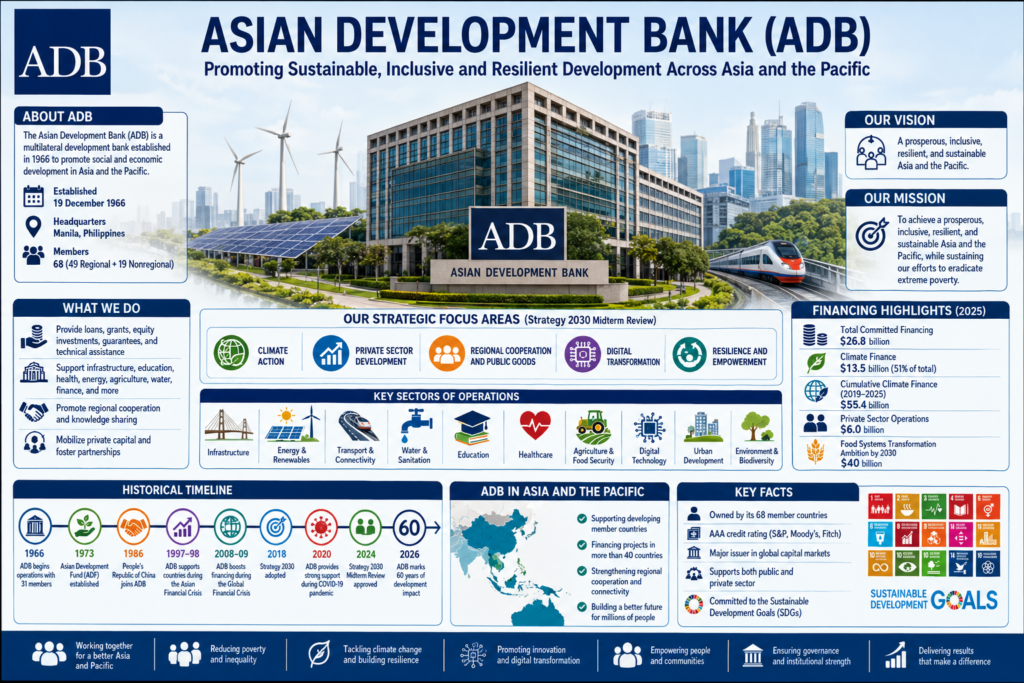
With 68 member countries (49 regional and 19 nonregional as of 2026), ADB continues to evolve in response to emerging global challenges such as climate change, digital disruption, pandemics, economic inequality, and sustainable development.
This comprehensive guide explores ADB’s history, mission, structure, financing mechanisms, development strategies, achievements, challenges, and future priorities.
Quick Facts About the Asian Development Bank
| Feature | Details |
|---|---|
| Full Name | Asian Development Bank |
| Abbreviation | ADB |
| Established | 19 December 1966 |
| Headquarters | Mandaluyong, Metro Manila, Philippines |
| Institution Type | Multilateral Development Bank |
| Region Served | Asia and the Pacific |
| Member Countries (2026) | 68 |
| Regional Members | 49 |
| Nonregional Members | 19 |
| Primary Goal | Promote sustainable, inclusive, and resilient development |
| Official Language | English |
| Main Financial Services | Loans, Grants, Technical Assistance, Equity Investments, Guarantees |
| Current Long-Term Strategy | Strategy 2030 |
What Is the Asian Development Bank (ADB)?
The Asian Development Bank (ADB) is an international financial institution established to support economic and social development across Asia and the Pacific. Unlike commercial banks, ADB does not exist to maximize profits. Instead, its primary purpose is to finance projects that improve living standards, reduce poverty, strengthen economies, and promote sustainable development.
ADB operates as a cooperative institution. Its member countries are both shareholders and beneficiaries, contributing capital while also participating in governance and strategic decision-making.
The bank works closely with:
- National governments
- Local authorities
- State-owned enterprises
- Private sector companies
- Civil society organizations
- International development partners
- Academic institutions
- Regional organizations
Through these partnerships, ADB helps countries address both immediate development needs and long-term structural challenges.
The Historical Background of ADB
Asia After World War II
Following the Second World War, much of Asia faced widespread devastation. Many countries had low incomes, weak infrastructure, limited industrial capacity, inadequate healthcare systems, and underdeveloped education sectors. Rapid population growth further intensified these challenges.
During the 1950s and early 1960s, many newly independent nations sought financial support to accelerate development. Existing global institutions such as the World Bank provided assistance, but many Asian leaders believed the region needed a dedicated institution focused specifically on Asia’s unique development priorities.
This vision laid the foundation for the Asian Development Bank.
The Birth of an Asian Development Institution
The idea of creating a regional development bank gained momentum under the leadership of the United Nations Economic Commission for Asia and the Far East (ECAFE), now known as the United Nations Economic and Social Commission for Asia and the Pacific (ESCAP).
At the First Ministerial Conference on Asian Economic Cooperation in 1963, participating countries adopted a landmark resolution supporting the establishment of a regional financial institution dedicated to Asia’s development.
The proposed institution would:
- Mobilize financial resources
- Encourage regional cooperation
- Reduce poverty
- Support industrialization
- Improve agriculture
- Finance infrastructure
- Promote trade and investment
The proposal received strong backing from governments throughout Asia and the international community.
Establishment of the Asian Development Bank
After several years of negotiations and planning, the Agreement Establishing the Asian Development Bank entered into force in 1966.
ADB officially began operations on:
19 December 1966
Its headquarters were established in Manila, Philippines, after member countries selected the city as the permanent home of the institution.
Initially, the bank consisted of 31 founding members, most of which were developing economies in Asia and the Pacific, along with several industrialized partner countries.
The first President of ADB was Takeshi Watanabe of Japan, who played a pivotal role in shaping the institution during its formative years.
Why Manila Was Chosen as ADB Headquarters
Several cities were considered to host the new institution. Manila was ultimately selected because of:
- Strategic geographic location
- Strong regional connectivity
- Political support from the Philippine government
- Accessibility to member countries
- Availability of diplomatic infrastructure
Today, the ADB headquarters in Mandaluyong, Metro Manila, serves as the institution’s global administrative center and houses thousands of professionals from around the world.
The Early Years (1966–1975)
During its first decade, ADB focused primarily on addressing the urgent development needs of low-income economies.
Its earliest investments emphasized:
- Agricultural modernization
- Rural development
- Irrigation systems
- Food production
- Road construction
- Water supply
- Power generation
- Public institutions
At the time, most Asian economies depended heavily on agriculture, making food security and rural productivity central priorities.
ADB financed projects that increased crop yields, improved irrigation, expanded access to agricultural credit, and strengthened rural infrastructure.
Expansion During the 1970s and 1980s
As Asian economies diversified, ADB broadened its development agenda.
The bank expanded lending for:
- Major highways
- Ports
- Airports
- Telecommunications
- Hydropower
- Industrial development
- Education systems
- Public administration
- Urban planning
During this period, ADB also increased technical assistance programs to strengthen institutional capacity and improve economic policymaking across member countries.
Responding to Economic Crises
Throughout its history, ADB has adapted its operations to support member countries during periods of economic and financial instability.
Notable responses include:
Asian Financial Crisis (1997–1998)
ADB provided emergency financial assistance, policy support, and reforms aimed at stabilizing financial systems and restoring investor confidence.
Global Financial Crisis (2008–2009)
The bank expanded lending to maintain investment, preserve employment, and strengthen infrastructure development during the global economic slowdown.
COVID-19 Pandemic (2020–2022)
ADB launched one of the largest emergency response packages in its history, helping member countries finance healthcare systems, vaccine procurement, social protection programs, and economic recovery initiatives.
Evolution of ADB’s Mission
When ADB began operations in 1966, its primary objective was reducing poverty through agricultural development.
Over the decades, its mission expanded to include:
- Sustainable infrastructure
- Climate resilience
- Renewable energy
- Gender equality
- Regional integration
- Private sector development
- Digital transformation
- Financial inclusion
- Good governance
- Disaster risk management
- Environmental protection
- Innovation-driven growth
Today, ADB aligns many of its activities with the United Nations Sustainable Development Goals (SDGs) and its own long-term Strategy 2030.
Vision of the Asian Development Bank
ADB’s vision is:
“An Asia and Pacific region that is prosperous, inclusive, resilient, and sustainable, while continuing efforts to eradicate extreme poverty.”
This vision emphasizes that economic growth should benefit all people while protecting natural resources and preparing societies for future challenges.
Mission of ADB
The mission of the Asian Development Bank is to help its developing member countries improve the quality of life of their citizens by:
- Reducing poverty
- Promoting inclusive economic growth
- Supporting sustainable development
- Enhancing regional cooperation
- Building resilient infrastructure
- Encouraging innovation
- Strengthening institutions
- Expanding access to quality education and healthcare
- Addressing climate change
- Mobilizing development finance
Core Values of ADB
The institution is guided by several fundamental principles:
- Integrity and accountability
- Transparency
- Inclusiveness
- Sustainability
- Innovation
- Partnership
- Excellence
- Respect for diversity
- Results-oriented development
These values shape ADB’s operations, governance, and relationships with member countries and stakeholders.
Key Milestones in ADB History
| Year | Milestone |
|---|---|
| 1963 | UN conference proposes an Asian development bank |
| 1965 | Agreement establishing ADB signed |
| 1966 | ADB officially begins operations in Manila |
| 1966 | Takeshi Watanabe becomes first President |
| 1970s | Expansion into infrastructure financing |
| 1980s | Increased investment in education and energy |
| 1997 | Asian Financial Crisis support programs |
| 2008 | Global financial crisis response |
| 2015 | Record financing commitments |
| 2017 | Adoption of Strategy 2030 preparation |
| 2018 | Strategy 2030 officially launched |
| 2020 | COVID-19 emergency assistance programs |
| 2021–2026 | Expanded focus on climate finance, digital transformation, resilient infrastructure, and sustainable growth |
Part 2: Organizational Structure, Governance, Membership, and Capital Resources
Understanding how the Asian Development Bank (ADB) is governed is essential to appreciating its effectiveness as one of the world’s leading multilateral development institutions. Unlike commercial banks that primarily focus on profits, ADB is owned by its member countries, which collectively determine its strategic direction, policies, and financial operations.
Its governance model is designed to ensure transparency, accountability, efficiency, and balanced representation among both regional and nonregional members.
Organizational Structure of the Asian Development Bank
ADB operates through a well-defined governance framework that enables it to make strategic decisions, oversee development projects, manage financial resources, and ensure accountability to its shareholders.
The institution consists of several interconnected governing bodies, including:
- Board of Governors
- Board of Directors
- President
- Vice-Presidents
- Management Committee
- Independent Evaluation Department
- Office of Anticorruption and Integrity
- Internal Audit Department
- Operational Departments
- Resident Missions
- Representative Offices
- Administrative and Support Departments
Together, these bodies oversee every aspect of ADB’s development operations across Asia and the Pacific.
Governance Framework
ADB follows international standards of corporate governance based on four key principles:
- Accountability
- Transparency
- Integrity
- Responsible financial management
Its governance structure ensures that member countries participate in decision-making while maintaining professional independence in daily operations.
The governance framework also supports:
- Efficient project approval
- Risk management
- Financial sustainability
- Environmental and social safeguards
- Procurement oversight
- Performance evaluation
- Ethical conduct
Board of Governors
The Board of Governors is the highest decision-making body of the Asian Development Bank.
Every member country appoints:
- One Governor
- One Alternate Governor
These representatives are usually:
- Ministers of Finance
- Ministers of Economy
- Central Bank Governors
- Senior Government Officials
The Board of Governors meets annually during the ADB Annual Meeting to discuss major policy issues affecting the institution and the region.
Powers of the Board of Governors
The Board has authority over the most significant institutional decisions, including:
- Admitting new member countries
- Electing the President
- Increasing authorized capital
- Approving amendments to the ADB Charter
- Reviewing annual financial statements
- Determining long-term institutional strategies
- Approving major governance reforms
While many routine responsibilities are delegated to the Board of Directors, ultimate authority remains with the Board of Governors.
Board of Directors
The Board of Directors is responsible for supervising the day-to-day operations of ADB.
It consists of elected Executive Directors representing constituencies of member countries.
Directors meet regularly to review:
- Loan proposals
- Grant approvals
- Country partnership strategies
- Investment projects
- Budget allocations
- Institutional policies
- Risk management frameworks
- Procurement decisions
The Board ensures that ADB’s operations align with its mission while protecting shareholder interests.
Responsibilities of the Board of Directors
Key responsibilities include:
- Approving development projects
- Monitoring implementation
- Reviewing financial performance
- Evaluating development effectiveness
- Establishing operational policies
- Ensuring environmental compliance
- Overseeing social safeguard policies
- Monitoring governance reforms
- Reviewing institutional risks
This continuous oversight helps maintain high standards of accountability and operational excellence.
President of the Asian Development Bank
The President serves as the chief executive officer of ADB and is responsible for leading the institution.
The President is elected by the Board of Governors for a fixed term and chairs meetings of the Board of Directors.
Major responsibilities include:
- Providing strategic leadership
- Representing ADB internationally
- Managing daily operations
- Overseeing implementation of Strategy 2030
- Strengthening partnerships
- Supervising senior management
- Promoting institutional reforms
- Ensuring operational efficiency
The President also serves as the public face of the institution during international development forums and regional meetings.
Vice-Presidents
Supporting the President are several Vice-Presidents, each responsible for specific operational or administrative portfolios.
Typical areas include:
- Operations
- Finance and Risk Management
- Administration
- Sustainable Development
- Private Sector Operations
- Knowledge Management
Together, they coordinate ADB’s diverse development programs across member countries.
Management Committee
The Management Committee consists of:
- President
- Vice-Presidents
- Managing Director General
- Senior Executives
The committee meets regularly to discuss:
- Institutional priorities
- Budget planning
- Operational performance
- Policy implementation
- Human resource management
- Strategic initiatives
This body ensures effective coordination across all departments.
Resident Missions
ADB maintains resident missions in many developing member countries.
These country offices:
- Coordinate with governments
- Supervise ongoing projects
- Identify new investment opportunities
- Monitor implementation
- Provide technical advice
- Engage with development partners
- Support policy dialogue
Resident missions enable ADB to remain closely connected with local development priorities.
Representative Offices
ADB also operates representative offices outside Asia to strengthen global partnerships.
These offices promote cooperation with:
- Donor governments
- International organizations
- Development agencies
- Research institutions
- Private investors
- Civil society organizations
Independent Evaluation Department
An important feature of ADB’s governance is its Independent Evaluation Department (IED).
The department objectively evaluates:
- Development projects
- Country programs
- Sector strategies
- Institutional performance
- Policy effectiveness
Independent evaluations help improve future operations through evidence-based learning.
Office of Anticorruption and Integrity
ADB maintains strict anti-corruption standards.
The Office of Anticorruption and Integrity investigates:
- Fraud
- Corruption
- Procurement violations
- Misuse of funds
- Conflicts of interest
The office also develops preventive measures and promotes ethical conduct throughout ADB-financed operations.
Internal Audit Department
The Internal Audit Department strengthens governance by reviewing:
- Financial controls
- Operational efficiency
- Compliance systems
- Information technology security
- Risk management processes
Regular audits enhance institutional accountability and safeguard public resources.
Membership of the Asian Development Bank
Membership in ADB is open to countries that are members of the United Nations or its specialized agencies and that accept the provisions of the ADB Charter.
ADB membership has expanded significantly since its establishment.
Membership Growth
| Year | Number of Members |
|---|---|
| 1966 | 31 |
| 1980 | 43 |
| 1995 | 56 |
| 2010 | 67 |
| 2026 | 68 |
Today, ADB includes countries from both inside and outside Asia and the Pacific.
Categories of Membership
ADB classifies its members into two categories:
1. Regional Members
Regional members are countries located in Asia and the Pacific.
They are both:
- Shareholders
- Development beneficiaries
Most borrowing members belong to this category.
2. Nonregional Members
Nonregional members are countries outside Asia and the Pacific that contribute financial resources and participate in governance.
Although they generally do not borrow from ADB, they play a significant role in funding and strategic decision-making.
Regional Members of ADB (2026)
The following countries are regional members:
- Afghanistan
- Armenia
- Australia
- Azerbaijan
- Bangladesh
- Bhutan
- Brunei Darussalam
- Cambodia
- People’s Republic of China
- Cook Islands
- Fiji
- Georgia
- Hong Kong, China
- India
- Indonesia
- Japan
- Kazakhstan
- Kiribati
- Republic of Korea
- Kyrgyz Republic
- Lao PDR
- Malaysia
- Maldives
- Marshall Islands
- Federated States of Micronesia
- Mongolia
- Myanmar
- Nauru
- Nepal
- New Zealand
- Pakistan
- Palau
- Papua New Guinea
- Philippines
- Samoa
- Singapore
- Solomon Islands
- Sri Lanka
- Taipei,China
- Tajikistan
- Thailand
- Timor-Leste
- Tonga
- Turkmenistan
- Tuvalu
- Uzbekistan
- Vanuatu
- Viet Nam
- Niue (newest regional member)
Nonregional Members
ADB’s nonregional members include:
- Austria
- Belgium
- Canada
- Denmark
- Finland
- France
- Germany
- Ireland
- Italy
- Luxembourg
- Netherlands
- Norway
- Portugal
- Spain
- Sweden
- Switzerland
- Türkiye
- United Kingdom
- United States
These countries provide capital, technical expertise, and development partnerships.
Shareholding Structure
ADB operates as a shareholder-owned institution.
Each member subscribes to shares of the bank’s capital stock.
Voting power is determined by:
- Basic votes shared equally among members
- Share votes based on subscribed capital
Countries with larger capital subscriptions generally possess greater voting influence.
Largest Shareholders
The largest shareholders include:
- Japan
- United States
- People’s Republic of China
- India
- Australia
These countries play an important role in governance while decisions are made through multilateral processes.
Voting System
ADB’s voting structure balances equality with financial participation.
Each member receives:
- A fixed number of basic votes
- Additional votes proportional to its shareholding
This approach ensures that both smaller and larger members have representation while recognizing capital contributions.
Capital Resources
ADB finances its operations through a diversified capital base.
Major sources include:
1. Paid-In Capital
Member countries contribute capital directly to the institution.
2. Callable Capital
Callable capital serves as a financial guarantee and can be requested only if necessary to meet ADB’s obligations.
3. Borrowing from International Capital Markets
ADB enjoys a strong international credit rating, enabling it to issue highly rated bonds worldwide at competitive interest rates.
4. Retained Earnings
Income generated from lending operations is reinvested to strengthen ADB’s financial position and expand future development financing.
5. Trust Funds
Special trust funds established by donor countries support targeted development initiatives such as:
- Climate adaptation
- Renewable energy
- Disaster recovery
- Education
- Gender equality
- Fragile and conflict-affected states
Financial Strength
ADB consistently maintains one of the highest credit ratings among multilateral development banks.
Its strong financial position enables it to:
- Borrow at low cost
- Provide affordable financing
- Mobilize private investment
- Support large-scale infrastructure projects
- Respond rapidly during economic crises
Prudent risk management and diversified funding sources have helped preserve its financial stability for decades.
Key Takeaways
- ADB is governed by a robust framework centered on the Board of Governors, Board of Directors, and the President.
- It has grown from 31 founding members in 1966 to 68 members by 2026, including 49 regional and 19 nonregional members.
- Its shareholder model combines equal representation with capital-based voting.
- ADB’s strong capital base, high credit ratings, and global bond issuances enable it to finance sustainable development across Asia and the Pacific.
Part 3: Objectives, Functions, Financial Assistance, and Development Operations
The Asian Development Bank (ADB) is more than a financial institution—it is a strategic development partner committed to improving lives across Asia and the Pacific. Through financing, technical expertise, policy advice, and regional cooperation, ADB helps member countries overcome development challenges and build more resilient, inclusive, and sustainable economies.
This section explores ADB’s objectives, core functions, financing instruments, and how it delivers development assistance to governments and the private sector.
Objectives of the Asian Development Bank
The overarching objective of ADB is to promote sustainable, inclusive, and resilient economic development while continuing efforts to eradicate extreme poverty across Asia and the Pacific.
Over the decades, ADB’s objectives have evolved from supporting agricultural development to addressing modern challenges such as climate change, digital transformation, urbanization, and regional integration.
Its principal objectives include:
- Reducing poverty and inequality
- Promoting sustainable economic growth
- Supporting environmentally responsible development
- Strengthening regional cooperation and integration
- Improving infrastructure and connectivity
- Encouraging private sector participation
- Expanding access to quality education and healthcare
- Enhancing financial inclusion
- Building resilience against natural disasters and climate change
- Supporting good governance and institutional capacity
These objectives align closely with the United Nations Sustainable Development Goals (SDGs) and ADB’s Strategy 2030.
Mission of ADB
ADB’s mission is to help its developing member countries achieve long-term prosperity by providing financial resources, technical expertise, and knowledge solutions.
Rather than simply financing projects, ADB works with governments and stakeholders to ensure investments produce measurable social, economic, and environmental benefits.
Its mission emphasizes:
- Inclusive development
- Sustainable infrastructure
- Regional prosperity
- Innovation
- Climate resilience
- Shared economic growth
Core Functions of ADB
ADB performs several interconnected functions that distinguish it from traditional commercial banks.
1. Providing Development Finance
ADB’s primary function is to mobilize and provide financial resources for development projects.
These resources help finance:
- Highways
- Bridges
- Railways
- Airports
- Ports
- Renewable energy
- Water supply
- Sanitation
- Schools
- Hospitals
- Digital infrastructure
- Climate adaptation projects
Long-term financing enables governments to undertake projects that might otherwise be unaffordable.
2. Offering Technical Assistance
Financing alone cannot guarantee successful development outcomes. Many countries also require technical expertise to design, implement, and evaluate complex projects.
ADB provides technical assistance in areas such as:
- Project preparation
- Feasibility studies
- Procurement planning
- Environmental assessments
- Economic analysis
- Institutional reforms
- Public financial management
- Capacity building
- Digital transformation
- Climate policy
Technical assistance often helps governments strengthen institutions and improve long-term governance.
3. Supporting Policy Reforms
ADB works closely with governments to improve policy frameworks that encourage sustainable economic growth.
Policy-based support may include reforms related to:
- Tax administration
- Public finance
- Banking regulation
- Trade liberalization
- Energy pricing
- Investment policies
- Public sector management
- Social protection systems
These reforms help create stronger institutions and more competitive economies.
4. Mobilizing Additional Investment
ADB leverages its strong credit standing to attract financing from other sources.
Through cofinancing arrangements, the bank mobilizes resources from:
- Bilateral development agencies
- Commercial banks
- Institutional investors
- Export credit agencies
- Sovereign wealth funds
- Philanthropic organizations
- Climate funds
- International financial institutions
This multiplies the impact of ADB’s own financing.
5. Promoting Knowledge Sharing
ADB serves as a knowledge institution by conducting research and disseminating best practices.
Its publications include:
- Economic Outlook reports
- Development indicators
- Country diagnostics
- Sector assessments
- Climate studies
- Policy papers
- Statistical databases
These resources support evidence-based policymaking throughout the region.
6. Encouraging Regional Cooperation
Many development challenges extend beyond national borders.
ADB promotes cooperation in areas including:
- Cross-border transportation
- Regional electricity markets
- Trade facilitation
- Customs modernization
- Water resource management
- Pandemic preparedness
- Disaster risk reduction
- Digital connectivity
Regional collaboration helps countries achieve shared prosperity.
Types of Financial Assistance
ADB provides several forms of financial support tailored to different development needs.
Its main financial instruments include:
- Sovereign loans
- Non-sovereign loans
- Grants
- Technical assistance
- Guarantees
- Equity investments
- Cofinancing
Each instrument serves distinct development objectives.
Sovereign Loans
Sovereign loans are extended to national governments or government-guaranteed entities.
These loans finance public investment projects such as:
- National highways
- Rural roads
- Metro rail systems
- Schools
- Universities
- Hospitals
- Power transmission
- Flood control systems
- Water treatment facilities
Repayment terms are generally longer and more favorable than commercial borrowing.
Characteristics of Sovereign Loans
Typical features include:
- Long repayment periods
- Grace periods before repayment begins
- Competitive interest rates
- Flexible financing structures
- Strong development focus
These terms help governments invest in long-term infrastructure without placing excessive pressure on public finances.
Non-Sovereign Operations
ADB also finances private sector projects without requiring government guarantees.
These operations support:
- Renewable energy companies
- Manufacturing
- Financial institutions
- Agribusiness
- Telecommunications
- Healthcare providers
- Educational institutions
- Logistics companies
Private sector financing helps stimulate innovation, employment, and economic diversification.
Benefits of Private Sector Operations
ADB’s involvement often:
- Attracts additional investors
- Reduces investment risks
- Improves environmental standards
- Strengthens corporate governance
- Encourages sustainable business practices
- Expands access to finance
Private investment complements public development efforts.
Grants
Some developing member countries face limited borrowing capacity due to income levels or debt sustainability concerns.
For these countries, ADB provides grants that do not require repayment.
Grant financing commonly supports:
- Fragile states
- Small island developing states
- Climate adaptation
- Disaster recovery
- Health initiatives
- Education
- Rural development
- Community infrastructure
Grants enable essential investments where borrowing may not be appropriate.
Technical Assistance
Technical assistance (TA) remains one of ADB’s most valuable development tools.
TA projects support:
- Institutional strengthening
- Government training
- Digital government
- Financial management
- Procurement reform
- Legal frameworks
- Environmental safeguards
- Project monitoring
- Economic planning
Technical assistance often precedes major investment projects by ensuring proper preparation and implementation.
Guarantees
ADB provides guarantees that reduce risks for private investors and lenders.
Guarantees encourage investment in sectors where financing may otherwise be difficult.
Common uses include:
- Infrastructure concessions
- Public-private partnerships
- Renewable energy
- Transport projects
- Municipal infrastructure
Risk-sharing mechanisms improve investor confidence and mobilize additional capital.
Equity Investments
In selected cases, ADB invests directly in companies through equity participation.
These investments aim to:
- Promote innovation
- Strengthen financial institutions
- Support clean energy
- Expand infrastructure
- Encourage sustainable business models
Equity investments are typically made alongside other institutional investors.
Cofinancing Operations
ADB frequently partners with other organizations to finance major development initiatives.
Cofinancing expands available resources and enables larger projects than ADB could support independently.
Partners include:
- World Bank Group
- Asian Infrastructure Investment Bank (AIIB)
- Japan International Cooperation Agency (JICA)
- Agence Française de Développement (AFD)
- KfW Development Bank
- Islamic Development Bank (IsDB)
- European Investment Bank (EIB)
- Green Climate Fund
- Global Environment Facility
- Bilateral donor agencies
How ADB Finances Development Projects
ADB follows a structured project cycle designed to maximize development impact and ensure accountability.
Step 1: Country Partnership Strategy
ADB works with each developing member country to identify priority sectors and long-term development goals.
Step 2: Project Identification
Potential projects are identified through consultations with governments, communities, experts, and development partners.
Step 3: Project Preparation
ADB conducts detailed analyses covering:
- Economic feasibility
- Financial viability
- Environmental impact
- Social safeguards
- Procurement arrangements
- Risk assessment
Step 4: Approval
The Board of Directors reviews project proposals before approving financing.
Step 5: Implementation
Once approved, projects are implemented by executing agencies with ADB supervision.
Implementation includes:
- Procurement
- Construction
- Financial management
- Monitoring
- Capacity building
Step 6: Monitoring and Evaluation
ADB continuously monitors project performance using measurable indicators.
Independent evaluations assess:
- Effectiveness
- Efficiency
- Sustainability
- Development impact
- Lessons learned
Development Impact
ADB-financed projects have contributed to significant improvements across Asia and the Pacific.
Examples of outcomes include:
- Expanded access to electricity
- Improved transportation networks
- Safer drinking water
- Better sanitation services
- Enhanced healthcare facilities
- Increased school enrollment
- Greater renewable energy capacity
- Stronger financial systems
- Improved disaster resilience
While outcomes vary by country and project, ADB emphasizes measurable results and long-term sustainability.
Strategy 2030 Operational Priorities
ADB’s current operations are guided by Strategy 2030, which identifies seven operational priorities:
- Address remaining poverty and reduce inequalities.
- Accelerate progress in gender equality.
- Tackle climate change, build climate and disaster resilience, and enhance environmental sustainability.
- Make cities more livable.
- Promote rural development and food security.
- Strengthen governance and institutional capacity.
- Foster regional cooperation and integration.
These priorities shape project selection, financing decisions, and policy engagement across member countries.
Key Takeaways
- ADB combines financing with technical expertise, policy advice, and knowledge sharing.
- Its assistance includes sovereign loans, private sector financing, grants, technical assistance, guarantees, equity investments, and cofinancing.
- Development projects follow a rigorous lifecycle from planning to independent evaluation.
- Strategy 2030 guides ADB’s efforts to promote inclusive, resilient, and environmentally sustainable growth across Asia and the Pacific.
Part 4: Core Areas of Operations
The Asian Development Bank (ADB) invests in a wide range of development sectors to help its developing member countries achieve sustainable, inclusive, and resilient growth. Its operations are guided by Strategy 2030, which prioritizes investments that reduce poverty, improve quality of life, strengthen infrastructure, promote environmental sustainability, and enhance regional cooperation.
ADB concentrates its resources on sectors where it has strong technical expertise and a proven track record. These investments not only support economic growth but also improve social welfare, strengthen institutions, and prepare countries for future challenges such as climate change, rapid urbanization, and digital transformation.
Infrastructure Development
Infrastructure is the cornerstone of economic development. Reliable infrastructure connects people to markets, supports businesses, improves access to essential services, and creates employment opportunities. Consequently, infrastructure has consistently been the largest area of ADB’s investment portfolio.
ADB finances projects that modernize and expand:
- National highways
- Expressways
- Rural roads
- Railways
- Airports
- Seaports
- Urban transit systems
- Bridges
- Water infrastructure
- Power transmission networks
- Digital infrastructure
High-quality infrastructure reduces transportation costs, increases productivity, promotes trade, and attracts domestic and foreign investment.
Importance of Infrastructure Investment
Well-developed infrastructure contributes to:
- Faster economic growth
- Increased industrial productivity
- Improved rural connectivity
- Reduced logistics costs
- Better access to healthcare and education
- Enhanced regional trade
- Greater employment opportunities
- Improved disaster resilience
ADB also encourages infrastructure projects that are environmentally sustainable, climate-resilient, and socially inclusive.
Energy and Renewable Energy
Affordable, reliable, and clean energy is essential for sustainable development. Millions of people across Asia and the Pacific still face challenges related to electricity access, energy affordability, and energy security.
ADB supports countries in expanding energy access while accelerating the transition toward low-carbon energy systems.
Major Areas of Energy Investment
ADB finances:
- Solar power plants
- Wind farms
- Hydropower projects
- Geothermal energy
- Battery energy storage systems
- Smart electricity grids
- Rural electrification
- Cross-border power transmission
- Energy efficiency improvements
- Clean cooking initiatives
The institution increasingly prioritizes renewable energy and has committed significant resources to supporting countries in reducing greenhouse gas emissions.
Energy Security
ADB promotes energy security by helping countries:
- Diversify energy sources
- Improve grid reliability
- Reduce dependence on imported fossil fuels
- Modernize electricity infrastructure
- Expand regional power trade
Reliable energy systems contribute to industrial development, digital transformation, and improved living standards.
Water Supply and Sanitation
Access to clean water and safe sanitation is fundamental to public health, environmental sustainability, and economic productivity.
ADB supports projects that improve water resource management and expand access to safe drinking water.
Key Areas of Support
Projects include:
- Urban water supply systems
- Rural water services
- Water treatment facilities
- Wastewater management
- Sewerage systems
- Flood management
- Irrigation modernization
- Integrated water resource management
- Water conservation technologies
Improved water infrastructure helps reduce waterborne diseases, supports agriculture, and enhances climate resilience.
Sustainable Water Management
ADB encourages countries to adopt integrated approaches that balance:
- Water supply
- Agricultural needs
- Industrial demand
- Ecosystem protection
- Climate adaptation
These strategies ensure long-term water security in the face of growing populations and changing weather patterns.
Transport and Connectivity
Efficient transportation networks are essential for economic integration, trade, tourism, and regional development.
ADB finances transport projects that improve connectivity within countries and across borders.
Transport Sectors Supported
Investments include:
- National highways
- Urban mass transit
- Metro rail systems
- High-speed rail
- Rural road networks
- Bridges
- Ports
- Airports
- Inland waterways
- Border infrastructure
- Intelligent transport systems
Improved transport networks reduce travel time, lower transportation costs, and strengthen regional integration.
Regional Connectivity
ADB actively supports cross-border infrastructure initiatives that facilitate:
- International trade
- Tourism
- Regional supply chains
- Economic cooperation
- People-to-people connectivity
Examples include transport corridors linking South Asia, Southeast Asia, Central Asia, and the Pacific.
Urban Development
Asia is experiencing one of the fastest rates of urbanization in history. Rapid population growth in cities creates challenges related to housing, transportation, sanitation, pollution, and public services.
ADB helps cities become more sustainable, inclusive, and resilient.
Urban Development Projects
Support includes:
- Affordable housing
- Public transportation
- Urban water supply
- Waste management
- Smart city technologies
- Flood protection
- Public parks
- Climate-resilient infrastructure
- Urban planning
- Municipal governance
ADB promotes integrated urban development that balances economic growth with environmental sustainability.
Smart Cities
ADB increasingly supports smart city initiatives using:
- Digital technologies
- Intelligent traffic management
- Energy-efficient buildings
- Smart water systems
- Geographic information systems
- Digital public services
These innovations improve service delivery while reducing environmental impacts.
Information and Communication Technology (ICT)
Digital transformation has become a major driver of economic development.
ADB supports ICT investments that improve digital connectivity and expand access to modern technologies.
Areas of ICT Investment
Projects include:
- Broadband expansion
- Fiber-optic networks
- Digital government platforms
- E-learning infrastructure
- Digital health systems
- Cybersecurity
- Digital payment systems
- Cloud infrastructure
- Data centers
- Artificial intelligence applications
Digital infrastructure helps governments deliver services more efficiently while improving access to education, healthcare, and financial services.
Bridging the Digital Divide
ADB works to reduce inequalities in digital access by supporting:
- Rural internet connectivity
- Affordable broadband
- Digital literacy programs
- Women’s digital inclusion
- Digital skills training
These initiatives contribute to inclusive economic growth and innovation.
Environmental Sustainability
Environmental protection is integrated across nearly all ADB operations.
The bank recognizes that economic development must be achieved without compromising natural ecosystems or future generations.
Environmental Priorities
ADB supports:
- Biodiversity conservation
- Forest management
- Air pollution reduction
- Sustainable land management
- Marine ecosystem protection
- Circular economy initiatives
- Waste reduction
- Climate adaptation
- Climate mitigation
Environmental safeguards are applied to all major investment projects.
Green Infrastructure
ADB increasingly finances:
- Nature-based solutions
- Green buildings
- Low-carbon transport
- Sustainable urban infrastructure
- Renewable energy
- Climate-smart agriculture
These investments contribute to long-term environmental resilience.
Education
Education is one of the most powerful drivers of economic and social development.
ADB invests in education systems that prepare individuals for the changing demands of modern economies.
Education Projects
Support includes:
- Primary education
- Secondary education
- Technical and vocational education
- Higher education
- Teacher training
- Digital classrooms
- STEM education
- Curriculum modernization
- School infrastructure
- Inclusive education
ADB also promotes lifelong learning and workforce development.
Skills Development
Modern economies require workers with advanced technical and digital skills.
ADB supports programs that strengthen:
- Technical education
- Vocational training
- Entrepreneurship
- Innovation
- Research institutions
- University partnerships
These investments enhance labor productivity and economic competitiveness.
Healthcare
Healthy populations are essential for sustainable development.
ADB finances health sector reforms and infrastructure that improve access to quality healthcare services.
Healthcare Investments
Projects include:
- Hospitals
- Community health centers
- Disease surveillance systems
- Laboratory capacity
- Emergency preparedness
- Maternal and child health
- Vaccination programs
- Telemedicine
- Health information systems
- Medical workforce training
The COVID-19 pandemic further reinforced the importance of resilient healthcare systems across the region.
Universal Health Coverage
ADB assists governments in strengthening health financing and expanding equitable access to essential healthcare services.
Its programs aim to reduce disparities between urban and rural populations while improving overall health outcomes.
Agriculture and Natural Resources
Although Asia has undergone rapid industrialization, agriculture remains a critical source of employment and food security for millions of people.
ADB supports agricultural modernization while promoting sustainable natural resource management.
Agricultural Investments
Projects focus on:
- Irrigation
- Agricultural research
- Climate-smart farming
- Rural roads
- Agricultural value chains
- Food storage
- Market access
- Fisheries
- Livestock
- Forestry
These initiatives improve productivity, farmer incomes, and food security.
Sustainable Resource Management
ADB encourages responsible management of:
- Forests
- Rivers
- Coastal ecosystems
- Fisheries
- Agricultural land
- Biodiversity
Sustainable resource use helps preserve ecosystems while supporting economic growth.
Finance Sector Development
A strong financial system enables businesses to invest, households to save, and economies to grow.
ADB supports financial sector reforms that improve stability, efficiency, and access to finance.
Areas of Support
ADB assists with:
- Banking sector reform
- Capital market development
- Microfinance
- Financial inclusion
- Digital finance
- SME financing
- Financial regulation
- Insurance markets
- Green finance
- Sustainable investment frameworks
Financial sector development promotes entrepreneurship, investment, and economic resilience.
Financial Inclusion
ADB places particular emphasis on expanding access to financial services for:
- Women
- Rural communities
- Small businesses
- Low-income households
- Youth entrepreneurs
Greater financial inclusion contributes to poverty reduction and economic empowerment.
Public Sector Management
Effective public institutions are fundamental to successful development.
ADB works with governments to strengthen governance, improve public services, and enhance institutional capacity.
Public Sector Reforms
Support includes:
- Public financial management
- Tax administration
- Budget reform
- Civil service modernization
- Procurement systems
- E-government
- Anti-corruption measures
- Regulatory reform
- Decentralization
- Public investment management
Improved governance enhances transparency, accountability, and efficient use of public resources.
Climate Change and Disaster Resilience
Asia and the Pacific are among the regions most vulnerable to climate change and natural disasters.
ADB has significantly increased investments in climate adaptation and disaster resilience to help countries prepare for future risks.
Climate Change Initiatives
ADB supports:
- Climate adaptation projects
- Flood control infrastructure
- Coastal protection
- Drought management
- Early warning systems
- Climate-resilient agriculture
- Renewable energy
- Carbon reduction initiatives
- Green transport
- Sustainable urban planning
These investments strengthen resilience while supporting low-carbon development.
Disaster Risk Management
ADB helps countries prepare for and recover from disasters through:
- Earthquake-resistant infrastructure
- Cyclone shelters
- Emergency response systems
- Disaster financing mechanisms
- Risk assessments
- Community resilience programs
- Reconstruction assistance
- Insurance solutions
Building resilience reduces economic losses and protects vulnerable communities.
Cross-Cutting Themes
Across all sectors, ADB integrates several cross-cutting priorities into its operations:
- Gender equality and women’s empowerment
- Digital innovation
- Climate resilience
- Private sector participation
- Inclusive development
- Good governance
- Regional cooperation
- Environmental and social safeguards
- Knowledge sharing
- Results-based management
These themes ensure that development investments generate long-term and equitable benefits.
Key Takeaways
- Infrastructure remains ADB’s largest area of investment, supporting transportation, energy, water, and digital connectivity.
- Renewable energy and climate action are increasingly central to ADB’s development strategy.
- Investments in education, healthcare, agriculture, finance, and governance complement infrastructure by strengthening human capital and institutions.
- Climate resilience, environmental sustainability, and digital transformation are integrated across nearly all ADB-financed projects.
- Through these core operational areas, ADB helps its developing member countries pursue sustainable, inclusive, and resilient growth.
The Asian Development Bank (ADB): History, Functions, Membership, Projects, and Global Impact (2026 Guide)
Part 5: Regional Cooperation, Poverty Reduction, Sustainable Development, and Strategic Development Priorities
The Asian Development Bank (ADB) recognizes that many of the challenges facing Asia and the Pacific—including poverty, climate change, food insecurity, pandemics, and economic inequality—cannot be solved by individual countries alone. As a result, ADB promotes regional collaboration while supporting national development strategies that foster inclusive, sustainable, and resilient growth.
Through financial assistance, policy advice, technical expertise, and strategic partnerships, ADB helps its developing member countries achieve long-term development goals that benefit both present and future generations.
Regional Cooperation and Integration (RCI)
Regional Cooperation and Integration (RCI) is one of ADB’s core operational priorities under Strategy 2030. The bank believes that closer economic cooperation among neighboring countries promotes peace, stability, trade, investment, and shared prosperity.
By supporting regional initiatives, ADB helps member countries address challenges that cross national borders, such as transportation, energy security, environmental protection, public health, and disaster management.
Objectives of Regional Cooperation
ADB promotes regional integration to:
- Increase cross-border trade
- Improve transportation connectivity
- Facilitate investment flows
- Enhance energy security
- Strengthen regional supply chains
- Promote tourism
- Encourage knowledge sharing
- Improve customs cooperation
- Enhance food security
- Build resilience against regional crises
Regional integration enables countries to benefit from larger markets, economies of scale, and shared infrastructure.
Major Regional Cooperation Programs
ADB supports several regional cooperation initiatives across Asia and the Pacific.
Central Asia Regional Economic Cooperation (CAREC)
CAREC promotes economic cooperation among Central Asian countries through investments in:
- Transport corridors
- Trade facilitation
- Energy connectivity
- Economic diversification
- Digital connectivity
The program strengthens regional competitiveness and improves access to international markets.
Greater Mekong Subregion (GMS)
The Greater Mekong Subregion Program promotes cooperation among countries connected by the Mekong River.
Key areas include:
- Transportation
- Energy
- Agriculture
- Tourism
- Environmental protection
- Urban development
- Digital infrastructure
Improved connectivity has strengthened regional trade and investment.
South Asia Subregional Economic Cooperation (SASEC)
SASEC supports regional integration among South Asian economies through investments in:
- Highways
- Railways
- Energy transmission
- Trade facilitation
- Border modernization
- Digital connectivity
The initiative enhances economic cooperation throughout South Asia.
Pacific Regional Cooperation
ADB also works closely with Pacific Island countries to strengthen:
- Climate resilience
- Maritime transport
- Renewable energy
- Telecommunications
- Disaster preparedness
- Fisheries management
Regional collaboration is particularly important for small island developing states.
Poverty Reduction Strategies
Reducing poverty remains at the heart of ADB’s mission.
Although Asia has experienced remarkable economic growth over recent decades, millions of people still face:
- Income inequality
- Limited access to healthcare
- Poor education
- Inadequate housing
- Food insecurity
- Unemployment
- Vulnerability to climate change
ADB addresses poverty through a comprehensive development approach rather than income support alone.
Inclusive Economic Growth
ADB promotes growth that benefits all segments of society rather than a limited portion of the population.
Inclusive growth focuses on:
- Job creation
- Equal opportunities
- Rural development
- Social inclusion
- Skills development
- Small business support
- Infrastructure access
- Financial inclusion
By expanding economic opportunities, ADB helps reduce long-term poverty.
Social Protection
ADB supports governments in strengthening social protection systems through:
- Cash transfer programs
- Pension reforms
- Employment programs
- Health insurance
- Disaster assistance
- Food security initiatives
Strong social safety nets improve resilience during economic shocks.
Rural Development
Many poor households continue to live in rural communities.
ADB finances projects that improve:
- Rural roads
- Irrigation
- Agricultural productivity
- Rural healthcare
- Rural education
- Market access
- Digital connectivity
These investments increase incomes while reducing regional disparities.
Sustainable Development Goals (SDGs)
ADB aligns its operations closely with the United Nations Sustainable Development Goals (SDGs) adopted in 2015.
The SDGs provide a global framework for ending poverty, protecting the environment, and promoting prosperity by 2030.
ADB contributes directly to many SDGs, including:
- SDG 1 – No Poverty
- SDG 2 – Zero Hunger
- SDG 3 – Good Health and Well-being
- SDG 4 – Quality Education
- SDG 5 – Gender Equality
- SDG 6 – Clean Water and Sanitation
- SDG 7 – Affordable and Clean Energy
- SDG 8 – Decent Work and Economic Growth
- SDG 9 – Industry, Innovation and Infrastructure
- SDG 10 – Reduced Inequalities
- SDG 11 – Sustainable Cities and Communities
- SDG 13 – Climate Action
- SDG 16 – Peace, Justice and Strong Institutions
- SDG 17 – Partnerships for the Goals
ADB integrates these goals into project design, implementation, and evaluation.
Climate Finance
Climate change represents one of the greatest development challenges facing Asia and the Pacific.
The region is particularly vulnerable to:
- Rising sea levels
- Floods
- Cyclones
- Heatwaves
- Droughts
- Glacial melting
- Biodiversity loss
ADB has significantly expanded climate-related investments to support adaptation and mitigation efforts.
Climate Adaptation
ADB finances projects that help communities adapt to changing climate conditions.
Examples include:
- Coastal protection
- Flood control systems
- Climate-resilient agriculture
- Water conservation
- Disaster-resistant infrastructure
- Urban drainage improvements
- Early warning systems
Adaptation investments reduce vulnerability while protecting lives and livelihoods.
Climate Mitigation
Mitigation efforts focus on reducing greenhouse gas emissions.
ADB supports:
- Renewable energy
- Electric mobility
- Energy efficiency
- Sustainable transport
- Green buildings
- Low-carbon infrastructure
- Forest conservation
These initiatives contribute to global climate goals while promoting sustainable economic growth.
Gender Equality and Women’s Empowerment
ADB recognizes that gender equality is essential for sustainable development.
When women have equal access to education, employment, finance, and leadership opportunities, economies become more productive and inclusive.
Gender-Focused Programs
ADB supports initiatives that promote:
- Girls’ education
- Women’s entrepreneurship
- Access to finance
- Maternal healthcare
- Leadership development
- Equal employment opportunities
- Gender-responsive infrastructure
- Protection from gender-based violence
Gender equality is integrated across many ADB-financed projects.
Women’s Economic Participation
ADB encourages greater participation of women in:
- Small businesses
- Agriculture
- Technology
- Financial services
- Public administration
- Engineering
- Renewable energy
- Digital industries
Expanding opportunities for women contributes to higher household incomes and stronger economic growth.
Digital Transformation
Digital technologies are reshaping economies worldwide.
ADB supports countries in harnessing digital innovation to improve public services, increase productivity, and expand economic opportunities.
Digital Priorities
Projects include:
- E-government
- Digital identity systems
- Broadband infrastructure
- Digital education
- Telemedicine
- Fintech
- Digital payments
- Cybersecurity
- Artificial intelligence applications
- Cloud computing
Digital transformation enhances efficiency while reducing barriers to development.
Digital Inclusion
ADB promotes equitable access to technology by supporting:
- Rural internet expansion
- Affordable broadband
- Digital literacy
- Women’s digital participation
- Digital entrepreneurship
- Skills development
Closing the digital divide ensures broader participation in the digital economy.
Private Sector Development
The private sector plays a crucial role in economic growth, innovation, and employment creation.
ADB works to create an enabling environment where businesses can thrive while contributing to sustainable development.
Support for Private Enterprises
ADB provides:
- Direct loans
- Equity investments
- Credit guarantees
- Advisory services
- Risk-sharing mechanisms
These financial instruments encourage investment in sectors that generate strong development impacts.
Small and Medium-Sized Enterprises (SMEs)
SMEs account for a large share of employment across Asia.
ADB supports SME growth by improving:
- Access to finance
- Business development services
- Digital technologies
- Market access
- Innovation
- Supply chain integration
Strong SME sectors contribute to inclusive economic growth.
Disaster Risk Management
Asia and the Pacific experience a significant proportion of the world’s natural disasters.
Earthquakes, floods, typhoons, droughts, volcanic eruptions, and tsunamis frequently threaten development gains.
ADB integrates disaster risk management into its development strategy.
Disaster Preparedness
ADB finances investments in:
- Early warning systems
- Hazard mapping
- Emergency communication systems
- Evacuation infrastructure
- Community preparedness
- Disaster-resilient schools
- Emergency healthcare facilities
Preparedness reduces disaster-related losses and strengthens resilience.
Post-Disaster Recovery
Following natural disasters, ADB provides support for:
- Emergency financing
- Infrastructure reconstruction
- Housing recovery
- Livelihood restoration
- Public service rehabilitation
- Institutional strengthening
Rapid recovery helps affected communities rebuild more effectively.
Green Finance
Green finance refers to investments that generate positive environmental outcomes while supporting sustainable economic development.
ADB has become one of the world’s leading promoters of green finance.
Green Investment Areas
Projects include:
- Renewable energy
- Green transport
- Sustainable agriculture
- Climate-smart infrastructure
- Forest conservation
- Water resource management
- Energy-efficient buildings
- Circular economy initiatives
Green investments support both environmental protection and economic growth.
Green Bonds
ADB raises funds through the issuance of green bonds in international capital markets.
The proceeds finance environmentally sustainable projects that contribute to:
- Carbon reduction
- Renewable energy
- Climate resilience
- Sustainable infrastructure
Green bonds also encourage greater participation by institutional investors seeking environmentally responsible investments.
Measuring Development Results
ADB places strong emphasis on accountability and measurable development outcomes.
Every project is monitored throughout its lifecycle to ensure resources achieve intended results.
Results-Based Management
ADB uses a results-based management framework that evaluates:
- Project effectiveness
- Financial efficiency
- Environmental performance
- Social impact
- Institutional strengthening
- Long-term sustainability
Lessons learned are incorporated into future operations.
Performance Indicators
Projects are assessed using indicators such as:
- Households connected to electricity
- Kilometers of roads constructed
- Schools built or upgraded
- Hospitals improved
- People gaining access to clean water
- Jobs created
- Greenhouse gas emissions reduced
- Farmers benefiting from irrigation
- Businesses receiving financial support
These indicators help demonstrate the real-world impact of ADB-financed investments.
Independent Evaluation
The Independent Evaluation Department (IED) conducts objective assessments of completed projects and country programs.
Evaluations examine:
- Relevance
- Effectiveness
- Efficiency
- Sustainability
- Development impact
Independent reviews strengthen transparency and improve future project design.
Partnerships for Greater Impact
ADB works closely with a broad range of partners to maximize development outcomes, including:
- National governments
- United Nations agencies
- World Bank Group
- Asian Infrastructure Investment Bank (AIIB)
- Islamic Development Bank (IsDB)
- Bilateral development agencies
- Civil society organizations
- Academic institutions
- Private investors
- Regional organizations
These partnerships allow ADB to mobilize additional financial resources, share expertise, and coordinate development efforts across sectors and countries.
Key Takeaways
- Regional cooperation enables countries to address shared development challenges through coordinated investments and policy dialogue.
- Poverty reduction remains central to ADB’s mission and is pursued through inclusive growth, social protection, and rural development.
- ADB aligns its operations with the United Nations Sustainable Development Goals (SDGs) and integrates climate action, gender equality, and digital transformation into its projects.
- Private sector development, green finance, and disaster risk management have become increasingly important components of ADB’s development strategy.
- Through rigorous monitoring, evaluation, and results-based management, ADB ensures that its investments deliver measurable and lasting development outcomes.
Part 6: ADB Operations by Region, Major Projects, Country Partnerships, and Development Case Studies
The Asian Development Bank operates across one of the world’s most geographically, economically, and culturally diverse regions. Its developing member countries include large emerging economies, landlocked states, fragile and conflict-affected economies, and small Pacific island nations exposed to severe climate and disaster risks.
Because development conditions differ considerably across Asia and the Pacific, ADB does not apply a single model to every country. Instead, it develops country partnership strategies, regional cooperation programs, sector plans, and project portfolios tailored to national priorities.
ADB’s regional operations generally focus on:
- Sustainable and climate-resilient infrastructure
- Poverty reduction and social inclusion
- Energy security and clean energy
- Urban development
- Transport and trade connectivity
- Education, healthcare, and skills development
- Agriculture and food security
- Financial-sector reform
- Governance and institutional capacity
- Private-sector development
- Digital transformation
- Regional cooperation and integration
Through these activities, ADB combines financing with technical assistance, policy dialogue, knowledge services, safeguards, and partnerships with governments, businesses, civil society, and other development institutions.
ADB Operations by Region
ADB organizes much of its development work through regional and country-focused departments. Its operational priorities reflect both the shared challenges of Asia and the Pacific and the particular needs of individual economies.
The principal geographic areas covered in this section are:
- South Asia
- Southeast Asia
- East Asia
- Central and West Asia
- The Pacific
Across all regions, ADB increasingly emphasizes climate resilience, private capital mobilization, gender equality, digital technology, and projects capable of producing measurable development results.
ADB Operations in South Asia
South Asia is home to a large share of the world’s population and includes some of its fastest-growing economies. It also faces major challenges, including income inequality, infrastructure deficits, climate vulnerability, urban congestion, unemployment, and unequal access to essential services.
ADB’s South Asia operations cover Bangladesh, Bhutan, India, Maldives, Nepal, and Sri Lanka. (adb.org)
Principal Areas of Support
ADB’s work in South Asia commonly includes:
- Roads, railways, ports, and regional transport corridors
- Renewable energy and electricity transmission
- Urban water supply and sanitation
- Climate-resilient cities
- Rural development and food security
- Education and vocational training
- Healthcare and social protection
- Financial-sector development
- Public financial management
- Digital government and digital connectivity
- Regional trade and economic integration
In 2025, ADB’s South Asia operations supported entrepreneurship, private-sector participation, digital-economy engagement, stronger financial and budgetary systems, and more equitable growth. (adb.org)
Regional Cooperation in South Asia
ADB promotes regional connectivity through initiatives such as the South Asia Subregional Economic Cooperation program, commonly known as SASEC.
SASEC-related investments support:
- Cross-border roads and railways
- Electricity transmission
- Port modernization
- Customs reform
- Trade facilitation
- Regional energy markets
- Digital trade systems
These investments are intended to reduce transport delays, lower trading costs, and improve access to regional and international markets.
ADB Operations in Southeast Asia
Southeast Asia includes rapidly industrializing economies, major production centers, large urban populations, and extensive regional supply chains. At the same time, many communities remain vulnerable to poverty, natural disasters, climate change, and unequal access to infrastructure.
ADB’s activities in Southeast Asia commonly focus on:
- Sustainable urban development
- Public transport
- Renewable energy
- Regional power connectivity
- Climate-smart agriculture
- Water and sanitation
- Education and workforce skills
- Public-sector reform
- Digital infrastructure
- Trade facilitation
- Private-sector investment
Greater Mekong Subregion Cooperation
One of ADB’s most important regional platforms is the Greater Mekong Subregion program.
The program supports cooperation in areas such as:
- Economic corridors
- Cross-border transportation
- Energy
- Agriculture
- Tourism
- Environmental protection
- Health security
- Urban development
- Digital connectivity
Transport corridors developed under regional cooperation programs can connect production centers, ports, border crossings, and consumer markets. However, ADB increasingly recognizes that physical infrastructure must be accompanied by customs modernization, regulatory cooperation, environmental protection, and inclusive local development.
Sustainable Urbanization
Rapid urban growth in Southeast Asia has increased demand for:
- Metro and bus systems
- Affordable housing
- Waste management
- Flood protection
- Clean water
- Energy-efficient buildings
- Digital public services
ADB therefore promotes integrated urban solutions rather than financing isolated infrastructure assets.
ADB Operations in East Asia
ADB’s East Asian operations have historically included support for large-scale infrastructure, environmental management, urban development, rural transformation, and regional public goods.
The needs of East Asian economies have evolved considerably. In many locations, the development agenda has shifted from basic infrastructure toward:
- Low-carbon growth
- Air and water pollution control
- Ecological restoration
- Aging populations
- Urban modernization
- Inclusive public services
- Green finance
- Climate resilience
- Advanced regional cooperation
Environmental and Ecological Priorities
ADB supports integrated environmental programs involving:
- River-basin management
- Sustainable land use
- Biodiversity conservation
- Pollution reduction
- Water security
- Low-carbon cities
- Circular-economy development
Projects increasingly combine engineering, environmental science, institutional reform, and local economic development.
Knowledge and Innovation
East Asian experience also contributes to ADB’s wider knowledge-sharing role. Lessons from transportation, urban planning, digitalization, renewable energy, and financial development can be adapted for use elsewhere in Asia and the Pacific.
ADB Operations in Central and West Asia
Central and West Asia includes landlocked economies, energy-producing states, mountainous countries, and nations positioned along historic trade routes between Asia and Europe.
The region faces challenges related to:
- Geographic isolation
- High transport costs
- Water scarcity
- Energy security
- Climate change
- Economic concentration
- Institutional capacity
- Regional political and economic uncertainty
ADB’s Central and West Asia Department covers operations in economies including Armenia, Azerbaijan, Georgia, Kazakhstan, the Kyrgyz Republic, Pakistan, Tajikistan, Turkmenistan, and Uzbekistan. ADB’s 2026 organizational structure places both the Central and West Asia Department and South Asia Department under a vice-presidential grouping for South, Central, and West Asia. (adb.org)
Central Asia Regional Economic Cooperation
The Central Asia Regional Economic Cooperation program, known as CAREC, is a major platform for regional collaboration.
Its priorities include:
- Transport corridors
- Railway modernization
- Border management
- Trade facilitation
- Energy cooperation
- Economic diversification
- Digital connectivity
- Regional public health
- Climate resilience
By improving connectivity, CAREC seeks to help landlocked economies participate more effectively in regional and global markets.
Water and Climate Challenges
Central and West Asia face growing pressure on rivers, groundwater, irrigation systems, and agricultural land. ADB therefore supports:
- Water-efficient irrigation
- River-basin management
- Drought resilience
- Climate-smart agriculture
- Flood protection
- Municipal water services
- Renewable energy
These interventions are important for food security, rural employment, and regional stability.
ADB Operations in the Pacific
Pacific developing member countries face development conditions that are distinct from those of continental Asia.
Many are characterized by:
- Small populations
- Remote geographic locations
- Dispersed islands
- High transportation costs
- Limited domestic markets
- Dependence on imported fuel and goods
- Exposure to cyclones, sea-level rise, and coastal erosion
- Limited institutional and technical capacity
ADB adapts its assistance to these circumstances through grants, concessional financing, technical assistance, policy advice, and regional solutions.
Main Areas of Pacific Support
ADB operations in the Pacific often include:
- Renewable energy
- Maritime transport
- Aviation
- Telecommunications
- Water and sanitation
- Coastal protection
- Disaster preparedness
- Public financial management
- Healthcare
- Education
- Fisheries management
- Climate adaptation
Regional Solutions for Small Island Economies
Because some Pacific states have limited capacity to maintain highly specialized national systems, ADB supports shared and regional approaches where appropriate.
These may include:
- Regional procurement
- Shared digital services
- Disaster-risk financing
- Maritime connectivity
- Aviation safety
- Regional health surveillance
- Pooled technical expertise
Such models can reduce costs and improve the reliability of essential services.
Major Infrastructure and Development Projects
ADB’s project portfolio includes both physical infrastructure and programs designed to improve policy, institutions, and human development.
Transportation Projects
ADB finances:
- National and regional highways
- Rural roads
- Railway systems
- Metro lines
- Bus rapid transit
- Ports and logistics centers
- Border-crossing facilities
- Airport modernization
Transportation projects can reduce travel times, improve road safety, connect rural producers to markets, and strengthen regional supply chains.
Energy Projects
ADB supports:
- Solar and wind power
- Hydropower
- Battery storage
- Electricity transmission
- Grid modernization
- Rural electrification
- Energy-efficiency programs
- Cross-border electricity trade
Energy investments increasingly prioritize decarbonization, affordability, reliability, and resilience.
Water and Urban Projects
Urban and water investments include:
- Drinking-water systems
- Sewerage networks
- Wastewater treatment
- Urban drainage
- Flood protection
- Solid-waste management
- Smart-city systems
- Climate-resilient municipal services
Social and Human Development Projects
ADB also finances:
- Schools and teacher training
- Technical and vocational education
- Hospitals and primary healthcare
- Social-protection systems
- Women’s economic empowerment
- Nutrition programs
- Digital education and telemedicine
Development impact depends not only on physical assets but also on the quality and accessibility of the services those assets deliver.
Bangladesh and ADB
Bangladesh joined ADB in 1973. ADB’s country partnership strategy for 2021–2025 was extended to 2027 and focuses on structural transformation, resilience, and the reduction of poverty and inequality. (adb.org)
ADB supports both the Government of Bangladesh and eligible private-sector organizations through established project and financing processes. It does not provide personal loans or direct financial assistance to individuals. (adb.org)
Principal Priorities in Bangladesh
ADB’s current areas of cooperation include:
- Job creation
- Social protection
- Sustainable infrastructure
- Climate resilience
- Financial-sector management
- Private-sector development
- Urban services
- Energy security
- Rural development
- Food security
- Regional cooperation
- Governance
- Education and healthcare
- Women’s empowerment
ADB’s Bangladesh program also promotes policy and institutional reforms intended to improve the investment environment and strengthen the delivery of public services. (adb.org)
Transport and Regional Connectivity
Bangladesh’s strategic location between South Asia and Southeast Asia gives regional connectivity particular importance.
ADB-supported initiatives have involved:
- Road and railway improvement
- Urban transport
- Trade corridors
- Border infrastructure
- Port-related connectivity
- Regional energy links
Improved connectivity can strengthen domestic commerce while creating opportunities for cross-border trade.
Energy and Urban Development
ADB has supported power generation, transmission, distribution, renewable energy, water supply, sanitation, and climate-resilient urban infrastructure.
As cities expand, future priorities include:
- Efficient public transport
- Reliable electricity
- Flood-resilient infrastructure
- Improved municipal governance
- Safer water and sanitation
- Better air quality
Healthcare and Vaccine Capacity
ADB has supported efforts to strengthen Bangladesh’s vaccine, therapeutic, and diagnostic manufacturing capacity. One project aims to expand domestic production capabilities and strengthen the national medicines regulator, contributing to pandemic preparedness and reduced vulnerability to vaccine-preventable diseases. (adb.org)
India and ADB
India is a founding member of ADB and is identified by ADB as its fourth-largest shareholder. (adb.org)
ADB’s partnership with India has evolved from conventional infrastructure financing toward more complex programs involving climate action, urban development, logistics, renewable energy, social services, and institutional reform.
Main Areas of Cooperation
ADB supports India through projects in:
- Transport and logistics
- Urban infrastructure
- Renewable energy
- Climate resilience
- Industrial corridors
- Education and skills
- Healthcare
- Agriculture and rural development
- Water-resource management
- State-level governance
- Private-sector financing
ADB describes its work in India as supporting sustainable growth through inclusive infrastructure, managed urbanization, efficient logistics, social investments, and green initiatives. (adb.org)
State-Level Operations
A significant feature of the India–ADB partnership is the strong focus on state-level development.
Projects frequently address:
- State highways
- Urban water systems
- metro and public transport
- renewable electricity
- flood and riverbank erosion
- schools and skills institutions
- healthcare facilities
- agricultural value chains
ADB’s 2026 project pipeline included proposed initiatives involving rooftop solar, green hydrogen, renewable-energy expansion, public schools, healthcare, urban livability, sustainable mobility, and flood-risk management. Proposed projects remain subject to preparation and approval and should not be treated as completed commitments. (adb.org)
Future Partnership Direction
In 2026, ADB indicated that it would begin preparatory studies and consultations for India’s next country partnership strategy for 2028–2032, with emphasis on transformational and multisector operations combining financing with knowledge work. (adb.org)
Pakistan and ADB
Pakistan is a founding regional member of ADB and has a long-standing development partnership with the institution.
ADB supports Pakistan’s inclusive, sustainable, and climate-resilient development through investments in economic management, energy, food security, institutional capacity, public finance, transportation, urban services, the private sector, and social development. (adb.org)
Major Areas of Cooperation
ADB’s work in Pakistan includes:
- Energy-sector reform
- Electricity transmission
- Transport and trade corridors
- Urban infrastructure
- Water-resource management
- Agriculture and food security
- Social protection
- Education and health
- Public financial management
- Climate and disaster resilience
- Private-sector development
Climate and Disaster Resilience
Pakistan’s exposure to floods, droughts, heat, and water stress has made climate resilience a major operational priority.
ADB-supported or proposed initiatives have addressed:
- Flood recovery
- Resilient housing
- Coastal protection
- Water-resource management
- Low-carbon agriculture
- Municipal services
- Public transport
- Disaster-risk financing
ADB’s project pipeline has included proposed programs related to green public transport, water-resource development, health workforce strengthening, climate-resilient agriculture, and power-transmission improvement. As with all proposed operations, implementation depends on appraisal and formal approval. (adb.org)
Economic and Institutional Reform
ADB also supports reforms intended to strengthen:
- Domestic resource mobilization
- Public spending
- State-owned enterprise governance
- Financial-sector stability
- Social-protection delivery
- Investment planning
Policy-based financing is often combined with technical assistance to help institutions implement reforms effectively.
The Philippines and ADB
The Philippines has a unique relationship with ADB because it is both a founding member and the host country of the institution’s headquarters.
ADB’s Philippines Country Office coordinates with the government, development partners, and other stakeholders; supports policy dialogue; monitors country operations; and helps address project implementation challenges. (adb.org)
Priority Areas
ADB operations in the Philippines commonly include:
- Public transportation
- Roads and bridges
- Flood management
- Water and sanitation
- Education
- Social protection
- Healthcare
- Agriculture
- Disaster resilience
- Public-sector reform
- Digital transformation
- Private-sector development
Urban Transport
Metro Manila and other urban centers face severe congestion, air pollution, and mobility challenges.
ADB supports the development of:
- Urban rail
- Bus systems
- Road networks
- pedestrian-friendly infrastructure
- integrated transport planning
These investments aim to improve access to employment and public services while reducing travel times and emissions.
Disaster Risk and Climate Resilience
The Philippines is highly exposed to typhoons, floods, earthquakes, volcanic activity, and coastal hazards.
ADB assistance therefore includes:
- Disaster preparedness
- Climate-resilient infrastructure
- Emergency financing
- post-disaster reconstruction
- social-protection systems
- insurance and risk-pooling mechanisms
- coastal and urban resilience
ADB project listings have included proposed operations involving the Manila Metro Rail Transit Line 4, integrated water-resource development, irrigation, public financial management, sustainable tourism, and disaster insurance. (adb.org)
Case Studies of ADB-Funded Development Projects
The following cases illustrate how ADB-supported operations can combine financing, institutional strengthening, social inclusion, and environmental sustainability.
Case Study 1: Regional Transport Corridors
Development Challenge
Landlocked and remote communities frequently face high transportation costs, long border delays, and weak access to major markets.
ADB Response
ADB-supported regional corridor projects may combine:
- Road construction
- Railway modernization
- Border facilities
- Customs reform
- logistics systems
- road-safety measures
- regional policy coordination
Development Impact
Well-designed transport corridors can:
- Reduce freight costs
- Improve trade
- Attract investment
- Connect farmers to markets
- Create employment
- Strengthen regional cooperation
However, long-term success depends on maintenance, border management, environmental safeguards, and benefits reaching communities located along the route.
Case Study 2: Renewable Energy and Grid Modernization
Development Challenge
Many economies depend heavily on imported fossil fuels or aging electricity infrastructure.
ADB Response
ADB may finance:
- Solar and wind generation
- transmission networks
- smart grids
- battery storage
- energy-efficiency programs
- power-sector reforms
Development Impact
Such programs can improve energy security, expand electricity access, reduce emissions, and support economic activity.
Renewable-energy projects are most effective when accompanied by grid planning, tariff reform, transparent procurement, and measures to protect low-income consumers.
Case Study 3: Climate-Resilient Urban Services
Development Challenge
Rapidly growing cities face flooding, congestion, unsafe water, poor sanitation, and inadequate waste management.
ADB Response
Integrated urban projects can combine:
- Water supply
- drainage
- sanitation
- flood control
- transport
- solid-waste management
- institutional capacity building
Development Impact
Potential results include:
- Reduced disease
- Fewer flood losses
- Improved mobility
- Greater economic productivity
- Safer living conditions
- Stronger municipal institutions
Case Study 4: Skills Development and Employment
Development Challenge
Economic growth does not automatically create suitable employment when workers lack technical, digital, or vocational skills.
ADB Response
ADB-supported skills programs may involve:
- Technical training centers
- curriculum modernization
- industry partnerships
- teacher and instructor development
- apprenticeships
- women’s employment initiatives
- digital learning systems
Development Impact
These programs can improve employability, support industrial development, and help businesses recruit workers with appropriate skills.
Case Study 5: Bangladesh Vaccine Manufacturing Capacity
Development Challenge
The COVID-19 pandemic demonstrated the risks developing countries face when they rely heavily on imported vaccines and essential medical products.
ADB Response
ADB-supported interventions in Bangladesh have sought to expand vaccine, therapeutic, and diagnostic manufacturing while strengthening the regulatory capacity responsible for product safety and effectiveness. (adb.org)
Expected Development Impact
Potential long-term benefits include:
- Stronger pandemic preparedness
- More reliable access to medical products
- Improved regulatory standards
- Development of specialized manufacturing skills
- Greater health-sector resilience
Lessons from ADB Regional and Country Operations
Several broad lessons emerge from ADB’s experience.
1. Infrastructure Must Be Connected to Services
A road, school, hospital, or water system creates lasting value only when it is properly operated, maintained, staffed, and accessible.
2. Regional Projects Require Policy Cooperation
Cross-border infrastructure produces limited results when customs procedures, technical standards, and national regulations remain disconnected.
3. Climate Resilience Must Begin at the Design Stage
Retrofitting infrastructure after disasters is often more expensive than incorporating resilience during project planning.
4. Strong Institutions Determine Sustainability
Governments and local agencies need the financial, technical, and administrative capacity to maintain investments after construction is completed.
5. Communities Must Participate
Consultation with affected people can identify risks, improve design, protect vulnerable groups, and increase local ownership.
6. Private Capital Can Expand Development Financing
Public resources alone cannot meet Asia and the Pacific’s investment requirements. ADB therefore uses guarantees, cofinancing, equity, and public-private partnerships to mobilize additional capital.
Key Takeaways
- ADB adapts its operations to the economic, environmental, institutional, and geographic conditions of each region.
- South Asia emphasizes infrastructure, social development, regional connectivity, and climate resilience.
- Southeast Asia combines regional integration with urban development, digitalization, and sustainable industrial growth.
- East Asia increasingly emphasizes green development, environmental restoration, and knowledge-based cooperation.
- Central and West Asia prioritize connectivity, water security, energy, trade, and economic diversification.
- Pacific operations address remoteness, limited institutional capacity, climate vulnerability, and the need for regional solutions.
- Bangladesh, India, Pakistan, and the Philippines maintain extensive but distinct partnerships with ADB.
- Successful ADB projects integrate infrastructure, policy reform, institutional capacity, environmental safeguards, and measurable social outcomes.
Part 7: Funding Sources, Development Partnerships, Institutional Comparisons, Achievements, and Challenges
The Asian Development Bank requires substantial and reliable financial resources to support infrastructure, social development, climate action, private-sector investment, and institutional reform across Asia and the Pacific.
Unlike a commercial bank, ADB does not depend primarily on customer deposits. Its financial model combines capital contributed by member countries, borrowing from international capital markets, retained income, concessional resources, donor-supported funds, trust funds, and cofinancing partnerships.
This diversified financing structure enables ADB to offer different forms of assistance according to the income level, debt position, institutional capacity, and development needs of its member countries.
ADB’s financial strength also allows it to respond to emergencies, mobilize private investment, support long-term infrastructure, and provide concessional assistance to some of the region’s poorest and most vulnerable economies.
Sources of ADB Funding
ADB finances its development activities through several interconnected sources.
The principal sources include:
- Ordinary capital resources
- Member-country capital subscriptions
- International capital-market borrowing
- Loan repayments and investment income
- Retained earnings and reserves
- Asian Development Fund resources
- Special funds
- Donor-supported trust funds
- Development-partner cofinancing
- Private-sector capital mobilization
ADB uses these resources to finance loans, grants, guarantees, equity investments, technical assistance, and knowledge programs.
Ordinary Capital Resources
ADB’s ordinary capital resources, commonly called OCR, form the main financial foundation of its regular lending operations.
OCR includes:
- Paid-in capital from member countries
- Callable capital commitments
- Funds raised through bond issuance
- Loan repayments
- Investment income
- Retained earnings
- Financial reserves
OCR is primarily used for sovereign and non-sovereign loans, guarantees, equity investments, and other financing activities.
ADB reported total commitments of approximately $29.3 billion in 2025, compared with $24.3 billion in 2024, while disbursements reached approximately $19 billion. Its ordinary capital resources recorded net income of about $1.9 billion in 2025. (adb.org)
Paid-In Capital
Paid-in capital is the portion of subscribed capital that member countries contribute directly to ADB.
This capital helps support:
- Lending capacity
- Financial stability
- Administrative operations
- Risk absorption
- Investor confidence
Although paid-in capital represents only part of ADB’s financial strength, it forms an important component of the institution’s balance sheet.
Callable Capital
Callable capital is capital that members promise to provide if ADB requires it to meet financial obligations.
It is not normally used to finance routine projects. Instead, it acts as a financial guarantee supporting ADB’s creditworthiness.
This strong shareholder backing helps ADB maintain high credit ratings and borrow at competitive rates in international financial markets.
Capital-Market Borrowing and Bonds
ADB is a major borrower in international and domestic capital markets.
As a triple-A-rated multilateral development institution, it regularly issues bonds to institutional investors, central banks, pension funds, insurance companies, asset managers, and other investors.
ADB describes itself as a leading triple-A borrower that raises funds through bond issues in domestic and international markets. (adb.org)
How ADB Bond Financing Works
The basic process is as follows:
- ADB issues bonds to investors.
- Investors purchase the securities and provide capital.
- ADB uses the proceeds to finance eligible development operations.
- Borrowing countries repay their ADB loans over time.
- ADB uses its income and financial resources to pay bondholders.
Because ADB can generally borrow on favorable terms, it can provide development financing under conditions that may be more affordable and longer-term than many borrowing countries could obtain independently.
Types of ADB Bonds
ADB issues bonds in numerous currencies, markets, and formats.
These may include:
- Global benchmark bonds
- Local-currency bonds
- Private placements
- Green bonds
- Blue bonds
- Water bonds
- Health bonds
- Education bonds
- Gender bonds
- Sustainable-development bonds
- Short-term commercial paper
ADB also operates a euro-commercial paper program for short-term financing needs and supports regional capital-market development through local-currency bond issuance. (adb.org)
Global Benchmark Bonds
Global benchmark bonds are large bond issues offered to a broad range of international investors.
They help ADB:
- Raise substantial funding
- Maintain access to global capital markets
- Establish pricing benchmarks
- Diversify its investor base
- Match funding with future lending requirements
Local-Currency Bonds
ADB may issue bonds denominated in the currencies of its member countries.
Local-currency financing can:
- Reduce foreign-exchange risk
- Support domestic capital markets
- Encourage institutional investment
- Improve the availability of long-term local-currency finance
This is particularly important for projects that generate revenue in local currency but would otherwise borrow in United States dollars or another international currency.
Thematic and Sustainable Bonds
ADB increasingly uses thematic bonds to connect investor capital with specific development objectives.
Examples include bonds supporting:
- Clean water
- Sanitation
- Healthcare
- Education
- Gender equality
- Oceans
- Climate action
- Renewable energy
By 2025, ADB reported that it had raised approximately $18 billion through thematic bonds supporting sectors such as water, health, and education. (adb.org)
Green Bonds
Green bonds finance projects that produce environmental or climate benefits.
Eligible activities may include:
- Renewable energy
- Low-carbon transport
- Energy efficiency
- Climate-resilient infrastructure
- Sustainable water management
- Green buildings
- Pollution reduction
Green bonds allow investors to support environmental projects while receiving a financial return.
Blue Bonds
Blue bonds are intended to support sustainable ocean and marine activities.
They may finance:
- Marine ecosystem protection
- Coastal resilience
- Wastewater management
- Plastic-pollution reduction
- Sustainable fisheries
- Ocean-friendly infrastructure
These financing instruments are especially relevant to coastal and Pacific island economies.
Asian Development Fund
The Asian Development Fund, or ADF, is one of ADB’s most important concessional financing mechanisms.
The fund was established to assist the poorest and most vulnerable developing member countries.
Today, the ADF primarily provides grants to countries facing high or moderate risks of debt distress. It is replenished every four years through contributions from donor countries. (adb.org)
Purpose of the Asian Development Fund
The ADF supports projects and programs involving:
- Poverty reduction
- Basic infrastructure
- Education
- Healthcare
- Rural development
- Food security
- Climate adaptation
- Disaster resilience
- Regional cooperation
- Institutional capacity
ADF grants are especially valuable for countries that cannot safely assume substantial additional debt.
Who Benefits from ADF Resources?
Eligibility depends on factors such as:
- Per-capita income
- Creditworthiness
- Debt sustainability
- Institutional capacity
- Economic vulnerability
- Fragility and conflict conditions
- Exposure to disasters and climate change
Small island developing states and fragile economies often require grant-based or highly concessional assistance because their economies are narrow, their fiscal resources are limited, and their exposure to external shocks is high.
ADF Replenishment
Donor governments periodically negotiate new funding packages for the ADF.
A replenishment process determines:
- Total donor contributions
- Strategic priorities
- Grant-allocation principles
- Support for regional projects
- Climate and disaster priorities
- Special assistance for fragile states
The replenishment process helps align donor resources with the changing development needs of eligible countries.
Special Funds and Trust Funds
In addition to OCR and the Asian Development Fund, ADB administers a range of special funds and trust funds.
These funds support targeted development activities that may not be adequately financed through standard lending operations.
ADB-administered funds address areas such as:
- Clean energy
- Climate change
- Disaster response
- Gender equality
- Regional cooperation
- Financial-sector development
- Technology
- Governance
- Poverty reduction
- Private-sector development
ADB identifies the Asian Development Fund, Technical Assistance Special Fund, Climate Change Fund, Asia Pacific Disaster Response Fund, Japan Special Fund, and Regional Cooperation and Integration Fund among the funds it administers. (adb.org)
Technical Assistance Special Fund
The Technical Assistance Special Fund supports advisory and capacity-building activities.
It may finance:
- Feasibility studies
- Policy analysis
- Institutional strengthening
- Project preparation
- Training
- Regulatory reform
- Knowledge products
- Economic research
Technical assistance is often essential before a major loan can be approved because it helps governments assess risks, prepare designs, improve procurement plans, and build implementation capacity.
Climate Change Fund
The Climate Change Fund supports activities related to climate adaptation, mitigation, clean energy, and land-use management.
Projects may involve:
- Climate-resilient infrastructure
- Renewable energy
- Sustainable transport
- Energy efficiency
- Climate-smart agriculture
- Forest and land management
- Climate-risk assessment
The fund can help prepare innovative climate projects before they are ready for larger-scale financing.
Asia Pacific Disaster Response Fund
The Asia Pacific Disaster Response Fund provides rapid grant assistance following major natural disasters.
It is intended to help affected countries meet immediate needs such as:
- Emergency supplies
- Temporary shelter
- Medical assistance
- Water and sanitation
- Early recovery
- Restoration of essential services
Rapid financing is particularly important when governments face urgent humanitarian needs and major disruptions to public services.
Trust Funds
Trust funds allow donors and development partners to channel resources through ADB for specific countries, sectors, or themes.
Contributors may include:
- National governments
- Bilateral development agencies
- Foundations
- Multilateral institutions
- Private companies
- Philanthropic organizations
Trust funds can finance loans, grants, technical assistance, equity investments, and other approved instruments. (adb.org)
Between 2015 and 2024, ADB worked with partners to channel approximately $14.7 billion through trust funds and other cofinancing arrangements in which it held an administrative role. During that period, it administered 61 trust funds and partnered with nine global funds. (adb.org)
Development Partnerships and Cofinancing
ADB cannot meet Asia and the Pacific’s development financing needs using its own resources alone.
Cofinancing allows other institutions to finance projects alongside ADB.
ADB defines cofinancing as an arrangement in which it and multilateral, bilateral, foundation, or other development partners jointly finance a project or program addressing the needs of developing member countries. (adb.org)
Cofinancing Partners
ADB works with:
- World Bank Group
- Asian Infrastructure Investment Bank
- Islamic Development Bank
- European Investment Bank
- Bilateral development agencies
- Climate funds
- Export credit agencies
- Commercial banks
- Institutional investors
- Foundations
- Private companies
Forms of Cofinancing
Cofinancing can take several forms:
- Parallel cofinancing
- Joint cofinancing
- Trust-fund grants
- Risk-sharing arrangements
- Syndicated loans
- Guarantees
- Blended finance
- Public-private partnerships
Benefits of Cofinancing
Cofinancing enables ADB and its partners to:
- Finance larger projects
- Share risks
- Combine technical expertise
- Mobilize private capital
- Reduce duplication
- Support innovative investments
- Improve donor coordination
- Expand development impact
Blended Finance
Blended finance combines concessional resources with commercial or market-based capital.
For example, donor grants may cover project-preparation costs or reduce investment risks, while ADB and private investors provide the remaining financing.
This approach can make projects commercially viable in areas such as:
- Renewable energy
- Sustainable agriculture
- Climate adaptation
- Affordable housing
- Health infrastructure
- Digital connectivity
However, blended finance must be designed carefully to avoid giving unnecessary subsidies to commercially viable businesses.
World Bank vs. Asian Development Bank
ADB and the World Bank are both multilateral development institutions, but they differ in geographic focus, membership, scale, and institutional structure.
| Area | Asian Development Bank | World Bank |
|---|---|---|
| Geographic focus | Primarily Asia and the Pacific | Global |
| Established | 1966 | 1944 |
| Headquarters | Metro Manila, Philippines | Washington, D.C., United States |
| Main purpose | Sustainable and inclusive development in Asia and the Pacific | Global poverty reduction and sustainable development |
| Clients | Governments and private-sector entities in developing member countries | Governments and private-sector clients worldwide |
| Main instruments | Loans, grants, equity, guarantees, and technical assistance | Loans, credits, grants, guarantees, technical assistance, and private-sector finance |
| Concessional facility | Asian Development Fund | International Development Association |
| Regional specialization | Strong Asia-Pacific focus | Worldwide expertise and operations |
The World Bank finances government programs, institutional reforms, public infrastructure, and capacity development across the world. It provides low-interest loans, concessional credits, and grants in sectors including health, education, infrastructure, public administration, agriculture, and environmental management. (World Bank)
Key Difference
The main difference is geographic scope.
ADB specializes in Asia and the Pacific, while the World Bank operates globally.
The two institutions are not necessarily competitors. They frequently cooperate and cofinance projects.
International Monetary Fund vs. Asian Development Bank
ADB and the International Monetary Fund serve fundamentally different purposes.
| Area | Asian Development Bank | International Monetary Fund |
|---|---|---|
| Primary role | Development finance | Macroeconomic and financial stability |
| Main financing | Projects, programs, infrastructure, and private-sector investments | Balance-of-payments and crisis financing |
| Typical duration | Medium- to long-term | Often short- to medium-term stabilization |
| Project lending | Yes | No |
| Main policy focus | Development, infrastructure, poverty, climate, and regional integration | Fiscal, monetary, exchange-rate, and financial stability |
| Technical assistance | Project, sector, and institutional capacity | Macroeconomic, fiscal, monetary, statistical, and financial management |
The IMF provides financing to countries experiencing balance-of-payments difficulties or economic crises. Unlike development banks, it does not normally finance individual roads, schools, power plants, or other specific development projects. (IMF)
The IMF’s broader mandate is to promote macroeconomic stability, monetary cooperation, and a stable international financial system. Its activities include crisis lending, economic surveillance, technical assistance, and policy advice. (IMF)
Simple Explanation
ADB helps countries finance development.
The IMF helps countries stabilize their economies and external financial positions.
A country may work with both institutions at the same time, but for different purposes.
Asian Infrastructure Investment Bank vs. Asian Development Bank
ADB and the Asian Infrastructure Investment Bank, or AIIB, are both multilateral development banks with significant operations in Asia.
However, they differ in age, headquarters, operational history, and strategic breadth.
| Area | Asian Development Bank | Asian Infrastructure Investment Bank |
|---|---|---|
| Began operations | 1966 | 2016 |
| Headquarters | Metro Manila | Beijing |
| Core geographic identity | Asia and the Pacific | Asia-focused but with global membership and operations |
| Main emphasis | Broad development agenda | Sustainable infrastructure |
| Key sectors | Infrastructure, education, health, finance, agriculture, governance, climate, and regional cooperation | Energy, transport, telecommunications, water, urban infrastructure, logistics, and related sectors |
| Concessional facility | Asian Development Fund | No directly equivalent long-established grant facility |
| Institutional experience | More than five decades | Newer institution |
AIIB describes its mission as financing “Infrastructure for Tomorrow,” with sustainability at the center of its infrastructure investments. It finances both sovereign and non-sovereign operations in energy, transportation, telecommunications, water, urban development, agriculture-related infrastructure, and environmental protection. (Asian Infrastructure Investment Bank)
As of March 31, 2026, AIIB reported 111 approved members, $100 billion in authorized capital, and approximately $76.91 billion in approved financing. (Asian Infrastructure Investment Bank)
Cooperation Rather Than Competition
ADB and AIIB frequently cooperate through cofinancing.
Such cooperation allows them to:
- Share project risks
- Combine institutional expertise
- Support larger infrastructure programs
- Coordinate environmental and social standards
- Mobilize additional capital
ADB has a broader historical mandate across economic and social development, while AIIB maintains a particularly strong focus on sustainable infrastructure.
Major Achievements and Success Stories
ADB’s contributions to Asia and the Pacific cannot be measured by financing volume alone.
Its major achievements include improvements in infrastructure, energy access, education, healthcare, financial systems, regional trade, and institutional capacity.
Expanding Infrastructure
ADB financing has supported:
- Roads and bridges
- Railways and metro systems
- Ports and airports
- Electricity networks
- Water and sanitation
- Urban infrastructure
- Digital connectivity
These investments have connected communities, reduced travel costs, improved access to public services, and supported economic growth.
Supporting Regional Cooperation
Programs such as CAREC, SASEC, and the Greater Mekong Subregion have helped develop:
- Regional transport corridors
- Border facilities
- Electricity networks
- Trade systems
- Tourism cooperation
- Regional knowledge exchange
ADB’s regional role is particularly important because many development problems extend across national boundaries.
Responding to Crises
ADB has provided emergency and recovery assistance during:
- Financial crises
- Earthquakes
- Floods
- Typhoons
- Droughts
- Health emergencies
- The COVID-19 pandemic
Its ability to combine emergency financing with longer-term reconstruction can help countries restore services while building more resilient infrastructure.
Advancing Climate Finance
ADB has expanded financing for:
- Renewable energy
- Climate adaptation
- Sustainable transport
- Disaster resilience
- Coastal protection
- Low-carbon cities
- Climate-smart agriculture
Climate action has moved from being a specialized environmental activity to a major component of the institution’s development model.
Mobilizing Private Investment
ADB’s private-sector operations have supported:
- Banks and microfinance institutions
- Renewable-energy developers
- Healthcare providers
- Agribusinesses
- Manufacturers
- Infrastructure companies
- Small and medium-sized enterprises
Guarantees, syndicated loans, trade finance, and equity investments help attract capital to projects and markets that private investors might otherwise consider too risky.
Strengthening Results and Accountability
ADB publishes results reports and operational data to assess how its projects contribute to Strategy 2030.
Its 2025 Results Report was designed to link portfolio monitoring more closely with measurable development outcomes and corporate accountability. (adb.org)
Criticisms and Controversies
Despite its achievements, ADB has faced criticism from communities, civil-society organizations, researchers, environmental advocates, and development specialists.
These criticisms do not mean that all ADB projects fail. Rather, they highlight the complex trade-offs involved in large-scale development finance.
Environmental and Social Impacts
Large infrastructure projects may affect:
- Forests
- Rivers
- Agricultural land
- Coastal ecosystems
- Indigenous communities
- Urban neighborhoods
- Local livelihoods
Critics have argued that some projects have not always identified or mitigated environmental and social risks early enough.
ADB has safeguard requirements covering environmental impacts, involuntary resettlement, consultation, compensation, grievance processes, and monitoring. (adb.org)
However, strong written policies do not automatically ensure effective implementation.
Involuntary Resettlement
Roads, dams, railways, power plants, and urban projects may require land acquisition and the relocation of households or businesses.
Potential problems include:
- Inadequate compensation
- Delayed payments
- Loss of employment
- Disruption of community networks
- Weak consultation
- Reduced access to land or natural resources
An ADB safeguard review found that performance related to involuntary resettlement was generally satisfactory but identified weaknesses in livelihood restoration, consultation, disclosure, and assistance for severely affected poor and vulnerable households. (adb.org)
These findings demonstrate why compensation alone may not restore the living standards of affected communities.
Debt Sustainability
ADB loans can support productive investments, but borrowing also creates repayment obligations.
If projects are poorly selected, delayed, or unable to deliver anticipated economic benefits, they may place additional pressure on public finances.
Debt risks are particularly important for:
- Low-income countries
- Fragile states
- Small island economies
- Countries with limited export revenue
- Governments already facing high debt-service costs
ADB addresses these concerns through concessional financing, debt-sustainability analysis, grants, and differentiated lending terms. Nevertheless, borrowing governments remain responsible for selecting projects that provide long-term public value.
Conditionality and Policy Reform
Some ADB financing is linked to policy and institutional reforms.
These may involve:
- Energy pricing
- Public-enterprise restructuring
- Tax reform
- Financial-sector regulation
- Subsidy reform
- Public expenditure management
Supporters argue that reforms improve efficiency and financial sustainability.
Critics contend that rapid reforms may increase costs for households, reduce public employment, or place excessive emphasis on market-based policies.
The effect depends on how reforms are designed, sequenced, communicated, and accompanied by social-protection measures.
Project Delays and Cost Overruns
Large development projects may experience:
- Procurement delays
- Land-acquisition disputes
- Contractor problems
- Weak project management
- Regulatory obstacles
- Currency movements
- Inflation
- Political changes
- Natural disasters
Such delays can increase costs and postpone anticipated benefits.
ADB’s Independent Evaluation Department evaluates policies, strategies, and operations and provides lessons intended to improve organizational and development effectiveness. (adb.org)
Governance and Representation
ADB’s voting system reflects both basic membership votes and capital subscriptions.
As a result, larger shareholders have greater influence than smaller members.
Critics sometimes question whether this structure gives sufficient voice to:
- Small developing economies
- Civil society
- Project-affected communities
- Indigenous peoples
- Local governments
ADB must therefore balance shareholder governance with meaningful stakeholder consultation and transparent decision-making.
Transparency and Access to Information
ADB publishes project documents, environmental assessments, procurement notices, evaluations, country strategies, and financial reports.
Nevertheless, critics may raise concerns about:
- Technical documents that are difficult for communities to understand
- Delayed disclosure
- Limited access in local languages
- Inadequate community consultation
- Complex complaint procedures
ADB’s Accountability Mechanism allows people adversely affected by ADB-assisted projects to raise concerns, seek problem-solving assistance, and report alleged noncompliance with operational policies. (adb.org)
The mechanism is an important accountability instrument, although ADB describes it as a last-resort process after affected people first attempt to resolve issues with the relevant operations department. (adb.org)
Institutional Challenges Facing ADB
ADB must address several strategic challenges as it expands its operations.
1. Financing the Infrastructure Gap
Asia and the Pacific require enormous investment in transport, energy, water, digital infrastructure, and cities.
ADB must increase financing while maintaining:
- Financial strength
- Project quality
- Debt sustainability
- Environmental safeguards
- Social inclusion
2. Responding to Climate Change
Climate risks are increasing more rapidly than many countries’ capacity to adapt.
ADB must balance:
- Climate mitigation
- Adaptation
- Energy security
- Economic growth
- Affordable energy access
- Protection of vulnerable communities
3. Mobilizing Private Capital
Public finance alone is insufficient.
However, private investors generally require predictable returns, while many high-impact development projects generate limited commercial revenue.
ADB must therefore design financing structures that attract private capital without privatizing gains while transferring excessive risk to governments.
4. Improving Project Speed
Borrowing countries often request faster approval and disbursement.
At the same time, rapid processing must not weaken:
- Project preparation
- Financial controls
- Procurement oversight
- Environmental assessment
- Community consultation
5. Operating in Fragile and Conflict-Affected Situations
Fragile countries frequently have the greatest development needs but the weakest implementation capacity.
ADB must adapt project design, supervision, procurement, and risk management to these environments.
6. Maintaining Institutional Relevance
ADB now works alongside the World Bank, AIIB, bilateral agencies, climate funds, commercial institutions, and numerous specialized development organizations.
Its future relevance will depend on its ability to provide:
- Regional expertise
- High-quality knowledge
- Innovative financing
- Rapid crisis response
- Strong partnerships
- Measurable results
Balanced Assessment of ADB
ADB has played a major role in the economic and social transformation of Asia and the Pacific.
Its strengths include:
- Strong financial capacity
- Regional expertise
- Long-term government relationships
- Infrastructure experience
- Crisis-response capability
- High credit ratings
- Knowledge and technical assistance
- Ability to mobilize partnerships
Its limitations include:
- Complex procedures
- Unequal shareholder influence
- Implementation challenges
- Social and environmental risks
- Project delays
- Difficulty measuring long-term development impact
- Dependence on government capacity
A balanced assessment therefore recognizes both ADB’s substantial contribution and the need for continuing reform, transparency, community participation, and institutional learning.
Key Takeaways
- ADB finances its operations through ordinary capital resources, member subscriptions, bond issuance, retained earnings, special funds, trust funds, and cofinancing.
- Capital-market borrowing allows ADB to transform its strong credit standing into long-term development finance.
- The Asian Development Fund provides grants to poor and vulnerable countries facing debt-distress risks.
- Trust funds and partnerships help finance specialized priorities such as climate action, gender equality, disaster response, and regional cooperation.
- ADB differs from the World Bank mainly in geographic focus, from the IMF in its development mandate, and from AIIB in its broader sectoral scope and longer operational history.
- ADB has supported major improvements in infrastructure, regional integration, clean energy, public services, and crisis recovery.
- Criticisms often concern resettlement, environmental impacts, debt, governance, consultation, and project implementation.
- ADB’s long-term effectiveness depends on balancing faster and larger financing with strong safeguards, accountability, and measurable development results.
Part 8: Strategy 2030, Future Priorities, Climate Action, Digital Transformation, and the Future Role of ADB
The Asian Development Bank is entering a decisive period in its institutional history. Asia and the Pacific have achieved extraordinary economic progress, but the region now faces a more complex development environment shaped by climate change, geopolitical uncertainty, demographic shifts, food insecurity, technological disruption, debt pressures, and widening inequality.
ADB’s future role will therefore extend beyond financing conventional infrastructure. The institution is increasingly expected to help governments solve interconnected development problems, mobilize private capital, introduce new technologies, improve regional cooperation, and build economic systems that are more inclusive, resilient, and environmentally sustainable.
The principal framework guiding this transformation is Strategy 2030, reinforced by its Midterm Review and a new set of strategic focus areas.
ADB Strategy 2030
ADB adopted Strategy 2030 as its long-term institutional framework for achieving a prosperous, inclusive, resilient, and sustainable Asia and the Pacific.
The strategy recognizes that economic growth alone cannot guarantee broad-based development. Growth must also:
- Reduce poverty and inequality
- Create decent employment
- Protect the environment
- Strengthen resilience
- Improve public services
- Expand opportunities for women
- Support regional cooperation
- Mobilize private investment
Strategy 2030 originally identified seven operational priorities:
- Address remaining poverty and reduce inequalities
- Accelerate progress in gender equality
- Tackle climate change, build climate and disaster resilience, and enhance environmental sustainability
- Make cities more livable
- Promote rural development and food security
- Strengthen governance and institutional capacity
- Foster regional cooperation and integration
These priorities remain relevant, but ADB’s operating environment has changed significantly since the strategy was adopted.
Why Strategy 2030 Required a Midterm Review
The period following the original adoption of Strategy 2030 brought major global and regional disruptions.
These included:
- The COVID-19 pandemic
- Accelerating climate change
- Rising sovereign debt
- Supply-chain disruption
- Food and energy insecurity
- Geopolitical tensions
- Rapid digitalization
- Artificial intelligence
- Widening inequality
- Increased demand for private capital
ADB therefore conducted a Midterm Review to assess progress, identify institutional weaknesses, and determine how the bank should evolve.
The review concluded that ADB needed to become faster, more responsive, more integrated across sectors, and more capable of mobilizing resources beyond its own balance sheet. (adb.org)
Strategy 2030 Midterm Review
ADB’s Board of Directors approved the principal recommendations of the Strategy 2030 Midterm Review in September 2024.
The review introduced a new organizational vision:
Solving challenges together, connecting the region, and empowering people for dynamic economies and a healthy planet.
It also consolidated ADB’s strategic direction into five major focus areas:
- Climate action
- Private-sector development
- Regional cooperation and public goods
- Digital transformation
- Resilience and empowerment
These focus areas are intended to sharpen the institution’s priorities while encouraging more integrated and transformative operations. (adb.org)
Five Strategic Focus Areas
1. Climate Action
Climate change has become one of ADB’s most important institutional priorities.
Climate action includes:
- Renewable energy
- Climate adaptation
- Disaster resilience
- Sustainable transport
- Low-carbon cities
- Nature protection
- Climate-smart agriculture
- Just energy transition
ADB increasingly evaluates infrastructure, social development, private-sector financing, and regional cooperation through a climate lens.
2. Private-Sector Development
ADB aims to expand the private sector’s contribution to development by:
- Financing commercially viable projects
- Strengthening investment environments
- Supporting small businesses
- Developing capital markets
- Reducing investment risks
- Mobilizing institutional investors
- Promoting public-private partnerships
Private-sector development is not limited to lending to corporations. It also involves improving the legal, regulatory, and financial conditions necessary for responsible business investment.
3. Regional Cooperation and Public Goods
Many challenges cannot be addressed by one country alone.
Regional public goods include:
- Cross-border energy systems
- Regional transport
- Disease surveillance
- Climate monitoring
- Shared water resources
- Digital connectivity
- Trade systems
- Disaster preparedness
ADB’s regional mandate gives it a distinctive role in coordinating governments and financing cross-border solutions.
4. Digital Transformation
Digital transformation is now treated as a central development priority rather than a specialized technology issue.
ADB seeks to support:
- Digital public infrastructure
- Digital identity
- E-government
- Artificial intelligence
- Cybersecurity
- Data governance
- Digital financial services
- Digital education
- Telemedicine
- Rural connectivity
5. Resilience and Empowerment
This focus area combines human development, social inclusion, institutional capacity, and resilience.
It includes:
- Education and skills
- Healthcare
- Social protection
- Gender equality
- Food security
- Community resilience
- Governance
- Employment
- Support for vulnerable populations
Future Development Priorities
ADB’s future operations are likely to be more multisectoral and problem-oriented.
Instead of treating transport, energy, education, finance, and climate as separate sectors, the institution increasingly seeks to combine them into integrated solutions.
For example, a climate-resilient urban program may include:
- Public transport
- Digital traffic systems
- Flood protection
- Water management
- Affordable housing
- Municipal finance
- Green buildings
Similarly, a food-security program may combine irrigation, digital agriculture, logistics, rural roads, financial inclusion, and climate adaptation.
This integrated approach reflects the reality that modern development challenges are interconnected.
Climate and Nature Finance
Asia and the Pacific face severe climate risks, including extreme heat, floods, droughts, typhoons, sea-level rise, glacier loss, and coastal erosion.
ADB has committed to delivering more than $100 billion in cumulative climate finance from its own resources between 2019 and 2030. By the end of 2025, it had reached approximately $55.4 billion toward that objective. (data.adb.org)
In 2025, ADB committed $13.5 billion in climate finance, representing 51% of its total annual committed financing. Of this amount, approximately $1.6 billion came through nonsovereign operations. (adb.org)
ADB also aims for 75% of its operations, measured on a three-year rolling average, to support climate mitigation or adaptation by 2030. (adb.org)
Climate Mitigation
Climate mitigation seeks to reduce greenhouse-gas emissions.
ADB-supported mitigation activities include:
- Solar energy
- Wind power
- Energy storage
- Electric transport
- Energy efficiency
- Smart electricity grids
- Green buildings
- Industrial decarbonization
- Sustainable public transport
Mitigation finance helps economies grow while reducing dependence on carbon-intensive development models.
Climate Adaptation
Climate adaptation helps countries manage the physical effects of climate change.
ADB supports:
- Flood protection
- Coastal defenses
- Climate-resilient roads
- Drought management
- Heat-resilient cities
- Early warning systems
- Water conservation
- Resilient agriculture
- Disaster preparedness
Adaptation is particularly important for low-income countries and small island states that contribute relatively little to global emissions but face severe climate damage.
Nature and Biodiversity Finance
Climate change and biodiversity loss are closely connected.
Healthy forests, wetlands, rivers, mangroves, and coastal ecosystems can:
- Store carbon
- Reduce flooding
- Protect coastlines
- Support fisheries
- Preserve water supplies
- Protect livelihoods
ADB is increasingly incorporating nature-based solutions into infrastructure, urban, agriculture, and climate programs.
Nature finance may support:
- Mangrove restoration
- Forest conservation
- Watershed protection
- Sustainable fisheries
- Biodiversity corridors
- Marine conservation
- Natural flood management
Digital Transformation and Artificial Intelligence
Digital technology is transforming public administration, finance, education, healthcare, agriculture, and private enterprise.
ADB’s Digital ADB Operational Approach for 2026–2030 provides an implementation framework for integrating digital transformation across its operations. The approach notes that only 11% of committed operations in 2023 included digital components under ADB’s digital classification system, indicating substantial room for expansion. (adb.org)
Digital Public Infrastructure
Digital public infrastructure may include:
- Digital identification
- Payment systems
- Data-exchange platforms
- Government cloud systems
- Digital registries
- Public-service portals
When designed responsibly, these systems can improve access to social protection, healthcare, taxation, education, and financial services.
Artificial Intelligence
ADB is increasing its support for the responsible use of artificial intelligence.
Potential applications include:
- Disaster forecasting
- Disease surveillance
- Traffic management
- Agricultural monitoring
- Public-service delivery
- Fraud detection
- Climate-risk analysis
- Personalized education
- Infrastructure maintenance
ADB’s current digital strategy emphasizes connectivity, digital skills, cybersecurity, privacy protection, data governance, and responsible AI adoption. (adb.org)
Risks of AI and Digitalization
Digital transformation also creates risks, including:
- Cyberattacks
- Privacy violations
- Algorithmic bias
- Misinformation
- Labor displacement
- Unequal access
- Excessive surveillance
- Dependence on foreign technology
ADB must therefore support digital innovation while helping governments establish responsible regulation and safeguards.
Renewable Energy and the Energy Transition
The energy transition is central to Asia’s climate and development future.
The region requires more electricity to support industrialization, urbanization, digital services, and rising living standards. At the same time, it must reduce greenhouse-gas emissions and dependence on fossil fuels.
ADB supports:
- Solar power
- Wind energy
- Hydropower
- Geothermal energy
- Battery storage
- Smart grids
- Cross-border electricity trade
- Energy efficiency
- Electric mobility
- Green hydrogen
Just Energy Transition
A just energy transition seeks to ensure that workers, communities, and vulnerable households are not left behind as countries move away from carbon-intensive industries.
This may require:
- Worker retraining
- Social protection
- Regional economic diversification
- Affordable electricity
- Community consultation
- Rehabilitation of former industrial areas
ADB’s role may include financing, policy advice, technical assistance, and private-sector mobilization.
Sustainable and Livable Cities
Asia’s urban population continues to grow rapidly.
Cities drive productivity and innovation, but they also face:
- Congestion
- Air pollution
- Housing shortages
- Flooding
- Waste
- Water insecurity
- Heat stress
- Unequal access to services
ADB promotes integrated urban development focused on:
- Public transport
- Affordable housing
- Green buildings
- Water and sanitation
- Flood management
- Waste recycling
- Digital services
- Public spaces
- Climate resilience
- Municipal finance
A livable city is not simply a technologically advanced city. It is one that is safe, accessible, affordable, inclusive, and environmentally sustainable.
Food Security and Rural Transformation
Food security has become a renewed development priority because of climate change, conflict, supply-chain disruption, water stress, and rising food prices.
In 2025, ADB announced an ambition to provide $40 billion by 2030 to help transform food systems across Asia and the Pacific. (adb.org)
Main Areas of Support
ADB’s food-system investments may include:
- Climate-smart agriculture
- Irrigation modernization
- Food storage
- Rural roads
- Agricultural finance
- Digital farming
- Fisheries
- Agribusiness
- Cold-chain logistics
- Nutrition
- Water management
Rural Transformation
Rural development is increasingly about more than increasing crop production.
Modern rural transformation involves:
- Better connectivity
- Digital services
- Financial inclusion
- Agricultural processing
- Rural entrepreneurship
- Women’s economic participation
- Renewable energy
- Access to education and healthcare
These investments can increase rural incomes while reducing migration pressures and regional inequality.
Private Capital Mobilization
The financing needs of Asia and the Pacific are far greater than the resources available from governments and development banks.
ADB therefore seeks to mobilize private capital from:
- Commercial banks
- Pension funds
- Insurance companies
- Investment funds
- Sovereign wealth funds
- Corporations
- Impact investors
ADB has established a target of reaching $13 billion in long-term private-sector financing from its own resources and directly mobilized funds by 2030, including at least $4.5 billion in private direct capital mobilization. (adb.org)
Mobilization Instruments
ADB may use:
- Guarantees
- Syndicated loans
- Equity investment
- Blended finance
- Risk-sharing arrangements
- Public-private partnerships
- Project-preparation facilities
- Political-risk mitigation
ADB’s participation can improve investor confidence by providing due diligence, environmental and social standards, and long-term financing.
Future Challenges for Asia and the Pacific
The region will confront several major challenges through 2030 and beyond.
Climate Change
Extreme weather and rising temperatures threaten infrastructure, agriculture, health, and economic stability.
Population Aging
Several Asian economies face aging populations, labor shortages, and higher pension and healthcare costs.
Youth Employment
Other economies have rapidly growing young populations but insufficient jobs and skills.
Debt Pressures
High public debt may restrict investment in essential services and infrastructure.
Geopolitical Fragmentation
Trade tensions and political instability may disrupt supply chains and regional cooperation.
Digital Inequality
Without inclusive policies, advanced technology could widen gaps between countries, regions, businesses, and households.
Food and Water Security
Population growth, urbanization, climate change, and ecological degradation are increasing pressure on food and water systems.
Urbanization
Cities must absorb millions of new residents while maintaining affordability, infrastructure, and environmental quality.
Institutional Capacity
Many governments require stronger systems for project preparation, taxation, public finance, procurement, regulation, and service delivery.
The Future Role of ADB
ADB’s future effectiveness will depend on more than the volume of financing it provides.
The institution must become:
- Faster in project preparation
- More responsive during crises
- Better at mobilizing private capital
- More integrated across sectors
- More innovative in using technology
- More accountable to affected communities
- More effective in measuring results
- More flexible in fragile states
- More ambitious in climate action
Capital-management reforms approved by ADB were expected to unlock approximately $100 billion in additional financing capacity over a decade, demonstrating the institution’s effort to expand its response to regional development needs. (adb.org)
ADB will also need to preserve financial discipline, environmental standards, debt sustainability, and social safeguards while increasing the speed and scale of operations.
Interesting Facts About ADB
- ADB officially opened on 19 December 1966.
- Its headquarters are in Metro Manila, Philippines.
- Takeshi Watanabe was ADB’s first President.
- ADB began with 31 members.
- Its original focus was heavily concentrated on agriculture and rural development.
- Member countries are both shareholders and participants in governance.
- ADB finances both governments and private companies.
- Its assistance includes loans, grants, guarantees, equity investments, and technical assistance.
- ADB is a major issuer of bonds in international capital markets.
- It issues thematic bonds supporting climate, water, education, health, gender, and ocean-related projects.
- ADB administers the Asian Development Fund for poor and vulnerable member countries.
- ADB supports major regional programs such as CAREC, SASEC, and the Greater Mekong Subregion.
- Climate finance represented 51% of ADB’s annual committed financing in 2025. (adb.org)
- ADB’s 2026–2030 digital approach treats artificial intelligence and digital public infrastructure as major development priorities. (adb.org)
- The year 2026 marks 60 years since ADB began operations.
Complete Historical Timeline of the Asian Development Bank
| Year | Major Development |
|---|---|
| 1963 | The first Ministerial Conference on Asian Economic Cooperation supports the concept of a regional development bank. |
| 1965 | Countries sign the agreement establishing the Asian Development Bank. |
| 1966 | ADB officially begins operations in Manila with 31 members. |
| 1966 | Takeshi Watanabe becomes the first President of ADB. |
| Late 1960s | ADB concentrates on agriculture, irrigation, food production, and rural development. |
| 1970s | ADB expands support for transport, energy, education, and public infrastructure. |
| 1973 | The Asian Development Fund is established to provide concessional assistance. |
| 1980s | ADB increases investment in industrial development, energy, education, and institutional capacity. |
| 1986 | The People’s Republic of China becomes an ADB member. |
| 1990s | ADB expands operations in Central Asia and newly independent economies. |
| 1997–1998 | ADB provides assistance during the Asian Financial Crisis. |
| 2000s | Climate change, regional cooperation, private-sector finance, and governance become more prominent. |
| 2008–2009 | ADB expands financing in response to the global financial crisis. |
| 2015 | The international community adopts the Sustainable Development Goals and the Paris Agreement, influencing ADB priorities. |
| 2016 | ADB marks its 50th anniversary. |
| 2017 | ADB combines concessional lending resources with its ordinary capital framework, strengthening financial capacity. |
| 2018 | ADB adopts Strategy 2030. |
| 2020 | ADB launches major emergency support during the COVID-19 pandemic. |
| 2021 | ADB increases its cumulative climate-finance ambition for 2019–2030 to more than $100 billion. |
| 2023 | Capital-management reforms are announced to expand future lending capacity. |
| 2023 | ADB adopts its Climate Change Action Plan for 2023–2030. |
| 2024 | The Strategy 2030 Midterm Review is approved. |
| 2024 | ADB adopts five strategic focus areas for its institutional evolution. |
| 2025 | ADB commits $13.5 billion in climate finance, representing 51% of annual committed financing. |
| 2025 | ADB announces a $40 billion ambition for food-system transformation by 2030. |
| 2026 | ADB marks 60 years of operations. |
| 2026 | ADB introduces its Digital ADB Operational Approach for 2026–2030. |
| 2030 | Target year for Strategy 2030, climate-finance commitments, digital transformation, private-capital mobilization, and other corporate goals. |
Key Takeaways
- Strategy 2030 remains ADB’s long-term development framework.
- Its Midterm Review introduced five strategic focus areas: climate action, private-sector development, regional cooperation and public goods, digital transformation, and resilience and empowerment.
- ADB has committed to providing more than $100 billion in climate finance from 2019 to 2030.
- Climate finance accounted for 51% of ADB’s annual committed financing in 2025.
- Artificial intelligence, digital public infrastructure, cybersecurity, and data governance will play larger roles in future operations.
- Renewable energy, livable cities, food security, and rural transformation will remain major priorities.
- ADB plans to expand private capital mobilization through guarantees, blended finance, syndication, and risk-sharing.
- The institution’s future success will depend on balancing greater speed and financing scale with accountability, safeguards, debt sustainability, and measurable results.
Part 9 (Final):
Frequently Asked Questions (FAQs)
1. What is the Asian Development Bank (ADB)?
The Asian Development Bank (ADB) is a regional multilateral development bank established in 1966 to promote sustainable, inclusive, and resilient economic and social development across Asia and the Pacific. It provides loans, grants, technical assistance, guarantees, equity investments, and policy advice to its developing member countries.
2. Where is the headquarters of ADB?
ADB’s headquarters is located in Mandaluyong City, Metro Manila, Philippines.
3. Who founded the Asian Development Bank?
ADB was established under the Agreement Establishing the Asian Development Bank, which entered into force in 1966 following the recommendation of the United Nations Economic Commission for Asia and the Far East (ECAFE), now known as the United Nations Economic and Social Commission for Asia and the Pacific (ESCAP).
4. When did ADB begin operations?
ADB officially commenced operations on 19 December 1966.
5. How many member countries does ADB have?
As of 2026, ADB has 68 member countries, comprising:
- 49 regional members
- 19 nonregional members
6. Who owns the Asian Development Bank?
ADB is owned by its member countries. Each member purchases shares in the institution, and voting power is determined by a combination of basic votes and shareholding.
7. What are the main objectives of ADB?
ADB aims to:
- Reduce poverty
- Promote inclusive economic growth
- Improve regional cooperation
- Support climate action
- Finance infrastructure
- Improve healthcare and education
- Strengthen governance
- Promote sustainable development
- Support private-sector growth
- Build disaster resilience
8. How is ADB funded?
ADB obtains funding from several sources, including:
- Paid-in capital from member countries
- Callable capital
- International bond issuance
- Loan repayments
- Investment income
- Ordinary Capital Resources (OCR)
- Asian Development Fund (ADF)
- Trust funds
- Development partners
- Cofinancing arrangements
9. What types of financial assistance does ADB provide?
ADB provides:
- Sovereign loans
- Non-sovereign loans
- Grants
- Technical assistance
- Guarantees
- Equity investments
- Trade finance
- Supply chain finance
- Climate finance
10. What is the Asian Development Fund (ADF)?
The Asian Development Fund is ADB’s concessional financing window that primarily provides grants and highly concessional assistance to the poorest and most vulnerable developing member countries.
11. What is Strategy 2030?
Strategy 2030 is ADB’s long-term strategic framework designed to guide its operations toward creating a prosperous, inclusive, resilient, and sustainable Asia and the Pacific.
12. What are ADB’s priority sectors?
ADB primarily invests in:
- Infrastructure
- Energy
- Renewable energy
- Transport
- Water
- Sanitation
- Healthcare
- Education
- Agriculture
- Climate change
- Digital transformation
- Urban development
- Financial sector reform
- Governance
13. Does ADB finance private companies?
Yes.
Through its Private Sector Operations, ADB provides loans, guarantees, equity investments, risk-sharing facilities, and advisory services to eligible private-sector entities that contribute to sustainable development.
14. What is climate finance?
Climate finance refers to financial resources dedicated to projects that reduce greenhouse gas emissions, improve climate resilience, support renewable energy, strengthen disaster preparedness, and protect ecosystems.
15. How does ADB support climate change mitigation?
ADB finances:
- Solar energy
- Wind energy
- Hydropower
- Green transport
- Smart grids
- Energy efficiency
- Climate-resilient infrastructure
- Nature-based solutions
- Coastal protection
- Sustainable agriculture
16. What is regional cooperation?
Regional cooperation involves countries working together to improve trade, transportation, energy connectivity, environmental protection, digital integration, and shared economic development.
ADB supports regional initiatives such as:
- CAREC
- SASEC
- Greater Mekong Subregion (GMS)
- Pacific regional cooperation programs
17. How does ADB differ from the World Bank?
Both institutions finance development, but:
- ADB focuses primarily on Asia and the Pacific.
- The World Bank operates globally.
ADB also places strong emphasis on regional integration across Asia.
18. What is the difference between ADB and the International Monetary Fund (IMF)?
ADB finances long-term development projects and programs.
The IMF primarily provides macroeconomic policy advice and financial assistance to countries experiencing balance-of-payments or financial crises.
19. How does ADB contribute to the Sustainable Development Goals (SDGs)?
ADB aligns its projects with the United Nations Sustainable Development Goals by supporting poverty reduction, clean energy, quality education, gender equality, climate action, sustainable cities, economic growth, and strong institutions.
20. What is the future role of ADB?
ADB is expected to play an increasingly important role in:
- Climate finance
- Renewable energy
- Artificial intelligence
- Digital infrastructure
- Food security
- Private capital mobilization
- Sustainable cities
- Disaster resilience
- Regional cooperation
- Nature-positive development
Comprehensive Conclusion
For nearly six decades, the Asian Development Bank has been one of the most influential multilateral development institutions in the world. Since commencing operations in 1966, it has played a central role in supporting the economic transformation of Asia and the Pacific through investments in infrastructure, energy, transportation, education, healthcare, agriculture, financial systems, governance, and regional integration.
The remarkable economic progress witnessed across much of Asia has been shaped by many factors—including national leadership, private enterprise, technological innovation, global trade, and domestic investment—but ADB has made an important contribution by providing long-term development finance, technical expertise, policy advice, and institutional support. Through its partnerships with governments, development agencies, civil society organizations, and the private sector, the bank has helped countries expand access to essential services, strengthen public institutions, and improve the quality of life for millions of people.
Today, however, the development landscape is changing rapidly. Climate change, biodiversity loss, food insecurity, public health emergencies, geopolitical tensions, demographic transitions, digital disruption, and rising debt levels present increasingly complex challenges that require coordinated regional and global responses. These issues cannot be addressed through infrastructure investment alone. They demand integrated solutions that combine finance, technology, knowledge, innovation, strong governance, and cross-border cooperation.
ADB’s Strategy 2030 and its Midterm Review reflect this evolving reality. The institution is broadening its focus from traditional development finance toward climate action, digital transformation, private-sector mobilization, resilient communities, nature-positive development, and regional public goods. Its growing emphasis on artificial intelligence, renewable energy, sustainable urbanization, food-system transformation, and blended finance demonstrates how development banking is adapting to the needs of the twenty-first century.
Despite its many achievements, ADB continues to face important challenges. Large infrastructure projects must balance economic benefits with environmental protection, social inclusion, and community participation. The institution must continue improving transparency, project implementation, safeguard compliance, accountability, and development effectiveness while expanding the speed and scale of its operations. It must also ensure that borrowing remains sustainable and that vulnerable countries receive support appropriate to their fiscal capacity and development needs.
Looking ahead, ADB’s success will depend not only on the volume of financing it provides but also on the quality of its partnerships, the effectiveness of its policy advice, the innovation of its financial instruments, and its ability to mobilize private investment alongside public resources. By working collaboratively with governments, international organizations, businesses, and local communities, ADB can continue to play a pivotal role in fostering sustainable, inclusive, and resilient growth across Asia and the Pacific.
As the institution approaches its seventh decade, it remains well positioned to support the region’s transition toward greener economies, stronger institutions, more connected societies, and improved opportunities for future generations. While the challenges ahead are significant, ADB’s evolving strategy, financial strength, regional expertise, and commitment to sustainable development suggest that it will remain an essential partner in shaping the future of Asia and the Pacific.
Complete Bibliography and References
Official Asian Development Bank Publications
Asian Development Bank. (1965). Agreement Establishing the Asian Development Bank. https://www.adb.org
Asian Development Bank. (2018). Strategy 2030: Achieving a Prosperous, Inclusive, Resilient, and Sustainable Asia and the Pacific. Manila: Asian Development Bank.
Asian Development Bank. (2024). Strategy 2030 Midterm Review: Evolution Approach. Manila: Asian Development Bank.
Asian Development Bank. (2025). Annual Report 2025. Manila: Asian Development Bank.
Asian Development Bank. (2025). Results Report 2025. Manila: Asian Development Bank.
Asian Development Bank. (2025). Management Discussion and Analysis and Annual Financial Statements. Manila: Asian Development Bank.
Asian Development Bank. (2025). Climate Finance 2025. Manila: Asian Development Bank.
Asian Development Bank. (2026). Digital ADB Operational Approach 2026–2030. Manila: Asian Development Bank.
Asian Development Bank. Asian Development Fund (ADF). https://www.adb.org/what-we-do/funds/adf
Asian Development Bank. Climate Change and Disaster Risk Management. https://www.adb.org/what-we-do/topics/climate-change
Asian Development Bank. Projects and Results Database. https://www.adb.org/projects
Asian Development Bank. Data Library. https://data.adb.org
Asian Development Bank. Independent Evaluation Department. https://www.adb.org/evaluation
International Organizations
United Nations. (2015). Transforming Our World: The 2030 Agenda for Sustainable Development. New York: United Nations.
United Nations Development Programme (UNDP). Human Development Reports. https://hdr.undp.org
United Nations Economic and Social Commission for Asia and the Pacific (ESCAP). https://www.unescap.org
World Bank. World Development Indicators. https://data.worldbank.org
World Bank. Financing Instruments. https://www.worldbank.org
International Monetary Fund (IMF). IMF Lending Factsheets. https://www.imf.org
International Monetary Fund. World Economic Outlook. https://www.imf.org
Asian Infrastructure Investment Bank (AIIB). Official Website. https://www.aiib.org
Organisation for Economic Co-operation and Development (OECD). https://www.oecd.org
Climate and Development Resources
Intergovernmental Panel on Climate Change (IPCC). Assessment Reports. https://www.ipcc.ch
United Nations Framework Convention on Climate Change (UNFCCC). https://unfccc.int
International Energy Agency (IEA). World Energy Outlook. https://www.iea.org
Food and Agriculture Organization of the United Nations (FAO). https://www.fao.org
World Health Organization (WHO). https://www.who.int
Additional Academic and Research Sources
Bhattacharyay, B. N. Infrastructure for Asian Connectivity.
Kawai, M., & Wignaraja, G. (Eds.). Asia’s Free Trade Agreements.
Rana, P. B. The Asian Development Bank and Regional Cooperation.
ADB Institute Working Papers.
World Bank Policy Research Working Papers.
OECD Development Centre Publications.
Peer-reviewed articles from journals such as:
- World Development
- Journal of Development Economics
- Asian Economic Papers
- Asia-Pacific Development Journal
- Development Policy Review
- Journal of Asian Economics
- Climate Policy
- Energy Policy
Recommended Official Websites
- https://www.adb.org
- https://data.adb.org
- https://www.worldbank.org
- https://www.imf.org
- https://www.aiib.org
- https://www.un.org
- https://www.unescap.org
- https://www.undp.org
- https://www.oecd.org
- https://www.ipcc.ch
- https://www.iea.org
- https://www.fao.org
- https://www.who.int
Final Remarks
This concludes the comprehensive guide to the Asian Development Bank (ADB). Covering its history, governance, financing, operations, regional programs, strategic priorities, achievements, challenges, and future outlook, this nine-part article provides a broad foundation for readers seeking to understand the role of ADB in advancing sustainable development across Asia and the Pacific. The included references point to authoritative sources for further research and help ensure the article remains useful for students, researchers, policymakers, finance professionals, and general readers.