
Future Banking
Future Banking 2050: How Banking Will Transform the World by Mid-Century
The banking industry has experienced remarkable transformation over the past few decades. From traditional branch banking to internet banking, mobile banking, and digital wallets, financial services have continuously evolved to meet changing customer expectations. As we move toward 2050, banking is expected to undergo even more revolutionary changes driven by artificial intelligence (AI), blockchain, quantum computing, biometrics, and advanced digital ecosystems.
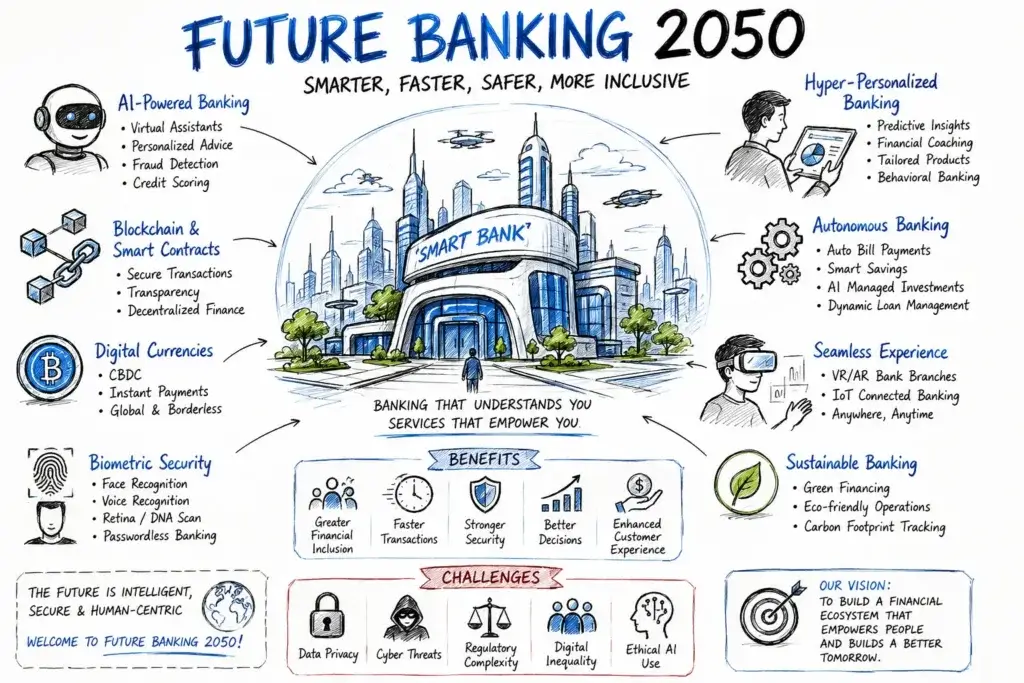
Future Banking 2050 represents a vision where financial services become highly personalized, intelligent, secure, and accessible. Traditional banking institutions will transform into technology-driven financial ecosystems capable of serving customers instantly and seamlessly across physical and virtual environments.
This article explores the future of banking in 2050, including emerging technologies, benefits, challenges, and the opportunities that will shape the next generation of financial services.
What is Future Banking 2050?
Future Banking 2050 refers to the advanced banking ecosystem expected to exist by the year 2050. It integrates cutting-edge technologies with customer-centric services to create a frictionless banking experience.
Key characteristics include:
-
Fully digital and paperless operations
-
AI-powered financial decision-making
-
Real-time global transactions
-
Biometric authentication
-
Decentralized financial systems
-
Hyper-personalized banking services
-
Smart contracts and blockchain integration
-
Sustainable and environmentally friendly banking
The primary goal of Future Banking 2050 is to provide faster, safer, and more intelligent financial solutions for individuals, businesses, and governments.
Evolution of Banking: From Traditional to Intelligent Banking
Traditional Banking Era (Before 2000)
Traditional banking relied heavily on:
-
Physical branches
-
Paper documentation
-
Manual transactions
-
Limited banking hours
Customers often waited in long queues and depended on bank employees for most services.
Digital Banking Era (2000–2025)
The digital revolution introduced:
-
Online banking
-
Mobile banking applications
-
ATM networks
-
Digital payments
-
Internet-based financial services
Banking became more convenient and accessible.
Intelligent Banking Era (2025–2050)
The next phase includes:
-
AI-driven banking assistants
-
Predictive financial planning
-
Automated lending
-
Smart investments
-
Decentralized finance systems
Banks will become intelligent financial partners rather than merely transaction processors.
Key Technologies Shaping Future Banking 2050
Artificial Intelligence (AI)
Artificial Intelligence will become the backbone of future banking.
Applications include:
-
Automated customer service
-
Fraud detection
-
Credit risk analysis
-
Personalized financial advice
-
Investment recommendations
AI systems will analyze customer behavior and provide tailored financial solutions in real time.
Blockchain Technology
Blockchain will significantly improve transparency and security.
Benefits include:
-
Faster cross-border payments
-
Reduced fraud
-
Smart contracts
-
Decentralized financial services
-
Enhanced transaction verification
Many traditional banking functions may migrate to blockchain-powered networks.
Quantum Computing
Quantum computing will revolutionize data processing and financial modeling.
Potential uses:
-
Complex risk analysis
-
Market forecasting
-
Portfolio optimization
-
Cybersecurity enhancement
Banks will process vast amounts of financial data within seconds.
Internet of Things (IoT)
Connected devices will enable seamless financial interactions.
Examples include:
-
Smart vehicles making automatic payments
-
Smart homes managing utility payments
-
Wearable devices conducting transactions
Banking will become embedded into daily life.
Extended Reality (XR)
Virtual Reality (VR) and Augmented Reality (AR) will transform customer experiences.
Future customers may:
-
Visit virtual bank branches
-
Meet AI financial advisors
-
Conduct transactions in immersive environments
The concept of physical branches may gradually disappear.
Hyper-Personalized Banking Services
By 2050, banking services will be uniquely tailored to each customer.
Features may include:
Personalized Financial Coaching
AI advisors will:
-
Monitor spending habits
-
Recommend savings plans
-
Suggest investments
-
Provide retirement strategies
Predictive Banking
Banks will anticipate customer needs before requests are made.
Examples:
-
Offering loans before financial shortages occur
-
Adjusting investment portfolios automatically
-
Predicting future expenses
Behavioral Banking
Financial products will adapt based on:
-
Lifestyle choices
-
Career progression
-
Family situations
-
Spending patterns
This creates a more customer-focused banking environment.
Biometric Banking and Identity Verification
Passwords may become obsolete by 2050.
Advanced authentication methods include:
Facial Recognition
Instant identity verification through facial scanning.
Voice Authentication
Unique voice patterns used for secure access.
Retina Scanning
Highly secure biometric identification.
DNA-Based Authentication
Future systems may utilize genetic identification for maximum security.
These technologies will significantly reduce fraud and identity theft.
Cashless Society and Digital Currency
The future banking landscape will likely be dominated by digital currencies.
Central Bank Digital Currencies (CBDCs)
Governments may issue official digital currencies that offer:
-
Faster payments
-
Greater transparency
-
Improved monetary control
Global Digital Payments
International transfers may become:
-
Instant
-
Low-cost
-
Borderless
Decline of Physical Cash
Cash usage is expected to decrease dramatically as digital payment systems become universal.
Autonomous Banking
Autonomous banking refers to self-operating banking systems.
Capabilities include:
-
Automatic bill payments
-
Smart savings allocation
-
AI-managed investments
-
Dynamic loan management
Customers may rarely need to interact directly with banks.
Sustainable and Green Banking
Environmental sustainability will become a major priority.
Paperless Operations
All banking processes will become digital.
Green Financing
Banks will support:
-
Renewable energy projects
-
Sustainable businesses
-
Eco-friendly investments
Carbon Tracking
Future banking applications may help customers monitor and reduce their carbon footprint.
Cybersecurity in Future Banking
As technology advances, cybersecurity becomes increasingly critical.
Future security measures include:
AI-Powered Threat Detection
Real-time identification of suspicious activities.
Quantum Encryption
Virtually unbreakable security protocols.
Continuous Authentication
Verification throughout the customer session.
Decentralized Security Systems
Reduced risk of centralized data breaches.
Banks will invest heavily in advanced cybersecurity infrastructure.
Benefits of Future Banking 2050
Enhanced Customer Experience
Customers receive instant, personalized services.
Greater Financial Inclusion
Remote populations gain access to banking through digital platforms.
Improved Efficiency
Automation reduces operational costs and processing times.
Better Decision-Making
AI-powered analytics support informed financial decisions.
Stronger Security
Advanced authentication and cybersecurity technologies protect users.
Challenges Facing Future Banking
Data Privacy Concerns
Managing vast amounts of personal data raises ethical issues.
Cybersecurity Threats
Sophisticated attacks will continue to evolve.
Digital Inequality
Not all populations may have equal access to advanced technologies.
Regulatory Challenges
Governments must develop new legal frameworks for emerging financial technologies.
Ethical AI Use
Ensuring fairness and transparency in AI-driven decisions remains essential.
Future Banking Jobs in 2050
While automation may replace some traditional roles, new opportunities will emerge.
Future careers may include:
-
AI Banking Specialists
-
Financial Data Scientists
-
Blockchain Auditors
-
Cybersecurity Analysts
-
Digital Asset Managers
-
Virtual Banking Consultants
-
Financial Technology Strategists
Human expertise will remain valuable alongside intelligent systems.
Future Banking in Developing Countries
Developing nations may experience significant benefits.
Potential advantages include:
-
Increased financial inclusion
-
Mobile-first banking solutions
-
Reduced transaction costs
-
Expanded access to credit
-
Economic empowerment
Emerging economies could leapfrog traditional banking infrastructure through digital innovation.
Conclusion
Future Banking 2050 promises a financial world that is smarter, faster, safer, and more inclusive than ever before. Artificial intelligence, blockchain, biometric authentication, quantum computing, and digital currencies will redefine how people save, spend, invest, and manage their finances.
While challenges related to privacy, security, and regulation remain, the opportunities offered by future banking are immense. Financial institutions that embrace innovation and prioritize customer needs will lead the transformation toward a highly connected and intelligent banking ecosystem.
The future of banking is not merely digital—it is autonomous, personalized, predictive, and seamlessly integrated into everyday life. By 2050, banking may no longer be a place people visit; it will be an intelligent service that accompanies them everywhere.
SEO Meta Description: Explore Future Banking 2050, including AI banking, blockchain, digital currencies, biometric security, autonomous banking, benefits, challenges, and emerging financial technologies.
SEO Keywords: Future Banking 2050, Future of Banking, AI Banking, Digital Banking, Smart Banking, Banking Technology, Financial Technology, Blockchain Banking, Banking Innovation, Banking Trends 2050, Future Financial Services, Digital Currency Banking.