
Sarva Haryana Gramin Bank: Comprehensive Institutional Overview
Sarva Haryana Gramin Bank is one of the prominent Regional Rural Banks (RRBs) in India, historically serving the rural and semi-urban population of Haryana. Like other RRBs, its core objective has been to promote financial inclusion, support agricultural development, and provide accessible banking services to underserved regions. Over time, the institution has evolved in structure and operations, especially after amalgamation reforms in India’s rural banking sector. Today, its legacy continues under the broader framework of Haryana Gramin Bank after consolidation, but its historical identity remains significant in understanding rural banking evolution.
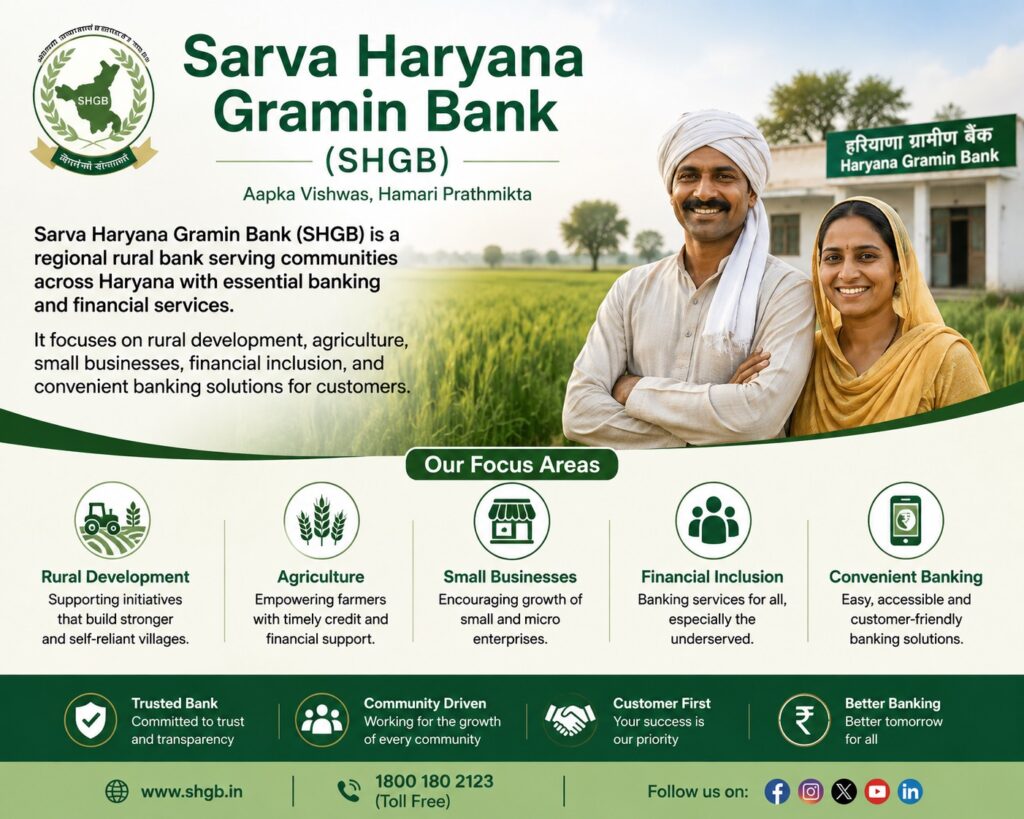
The bank plays a crucial role in channeling credit to farmers, small businesses, artisans, and rural entrepreneurs. It operates under the joint ownership of the Government of India, Government of Haryana, and a sponsor bank (historically Punjab National Bank). Its operations are guided by NABARD regulations and RBI oversight, ensuring financial stability and policy alignment with national development goals.
This article provides a complete SEO-optimized institutional profile of Sarva Haryana Gramin Bank, covering mission, vision, leadership, financial structure, products, services, SWOT analysis, and MCQs for academic and competitive exam preparation.
Mission and Vision
Mission of Sarva Haryana Gramin Bank
The mission of Sarva Haryana Gramin Bank revolves around strengthening rural financial infrastructure and ensuring inclusive banking services across Haryana. The bank aims to empower rural households by offering accessible credit, savings facilities, and financial literacy programs. Its mission is deeply rooted in supporting agriculture, small-scale industries, and rural employment generation.
A key part of its mission is to bridge the gap between urban and rural banking ecosystems. By offering simplified banking procedures and localized services, the bank ensures that even economically weaker sections can participate in formal financial systems. It also focuses on implementing government schemes like PMJDY, Kisan Credit Card (KCC), and direct benefit transfers (DBT).
Additionally, the mission emphasizes sustainable banking practices. This includes responsible lending, risk management, and digital transformation to enhance service efficiency. The bank aims to be not just a financial institution but a development partner for rural India.
Vision of Sarva Haryana Gramin Bank
The vision of Sarva Haryana Gramin Bank is to become a leading rural financial institution known for trust, innovation, and inclusive growth. It aspires to deliver high-quality banking services comparable to commercial banks while maintaining its rural focus.
The vision also includes digital empowerment of rural customers through mobile banking, UPI integration, and ATM expansion. The bank envisions a financially literate rural population that actively participates in economic growth.
Another critical aspect of its vision is sustainability and resilience. The bank aims to maintain strong financial health while expanding outreach. It focuses on modernization without losing its grassroots connection with rural communities.
History and Founder
Formation and Background
Sarva Haryana Gramin Bank was established as part of India’s Regional Rural Bank initiative launched in 1975 under the Regional Rural Banks Act, 1976. The objective was to create hybrid banking institutions combining the reach of cooperatives with the efficiency of commercial banks.
The bank was sponsored by Punjab National Bank and operated under joint ownership with the Government of India and Government of Haryana. It was created to specifically address the financial needs of Haryana’s rural economy, which is heavily dependent on agriculture and allied activities.
In 2019, a major consolidation of RRBs led to the merger of Sarva Haryana Gramin Bank with another regional rural bank, resulting in the formation of Haryana Gramin Bank. This restructuring aimed to improve operational efficiency, reduce redundancy, and strengthen capital adequacy.
While no single individual is credited as the “founder,” the institution was a product of government policy reform aimed at rural development banking. Its legacy remains important in shaping Haryana’s rural financial ecosystem.
Head Office and Key People
Head Office Location and Importance
The head office of Sarva Haryana Gramin Bank was located in Rohtak, Haryana. This strategic location placed it at the heart of the state’s administrative and agricultural regions. The head office functioned as the central hub for policy implementation, credit planning, branch coordination, and compliance monitoring.
From this headquarters, the bank managed hundreds of branches across Haryana. It coordinated rural credit programs, monitored loan disbursements, and ensured alignment with RBI and NABARD guidelines. The head office also played a key role in digital transformation initiatives and banking modernization projects.
Key People and Leadership Structure
The leadership of Sarva Haryana Gramin Bank included a Chairman appointed by the sponsor bank, along with senior executives such as General Managers and Regional Managers. The board structure reflected joint ownership between central government, state government, and sponsor bank representatives.
Key roles included oversight of credit policy, risk management, IT systems, and branch operations. Leadership continuity was maintained through periodic appointments, ensuring stability in rural banking operations.
Last 10 CEOs and Leadership Timeline
The leadership history of Sarva Haryana Gramin Bank reflects a structured rotation of Chairpersons/CEOs appointed from sponsor banks or banking services. However, detailed public records of all last 10 CEOs are not consistently available in consolidated form due to RRB restructuring and mergers.
Typically, CEOs were senior banking professionals from Punjab National Bank or other public sector banks deputed to lead the institution. Their responsibilities included strengthening rural credit, improving asset quality, and implementing government financial inclusion schemes.
The leadership timeline saw a gradual shift from traditional banking to digital-first operations, especially in the last decade before amalgamation. Each CEO contributed to improving branch expansion, reducing NPAs, and increasing deposit mobilization.
Post-merger, leadership transitioned into Haryana Gramin Bank, continuing under a unified governance structure.
Products and Services Overview
Deposit Products
Sarva Haryana Gramin Bank offered a wide range of deposit products designed for rural and semi-urban customers. These included savings accounts, current accounts, fixed deposits, and recurring deposits. Savings accounts were particularly popular due to low minimum balance requirements and accessibility in rural branches.
Fixed deposits provided stable returns for farmers and small investors, while recurring deposits encouraged disciplined savings habits. The bank also participated in government-backed savings schemes, enhancing financial security for low-income households.
Loan Products
Loan offerings formed the backbone of the bank’s credit operations. Major loan categories included agricultural loans, crop loans, dairy loans, MSME loans, and housing loans. The Kisan Credit Card (KCC) was one of the most significant products, providing flexible credit to farmers.
The bank also supported self-help groups (SHGs), women entrepreneurs, and small businesses through microfinance initiatives. Loan approval processes were simplified to ensure faster credit delivery in rural areas.
Retail Banking Products
Retail banking services included ATM cards, debit cards, mobile banking, and remittance services. The bank gradually integrated digital banking solutions such as UPI and internet banking to improve accessibility.
These services helped bridge the digital divide in rural Haryana and increased customer convenience significantly.
Financial Performance Overview
Revenue, Profit, Assets, Employees, Capital Adequacy
As a Regional Rural Bank, Sarva Haryana Gramin Bank’s financial performance was closely monitored by NABARD and RBI. While exact standalone historical figures vary, RRBs generally reported steady growth in deposits and advances.
Revenue was primarily generated through interest income from agricultural and retail loans. Profitability improved over time due to better asset quality and reduced NPAs. Total assets included loan portfolios, government securities, and cash reserves.
Employee strength was significant, with hundreds of branch-level staff serving rural customers. Capital adequacy ratios were maintained as per regulatory norms, typically above minimum thresholds mandated by RBI.
Annual Report Insights
Annual reports of Sarva Haryana Gramin Bank highlighted consistent focus on rural credit expansion, financial inclusion, and digital transformation. Key insights included growth in deposit base, improvement in recovery rates, and expansion of priority sector lending.
Reports also emphasized government scheme implementation such as PMJDY accounts and DBT transactions. Operational efficiency improved through digitization and core banking system upgrades.
Risk management and NPA reduction strategies were central themes in annual reporting, reflecting a stable but evolving rural banking institution.
Branch Network and ATM Coverage
Sarva Haryana Gramin Bank had an extensive branch network across Haryana, covering rural, semi-urban, and semi-developed regions. At its peak before amalgamation, the bank operated hundreds of branches.
ATM networks were more limited compared to commercial banks but steadily expanded through collaborations and shared ATM networks. The goal was to enhance rural accessibility and reduce dependency on physical branches.
Branch expansion played a crucial role in financial inclusion, especially in remote agricultural regions.
SWOT Analysis of Sarva Haryana Gramin Bank
The SWOT analysis provides a strategic overview of the bank’s position in rural banking.
Strengths include strong rural presence, government backing, and trust among farmers.
Weaknesses include limited digital infrastructure historically and lower scalability compared to commercial banks.
Opportunities include fintech integration, rural credit expansion, and government scheme participation.
Threats include rising competition from private banks and digital-only banking platforms.
This analysis reflects the transitional nature of RRBs in India’s evolving financial ecosystem.
MCQs and Answers (25 Questions with Explanations)
1. Sarva Haryana Gramin Bank primarily focused on which type of banking?
A. Investment banking
B. Rural and priority sector banking
C. Foreign exchange banking
D. Cryptocurrency banking
Answer: B
Explanation: The bank was created to serve rural, agricultural, and priority sectors, not corporate or investment banking.
2. What is the main objective of Regional Rural Banks like Sarva Haryana Gramin Bank?
A. Maximize shareholder profit
B. Provide rural credit and financial inclusion
C. Serve international markets
D. Promote stock trading
Answer: B
Explanation: RRBs focus on financial inclusion and rural credit support.
3. Sarva Haryana Gramin Bank operated under the guidance of which organization?
A. SEBI
B. NABARD
C. IRDAI
D. SIDBI
Answer: B
Explanation: NABARD supervises and regulates Regional Rural Banks in India.
4. Which of the following was NOT a typical loan product of Sarva Haryana Gramin Bank?
A. Kisan Credit Card
B. Agricultural loans
C. Luxury car loans
D. MSME loans
Answer: C
Explanation: Luxury car loans are not part of rural banking focus.
5. What does KCC stand for?
A. Kisan Credit Card
B. Key Cash Credit
C. Kerala Credit Code
D. Knowledge Credit Card
Answer: A
Explanation: It is a credit scheme for farmers.
6. The headquarters of Sarva Haryana Gramin Bank was located in:
A. Gurgaon
B. Rohtak
C. Chandigarh
D. Hisar
Answer: B
Explanation: Rohtak served as its head office location.
7. Who jointly owns Regional Rural Banks in India?
A. Private investors only
B. Government of India, State Government, and Sponsor Bank
C. RBI only
D. Foreign institutions
Answer: B
Explanation: RRBs have a tripartite ownership structure.
8. Which sector benefited most from Sarva Haryana Gramin Bank loans?
A. IT sector
B. Agriculture sector
C. Aviation sector
D. Telecom sector
Answer: B
Explanation: Agriculture was the primary focus area.
9. What was a key function of Sarva Haryana Gramin Bank?
A. Stock trading
B. Rural credit distribution
C. Insurance underwriting
D. Export financing
Answer: B
Explanation: Rural credit distribution was its core role.
10. Which of the following accounts was most common in rural areas?
A. Demat account
B. Savings account
C. Hedge fund account
D. Forex account
Answer: B
Explanation: Savings accounts were widely used for basic banking.
11. What is the main purpose of SHG financing?
A. Corporate mergers
B. Empowering self-help groups financially
C. Foreign investments
D. Stock trading
Answer: B
Explanation: SHGs help rural women and groups access credit.
12. Which banking system did Sarva Haryana Gramin Bank adopt in later years?
A. Manual ledger system
B. Core Banking Solution (CBS)
C. Barter system
D. Crypto banking
Answer: B
Explanation: CBS enabled digital banking operations.
13. What does NPA stand for in banking?
A. Net Profit Account
B. Non-Performing Asset
C. National Payment Agreement
D. New Profit Allocation
Answer: B
Explanation: Loans that stop generating income are NPAs.
14. Which institution regulates banking policy in India?
A. RBI
B. SEBI
C. IRDAI
D. FMC
Answer: A
Explanation: RBI regulates all banks in India.
15. What type of banking is Sarva Haryana Gramin Bank classified as?
A. Private Bank
B. Public Sector Bank
C. Regional Rural Bank
D. Foreign Bank
Answer: C
Explanation: It is an RRB.
16. Which product encourages disciplined savings over time?
A. Fixed Deposit
B. Recurring Deposit
C. Mutual Fund
D. Equity share
Answer: B
Explanation: RD promotes monthly savings habits.
17. What is a major benefit of rural banks?
A. High-risk speculation
B. Financial inclusion
C. Forex trading
D. Crypto mining
Answer: B
Explanation: They bring banking to rural populations.
18. Which scheme is linked with direct benefit transfer?
A. DBT
B. IPO
C. FPO
D. ETF
Answer: A
Explanation: DBT transfers subsidies directly to beneficiaries.
19. What does ATM stand for?
A. Automated Teller Machine
B. Automatic Transfer Module
C. Advanced Tax Mechanism
D. Account Transaction Model
Answer: A
Explanation: ATM allows cash withdrawal and banking services.
20. What is the primary source of income for RRBs?
A. Advertising
B. Interest on loans
C. Stock trading
D. Real estate
Answer: B
Explanation: Loan interest is the main revenue source.
21. What is a recurring theme in RRB annual reports?
A. Cryptocurrency investment
B. Rural credit expansion
C. International mergers
D. Luxury banking
Answer: B
Explanation: RRBs focus on rural lending growth.
22. What does financial inclusion mean?
A. Only rich people banking
B. Access to affordable financial services for all
C. Stock market growth
D. Corporate banking
Answer: B
Explanation: It ensures banking access for underserved populations.
23. Which loan is specifically designed for farmers?
A. Personal loan
B. Kisan Credit Card loan
C. Education loan
D. Travel loan
Answer: B
Explanation: KCC is designed for agricultural needs.
24. What is a key challenge faced by RRBs?
A. Over digitalization
B. High urban exposure
C. High NPAs
D. Excess foreign branches
Answer: C
Explanation: Rural lending risks can lead to NPAs.
25. What is the long-term goal of RRB modernization?
A. Reduce rural banking
B. Improve digital and financial inclusion
C. Eliminate agriculture loans
D. Replace banking with cash economy
Answer: B
Explanation: Modernization focuses on digital banking and inclusion.