
Month-End Account Procedure for Banks: Complete Step-by-Step Guide
The month-end account procedure for a bank is one of the most important parts of banking operations and financial management. At the end of every accounting month, banks need to review transactions, reconcile accounts, calculate income and expenses, recognize accrued items, verify customer and general ledger balances, classify loans and advances, review suspense accounts, and prepare financial and management reports.
Unlike many ordinary businesses, banks process thousands or even millions of financial transactions every day. These transactions may involve deposits, loans, remittances, clearing, cards, cash, foreign exchange, interest, fees, interbranch transactions, treasury activities, digital banking, and many other services. Even a small error that remains unresolved can affect the accuracy of the bank’s financial statements.
For this reason, a bank cannot simply wait until the end of the financial year to check its books. A systematic monthly closing process helps management identify errors quickly, maintain accurate accounting records, monitor profitability, control operational risks, and prepare the institution for regulatory reporting and audit.
This article provides a detailed, step-by-step discussion of the month-end accounting procedure in banks, including account reconciliation, general ledger verification, interest calculations, accruals, loan review, deposit verification, suspense account monitoring, fixed assets, provisions, reporting, internal controls, and the final closing process.
What Is the Month-End Account Procedure in Banking?
The month-end account procedure is the structured process through which a bank reviews, verifies, adjusts, reconciles, and closes its accounting records for a particular month.
The objective is to ensure that transactions recorded during the month are:
- Complete
- Accurate
- Properly authorized
- Correctly classified
- Posted to the correct accounts
- Properly reconciled
- Supported by necessary documents
- Reported in the correct accounting period
- Compliant with applicable accounting and regulatory requirements
The procedure normally involves different departments rather than only the accounts department.
Depending on the organizational structure of a bank, the process may involve:
- Branch operations
- Finance and accounts
- Credit administration
- Treasury
- Foreign exchange department
- Information technology
- Internal control
- Risk management
- Human resources
- Fixed asset administration
- Regulatory reporting teams
- Head office finance
- Internal audit
The exact procedure differs among banks and jurisdictions. Therefore, a bank’s approved accounting manual, regulatory instructions, applicable accounting standards, tax laws, and internal policies should always take precedence over a general month-end checklist.
Objectives of Month-End Closing in Banks
The month-end closing process serves several important purposes.
1. Ensure Accuracy of Financial Records
The first objective is to determine whether all transactions have been correctly recorded.
Errors can occur because of:
- Incorrect account numbers
- Duplicate transactions
- Missing entries
- Incorrect amounts
- Wrong general ledger heads
- System failures
- Incorrect value dates
- Unauthorized adjustments
- Unreconciled interbranch transactions
Month-end verification helps identify and correct these problems.
2. Determine Monthly Profitability
A bank needs to know whether it has earned a profit or incurred a loss during the month.
The bank therefore calculates major income and expense components, including:
Income
- Interest on loans and advances
- Investment income
- Foreign exchange income
- Commission income
- Service charges
- Remittance income
- Card-related fees
- Other operating income
Expenses
- Interest paid on deposits and borrowings
- Employee expenses
- Rent
- Utility expenses
- Depreciation
- Technology expenses
- Administrative expenses
- Provisions
- Other operating costs
The resulting figures contribute to the monthly profit and loss statement.
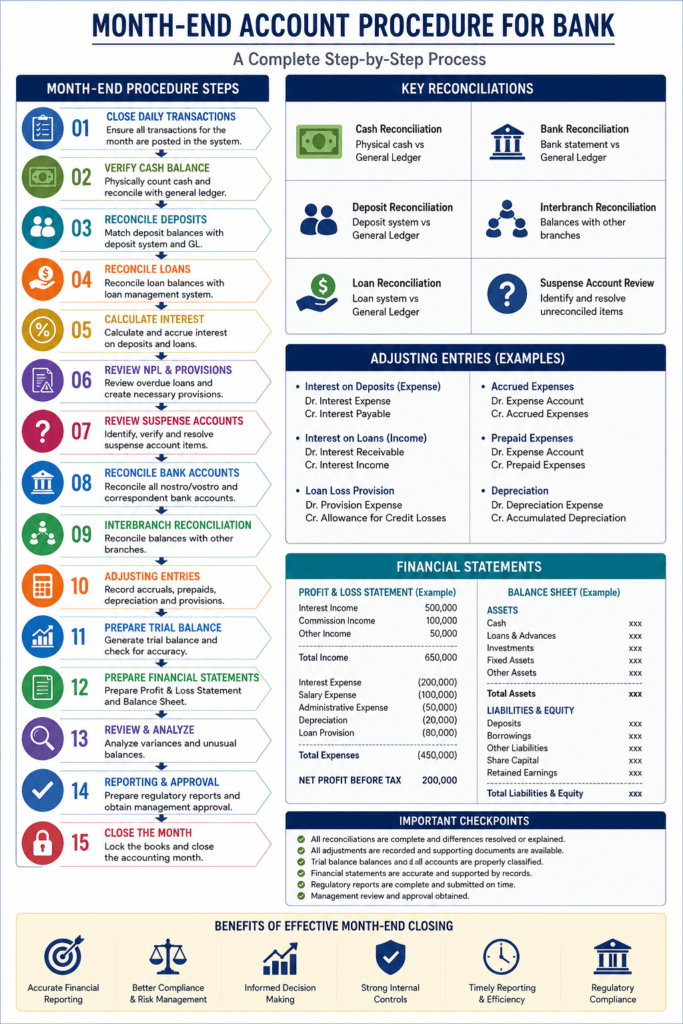
Step-by-Step Month-End Account Procedure for Banks
Step 1: Establish the Month-End Closing Schedule
A successful month-end closing begins before the final day of the month.
The finance or accounts department should prepare a month-end closing calendar specifying:
- Closing date
- Transaction cut-off time
- Departmental responsibilities
- Reconciliation deadlines
- Adjustment deadlines
- Review deadlines
- Report submission dates
- Responsible officers
- Approving authorities
A clearly defined timetable prevents important activities from being overlooked.
Banks should also distinguish between activities that must be completed on the last business day and activities that can be finalized during the first few working days of the following month.
Step 2: Apply the Transaction Cut-Off
Cut-off control is extremely important in financial accounting.
Transactions must be recorded in the accounting period to which they relate.
For example, if an expense relates to August but the invoice is received in September, accounting rules may require an accrual to recognize the expense in August.
Banks should review cut-off arrangements for:
- Cash transactions
- Clearing transactions
- Fund transfers
- Remittances
- Loan disbursements
- Loan repayments
- Deposit transactions
- Treasury transactions
- Foreign exchange transactions
- Card settlements
- ATM transactions
- Digital banking transactions
- Fees and commissions
The objective is to prevent transactions from being improperly shifted between accounting periods.
Step 3: Complete Daily Transactions Before Monthly Closing
Before monthly closing begins, all authorized transactions for the last working day should be properly processed.
Branches and departments should confirm that:
- Teller transactions have been completed.
- Cash registers have been balanced.
- Authorized vouchers have been posted.
- Clearing transactions have been processed.
- Fund transfers have been recorded.
- Remittance transactions have been posted.
- Loan transactions have been updated.
- Deposit transactions have been completed.
- Necessary corrections have been authorized.
Any incomplete or failed transaction should be identified and investigated before final closing wherever possible.
Step 4: Verify the General Ledger
The General Ledger (GL) is at the heart of a bank’s accounting system.
During month-end closing, the finance department should review general ledger balances and compare them with supporting subsidiary records.
Important GL categories may include:
Assets
- Cash
- Balance with central bank
- Balance with other banks
- Investments
- Loans and advances
- Fixed assets
- Accrued income
- Other assets
Liabilities
- Customer deposits
- Borrowings
- Accrued expenses
- Other liabilities
Equity
- Paid-up capital
- Statutory reserves
- Other reserves
- Retained earnings
Income
- Interest income
- Investment income
- Commission income
- Exchange income
- Service charges
- Other operating income
Expenses
- Interest expense
- Salary and employee benefits
- Rent
- Utilities
- Depreciation
- Administrative expenses
- Provision expenses
Unusual balances, abnormal movements, debit balances in accounts normally expected to be credit balances, and vice versa should be investigated.
Step 5: Reconcile Subsidiary Ledgers with the General Ledger
Subsidiary systems contain detailed information supporting general ledger balances.
For example, the loan management system may contain individual borrower balances, while the GL contains the total balance of loans under particular accounting heads.
At month-end, the total of the subsidiary records should agree with the relevant GL balance.
Common reconciliations include:
- Deposit system vs. deposit GL
- Loan system vs. loan GL
- Fixed asset register vs. fixed asset GL
- Investment register vs. investment GL
- Payroll records vs. salary-related GL
- Card settlement records vs. card GL
- Remittance system vs. remittance GL
Differences should be investigated, documented, and corrected according to the bank’s authorization procedure.
Step 6: Perform Cash Reconciliation
Cash is one of the most sensitive assets of a bank.
Branches should verify the actual cash held at the end of the month against the balance shown in the accounting system.
Cash may include:
- Teller cash
- Vault cash
- ATM-related cash where applicable
- Cash in transit
- Foreign currency notes
- Other authorized cash holdings
The bank should confirm that:
Physical Cash = System/Book Cash Balance
Any shortage or excess should be immediately reported and investigated according to internal procedures.
Surprise cash verification and independent checking may also form part of the bank’s control environment.
Step 7: Reconcile Central Bank Accounts
Banks generally maintain accounts with their country’s central bank.
These accounts can be important for:
- Statutory reserves
- Clearing settlements
- Interbank settlements
- Payment systems
- Other regulatory purposes
The bank should reconcile its internal ledger with statements or settlement records received from the central bank.
Outstanding items should be listed separately and investigated.
Long-outstanding differences require particular attention because they may indicate posting errors or unresolved settlement issues.
Step 8: Reconcile Accounts with Other Banks
Banks often maintain nostro, settlement, correspondent, or operational accounts with other financial institutions.
Month-end reconciliation should compare:
Bank’s Internal Book Balance
with
Correspondent/Other Bank Statement Balance
Differences may arise from:
- Unpresented transactions
- Timing differences
- Charges
- Interest
- Value-date differences
- Unrecorded transfers
- Incorrect postings
- Foreign exchange differences
Each reconciling item should be clearly identified and followed up.
Step 9: Reconcile Interbranch and Head Office Accounts
Banks operating through multiple branches frequently use interbranch accounts.
One branch may send money or accounting instructions to another branch or to head office. If one side records the transaction but the other side does not, an unmatched balance may arise.
The bank should reconcile:
- Branch-to-branch accounts
- Branch-to-head-office accounts
- Head-office-to-branch accounts
- Internal settlement accounts
Unmatched entries should be identified by:
- Date
- Amount
- Reference number
- Originating branch
- Responding branch
- Nature of transaction
Old outstanding entries should receive priority.
Step 10: Review Customer Deposit Accounts
Customer deposits are normally among the largest liabilities on a commercial bank’s balance sheet.
Major deposit categories may include:
- Current accounts
- Savings accounts
- Fixed deposits
- Term deposits
- Notice deposits
- Special deposit products
Month-end review should confirm that deposit balances in subsidiary systems reconcile with the relevant general ledger accounts.
The bank should also review unusual situations such as:
- Unauthorized overdrafts
- Abnormal debit balances
- Dormant-account transactions
- Incorrect interest postings
- Incorrect fees
- Matured term deposits awaiting action
- Unusual large transactions
Customer-level exceptions should be handled according to approved procedures.
Step 11: Calculate Interest on Deposits
Interest payable to depositors must be calculated according to the terms of each product and the bank’s accounting policy.
Depending on the deposit type, interest may be calculated based on:
- Daily balance
- Average balance
- Minimum balance
- Contractual rate
- Fixed-term rate
- Variable rate
The bank’s core banking system normally performs much of this calculation automatically.
However, month-end controls should verify that:
- Correct interest rates are configured.
- Interest is calculated for the correct period.
- Eligible accounts receive appropriate interest.
- Ineligible accounts are excluded.
- Applicable taxes or withholding are correctly treated.
- Accrued interest is properly posted.
System-generated totals should be reconciled with relevant GL balances.
Step 12: Review Loans and Advances
Loans and advances usually represent a major portion of a commercial bank’s earning assets.
The month-end loan review may include:
- Outstanding principal
- Accrued interest
- Interest received
- Overdue installments
- Past-due amounts
- Loan classifications
- Restructured or rescheduled loans
- Suspended interest
- Loan provisions
- Collateral information
- Credit limits
- Expired facilities
The loan subsidiary ledger should reconcile with the general ledger.
Any significant difference should be investigated before financial reports are finalized.
Step 13: Calculate Interest Income on Loans
Interest on loans is an important source of bank revenue.
The bank should verify whether interest income has been calculated using the correct:
- Outstanding balance
- Interest rate
- Number of days
- Repayment structure
- Value date
- Product rules
- Classification status
- Accounting treatment
Particular care is required for impaired or non-performing loans because the recognition of interest may be restricted under applicable accounting standards, regulatory rules, or internal policy.
Banks should not automatically recognize interest as income merely because the system calculates it if recognition is prohibited by applicable requirements.
Step 14: Review Non-Performing Loans and Credit Classification
Month-end closing is also an opportunity to evaluate the quality of the loan portfolio.
The bank should identify accounts that have become overdue or otherwise meet applicable criteria for credit deterioration.
Depending on local regulation and accounting standards, categories may include performing, watch-list, special mention, substandard, doubtful, or loss classifications.
The exact terminology and thresholds vary by jurisdiction.
The bank should determine:
- Which accounts require classification
- Whether classifications have changed
- Whether provisions need adjustment
- Whether interest recognition needs modification
- Whether additional management review is required
Credit classification has a direct impact on profitability and asset quality reporting.
Step 15: Calculate Loan-Loss Provisions and Impairment
Banks must recognize appropriate allowances for expected or identified credit losses in accordance with applicable regulatory and accounting requirements.
Depending on the reporting framework, this may involve:
- Regulatory loan-loss provisions
- Specific provisions
- General provisions
- Expected credit loss calculations
- Collective assessments
- Individual impairment assessments
Where IFRS 9 applies, expected credit loss calculations may involve different stages based on changes in credit risk.
Because impairment calculations can materially affect profit and capital, the results should be carefully reviewed and approved.
Step 16: Review Interest Suspense
Interest relating to certain classified or impaired loans may need to be placed in an interest suspense account rather than recognized immediately as income, depending on applicable rules.
Month-end review should determine:
- Whether appropriate accounts are included
- Whether amounts are correctly calculated
- Whether recoveries have been properly treated
- Whether reversals or transfers are necessary
- Whether GL balances agree with supporting schedules
Interest suspense should not become an uncontrolled parking account.
Step 17: Review Suspense Accounts
A suspense account temporarily holds transactions whose final accounting destination has not yet been determined.
Examples include:
- Unidentified customer transfers
- Incomplete remittance information
- Posting errors
- Clearing differences
- Failed system transactions
- Unallocated receipts
At month-end, every suspense item should ideally have:
- Transaction date
- Amount
- Reference
- Explanation
- Responsible department
- Current status
- Expected resolution date
Old suspense items should be escalated according to policy.
The goal should be resolution rather than carrying unexplained balances from month to month.
Step 18: Review Sundry and Other Receivable Accounts
Other receivables can include various temporary or recoverable balances.
Examples may include:
- Staff advances
- Recoverable expenses
- Prepaid expenses
- Claims receivable
- Security deposits
- Tax receivables
- Other miscellaneous receivables
The bank should determine whether these amounts are:
- Genuine
- Recoverable
- Properly supported
- Correctly classified
- Appropriately aged
Old or doubtful receivables may require adjustment or provision according to policy.
Step 19: Review Accounts Payable and Other Liabilities
Month-end procedures should also cover outstanding obligations.
These may include:
- Vendor bills
- Utility expenses
- Professional fees
- Employee-related liabilities
- Taxes payable
- Rent payable
- Interest payable
- Other accrued expenses
Finance staff should verify that liabilities relating to the current period are appropriately recognized even when payment has not yet been made.
Step 20: Record Accrued Income
Income may be earned during the month but not yet received.
Examples include:
- Interest receivable
- Investment income receivable
- Commission receivable
- Other earned income
Where recognition criteria are satisfied, an accrual may be necessary.
A simplified entry could be:
Debit: Accrued Income / Interest Receivable
Credit: Relevant Income Account
Actual entries depend on the bank’s chart of accounts and accounting policies.
Step 21: Record Accrued Expenses
Similarly, expenses may relate to the current month even though payment will occur later.
Examples include:
- Electricity
- Telecommunications
- Rent
- Professional services
- Audit fees
- Security services
- Technology services
- Interest payable
A simplified accounting entry could be:
Debit: Relevant Expense Account
Credit: Accrued Expenses / Payable
Accrual accounting helps ensure that the month’s financial results reflect the economic activity of that month.
Step 22: Review Prepaid Expenses
Some expenses are paid in advance and should not be charged entirely to one month.
Examples include:
- Annual insurance
- Software licenses
- Maintenance agreements
- Annual subscriptions
- Rent paid in advance
The prepaid amount should be allocated over the appropriate accounting periods.
The remaining balance should reconcile with the prepaid expense schedule.
Step 23: Review Fixed Assets
Banks own various fixed assets, including:
- Buildings
- Furniture
- Computers
- Servers
- ATMs
- Vehicles
- Office equipment
- Security equipment
Month-end procedures should identify:
- New assets purchased
- Assets transferred
- Assets sold
- Assets disposed of
- Assets under construction
- Assets requiring capitalization
- Assets requiring depreciation
The fixed asset register should reconcile with the general ledger.
Step 24: Calculate Depreciation and Amortization
Depreciation allocates the cost of qualifying tangible assets over their useful lives.
The bank should calculate depreciation according to its approved accounting policy.
A simplified entry is:
Debit: Depreciation Expense
Credit: Accumulated Depreciation
Likewise, qualifying intangible assets may require amortization.
Finance staff should ensure that:
- Correct useful lives are used.
- Correct methods are applied.
- Disposed assets are removed.
- Newly capitalized assets are treated correctly.
- The depreciation schedule agrees with the GL.
Step 25: Reconcile Investment Accounts
Banks may invest in:
- Government securities
- Treasury bills
- Bonds
- Money-market instruments
- Other permitted investments
At month-end, the bank should reconcile investment records with accounting balances.
The review may cover:
- Cost
- Face value
- Accrued interest
- Maturity date
- Coupon rate
- Purchase date
- Sale or redemption
- Valuation
- Classification
- Impairment, where applicable
Accounting treatment should follow applicable standards and regulatory requirements.
Step 26: Review Foreign Exchange Transactions
Banks engaged in foreign exchange operations should reconcile foreign currency balances.
The process may include:
- Foreign currency cash
- Nostro accounts
- Foreign currency customer accounts
- Foreign exchange contracts
- Remittances
- FX income and expense
Foreign currency monetary balances may need to be translated using the appropriate closing exchange rate in accordance with the applicable accounting framework.
Resulting exchange differences should be properly recorded.
Step 27: Reconcile Clearing Accounts
Banks participate in various clearing and payment arrangements.
Month-end procedures should review:
- Cheque clearing
- Electronic fund transfers
- Real-time settlement systems
- Card settlements
- ATM transactions
- Mobile banking settlements
- Other payment channels
Unsettled or rejected transactions should be separately identified.
Aged clearing differences require prompt investigation.
Step 28: Reconcile ATM and Card Transactions
Digital payment channels can create large volumes of settlement entries.
Banks should reconcile:
- ATM withdrawals
- ATM deposits where applicable
- Debit card transactions
- Credit card settlements
- POS transactions
- Network settlement files
- Merchant settlements
Differences may result from:
- Failed transactions
- Reversals
- Chargebacks
- Network delays
- Duplicate postings
- Cash shortages
- Technical failures
Month-end reconciliation should ensure that outstanding differences are supported and actively monitored.
Step 29: Review Fees and Commission Income
Banks earn non-interest income from numerous services.
Examples include:
- Account maintenance fees
- Loan processing fees
- Card fees
- Remittance commissions
- Guarantee commissions
- Trade finance charges
- Locker fees
- Transfer charges
Finance should determine whether such income has been recognized in accordance with the applicable accounting policy.
Some fees may need to be recognized over time rather than immediately.
Step 30: Process Payroll and Employee-Related Expenses
Employee expenses often represent a major operating cost.
Month-end payroll-related accounting may include:
- Salaries
- Overtime
- Bonuses
- Allowances
- Provident or retirement contributions
- Employee benefits
- Payroll taxes
- Staff loan deductions
Payroll reports should reconcile with accounting entries and authorized HR records.
Step 31: Review Tax Accounts
Banks are subject to various taxes depending on jurisdiction.
These may include:
- Corporate income tax
- Withholding tax
- Payroll-related taxes
- Value-added or indirect taxes
- Other statutory levies
Tax-related balances should be reconciled with supporting schedules.
Banks should ensure that tax liabilities are appropriately recognized and that statutory payments are made within prescribed deadlines.
Step 32: Review Off-Balance-Sheet Items
Not all banking exposures appear directly as funded assets on the balance sheet.
Off-balance-sheet exposures may include:
- Letters of credit
- Bank guarantees
- Undrawn commitments
- Acceptances
- Other contingent liabilities
Month-end controls should verify that these exposures are properly recorded in memorandum or relevant systems and reported according to applicable requirements.
Provisioning or expected credit loss requirements may also apply to some commitments and guarantees.
Step 33: Review Unusual and High-Value Transactions
Banks should identify unusual accounting movements before closing the month.
Finance and control teams may review:
- Large manual entries
- Large reversals
- Backdated transactions
- Unusual write-offs
- Significant adjustments
- Transactions posted directly to GL
- Unusual related-account movements
- Large expense increases
- Significant income fluctuations
The purpose is not merely to find fraud. It is also to identify errors, unusual business events, or accounting treatments requiring further review.
Step 34: Review Manual Journal Entries
Manual journal entries deserve special attention because they can bypass automated transaction flows.
Each significant manual journal should normally have:
- Clear description
- Supporting documentation
- Prepared-by information
- Appropriate authorization
- Correct accounting heads
- Correct amount
- Correct accounting period
Maker-checker controls should be followed where required.
Unauthorized journal entries should never be used simply to force accounts to balance.
Step 35: Perform Trial Balance Review
After major adjustments and reconciliations have been completed, the bank should generate a trial balance.
The trial balance contains ledger account balances and helps confirm that accounting entries remain mathematically balanced.
The basic principle is:
Total Debit Balances = Total Credit Balances
However, a balanced trial balance does not automatically mean that every accounting entry is correct.
Therefore, finance personnel should also review:
- Abnormal balances
- Large movements
- New GL accounts
- Zero balances where activity was expected
- Unexpected debit or credit positions
- Month-to-month variations
Step 36: Conduct Variance Analysis
Variance analysis compares current financial results with relevant benchmarks.
Typical comparisons include:
Current Month vs. Previous Month
Actual vs. Budget
Current Year vs. Previous Year
Actual vs. Forecast
Large variances should be investigated.
For example, if administrative expenses increase sharply, management should determine whether the increase resulted from:
- A one-time payment
- Incorrect posting
- Higher business volume
- New contracts
- Additional employees
- Technology expenditure
- Unexpected operational costs
Variance analysis transforms accounting information into useful management information.
Step 37: Prepare the Monthly Profit and Loss Statement
After adjustments are completed, the bank can prepare its monthly income statement.
A simplified structure may be:
Interest Income
Less: Interest Expense
Net Interest Income
Add:
- Commission income
- Fee income
- Foreign exchange income
- Investment income
- Other operating income
Less:
- Employee expenses
- Administrative expenses
- Depreciation
- Technology expenses
- Other operating expenses
Operating Profit
Less:
- Loan-loss provisions
- Impairment expenses
- Other provisions
Then, after applicable items and taxes:
Net Profit / Loss
The actual presentation depends on accounting and regulatory requirements.
Step 38: Prepare the Balance Sheet
The month-end balance sheet summarizes the bank’s financial position.
The fundamental equation is:
Assets = Liabilities + Equity
Typical assets include:
- Cash
- Central bank balances
- Balances with other banks
- Investments
- Loans and advances
- Fixed assets
- Other assets
Typical liabilities include:
- Customer deposits
- Bank borrowings
- Other borrowings
- Accrued expenses
- Other liabilities
Equity may include:
- Share capital
- Reserves
- Retained earnings
- Current-period results
Major changes from the previous month should be investigated.
Step 39: Review Key Banking Ratios and Indicators
Management may review important indicators after monthly closing.
These can include:
- Loan-to-deposit ratio
- Deposit growth
- Loan growth
- Non-performing loan ratio
- Provision coverage
- Net interest margin
- Cost-to-income ratio
- Return on assets
- Return on equity
- Liquidity indicators
- Capital adequacy indicators
The definitions and regulatory thresholds vary by jurisdiction, so banks should use the official formulas applicable to them.
Step 40: Complete Regulatory Reporting
Banks operate in a highly regulated environment.
After month-end closing, financial information may be used to prepare regulatory returns relating to areas such as:
- Capital adequacy
- Liquidity
- Loans and advances
- Deposits
- Classified loans
- Provisions
- Large exposures
- Foreign exchange
- Statutory reserves
- Other prudential information
The figures submitted to regulators should be consistent with the underlying accounting records unless reporting instructions explicitly require different classifications or adjustments.
Step 41: Perform Management Review
Month-end closing should not be considered complete merely because the accounting system has generated reports.
Senior finance or authorized management personnel should review:
- Trial balance
- Balance sheet
- Profit and loss statement
- Reconciliation summaries
- Outstanding suspense items
- Major adjustments
- Loan provisions
- Variance analysis
- Unusual transactions
- Regulatory figures
Questions and unresolved exceptions should be documented and assigned for resolution.
Step 42: Maintain Month-End Documentation
Documentation is essential for accountability and audit.
A month-end closing file may contain:
- Trial balance
- GL schedules
- Reconciliation statements
- Bank statements
- Central bank reconciliation
- Interbranch reconciliation
- Deposit reconciliation
- Loan reconciliation
- Investment schedules
- Fixed asset schedules
- Accrual schedules
- Provision calculations
- Suspense account schedules
- Journal vouchers
- Adjustment approvals
- Management review evidence
- Regulatory reports
Good documentation provides evidence that controls were actually performed.
Step 43: Use a Month-End Closing Checklist
A formal checklist reduces the risk of missing important procedures.
A typical bank month-end closing checklist may cover the following.
Cash and Banking
- Verify physical cash
- Reconcile cash GL
- Reconcile central bank balances
- Reconcile correspondent bank accounts
- Review cash in transit
Deposits
- Reconcile deposit subsidiary ledger with GL
- Verify deposit interest
- Review unusual debit balances
- Review matured deposits
- Review dormant-account exceptions
Loans and Advances
- Reconcile loan ledger with GL
- Verify accrued interest
- Review overdue accounts
- Update classifications
- Calculate required provisions
- Review interest suspense
General Ledger
- Review all GL balances
- Investigate abnormal balances
- Review manual journals
- Review suspense accounts
- Review interbranch balances
- Verify accruals and prepayments
Fixed Assets
- Update asset register
- Record additions
- Record disposals
- Calculate depreciation
- Reconcile fixed assets with GL
Income and Expenses
- Verify interest income
- Verify interest expense
- Review fees and commissions
- Record accrued expenses
- Record accrued income
- Perform variance analysis
Reporting
- Generate trial balance
- Prepare profit and loss statement
- Prepare balance sheet
- Review key ratios
- Prepare regulatory reports
- Obtain required approvals
Importance of Reconciliation in Month-End Closing
Reconciliation is one of the strongest accounting controls in banking.
Suppose a bank’s GL shows a loan balance of $100 million, but the loan management system shows $99.8 million.
The $200,000 difference cannot simply be ignored.
Possible causes include:
- Missing postings
- Duplicate entries
- Incorrect GL mapping
- System interface failures
- Unauthorized adjustments
- Timing differences
The reconciliation process should identify the cause and determine the appropriate corrective action.
For this reason, reconciliation should involve more than writing “checked and found correct.” It should provide evidence showing what was compared, when it was compared, who performed the reconciliation, who reviewed it, and how exceptions were resolved.
Maker-Checker Control in Month-End Accounting
An effective bank accounting environment generally separates preparation from approval.
For example:
Maker: Prepares an adjustment or reconciliation.
Checker: Independently reviews the transaction or reconciliation.
Approver: Where required, authorizes significant or sensitive adjustments.
This reduces the risk of:
- Errors
- Unauthorized entries
- Manipulation
- Fraud
- Inappropriate accounting treatment
The exact segregation of duties should follow the bank’s internal control framework.
Common Problems During Bank Month-End Closing
Several issues frequently make monthly closing difficult.
Unreconciled Accounts
Differences may remain between subsidiary systems and the general ledger.
Old Suspense Items
Temporary accounts may accumulate items that have not been resolved for months.
Late Adjustments
Departments may submit accounting adjustments after the closing deadline.
Incorrect Accruals
Expenses or income may be recognized in the wrong period.
Manual Posting Errors
Incorrect GL codes or amounts can distort financial reports.
Interbranch Differences
Transactions may be posted by one branch but remain unmatched at another.
System Interface Problems
A transaction may appear in one operational system but fail to reach the general ledger.
Incomplete Documentation
An accounting figure may be correct but unsupported by adequate evidence.
These problems can delay closing and increase audit and operational risks.
How Banks Can Improve the Month-End Closing Process
Standardize the Closing Calendar
Every department should know exactly when information must be submitted.
Automate Reconciliation
Automated reconciliation tools can help match high-volume transactions more efficiently.
Reduce Unnecessary Manual Entries
Automated interfaces can reduce posting errors.
Monitor Suspense Accounts Daily
Waiting until month-end to investigate suspense balances creates unnecessary pressure.
Use Exception Reporting
Systems should highlight unusual balances, failed transactions, and reconciliation differences.
Assign Clear Ownership
Every GL and reconciliation should have a designated owner.
Track Aging
Outstanding items should be categorized by age, such as:
- 0–30 days
- 31–60 days
- 61–90 days
- More than 90 days
Older items should receive progressively stronger management attention.
Introduce Closing Dashboards
Management dashboards can display:
- Percentage of reconciliations completed
- Number of outstanding items
- Value of unreconciled balances
- Number of pending journals
- Departmental completion status
- Reporting deadlines
This makes month-end closing easier to manage.
Role of Technology in Bank Month-End Procedures
Modern banks increasingly automate their financial closing processes.
Technology can support:
- Automatic interest calculation
- GL posting
- Reconciliation
- Accrual processing
- Depreciation
- Foreign currency revaluation
- Loan classification
- Provision calculation
- Regulatory reporting
- Financial statement preparation
However, automation does not eliminate the need for human review.
A system can consistently produce incorrect results if:
- Product parameters are wrong.
- Interest rates are incorrectly configured.
- GL mapping is incorrect.
- Data is incomplete.
- Accounting rules are improperly implemented.
Therefore, automated calculations should still be subject to appropriate controls.
Role of Internal Control and Audit
Internal control functions may review whether month-end procedures are being followed properly.
Areas of focus can include:
- Cash verification
- Reconciliation
- Manual journal authorization
- Suspense accounts
- Accruals
- Loan classification
- Provisions
- Revenue recognition
- Expense recognition
- Segregation of duties
- System access controls
Internal audit may later test the effectiveness of these controls and verify whether policies and regulatory requirements have been followed.
Difference Between Daily Closing and Month-End Closing
Daily and monthly closing are related but not identical.
Daily closing focuses primarily on ensuring that transactions for the business day have been completed, balanced, and properly recorded.
Month-end closing goes further.
It includes:
- Accruals
- Provisions
- Depreciation
- Detailed reconciliations
- Portfolio review
- Financial statement preparation
- Variance analysis
- Management reporting
- Regulatory reporting
Therefore, strong daily controls make the monthly closing process considerably easier.
Difference Between Month-End and Year-End Closing
Month-end closing is performed every month, whereas year-end closing finalizes the financial records for the financial year.
Year-end procedures are generally more extensive and may include:
- External audit
- Detailed impairment assessment
- Tax computation
- Annual financial statements
- Regulatory disclosures
- Confirmation procedures
- Comprehensive asset verification
- Annual provisions and estimates
- Board approval
A bank that maintains disciplined monthly closing procedures usually experiences a smoother year-end audit and reporting process.
Sample Month-End Workflow for a Bank
A simplified month-end workflow could look like this:
Transaction Cut-Off
↓
Complete Operational Posting
↓
Cash and Settlement Reconciliation
↓
Subsidiary Ledger vs. GL Reconciliation
↓
Deposit and Loan Review
↓
Interest Calculation
↓
Accruals and Adjustments
↓
Loan Classification and Provisioning
↓
Suspense and Interbranch Review
↓
Fixed Asset and Depreciation Processing
↓
Investment and FX Review
↓
Trial Balance Generation
↓
Variance Analysis
↓
Financial Statement Preparation
↓
Management Review
↓
Regulatory Reporting
↓
Final Month Closure
This sequence may differ depending on the bank’s systems and organizational structure.
Frequently Asked Questions About Bank Month-End Procedures
What is a bank month-end closing?
Bank month-end closing is the process of reconciling, adjusting, reviewing, and finalizing accounting records for a particular month.
Why is month-end reconciliation important?
It helps ensure that balances in the general ledger agree with subsidiary systems, bank statements, settlement records, and other supporting documents.
What accounts should be reconciled at month-end?
Important accounts commonly include cash, central bank accounts, correspondent accounts, deposits, loans, investments, fixed assets, interbranch accounts, suspense accounts, clearing accounts, and other significant GL balances.
What is an accrual in banking?
An accrual recognizes income earned or expenses incurred during an accounting period even when the related cash has not yet been received or paid.
What is a suspense account?
A suspense account temporarily records a transaction when its correct final accounting treatment has not yet been determined.
What is loan provisioning?
Loan provisioning involves recognizing an allowance or expense for expected or identified credit losses in accordance with applicable accounting and regulatory requirements.
Who is responsible for month-end closing?
Responsibility is normally shared among finance, operations, credit, treasury, IT, risk, branches, and other relevant departments, with finance generally coordinating the overall accounting close.
How long does bank month-end closing take?
The time varies according to the bank’s size, systems, transaction volume, regulatory environment, and level of automation. Some activities occur on the final business day, while others may continue during the first few working days of the following month.
Best Practices for Bank Month-End Accounting
An efficient monthly closing process should follow several core principles:
- Start early: Do not leave every reconciliation until the final day.
- Reconcile frequently: High-risk accounts should be reconciled daily where appropriate.
- Document differences: Every unresolved item should have an explanation and owner.
- Maintain segregation of duties: Preparation and approval responsibilities should be appropriately separated.
- Review aging: Old outstanding balances require escalation.
- Automate carefully: Automation should improve controls rather than replace oversight.
- Maintain evidence: Reconciliations and adjustments should have adequate supporting documents.
- Investigate variances: Unexpected financial movements should not be accepted without explanation.
- Follow regulatory requirements: Regulatory rules should override generic procedures where applicable.
- Obtain approval: Final reports and significant adjustments should receive the required level of authorization.
Month-End Account Procedure: Final Control Checklist
Before declaring the month closed, the responsible team should be able to answer yes to the following questions:
- Have all authorized transactions for the period been recorded?
- Has physical cash been verified and reconciled?
- Have central bank accounts been reconciled?
- Have correspondent bank accounts been reconciled?
- Do deposit subsidiary balances agree with the GL?
- Do loan subsidiary balances agree with the GL?
- Has deposit interest been correctly calculated?
- Has loan interest been correctly recognized?
- Have overdue and impaired loans been reviewed?
- Have required provisions been calculated?
- Have interest suspense accounts been reviewed?
- Have interbranch accounts been reconciled?
- Have suspense accounts been reviewed?
- Have clearing and settlement accounts been reconciled?
- Have accruals been recorded?
- Have prepaid expenses been adjusted?
- Has depreciation been recorded?
- Have investments been reconciled?
- Have foreign currency balances been reviewed?
- Have manual journals been independently checked?
- Have unusual transactions been investigated?
- Has the trial balance been reviewed?
- Has variance analysis been completed?
- Have the profit and loss statement and balance sheet been prepared?
- Have regulatory reports been prepared where required?
- Has management completed the required review and approval?
Practical Example of Month-End Account Procedure for a Bank
Suppose ABC Bank Ltd. is closing its accounts for August 2026. The following is a simplified practical example of how the month-end procedure may work.
1. Cash Verification
At the end of August 31, the branch’s books show:
Cash balance as per General Ledger: $250,000
Physical cash counted in the vault and teller counters:
Physical cash: $250,000
Therefore:
Cash Difference = $0
The cash account is reconciled successfully.
If physical cash had been $249,900, the bank would have had a $100 cash shortage, which would require investigation and accounting treatment according to the bank’s policy.
2. Deposit Account Reconciliation
Assume the bank’s deposit system shows:
Deposit Type Balance Current Accounts $4,000,000 Savings Accounts $6,000,000 Fixed Deposits $5,000,000 Total Deposits $15,000,000 The General Ledger also shows:
Customer Deposits = $15,000,000
Therefore, the deposit subsidiary ledger agrees with the General Ledger.
Difference = $0
3. Deposit Interest Accrual
Suppose depositors earned $40,000 in interest during August, but the interest will be paid in September.
The bank needs to recognize the expense in August.
Journal Entry
Debit: Interest Expense — $40,000
Credit: Interest Payable — $40,000
This ensures that August’s profit reflects the actual interest cost incurred during August.
4. Loan Balance Reconciliation
Suppose the bank’s loan management system shows:
Loan Category Outstanding Balance Business Loans $8,000,000 Personal Loans $2,000,000 Home Loans $3,000,000 Agricultural Loans $2,000,000 Total Loans $15,000,000 However, the General Ledger shows:
Loans and Advances = $15,050,000
There is a difference of:
$15,050,000 − $15,000,000 = $50,000
The accounts department investigates and finds that a $50,000 loan repayment was recorded in the loan system but not posted to the General Ledger.
After correction, both balances become:
$15,000,000
The reconciliation is complete.
5. Loan Interest Income
Suppose ABC Bank earned $120,000 in loan interest during August.
Of this amount:
- $100,000 was received from customers.
- $20,000 was earned but not yet received.
The $20,000 should normally be recognized as accrued interest if recognition is permitted under the applicable accounting rules.
Journal Entry
Debit: Interest Receivable — $20,000
Credit: Interest Income — $20,000
Total interest income for August becomes:
$120,000
6. Non-Performing Loan Review
Assume one borrower has a loan outstanding of:
$100,000
During the month-end review, the account meets the bank’s applicable criteria for classification as a non-performing or impaired loan.
Suppose the required provision is calculated at:
$30,000
The bank records:
Debit: Loan-Loss Provision Expense — $30,000
Credit: Allowance for Credit Losses — $30,000
This reduces the bank’s profit for the month but provides a more realistic view of the potential credit loss.
7. Suspense Account Review
Suppose the suspense account shows:
Balance: $25,000
The bank investigates the items:
Item Amount Status Unidentified customer transfer $10,000 Identified ATM settlement difference $5,000 Under investigation Incorrect remittance posting $7,000 Corrected Clearing difference $3,000 Pending Total $25,000 After resolving the first and third items, $17,000 is cleared.
Remaining suspense balance:
$25,000 − $17,000 = $8,000
The remaining $8,000 must continue to be monitored and resolved.
8. Accrued Expense Example
ABC Bank used electricity during August but will receive the bill in September.
Estimated August electricity expense:
$8,000
The bank records:
Debit: Electricity Expense — $8,000
Credit: Accrued Expenses — $8,000
This follows the accrual accounting principle.
9. Prepaid Expense Example
Suppose the bank paid annual insurance of:
$120,000
The insurance covers 12 months.
Monthly insurance expense:
$120,000 ÷ 12 = $10,000
At August month-end, the bank recognizes:
Debit: Insurance Expense — $10,000
Credit: Prepaid Insurance — $10,000
The remaining prepaid balance is carried forward for future months.
10. Fixed Asset Depreciation
Suppose the bank owns computers costing:
$240,000
Assume monthly depreciation under the bank’s approved depreciation policy is:
$4,000
The month-end entry is:
Debit: Depreciation Expense — $4,000
Credit: Accumulated Depreciation — $4,000
11. Bank Reconciliation Example
Suppose ABC Bank maintains an account with another bank.
Balance according to ABC Bank’s ledger:
$500,000
Balance according to the correspondent bank statement:
$490,000
Difference:
$10,000
Investigation reveals that ABC Bank issued a transfer of $10,000 on August 31, but the correspondent bank processed it on September 1.
This is a timing difference.
Therefore, no accounting error exists, but the item should appear in the reconciliation statement.
12. Interbranch Reconciliation Example
ABC Bank Branch A records:
Amount receivable from Branch B = $75,000
Branch B records:
Amount payable to Branch A = $70,000
Difference:
$5,000
Investigation shows that Branch A posted a $5,000 transaction late on August 31, but Branch B had not yet received the transaction advice.
The item should be followed up and reconciled.
13. Monthly Income Example
Assume ABC Bank earned the following income during August:
Income Amount Loan Interest $120,000 Investment Income $30,000 Commission Income $25,000 Remittance Income $10,000 Foreign Exchange Income $15,000 Other Income $5,000 Total Income $205,000 14. Monthly Expense Example
Assume the bank incurred:
Expense Amount Deposit Interest Expense $40,000 Salary Expense $50,000 Rent $10,000 Electricity $8,000 Insurance $10,000 Depreciation $4,000 Loan-Loss Provision $30,000 Other Expenses $13,000 Total Expenses $165,000 15. Monthly Profit Calculation
The bank’s monthly profit is calculated as:
Total Income = $205,000
Total Expenses = $165,000
Therefore:
Net Profit Before Tax = $205,000 − $165,000
Net Profit Before Tax = $40,000
This amount will be reflected in the bank’s monthly profit and loss statement, subject to any additional adjustments or taxes.
16. Simplified Month-End Trial Balance Example
Account Debit Credit Cash $250,000 Loans and Advances $15,000,000 Interest Receivable $20,000 Fixed Assets $240,000 Other Assets $490,000 Customer Deposits $15,000,000 Interest Payable $40,000 Accumulated Depreciation $4,000 Allowance for Credit Losses $30,000 Capital and Other Liabilities Balance Income Accounts $205,000 Expense Accounts $165,000 In a real bank, the trial balance would contain hundreds or thousands of General Ledger accounts, but the principle remains the same:
Total Debit = Total Credit
Complete Month-End Example in Simple Steps
For ABC Bank Ltd., the August month-end process can therefore be summarized as:
Step 1: Complete all August transactions.
Step 2: Verify physical cash.
Step 3: Reconcile cash with the General Ledger.
Step 4: Reconcile customer deposits with the deposit system.
Step 5: Calculate deposit interest.
Step 6: Reconcile loans with the loan management system.
Step 7: Calculate loan interest income.
Step 8: Review overdue and non-performing loans.
Step 9: Calculate loan-loss provisions.
Step 10: Review suspense accounts.
Step 11: Reconcile correspondent bank accounts.
Step 12: Reconcile interbranch accounts.
Step 13: Record accrued income.
Step 14: Record accrued expenses.
Step 15: Adjust prepaid expenses.
Step 16: Record depreciation.
Step 17: Review investment and foreign exchange accounts.
Step 18: Check manual journal entries.
Step 19: Generate the trial balance.
Step 20: Prepare the monthly Profit and Loss Statement.
Step 21: Prepare the Balance Sheet.
Step 22: Review major variances and unusual balances.
Step 23: Prepare applicable regulatory reports.
Step 24: Obtain management review and approval.
Step 25: Close the accounting month.
Short Practical Example
Suppose a bank has the following figures at month-end:
Interest Income: $500,000
Commission Income: $100,000
Other Income: $50,000Total Income:
$650,000
Expenses:
Interest Expense: $200,000
Salary Expense: $100,000
Administrative Expense: $50,000
Depreciation: $20,000
Loan Provision: $80,000Total Expenses:
$450,000
Therefore:
Monthly Profit = $650,000 − $450,000 = $200,000
Before accepting the $200,000 profit as final, the bank must make sure that deposits, loans, cash, suspense accounts, interest, provisions, fixed assets, interbank balances, and other major accounts have been properly reconciled.
Conclusion
A practical bank month-end account procedure combines accounting entries with verification and reconciliation. The bank does not simply calculate income and expenses. It must first establish that the underlying balances are complete, accurate, supported, and properly classified.
For example, if ABC Bank reports a $40,000 monthly profit but later discovers that a $50,000 expense was omitted, its reported result would be incorrect. Similarly, incorrect loan classification or unreconciled suspense balances may materially affect the bank’s financial position.
Therefore, the strongest month-end process follows a simple principle:
Record → Reconcile → Review → Adjust → Verify → Report → Approve → Close.
Conclusion
The month-end account procedure for banks is much more than generating a trial balance at the end of the month. It is a comprehensive financial-control process that brings together transaction processing, reconciliation, accounting adjustments, loan review, deposit verification, interest calculation, provisioning, suspense-account monitoring, fixed assets, investments, foreign exchange, financial reporting, and regulatory compliance.
A strong month-end process begins with accurate daily accounting. Transactions should be recorded correctly, reconciliations should be performed regularly, suspense items should be resolved promptly, and accounting adjustments should be properly authorized.
At month-end, the bank then brings these activities together to ensure that its financial records provide a reliable picture of its financial position and performance.
The most effective banks treat month-end closing as a continuous control process rather than a last-day accounting exercise. Automation can make the process faster, but strong reconciliation, maker-checker controls, documentation, management review, and accountability remain essential.
When these procedures are properly implemented, month-end closing helps a bank produce accurate financial statements, strengthen internal control, detect errors early, improve regulatory compliance, support management decisions, and prepare efficiently for quarterly and annual reporting.
Complete Month-End Example in Simple Steps
To understand the month-end accounting procedure in a bank, it is helpful to follow a complete practical example. The following illustration shows how ABC Bank Ltd. may close its accounts for the month of August 2026.
For simplicity, the figures used below are illustrative. In a real bank, the process would involve many more accounts, branches, systems, approvals, and regulatory requirements.
Assume ABC Bank Ltd. has the following key balances at the end of August:
| Item | Amount |
|---|---|
| Physical Cash | $500,000 |
| Customer Deposits | $20,000,000 |
| Loans and Advances | $15,000,000 |
| Investments | $5,000,000 |
| Fixed Assets | $1,000,000 |
| Interest Income | $500,000 |
| Commission Income | $100,000 |
| Other Income | $50,000 |
| Interest Expense | $200,000 |
| Salary Expense | $100,000 |
| Administrative Expense | $50,000 |
| Depreciation | $20,000 |
| Loan-Loss Provision | $80,000 |
Step 1: Complete All August Transactions
The first step is to ensure that all transactions relating to August have been properly recorded.
Before closing the month, ABC Bank Ltd. reviews all transactions processed on August 31.
These transactions may include:
- Cash deposits
- Cash withdrawals
- Cheque clearing
- Fund transfers
- Loan disbursements
- Loan repayments
- Deposit maturity payments
- Remittances
- ATM transactions
- Card settlements
- Foreign exchange transactions
- Commission income
- Service charges
- Interbranch transactions
Suppose the bank receives a customer loan repayment of $25,000 on August 31.
The transaction should be recorded before the August accounts are closed.
Example Entry
Debit: Customer Deposit/Cash — $25,000
Credit: Loan Account — $25,000
If the transaction is posted in September instead of August, the August loan balance would be overstated.
Therefore, the purpose of this step is to ensure proper cut-off.
Step 2: Verify Physical Cash
The next step is to physically count the cash held by the branch or bank.
Suppose the accounting system shows:
Cash Balance as per General Ledger = $500,000
The physical cash counted in:
- Teller counters
- Vault
- Cash chest
- ATM cash reserve, where applicable
also totals:
Physical Cash = $500,000
Therefore:
Difference = $500,000 – $500,000 = $0
The cash balance is correct.
Example of a Cash Shortage
Suppose physical cash was only:
$499,900
Then:
Cash Shortage = $100
The bank must investigate the reason.
Possible causes may include:
- Teller error
- Incorrect withdrawal posting
- Unrecorded expense
- Cash counting error
- Fraud or unauthorized transaction
The shortage should not simply be ignored.
Step 3: Reconcile Cash with the General Ledger
After physical verification, the cash balance must be matched with the General Ledger.
Suppose the cash records show:
| Source | Amount |
|---|---|
| Physical Cash | $500,000 |
| Cash Register | $500,000 |
| General Ledger | $500,000 |
All three figures agree.
Therefore, the reconciliation is complete.
If the General Ledger had shown $505,000, while physical cash was only $500,000, the bank would have an unexplained difference of $5,000.
The finance or operations team would need to trace the difference before finalizing the month.
Step 4: Reconcile Customer Deposits with the Deposit System
Customer deposits represent a major liability for banks.
ABC Bank Ltd. reviews the balances in its core banking deposit system.
Suppose the deposit system shows:
| Deposit Type | Balance |
|---|---|
| Current Accounts | $6,000,000 |
| Savings Accounts | $8,000,000 |
| Fixed Deposits | $5,000,000 |
| Other Deposits | $1,000,000 |
| Total Deposits | $20,000,000 |
The General Ledger shows:
Customer Deposits = $20,000,000
Therefore:
Difference = $0
The deposit balance is reconciled.
If a Difference Exists
Suppose the deposit system shows:
$20,000,000
but the General Ledger shows:
$20,050,000
Difference:
$50,000
The bank must identify whether the difference arose from:
- Incorrect GL posting
- Failed interface
- Duplicate transaction
- Incorrect branch posting
- Unprocessed deposit transaction
The accounts should be reconciled before month-end close.
Step 5: Calculate Deposit Interest
Banks pay interest on eligible deposit products such as savings accounts and fixed deposits.
Suppose ABC Bank Ltd. calculates the following deposit interest for August:
| Deposit Type | Interest Expense |
|---|---|
| Savings Accounts | $80,000 |
| Fixed Deposits | $110,000 |
| Other Interest-Bearing Deposits | $10,000 |
| Total Deposit Interest | $200,000 |
Therefore:
Total Interest Expense = $200,000
If the interest has been incurred but not yet paid, the bank may record an accrual.
Example Journal Entry
Debit: Interest Expense — $200,000
Credit: Interest Payable — $200,000
This ensures that the August financial statements include the full cost of deposits.
Step 6: Reconcile Loans with the Loan Management System
ABC Bank Ltd. next reconciles its loan portfolio.
Suppose the loan management system shows:
| Loan Category | Outstanding Balance |
|---|---|
| Business Loans | $6,000,000 |
| Home Loans | $4,000,000 |
| Personal Loans | $2,000,000 |
| Agricultural Loans | $2,000,000 |
| Other Loans | $1,000,000 |
| Total Loans | $15,000,000 |
The General Ledger also shows:
Loans and Advances = $15,000,000
Therefore:
Difference = $0
The loan balance is reconciled.
Example of a Difference
Suppose the GL shows:
$15,030,000
but the loan system shows:
$15,000,000
Difference:
$30,000
The bank investigates and finds that a loan repayment of $30,000 was updated in the loan system but not in the GL.
A correcting entry would be required.
Step 7: Calculate Loan Interest Income
ABC Bank Ltd. calculates interest earned from borrowers during August.
Suppose:
Loan Interest Earned = $500,000
Of this amount:
- $450,000 has already been received.
- $50,000 has been earned but not yet received.
The bank records the accrued income, subject to applicable accounting rules.
Journal Entry
Debit: Interest Receivable — $50,000
Credit: Interest Income — $50,000
Therefore, total interest income recognized for August is:
$500,000
This ensures that income is recognized in the correct accounting period.
Step 8: Review Overdue and Non-Performing Loans
ABC Bank Ltd. then reviews the loan portfolio to identify overdue and non-performing loans.
Suppose total loans are:
$15,000,000
Out of this:
- Performing loans = $14,000,000
- Overdue or impaired loans = $1,000,000
The bank examines each overdue loan based on:
- Number of overdue days
- Repayment history
- Financial condition of borrower
- Collateral
- Regulatory classification rules
- Internal credit policy
Suppose one borrower has an outstanding loan of:
$200,000
and the loan meets the criteria for classification as non-performing.
The bank should classify it according to the applicable rules.
Step 9: Calculate Loan-Loss Provisions
Once non-performing and risky loans are identified, the bank calculates required provisions.
Suppose ABC Bank determines that its total loan-loss provision for August should be:
$80,000
Journal Entry
Debit: Loan-Loss Provision Expense — $80,000
Credit: Allowance for Credit Losses — $80,000
This provision reduces the bank’s profit.
Without the provision, profit would appear higher than it should be.
Loan-loss provisioning is therefore essential for presenting a realistic picture of credit risk.
Step 10: Review Suspense Accounts
Suspense accounts should receive special attention at month-end.
Suppose the suspense account contains:
| Suspense Item | Amount |
|---|---|
| Unidentified Customer Transfer | $20,000 |
| ATM Settlement Difference | $10,000 |
| Incorrect Remittance Posting | $15,000 |
| Clearing Difference | $5,000 |
| Total Suspense Balance | $50,000 |
The bank investigates the items.
It finds that:
- $20,000 customer transfer has been identified.
- $15,000 remittance posting has been corrected.
- $10,000 ATM difference remains under investigation.
- $5,000 clearing difference remains pending.
Resolved amount:
$35,000
Remaining suspense balance:
$50,000 – $35,000 = $15,000
The remaining $15,000 should be carried forward with proper explanation and responsibility for follow-up.
Step 11: Reconcile Correspondent Bank Accounts
ABC Bank Ltd. maintains accounts with other banks for payment and settlement purposes.
Suppose ABC Bank’s General Ledger shows:
Correspondent Bank Balance = $1,000,000
The external bank statement shows:
$990,000
Difference:
$10,000
Investigation shows that ABC Bank sent a transfer of $10,000 on August 31, but the correspondent bank recorded it on September 1.
This is a timing difference.
The reconciliation may look like:
Balance as per Bank Statement: $990,000
Add:
Outstanding Transfer: $10,000
Adjusted Balance:
$1,000,000
This agrees with the General Ledger.
Step 12: Reconcile Interbranch Accounts
Suppose ABC Bank has Branch A and Branch B.
Branch A records:
Receivable from Branch B = $100,000
Branch B records:
Payable to Branch A = $95,000
Difference:
$5,000
After investigation, the bank finds that Branch A recorded a $5,000 transaction on August 31, but Branch B had not yet posted it.
The bank should ensure that both sides are matched.
Interbranch differences should not remain unexplained for long periods.
Step 13: Record Accrued Income
Accrued income refers to income already earned but not yet received.
Suppose ABC Bank earned commission income of:
$20,000
during August, but payment will be received in September.
Journal Entry
Debit: Commission Receivable — $20,000
Credit: Commission Income — $20,000
This ensures that the August income statement includes the income earned during August.
Step 14: Record Accrued Expenses
Some expenses may relate to August but remain unpaid.
Suppose ABC Bank estimates the following:
| Expense | Amount |
|---|---|
| Electricity | $15,000 |
| Internet and Communication | $10,000 |
| Security Services | $5,000 |
| Total Accrued Expenses | $30,000 |
The bank records:
Debit: Electricity Expense — $15,000
Debit: Communication Expense — $10,000
Debit: Security Expense — $5,000
Credit: Accrued Expenses — $30,000
This prevents August expenses from being understated.
Step 15: Adjust Prepaid Expenses
Suppose ABC Bank paid annual insurance of:
$120,000
The insurance covers 12 months.
Monthly insurance expense is:
$120,000 ÷ 12 = $10,000
At the end of August, the bank recognizes one month’s expense.
Journal Entry
Debit: Insurance Expense — $10,000
Credit: Prepaid Insurance — $10,000
The remaining amount continues to appear as a prepaid asset until future months.
Step 16: Record Depreciation
Suppose ABC Bank has fixed assets including:
- Computers
- ATMs
- Furniture
- Vehicles
- Office equipment
Assume monthly depreciation is calculated at:
$20,000
The journal entry is:
Debit: Depreciation Expense — $20,000
Credit: Accumulated Depreciation — $20,000
Depreciation allocates the cost of fixed assets over their useful lives.
Step 17: Review Investment and Foreign Exchange Accounts
ABC Bank Ltd. holds investments of:
$5,000,000
These may include:
- Government securities
- Treasury bills
- Bonds
- Money-market instruments
The bank checks:
- Investment balances
- Interest income
- Maturity dates
- Valuation
- Accrued investment income
Suppose the bank also holds foreign currency.
The foreign currency balances should be translated using the applicable closing exchange rate.
Example
Suppose ABC Bank holds:
USD 100,000
Book exchange rate:
1 USD = 110 local currency units
Closing exchange rate:
1 USD = 112 local currency units
Book value:
100,000 × 110 = 11,000,000
Closing value:
100,000 × 112 = 11,200,000
Exchange gain:
200,000 local currency units
The accounting treatment should follow applicable accounting standards and bank policy.
Step 18: Check Manual Journal Entries
ABC Bank reviews all manual journal entries passed during August.
Suppose there were 50 manual journals.
The finance team verifies whether each journal has:
- Proper narration
- Supporting documents
- Correct GL account
- Correct amount
- Correct date
- Maker identification
- Checker approval
Suppose a journal of:
$25,000
was posted directly to miscellaneous expenses without adequate support.
The bank should investigate and either obtain the required evidence or reverse or correct the entry.
Manual journals deserve careful review because they can create accounting errors or control weaknesses.
Step 19: Generate the Trial Balance
After completing adjustments, ABC Bank generates its month-end trial balance.
A simplified trial balance might look like this:
| Account | Debit | Credit |
|---|---|---|
| Cash | $500,000 | |
| Loans and Advances | $15,000,000 | |
| Investments | $5,000,000 | |
| Fixed Assets | $1,000,000 | |
| Interest Receivable | $50,000 | |
| Commission Receivable | $20,000 | |
| Other Assets | $430,000 | |
| Customer Deposits | $20,000,000 | |
| Interest Payable | $200,000 | |
| Accrued Expenses | $30,000 | |
| Allowance for Credit Losses | $80,000 | |
| Other Liabilities and Equity | Balancing Amount |
The trial balance should satisfy:
Total Debits = Total Credits
However, equal debits and credits do not automatically mean that every transaction is correct.
Management must still review unusual and abnormal balances.
Step 20: Prepare the Monthly Profit and Loss Statement
ABC Bank now prepares its August Profit and Loss Statement.
Income
| Income | Amount |
|---|---|
| Interest Income | $500,000 |
| Commission Income | $100,000 |
| Other Income | $50,000 |
| Total Income | $650,000 |
Expenses
| Expense | Amount |
|---|---|
| Interest Expense | $200,000 |
| Salary Expense | $100,000 |
| Administrative Expense | $50,000 |
| Depreciation | $20,000 |
| Loan-Loss Provision | $80,000 |
| Total Expenses | $450,000 |
Therefore:
Net Profit Before Tax = Total Income – Total Expenses
$650,000 – $450,000 = $200,000
Net Profit Before Tax = $200,000
This is the bank’s monthly accounting profit before any further tax or adjustment.
Step 21: Prepare the Balance Sheet
ABC Bank then prepares its month-end Balance Sheet.
A simplified example may be:
Assets
| Asset | Amount |
|---|---|
| Cash | $500,000 |
| Loans and Advances | $15,000,000 |
| Investments | $5,000,000 |
| Fixed Assets | $1,000,000 |
| Interest Receivable | $50,000 |
| Commission Receivable | $20,000 |
| Other Assets | $430,000 |
| Total Assets | $22,000,000 |
Liabilities and Equity
| Liability/Equity | Amount |
|---|---|
| Customer Deposits | $20,000,000 |
| Interest Payable | $200,000 |
| Accrued Expenses | $30,000 |
| Other Liabilities | $270,000 |
| Shareholders’ Equity | $1,300,000 |
| Current Profit | $200,000 |
| Total Liabilities and Equity | $22,000,000 |
The balance sheet must satisfy:
Assets = Liabilities + Equity
In this example:
$22,000,000 = $22,000,000
Therefore, the balance sheet is balanced.
Step 22: Review Major Variances and Unusual Balances
ABC Bank compares August performance with July.
Suppose:
| Item | July | August | Change |
|---|---|---|---|
| Interest Income | $450,000 | $500,000 | +$50,000 |
| Salary Expense | $90,000 | $100,000 | +$10,000 |
| Loan Provision | $30,000 | $80,000 | +$50,000 |
| Profit | $220,000 | $200,000 | -$20,000 |
The finance team investigates why profit decreased.
The main reason is the increase in loan-loss provisions from:
$30,000 to $80,000
Difference:
$50,000
Although interest income increased, the higher credit-loss provision reduced overall profitability.
Variance analysis helps management understand the real reasons behind financial changes.
Step 23: Prepare Applicable Regulatory Reports
ABC Bank may then use the finalized accounting information to prepare regulatory reports.
Depending on jurisdiction, reports may include information on:
- Capital adequacy
- Liquidity
- Loan classification
- Loan-loss provisions
- Deposits
- Advances
- Large exposures
- Foreign exchange
- Statutory reserves
- Non-performing loans
- Off-balance-sheet exposures
Suppose the regulator requires a monthly report on non-performing loans.
ABC Bank reports:
Total Loans = $15,000,000
Non-Performing Loans = $1,000,000
Therefore:
NPL Ratio = $1,000,000 ÷ $15,000,000 × 100
NPL Ratio = 6.67%
The bank then reports the figure according to the prescribed format.
Step 24: Obtain Management Review and Approval
Before officially closing August, the responsible managers review the financial information.
The review may include:
- Trial balance
- Profit and Loss Statement
- Balance Sheet
- Cash reconciliation
- Deposit reconciliation
- Loan reconciliation
- Suspense accounts
- Provision calculations
- Manual journals
- Variance analysis
- Regulatory reports
Suppose the Chief Financial Officer notices that suspense accounts still contain:
$15,000
Management asks the responsible team to provide:
- Explanation
- Supporting documents
- Responsible officer
- Expected resolution date
If the remaining amount is properly explained and does not prevent closing under internal policy, management may approve the month-end accounts.
Step 25: Close the Accounting Month
After all required reviews and approvals are completed, ABC Bank closes August in the accounting system.
The month may then be locked so that ordinary users cannot post new transactions back into August without special authorization.
This prevents unauthorized backdated changes.
The final closure may include:
- Locking the accounting period
- Saving final reports
- Archiving reconciliations
- Filing supporting documents
- Recording management approvals
- Carrying approved outstanding items into September
ABC Bank can now begin September with finalized August accounts.
Complete Month-End Accounting Flow
Complete Transactions
↓
Verify Cash
↓
Reconcile Cash
↓
Reconcile Deposits
↓
Calculate Deposit Interest
↓
Reconcile Loans
↓
Calculate Loan Interest
↓
Review NPLs
↓
Calculate Provisions
↓
Review Suspense Accounts
↓
Reconcile Correspondent Banks
↓
Reconcile Interbranch Accounts
↓
Record Accrued Income
↓
Record Accrued Expenses
↓
Adjust Prepaid Expenses
↓
Record Depreciation
↓
Review Investments and Foreign Exchange
↓
Check Manual Journals
↓
Generate Trial Balance
↓
Prepare Profit and Loss Statement
↓
Prepare Balance Sheet
↓
Perform Variance Analysis
↓
Prepare Regulatory Reports
↓
Obtain Management Approval
↓
Close the Month
Final Practical Summary
For ABC Bank Ltd., the most important principle is that month-end closing is not only an accounting exercise.
It is a combination of:
Reconciliation + Verification + Adjustment + Review + Reporting + Approval
For example, ABC Bank may initially calculate a monthly profit of $280,000.
However, after recording:
- Additional loan-loss provision of $50,000
- Depreciation of $20,000
- Accrued electricity expense of $10,000
the final profit may fall to:
$200,000
This shows why the bank should not finalize its profit figure before completing all month-end adjustments.
Similarly, if customer deposits in the deposit system total $20 million, but the General Ledger shows $20.05 million, the financial statements should not simply be accepted without investigating the $50,000 difference.
A strong month-end procedure therefore follows this principle:
Record correctly → Reconcile carefully → Adjust accurately → Review critically → Report properly → Approve formally → Close securely.
Conclusion
The complete month-end accounting process in a bank is designed to ensure that every major financial balance is accurate, supported, reconciled, and properly reported.
Using the example of ABC Bank Ltd., the process begins with completing transactions and verifying cash. It then covers deposit and loan reconciliation, interest calculation, provisions, suspense accounts, accrued income, accrued expenses, prepaid expenses, depreciation, investments, foreign exchange, journal review, trial balance preparation, financial statements, variance analysis, regulatory reporting, management approval, and final system closure.
When each step is properly completed, management can have greater confidence that the monthly financial statements present a reliable picture of the bank’s financial position and performance.