
Evening Banking
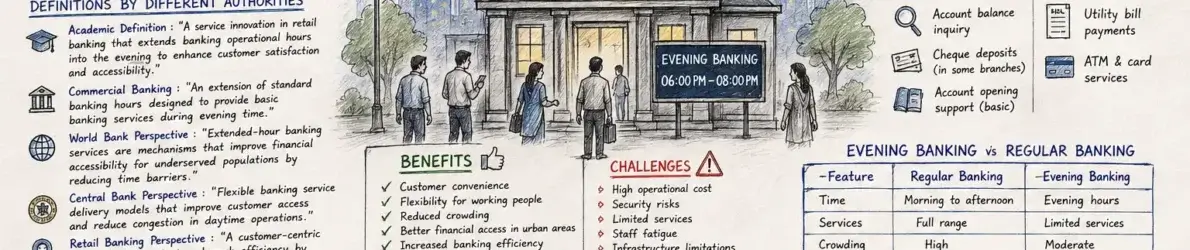
Evening Banking of Bangladeshi Bank: Evening Banking hours 06:00PM – 08:00PM. Unavoidable circumstances may lead to change in evening banking hours on a given day.
Evening Banking: Meaning, Definitions, Benefits, Challenges, and Future Scope (Complete Guide)
The banking sector has undergone massive transformation over the last few decades due to technological innovation, globalization, and changing customer expectations. One of the most significant service innovations in modern retail banking is Evening Banking, a system that extends traditional banking hours into the evening to serve customers beyond the standard working schedule.
In many countries, especially in developing economies like Bangladesh, India, and parts of Southeast Asia, banking hours are traditionally limited to daytime operations. However, as working lifestyles have evolved, millions of customers find it difficult to access banking services during regular hours. To solve this problem, banks introduced evening banking services.
Evening banking is not just a convenience feature—it is part of a broader financial inclusion strategy supported by global financial institutions such as the World Bank and central banks including the Reserve Bank of India.
This article provides a complete discussion on evening banking, including definitions by different authors, objectives, benefits, problems, operational structure, and future scope.
1. What is Evening Banking? (Definition and Meaning)
Evening banking refers to banking services provided after regular banking hours, typically between 5:00 PM and 8:00 PM, depending on the institution.
Simple Definition
Evening banking means:
“A banking facility that allows customers to perform selected financial transactions during evening hours after normal banking time.”
It is designed to ensure that customers who are unable to visit banks during office hours can still access essential banking services.
Key Characteristics of Evening Banking
-
Operates after normal banking hours
-
Provides limited but essential banking services
-
Focuses on customer convenience
-
Supports financial inclusion
-
Often available in urban and semi-urban areas
-
May operate through branches, agents, or digital kiosks
2. Definitions of Evening Banking by Different Authors and Institutions
Evening banking is not always defined in a single standardized textbook definition. However, various authors, institutions, and banking authorities describe it in similar ways.
2.1 Academic Definition
Modern banking scholars define evening banking as:
“A service innovation in retail banking that extends banking operational hours into the evening to enhance customer satisfaction and accessibility.”
This definition highlights its role as a customer service innovation.
2.2 Commercial Banking Definition
Commercial banking literature defines it as:
“An extension of standard banking hours designed to provide basic banking services such as deposits, withdrawals, and utility bill payments during evening time.”
2.3 World Bank Perspective
The World Bank connects evening banking with financial inclusion:
“Extended-hour banking services are mechanisms that improve financial accessibility for underserved populations by reducing time barriers.”
This means evening banking is not just convenience—it is inclusion.
2.4 Central Bank Perspective
Central banks such as the Reserve Bank of India define extended banking operations as:
“Flexible banking service delivery models that improve customer access and reduce congestion in daytime banking operations.”
2.5 Retail Banking Perspective
Retail banking experts describe evening banking as:
“A customer-centric approach that optimizes branch efficiency by distributing customer traffic beyond traditional working hours.”
3. Objectives of Evening Banking
The introduction of evening banking is driven by multiple economic and social objectives.
3.1 To Increase Customer Convenience
The primary objective is to allow customers to access banking services after work hours.
3.2 To Support Working Professionals
Employees, businessmen, and students often cannot visit banks during daytime.
3.3 To Reduce Branch Congestion
Evening banking reduces pressure during peak daytime hours.
3.4 To Promote Financial Inclusion
It ensures that low-income workers and busy individuals can still access banking services.
3.5 To Improve Service Efficiency
Banks can distribute customer flow across extended hours.
3.6 To Increase Revenue Opportunities
More operating hours can lead to increased transaction volume.
4. Services Offered Under Evening Banking
Evening banking does not include all services but focuses on essential transactions.
Common services include:
-
Cash deposit and withdrawal
-
Account balance inquiry
-
Fund transfer (limited)
-
Utility bill payments
-
ATM and card services
-
Cheque deposits (in some branches)
-
Account opening support (basic assistance)
5. Benefits of Evening Banking
Evening banking provides significant advantages to customers, banks, and the overall financial system.
5.1 Customer Convenience
Customers can visit banks after office hours, reducing stress and time pressure.
5.2 Flexibility for Working People
Office employees, freelancers, and business owners benefit greatly.
5.3 Reduced Crowding
Daytime queues are reduced, improving service quality.
5.4 Better Financial Access in Urban Areas
Urban populations with busy schedules benefit most.
5.5 Increased Banking Efficiency
Banks optimize staff utilization and service distribution.
5.6 Supports Digital Banking Growth
Evening banking complements mobile banking and online banking platforms.
5.7 Encourages Cash Flow in Economy
More transaction opportunities increase financial circulation.
5.8 Improved Customer Satisfaction
Customers feel more supported and valued.
6. Problems and Challenges of Evening Banking
Despite its benefits, evening banking has several limitations.
6.1 High Operational Cost
Banks face additional expenses:
-
Staff overtime payments
-
Electricity and utility bills
-
Security arrangements
-
Equipment maintenance
6.2 Security Risks
Cash handling during evening hours increases risk:
-
Theft
-
Robbery
-
Transportation risks
6.3 Limited Services
Evening banking does not offer full banking services:
-
Loan processing is often unavailable
-
Large financial transactions may be restricted
6.4 Staff Fatigue
Long working hours reduce employee efficiency and morale.
6.5 Infrastructure Limitations
Rural branches may lack proper lighting, security, and digital infrastructure.
6.6 Low Customer Awareness
Many customers are still unaware of evening banking services.
6.7 Regulatory Restrictions
In some regions, banking hours are strictly regulated by central authorities.
6.8 Digital Competition
Mobile financial services reduce the demand for physical banking hours.
7. Evening Banking vs Regular Banking
| Feature | Regular Banking | Evening Banking |
|---|---|---|
| Time | Morning to afternoon | Evening hours |
| Services | Full range | Limited services |
| Crowding | High | Moderate |
| Accessibility | Restricted | Flexible |
| Staff load | Normal | Extended |
8. Evening Banking in Developing Countries
In developing economies, evening banking plays a critical role in financial inclusion.
Example: Bangladesh
Banks in Bangladesh have introduced extended banking hours through branches and agent networks, especially in urban commercial areas.
Institutions like BRAC Bank and other commercial banks have experimented with flexible service hours to support customers.
9. Role of Technology in Evening Banking
Technology has greatly enhanced evening banking through:
9.1 ATM Services
24/7 cash withdrawal reduces pressure on evening counters.
9.2 Mobile Banking
Apps allow users to perform transactions without visiting branches.
9.3 Agent Banking
Local agents provide banking services in rural and semi-urban areas.
9.4 Digital Kiosks
Self-service machines extend banking hours without staff dependency.
10. Impact of Evening Banking on Financial Inclusion
Evening banking directly contributes to financial inclusion by:
-
Bringing banking services closer to working-class citizens
-
Supporting small businesses
-
Encouraging savings habits
-
Increasing account usage activity
This aligns with global inclusion goals promoted by organizations like the World Bank.
11. Future of Evening Banking
The future of evening banking is closely linked with digital transformation.
11.1 Hybrid Banking Model
Physical + digital banking integration will dominate.
11.2 AI-Powered Banking
AI chatbots and automated services will reduce dependency on human staff.
11.3 24/7 Banking Evolution
Evening banking may evolve into full 24-hour banking systems.
11.4 Cashless Economy Growth
As digital payments increase, physical evening banking may reduce but remain important.
12. Recommendations for Improving Evening Banking
-
Improve security systems
-
Increase staff incentives
-
Expand awareness campaigns
-
Strengthen digital infrastructure
-
Introduce flexible shift systems
-
Integrate mobile banking with branch services
Conclusion
Evening banking is a vital innovation in modern retail banking that enhances accessibility, improves customer satisfaction, and supports financial inclusion. While it has operational challenges such as cost and security concerns, its benefits far outweigh the limitations.
With increasing digital transformation and changing customer behavior, evening banking is expected to evolve into more flexible and technology-driven banking systems in the future.