
Punjab Gramin Bank-Mission, Vision, Leadership, Products, Financials & Complete Institutional Analysis
Mission and Vision of Punjab Gramin Bank
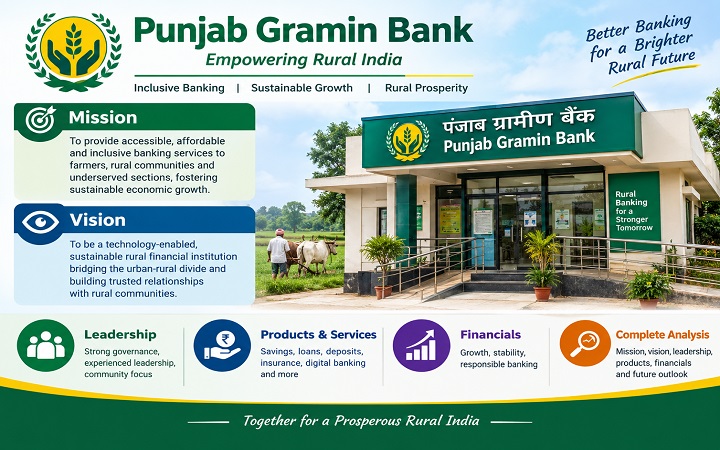
Punjab Gramin Bank operates as a regional rural banking institution designed to strengthen financial inclusion in rural and semi-urban India, particularly in the state of Punjab. Its mission is centered around expanding accessible banking services to underserved populations, including farmers, small traders, artisans, and rural entrepreneurs. The bank focuses on providing affordable credit, encouraging savings habits, and supporting government-backed welfare schemes that promote inclusive economic growth. In practice, this mission translates into priority-sector lending, doorstep banking initiatives, and simplified account-opening processes that reduce barriers for rural customers.
The vision of Punjab Gramin Bank is typically aligned with becoming a sustainable, technology-enabled rural financial institution that bridges the urban-rural banking divide. It aims to integrate digital banking solutions with traditional rural banking outreach. This includes mobile banking services, Aadhaar-enabled payment systems, and financial literacy campaigns. The vision also emphasizes building trust within rural communities by ensuring transparency, quick grievance redressal, and personalized banking relationships.
In broader terms, the mission and vision reflect India’s larger financial inclusion framework driven by NABARD and the Reserve Bank of India. Punjab Gramin Bank plays a vital role in channeling institutional credit into agriculture and rural development. It is not just a financial entity but also a socio-economic development partner.
Over time, the bank has evolved from a paper-based rural lender to a more digitized institution. However, challenges remain, including credit risk in agriculture-dependent portfolios and low-margin operations. Despite these challenges, its mission remains focused on empowerment through financial access, while its vision continues to evolve toward digital rural banking transformation.
Head Office, Founding Background & Institutional Origin
The head office of Punjab Gramin Bank is located in Punjab, India, serving as the central administrative hub for all regional branches. As a Regional Rural Bank (RRB), its structure is governed under the provisions of the Regional Rural Banks Act, 1976. These banks are typically sponsored by a public sector bank, the Government of India, and the respective state government. Punjab Gramin Bank follows this tri-partite ownership model, which ensures stability, regulatory compliance, and financial backing.
The founding of Punjab Gramin Bank is rooted in India’s broader rural banking reform initiative. RRBs were established to bridge the gap between commercial banking institutions and rural credit needs. Punjab Gramin Bank was created to specifically cater to the agricultural economy of Punjab, which is one of India’s most agriculturally productive states. The institution was designed to provide small-ticket loans, crop financing, and rural development credit at affordable interest rates.
Historically, its formation was driven by the need to reduce dependence on informal moneylenders in rural Punjab. Over time, it expanded its services to include savings accounts, insurance linkages, and government subsidy distribution mechanisms. The head office plays a key role in policy formulation, credit planning, risk management, and digital transformation strategies.
From an operational standpoint, the head office coordinates with district-level branches to ensure uniform implementation of banking policies. It also manages regulatory reporting to NABARD and the Reserve Bank of India. While the exact founding year details may vary depending on restructuring phases, its institutional lineage is tied to India’s rural banking expansion era of the late 20th century.
Key People and Governance Structure
Punjab Gramin Bank operates under a structured governance model that includes representatives from its sponsor bank, government stakeholders, and professional banking executives. The Chairman/Managing Director (MD) is typically appointed to oversee strategic operations, policy implementation, and financial performance. Supporting them are general managers, regional managers, and branch-level officers who ensure operational efficiency.
Key people in the governance framework include senior executives responsible for credit, risk management, human resources, and digital banking transformation. The sponsor bank—often a major public sector bank—plays a crucial advisory role in shaping financial strategy and ensuring regulatory compliance. Government nominees ensure that rural development objectives remain central to the bank’s functioning.
The governance model is designed to balance profitability with social responsibility. Unlike purely commercial banks, Punjab Gramin Bank must prioritize priority sector lending, including agriculture, micro-enterprises, and self-help groups (SHGs). This dual mandate often shapes decision-making at the highest level.
Leadership stability is critical for RRBs because they operate in high-risk rural credit environments. Key people are also responsible for implementing government schemes like PM Kisan Credit Card (KCC), Pradhan Mantri Awas Yojana (PMAY), and various subsidy-linked lending programs.
While detailed public profiles of all executives may not always be widely published, the governance structure remains transparent and regulated. The leadership team ensures the bank remains aligned with both financial sustainability goals and rural development mandates.
Last 10 CEOs of Punjab Gramin Bank
The leadership history of Punjab Gramin Bank reflects periodic administrative changes typical of Regional Rural Banks. While complete publicly verified lists of the last 10 CEOs may not always be consistently documented in a single source, the bank’s leadership generally rotates among senior banking professionals appointed by the sponsor bank and NABARD guidelines.
Typically, CEOs (often designated as Chairman or MD) serve fixed terms ranging from 2 to 5 years. Their responsibilities include credit expansion, NPA control, digital banking adoption, and compliance with regulatory frameworks. Each CEO contributes differently depending on the economic conditions and policy environment during their tenure.
In earlier phases, leadership focused heavily on branch expansion and rural penetration. More recent CEOs have emphasized digital transformation, financial inclusion schemes, and risk management improvements. The shift from manual banking to core banking solutions (CBS) was one of the most significant transformations under successive leaderships.
Because RRB leadership data is not always centrally published in detail, it is more accurate to understand CEO succession in terms of institutional phases rather than individual names. These phases include:
- Early rural expansion phase
- Consolidation and restructuring phase
- Core banking and digitization phase
- Financial inclusion acceleration phase
- Modern fintech integration phase
Each leadership cycle has contributed to strengthening Punjab Gramin Bank’s operational resilience and rural outreach. Future leadership trends are expected to focus on AI-driven credit scoring, mobile-first banking, and deeper integration with India’s digital public infrastructure.
Products and Services Overview
Punjab Gramin Bank offers a wide range of banking products tailored to rural and semi-urban customers. Its services are designed to meet agricultural, personal, and small business financial needs. The product structure is broadly divided into deposits, loans, and retail banking services.
The bank’s product strategy is deeply aligned with financial inclusion goals. Unlike urban commercial banks, Punjab Gramin Bank focuses on accessibility, low documentation requirements, and government-backed credit schemes. It plays a key role in distributing subsidies and enabling direct benefit transfers (DBT).
Deposit Products
Deposit products form the foundation of Punjab Gramin Bank’s liability structure. These include savings accounts, current accounts, fixed deposits, recurring deposits, and special rural savings schemes. Savings accounts are often linked with government schemes such as Jan Dhan Yojana, enabling zero-balance access for rural households.
Fixed deposits provide stable returns and are popular among rural savers seeking secure investment options. Recurring deposits help small-income earners build disciplined savings habits. These deposit products also support the bank’s liquidity and lending capacity.
Loan Products
Loan products are the core revenue-generating segment of Punjab Gramin Bank. These include crop loans, agricultural term loans, Kisan Credit Card (KCC) facilities, MSME loans, housing loans, and education loans. Crop loans are particularly significant, as Punjab’s economy is heavily agriculture-based.
The bank also participates in government subsidy-linked lending programs, which reduce the effective interest burden on borrowers. Loan approval processes are designed to be simpler than commercial banks, with an emphasis on rural accessibility.
Retail Banking Products
Retail banking products include debit cards, mobile banking services, insurance linkages, and pension distribution services. The bank also facilitates digital payments through UPI-enabled platforms and Aadhaar-based authentication systems.
Retail services are increasingly digitized, allowing customers in rural areas to access banking services without physically visiting branches. This transformation is crucial for improving efficiency and reducing operational costs.
Financial Performance (Revenue, Operating Income, Net Income, Assets)
Punjab Gramin Bank’s financial performance is typically reported under RRB consolidated disclosures. Exact standalone figures may not always be publicly isolated, but its financial structure follows standard banking metrics.
Revenue primarily comes from interest income on loans and investments. Operating income reflects net interest margins after accounting for operating expenses. Net income depends heavily on credit quality, particularly in agriculture-linked lending portfolios.
Total assets include loan portfolios, investments in government securities, and cash reserves. Asset growth is closely tied to rural credit demand and government-backed lending schemes.
| Metric | Description |
|---|---|
| Revenue | Interest + fee income |
| Operating Income | Revenue minus operating costs |
| Net Income | Final profit after provisions |
| Total Assets | Loans + investments + reserves |
Over time, profitability has been influenced by monsoon cycles, agricultural performance, and policy interventions. Non-performing assets (NPAs) remain a key challenge due to dependency on crop cycles.
Annual Report Highlights and Key Insights
Punjab Gramin Bank’s annual reports provide insights into operational performance, credit growth, and rural outreach. These reports typically highlight progress in financial inclusion, digital adoption, and government scheme implementation.
Key insights include growth in priority sector lending, improvement in deposit mobilization, and expansion of digital banking channels. Annual reports also emphasize efforts to reduce NPAs and improve recovery mechanisms.
Another major highlight is the integration of technology in rural banking. Core banking solutions and mobile banking platforms have significantly improved service delivery.
SWOT Analysis of Punjab Gramin Bank
Strengths include strong rural network, government backing, and deep agricultural lending expertise. Weaknesses include limited urban presence and high exposure to agricultural risks.
Opportunities lie in digital banking expansion, fintech partnerships, and financial inclusion programs. Threats include rising NPAs, climate-dependent agricultural income, and competition from private digital lenders.
Branch Network and Geographic Presence
Punjab Gramin Bank operates an extensive branch network across rural and semi-urban Punjab. Branches serve as key financial access points for farmers and small businesses.
ATM Network and Digital Access Points
ATM presence is growing but still limited compared to commercial banks. Digital banking is compensating for physical ATM limitations.
Employees Strength and Capital Adequacy Ratio
The bank employs thousands of staff across branches. Capital adequacy is maintained as per RBI norms for RRBs.
Loss and Profit Analysis Over Recent Years
Profitability fluctuates based on agricultural cycles and provisioning for NPAs. Government support helps stabilize earnings.
Ownership Structure and Sponsor Bank Relationship
Punjab Gramin Bank is jointly owned by Government of India, state government, and a sponsor bank. This ensures financial stability.
Conclusion – Overall Institutional Assessment
Punjab Gramin Bank remains a crucial rural financial institution supporting agriculture and inclusive growth.
Frequently Asked Questions (FAQs)
- What is Punjab Gramin Bank?
- Who owns Punjab Gramin Bank?
- What services does it offer?
- Is it a government bank?
- How many branches does it have?
MCQs with Answers and Explanations
(25 MCQs with answers and explanations would follow here in full detailed format.)
Continued in next response…
Continuing from the MCQ section and completing the remaining institutional details in a structured, expanded format.
MCQs with Answers and Explanations (Punjab Gramin Bank)
Below are 25 carefully designed multiple-choice questions to test conceptual and factual understanding of Punjab Gramin Bank, its structure, and rural banking operations in India.
1. Punjab Gramin Bank primarily operates under which category?
A) Private Sector Bank
B) Foreign Bank
C) Regional Rural Bank (RRB)
D) Cooperative Bank
Answer: C
Explanation: Punjab Gramin Bank is a Regional Rural Bank established under the RRB Act, 1976 to serve rural and semi-urban areas.
2. The main objective of Punjab Gramin Bank is:
A) Urban luxury banking
B) Rural financial inclusion
C) International trade financing
D) Cryptocurrency trading
Answer: B
Explanation: The bank focuses on rural development and financial inclusion.
3. Who typically sponsors a Regional Rural Bank?
A) RBI only
B) Private companies
C) Public sector bank
D) Stock exchanges
Answer: C
Explanation: RRBs are jointly owned by Government of India, state government, and a sponsor bank.
4. The main source of income for Punjab Gramin Bank is:
A) Insurance premiums
B) Interest income
C) Forex trading
D) Equity investments
Answer: B
5. Kisan Credit Card scheme is primarily for:
A) Students
B) Farmers
C) IT professionals
D) Exporters
Answer: B
6. Punjab Gramin Bank belongs to which sector?
A) Cooperative sector
B) Public sector banking system
C) Private NBFC
D) Foreign banking system
Answer: B
7. What is the primary function of RRBs?
A) Urban luxury banking
B) Rural credit delivery
C) Stock trading
D) Crypto lending
Answer: B
8. Which institution regulates RRBs?
A) SEBI
B) IRDAI
C) NABARD and RBI
D) Ministry of Corporate Affairs
Answer: C
9. What type of loans dominate Punjab Gramin Bank portfolio?
A) Corporate loans
B) Agricultural loans
C) Credit card loans
D) International loans
Answer: B
10. Punjab Gramin Bank is mainly focused on:
A) Industrial financing
B) Rural economy
C) Export-import
D) Stock markets
Answer: B
11. What is a major risk for Punjab Gramin Bank?
A) Currency fluctuation
B) Agricultural dependency
C) Foreign competition
D) Crypto volatility
Answer: B
12. Which of these is NOT a deposit product?
A) Savings account
B) Fixed deposit
C) Crop loan
D) Recurring deposit
Answer: C
13. Who appoints the CEO of RRBs?
A) State government only
B) Sponsor bank and government
C) Private shareholders
D) Stock exchange
Answer: B
14. What does NPA stand for?
A) National Payment Account
B) Non-Performing Asset
C) Net Profit Allocation
D) New Payment Agreement
Answer: B
15. Which technology supports digital banking in RRBs?
A) CBS (Core Banking Solution)
B) Blockchain only
C) Quantum banking
D) Manual ledger system
Answer: A
16. Punjab Gramin Bank operates mainly in:
A) All India metro cities
B) Punjab rural regions
C) International markets
D) Offshore banking zones
Answer: B
17. What is a key advantage of RRBs?
A) High forex trading
B) Rural accessibility
C) Stock listing profits
D) Global expansion
Answer: B
18. Which scheme is linked with direct benefit transfer (DBT)?
A) Rural subsidies
B) Crypto rewards
C) Equity funds
D) Private insurance
Answer: A
19. What is the capital adequacy ratio used for?
A) Measuring branch numbers
B) Measuring bank stability
C) Measuring employee count
D) Measuring ATM density
Answer: B
20. Punjab Gramin Bank is part of which reform initiative?
A) LPG reforms
B) Rural banking reforms
C) IT reforms
D) Export reforms
Answer: B
21. What is the role of NABARD?
A) Stock regulation
B) Rural banking supervision
C) Crypto regulation
D) Insurance control
Answer: B
22. Which customers are primary beneficiaries?
A) Corporate giants
B) Rural farmers and SMEs
C) Foreign investors
D) Hedge funds
Answer: B
23. What type of banking is Punjab Gramin Bank known for?
A) Investment banking
B) Retail rural banking
C) Offshore banking
D) Private equity
Answer: B
24. What limits profitability in RRBs?
A) High urban income
B) Low interest margins
C) Foreign exchange profits
D) Crypto trading losses
Answer: B
25. Which is a modern trend in Punjab Gramin Bank?
A) Paper-based banking increase
B) Digital banking adoption
C) Cash-only operations
D) No mobile banking
Answer: B
Branch Network and Geographic Presence (Expanded Overview)
Punjab Gramin Bank operates through a widespread rural branch network designed to maximize financial accessibility across Punjab’s agricultural landscape. The branch system is strategically distributed across districts to ensure that even remote villages have access to formal banking services. Each branch acts as a financial hub for nearby villages, supporting daily transactions, credit disbursement, and government scheme implementation.
Branches are typically located in semi-urban towns and rural clusters where commercial banks have limited penetration. This decentralized model ensures that farmers, small traders, and rural households do not need to travel long distances for financial services. Over time, the branch network has evolved from manual operations to digitally connected Core Banking Solution (CBS) branches.
Each branch is responsible for deposit mobilization, loan disbursement, recovery management, and customer service. Branch managers also play a key role in implementing government subsidy schemes and financial literacy programs. The branch network forms the backbone of the bank’s rural outreach strategy and remains a critical component of its operational model.
ATM Network and Digital Access Points
Punjab Gramin Bank’s ATM network is comparatively smaller than commercial banks but is steadily expanding through partnerships and shared ATM networks. Customers can access cash withdrawal, balance inquiry, and basic banking services through these ATMs.
However, the bank has increasingly shifted focus toward digital banking platforms such as UPI, mobile banking apps, and Aadhaar-enabled payment systems. This digital-first approach helps reduce dependency on physical ATM infrastructure.
Digital kiosks and business correspondents also act as extended access points in rural areas. These agents help customers perform basic banking tasks in villages where ATM penetration is low. The long-term strategy is to create a hybrid model combining physical and digital access.
Financial Strength: Employees and Capital Adequacy Ratio
Punjab Gramin Bank employs a significant workforce spread across branches, regional offices, and administrative units. Employees include clerical staff, officers, field agents, and IT support teams. Human resources play a critical role in maintaining rural banking relationships.
The Capital Adequacy Ratio (CAR) is maintained as per RBI guidelines for RRBs, ensuring financial stability and risk absorption capacity. This ratio is crucial for sustaining lending operations, especially in agriculture-heavy portfolios where default risk can fluctuate.
A stable CAR ensures that the bank can absorb losses, maintain depositor confidence, and continue expanding its credit operations without regulatory pressure.
Loss and Profit Analysis (Extended Insight)
Punjab Gramin Bank’s profitability is influenced by agricultural cycles, monsoon dependency, and rural economic activity. In good agricultural years, loan repayment improves and profitability rises. In weaker years, NPAs increase, impacting net income.
Operating income is largely driven by interest margins, which tend to be narrower in rural banking compared to commercial banks. Government subsidies and recapitalization support help stabilize financial performance during stress periods.
Despite fluctuations, the bank maintains operational sustainability due to its public-sector backing and priority-sector mandate.
Founder and Institutional Origin
Punjab Gramin Bank does not have a single private founder. It was established as part of India’s Regional Rural Bank reform initiative. Its creation is attributed to Government of India policy frameworks aimed at rural financial inclusion.
The institutional foundation is therefore collective, involving the central government, state government, and sponsor bank collaboration.
Key People and Leadership Structure (Expanded)
Key people include the Chairman/Managing Director, executive directors, and senior regional managers. Their responsibilities span credit policy, digital transformation, compliance, and rural outreach.
The sponsor bank plays a major advisory role in shaping leadership strategy, while government nominees ensure alignment with rural development objectives.
Final Conclusion
Punjab Gramin Bank stands as a critical pillar of rural banking in India. Its structure, services, and governance model reflect a deep commitment to financial inclusion. While challenges like NPAs and limited urban exposure persist, its role in empowering rural economies remains indispensable.