U.S. News’ Best Credit Card Offers of November 2026: Top Rewards, Cash Back, and 0% APR Deals
Choosing the right credit card can help consumers earn rewards, manage everyday expenses, save on interest, and enjoy valuable travel benefits. However, with hundreds of credit cards available in the United States, finding the most suitable option requires more than simply comparing welcome bonuses.
The best credit card depends on individual spending habits, financial goals, credit history, and ability to pay the monthly balance in full. Some cards offer straightforward cash back, while others provide travel points, airline miles, introductory annual percentage rates (APRs), or premium benefits.
The November 2026 credit card market features options for everyday purchases, travel, groceries, balance transfers, and consumers looking to avoid annual fees. Recent credit card comparisons from U.S. News, CNBC Select, and other personal finance publications provide useful starting points for evaluating these products.
This guide examines notable credit card offers, their major benefits, potential drawbacks, and the factors consumers should consider before applying. Because issuers can change promotions without notice, readers should verify the current offer and complete terms on the issuer’s official website before submitting an application.
Best Credit Card Offers of November 2026 at a Glance
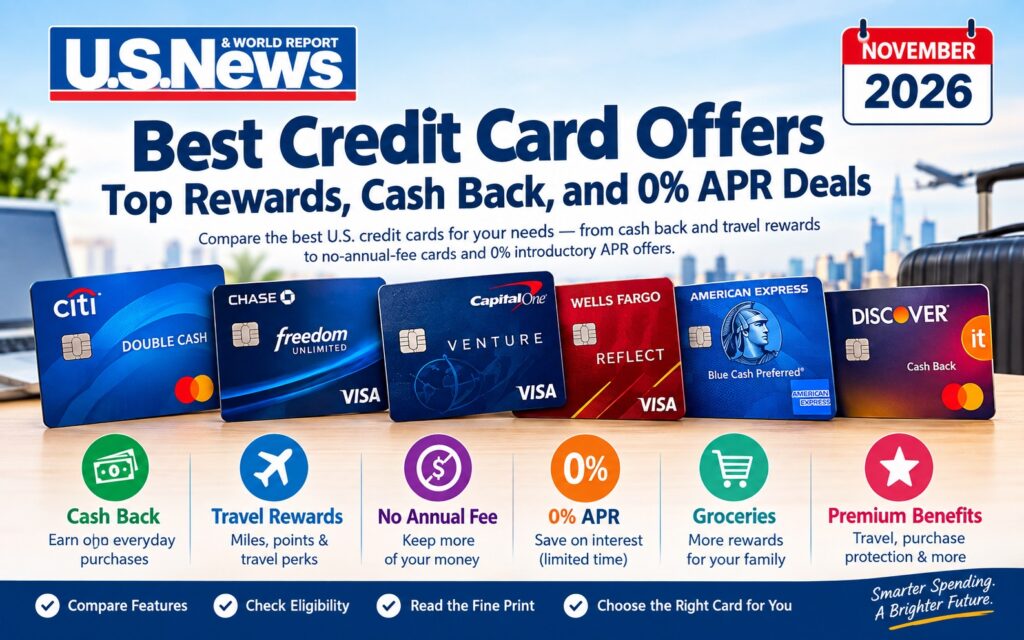
The following cards represent different credit card categories and consumer needs. This is an independently researched comparison, not a claim that every card appears on an official U.S. News November ranking.
| Credit Card | Best For | Annual Fee | Main Feature |
|---|---|---|---|
| Citi Double Cash Card | Everyday cash back | $0 | 2% cash back overall when you buy and pay |
| Chase Freedom Unlimited | Everyday spending | $0 | Cash back on general purchases and bonus categories |
| Capital One Venture Rewards | Travel rewards | $95 | Miles on purchases and a travel-related welcome offer |
| Wells Fargo Reflect Card | Introductory APR | $0 | Long introductory 0% APR period on qualifying transactions |
| Blue Cash Preferred Card from American Express | Grocery spending | $95 | Elevated cash back at eligible U.S. supermarkets |
| Discover it Cash Back | Rotating-category cash back | $0 | Quarterly bonus categories and a first-year Cashback Match offer for eligible new cardmembers |
Annual fees and offers are subject to change. See the issuer’s official terms for eligibility, reward caps, introductory periods, and other conditions.
1. Citi Double Cash Card: Best for Everyday Cash Back
The Citi Double Cash Card is worth considering for consumers who want a straightforward rewards structure without paying an annual fee.
Instead of requiring cardholders to enroll in multiple bonus categories, the card offers cash back through a two-part rewards structure: one portion when making an eligible purchase and another when paying for that purchase.
Key Features
- Annual fee: $0.
- Rewards: 1% cash back when purchasing and an additional 1% when paying.
- Welcome offer: The issuer’s listed offer includes $200 cash back after spending $1,500 on purchases within the first six months.
- Balance transfers: An introductory 0% APR offer may apply to qualifying balance transfers for a limited period.
- Redemption: Eligible rewards can be redeemed through available Citi options.
The welcome bonus, introductory APR, and standard variable APR are subject to eligibility and the terms in effect when applying.
Pros
- No annual fee.
- A simple rewards structure for everyday purchases.
- No rotating-category enrollment requirement for its standard rewards.
- Potential introductory savings on qualifying balance transfers.
Cons
- The full 2% reward requires both making purchases and paying for them.
- Balance transfers incur fees.
- Purchases made abroad may incur foreign transaction fees.
- Carrying an unpaid balance can lead to interest charges that outweigh the value of rewards.
Who Should Consider It?
This card may suit consumers who regularly use credit cards for ordinary purchases and pay their balances responsibly. It is particularly attractive to people who prefer consistent rewards instead of tracking changing bonus categories.
Official source: https://www.citi.com/credit-cards/citi-double-cash-credit-card
2. Chase Freedom Unlimited: Best for Flexible Everyday Rewards
The Chase Freedom Unlimited card offers a combination of base cash-back rewards and higher rewards rates in selected categories. It may be suitable for consumers who want one card for everyday purchases, dining, drugstore spending, and eligible travel bookings.
Key Features
- Annual fee: $0.
- General purchases: 1.5% cash back.
- Dining and drugstores: 3% cash back on eligible purchases.
- Eligible travel booked through Chase Travel: 5% cash back.
- Welcome offer: The issuer’s listed offer includes a $200 bonus after spending $500 on purchases during the first three months.
Rates, bonuses, and eligibility conditions may change. The introductory APR, where available, should also be checked in the current pricing disclosures.
Pros
- No annual fee.
- Straightforward cash-back rewards.
- Higher rewards rates for selected everyday categories.
- A relatively modest spending requirement for the listed welcome bonus.
Cons
- Some competitors offer a higher base cash-back rate.
- The highest travel rewards rate applies to eligible bookings through the issuer’s travel platform.
- Rewards do not automatically justify spending more than planned.
Who Should Consider It?
Consumers looking for a general-purpose cash-back card may find this option useful, especially if their spending includes dining and eligible travel purchases.
Official source: https://creditcards.chase.com/cash-back-credit-cards/freedom
3. Capital One Venture Rewards: Best for Travel Rewards
The Capital One Venture Rewards Credit Card is designed for consumers who want to earn miles on purchases and redeem rewards for eligible travel expenses.
The issuer’s listed promotion includes 75,000 bonus miles and a $300 eligible travel-stays credit, subject to the applicable offer terms. The card has a $95 annual fee.
Key Features
- Annual fee: $95.
- Standard rewards: 2 miles per dollar on every purchase.
- Welcome offer: 75,000 bonus miles under the listed promotion.
- Travel benefit: A $300 eligible stays credit under the advertised offer.
- Additional benefits: Certain travel-related credits or protections may be available under current terms.
The value of miles depends on the redemption method, eligible travel purchases, transfer partners, and applicable restrictions.
Pros
- Rewards on everyday spending.
- A potentially valuable welcome offer.
- Travel-focused redemption options.
- A simpler rewards structure than cards with many rotating categories.
Cons
- The annual fee reduces the net value for infrequent travelers.
- Rewards value varies by redemption method.
- Welcome bonuses generally require qualifying spending.
- Travel credits may have booking restrictions.
Who Should Consider It?
This card may be appropriate for consumers who travel regularly, can meet the spending requirement through normal expenses, and expect to redeem the rewards at a value that exceeds the annual fee and other costs.
Official source: https://www.capitalone.com/credit-cards/
4. Wells Fargo Reflect Card: Best for Introductory 0% APR
Consumers planning a large purchase or considering a qualifying balance transfer may want to compare cards with introductory 0% APR offers.
The Wells Fargo Reflect Card has been listed with a lengthy introductory APR period of up to 21 months on qualifying purchases and balance transfers, subject to transaction deadlines and the issuer’s terms.
Key Features
- Annual fee: $0.
- Introductory APR: A listed 0% introductory period of up to 21 months for qualifying purchases and balance transfers.
- Balance transfers: Eligibility, timing, and transfer fees apply.
- Standard APR: A variable APR applies after the introductory period ends.
Pros
- No annual fee.
- A potentially useful period for reducing interest costs.
- May help eligible cardholders pay down qualifying balances more efficiently.
- Can be useful for planned purchases when the repayment schedule is realistic.
Cons
- A balance transfer fee may apply.
- The standard APR can be substantial after the introductory period.
- Approval and credit limits are not guaranteed.
- New spending can undermine a balance-reduction plan.
Who Should Consider It?
This card may suit eligible consumers who need time to repay qualifying purchases or transferred balances. Before applying, calculate the monthly payment required to clear the balance before the introductory period expires.
For example, a $3,000 balance divided across 15 months would require approximately $200 per month, excluding fees and any other account activity. The actual repayment plan should use the introductory period and terms offered to the individual applicant.
5. Blue Cash Preferred Card from American Express: Best for Grocery Rewards
The Blue Cash Preferred Card from American Express is a rewards card focused on household spending, particularly eligible supermarket purchases in the United States.
The card offers 6% cash back at eligible U.S. supermarkets on up to $6,000 in purchases per calendar year, followed by 1% on additional eligible purchases in that category. Other bonus categories and terms apply.
Key Features
- Annual fee: $95.
- Grocery rewards: 6% cash back at eligible U.S. supermarkets on up to $6,000 per calendar year.
- Streaming: Elevated cash back on eligible select U.S. streaming subscriptions.
- Other categories: Additional rewards may apply to eligible transit, gas, and other purchases.
- Welcome offer: Check the issuer’s current offer and qualifying spending requirement.
Pros
- Strong potential rewards for eligible grocery purchases.
- Additional bonus categories for some household expenses.
- Useful for families with predictable eligible spending.
Cons
- The annual fee reduces net rewards.
- The supermarket reward has a spending cap.
- Warehouse clubs and some other retailers may not qualify as supermarkets.
- Rewards may not offset the annual fee for households with low eligible spending.
Who Should Consider It?
This card may be attractive to households that spend enough at eligible U.S. supermarkets to justify the annual fee. Compare the estimated annual rewards with the fee and the benefits of a no-annual-fee alternative.
Official source: https://www.americanexpress.com/
6. Discover it Cash Back: Best for Rotating Cash-Back Categories
The Discover it Cash Back card offers a different rewards approach. Instead of providing the same elevated rate in every category, it features rotating quarterly bonus categories that cardholders generally need to activate.
Eligible new cardmembers may also receive a first-year Cashback Match under the issuer’s applicable terms.
Key Features
- Annual fee: $0.
- Rewards: 5% cash back on eligible purchases in activated quarterly categories, up to the applicable quarterly limit.
- Other purchases: Generally earn 1% cash back.
- First-year promotion: Cashback Match may apply to eligible new cardmembers.
- Category activation: Required for the rotating bonus categories.
Pros
- No annual fee.
- Potentially high rewards in selected categories.
- First-year Cashback Match can increase rewards for eligible new cardmembers.
- Useful for consumers who can plan spending around bonus categories.
Cons
- Bonus categories change over time.
- Activation is required.
- Spending caps apply.
- Rewards may be less predictable than a flat-rate cash-back card.
Who Should Consider It?
This card may work well for organized consumers who review quarterly categories and can direct eligible purchases toward them without changing their spending habits unnecessarily.
Official source: https://www.discover.com/credit-cards/
How to Choose the Best Credit Card Offer
The most valuable card is not necessarily the one with the largest advertised bonus. Consumers should compare the total value of rewards and benefits with annual fees, interest, transaction fees, and spending requirements.
Compare Annual Fees
A no-annual-fee card may be suitable for consumers who want basic rewards and minimal ongoing costs. A card with an annual fee may be worthwhile if its usable benefits and additional rewards exceed that fee.
Evaluate Welcome Bonuses Carefully
Welcome bonuses can provide substantial value, but many require cardholders to spend a specified amount within a limited period.
Before applying, ask:
- Can I meet the spending requirement using planned purchases?
- Is the bonus available to me under the issuer’s eligibility rules?
- Will the bonus compensate for any annual fee?
- Can I pay the full statement balance without borrowing more?
Do not make unnecessary purchases simply to earn a bonus.
Compare Rewards Rates
Cash-back rewards can be easy to understand, while travel points and miles may provide more value through selected redemption methods. Compare rewards based on your actual spending rather than advertised maximum rates.
Understand Introductory APR Offers
A 0% introductory APR is temporary. Once the promotional period ends, the standard APR may apply to remaining balances. Some offers apply only to purchases, while others apply to qualifying balance transfers.
Read the full pricing disclosures and confirm the balance-transfer deadline and fee.
Review Credit Requirements
Credit card issuers assess applications using factors that may include credit history, income, existing debt, and other eligibility criteria. A card’s published credit category is not a guarantee of approval.
Applying for multiple cards within a short period can also affect a consumer’s credit profile.
Benefits of Using Credit Cards Responsibly
Credit cards can offer practical financial benefits when used carefully.
Convenience: They provide a widely accepted method of payment for eligible purchases.
Rewards: Cardholders may earn cash back, points, or miles on eligible transactions.
Purchase protections: Certain cards offer eligible purchase protection, extended warranty benefits, or fraud-related protections, subject to issuer terms.
Credit history: Responsible use and timely payments may help build a positive credit history in the United States.
Emergency flexibility: A credit line can provide short-term payment flexibility, but it should not replace emergency savings or a sustainable budget.
Potential Risks of Credit Cards
Credit cards also create financial risks when balances are not paid on time.
- High interest charges: Interest can outweigh rewards when a balance is carried.
- Late-payment fees: Missing payment deadlines can lead to fees and other consequences.
- Overspending: Reward incentives can encourage purchases that were not part of a budget.
- Annual fees: Premium benefits may not justify recurring fees for every cardholder.
- Balance-transfer costs: A promotional APR does not necessarily mean a transfer is free.
- Credit impact: Late payments, high credit utilization, and repeated applications may negatively affect a credit profile.
Consumers should prioritize affordability and repayment over earning points or miles.
Are U.S. Credit Cards Available to Applicants in Bangladesh?
Most U.S.-issued credit cards are intended for applicants who meet the issuer’s U.S. eligibility and identification requirements. Depending on the issuer and product, an applicant may need a qualifying U.S. mailing address, Social Security number or Individual Taxpayer Identification Number, sufficient income, and a qualifying credit history.
A person living in Bangladesh should not assume that a U.S. credit card can be obtained using only a Bangladeshi address or local bank account. Eligibility differs by issuer and card.
Before applying, check the issuer’s requirements directly. Never provide false address, identity, income, or residency information to obtain a credit card.
For Bangladesh-based consumers, locally issued bank cards may be more practical. Compare local issuing banks’ annual fees, interest or profit terms, foreign-currency transaction costs, installment facilities, and eligibility requirements.
Frequently Asked Questions
1. What is the best credit card offer for November 2026?
There is no single best card for everyone. Citi Double Cash is worth comparing for everyday cash back, Capital One Venture Rewards for travel rewards, Wells Fargo Reflect for introductory APR offers, and Blue Cash Preferred for eligible supermarket spending.
2. Which credit card has no annual fee?
The Citi Double Cash, Chase Freedom Unlimited, Wells Fargo Reflect, and Discover it Cash Back are examples of cards with no annual fee under their listed standard terms. Always verify current issuer disclosures.
3. Which credit card is best for cash back?
The answer depends on spending habits. A flat-rate rewards card may suit general spending, while a rotating-category or supermarket-focused card may produce more rewards for eligible purchases in its bonus categories.
4. What does 0% introductory APR mean?
A 0% introductory APR means that interest is not charged on qualifying transactions during a specified promotional period, subject to the card agreement. Fees may still apply, and the regular APR generally applies after the promotion ends.
5. Is a credit card welcome bonus worth it?
A welcome bonus can be valuable when the required spending fits within a normal budget and the card’s fees do not outweigh its benefits. It is usually unwise to incur debt or make unnecessary purchases to qualify.
6. Can someone in Bangladesh apply for a U.S. credit card?
Possibly in limited circumstances, depending on the issuer and the applicant’s eligibility, but most standard U.S. credit cards require specific U.S. identification, address, and credit-history criteria. Check the issuer’s rules before applying.
7. Does applying for a credit card affect a credit score?
A formal application may generate a hard inquiry, which can affect a U.S. credit score. The impact varies. Some issuers offer prequalification tools that use a soft inquiry, but prequalification does not guarantee approval.
8. Should I choose a rewards card or a low-interest card?
Consumers who pay their full statement balances each month may benefit from rewards. Consumers who need to repay an existing balance may prioritize a suitable low-interest or introductory APR offer, while carefully considering transfer fees and repayment deadlines.
9. How often do credit card offers change?
Issuers can change welcome bonuses, spending requirements, APRs, annual fees, and promotional terms at any time. Check the official card page immediately before applying.
10. Where can I compare U.S. credit card offers?
Consumers can review the U.S. News credit card section, CNBC Select’s credit card comparisons, and official issuer websites. Compare multiple sources and read the card agreement before making a decision.
Final Verdict
The best U.S. credit card offers for November 2026 depend on the cardholder’s goals, spending patterns, and repayment capacity. Cash-back cards may suit everyday purchases, travel cards may benefit frequent travelers, and introductory APR cards may help eligible consumers manage a repayment plan.
Before choosing a card, compare the annual fee, welcome bonus, rewards structure, introductory and ongoing APR, transaction fees, and eligibility requirements. An attractive promotion is only valuable when the card fits your financial circumstances.
Editorial note: Credit card offers and terms are subject to change. This article is for general educational purposes and does not constitute individualized financial advice. Verify all current offers directly with the issuer before applying.
References
- U.S. News & World Report — https://money.usnews.com/credit-cards
- CNBC Select — https://www.cnbc.com/select/best-credit-cards/
- Citi Double Cash Card — https://www.citi.com/credit-cards/citi-double-cash-credit-card
- Chase Freedom Credit Cards — https://creditcards.chase.com/cash-back-credit-cards/freedom
- Capital One Credit Cards — https://www.capitalone.com/credit-cards/
- American Express — https://www.americanexpress.com/
- Discover Credit Cards — https://www.discover.com/credit-cards/