
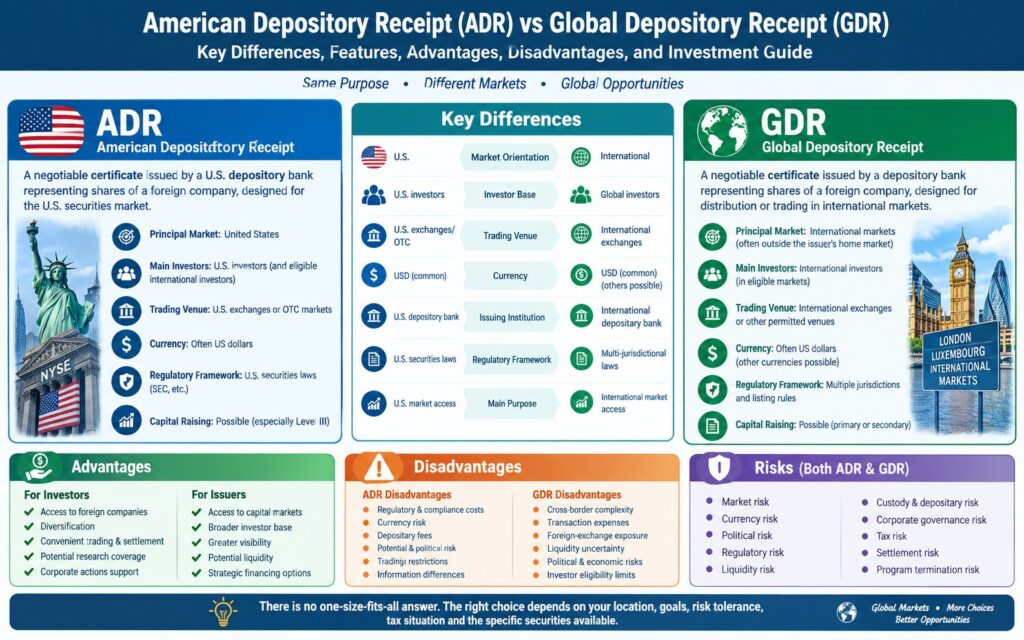
American Depository Receipt (ADR) vs Global Depository Receipt (GDR): Key Differences, Features, Advantages, Disadvantages, and Investment Guide
International capital markets provide companies with opportunities to raise funds beyond their domestic financial systems, while investors can diversify their portfolios by investing in securities issued by companies located in different countries. Two important financial instruments that facilitate cross-border investment are the American Depository Receipt (ADR) and the Global Depository Receipt (GDR). Both instruments allow investors to gain economic exposure to foreign companies without necessarily purchasing and holding the companies’ ordinary shares directly in their home markets.
Although ADRs and GDRs serve similar purposes, they differ in their principal markets, investor bases, regulatory requirements, trading arrangements, disclosure obligations, and methods of distribution. Understanding these differences is important for investors, bankers, financial analysts, corporate finance professionals, regulators, and students of international finance.
An American Depository Receipt is a negotiable financial instrument issued by a depository bank in the United States that represents ownership of a specified number of shares in a foreign company. ADRs are designed primarily to facilitate investment in foreign companies through the US securities market. Depending on the particular program, they may trade over the counter or on a major US stock exchange.
A Global Depository Receipt, by contrast, is a negotiable certificate issued by a depository bank representing shares in a foreign company and designed for distribution or trading in one or more international markets. GDRs are commonly associated with international financial centers, including London and Luxembourg, although the available markets and listing arrangements depend on the individual offering and applicable rules.
The fundamental difference is that an ADR is specifically associated with the US securities market, whereas a GDR is generally structured for international distribution across markets outside, or potentially including, the United States, subject to the applicable securities laws and offering arrangements.
Both instruments help bridge the gap between domestic share markets and international investors. They can improve access to capital, increase the visibility of issuing companies, and provide investors with alternative ways to participate in foreign equity markets. However, neither instrument eliminates investment risk, foreign-exchange exposure, regulatory complexity, or the possibility of losses.
This comprehensive guide explains ADRs and GDRs, their structures, major differences, operating mechanisms, regulatory frameworks, advantages, disadvantages, costs, risks, practical examples, and relevance to emerging economies such as Bangladesh.
What Is an American Depository Receipt (ADR)?
An American Depository Receipt (ADR) is a negotiable certificate issued by a US depository bank that represents shares of a company incorporated outside the United States. It enables US investors to obtain exposure to foreign companies through familiar US market infrastructure.
Instead of purchasing shares directly through a foreign stock exchange, an investor may buy an ADR through a US brokerage account, where the particular ADR is eligible for trading.
For example, an investor in the United States who wants to invest in a company incorporated in another country may purchase its ADR if the company has established an appropriate ADR program and the investor is eligible to trade it.
The ADR represents an interest in the underlying foreign shares. It does not necessarily mean that the investor becomes the registered shareholder of the foreign company’s ordinary shares in the same manner as an investor purchasing shares directly in the home market. The precise legal rights depend on the deposit agreement, custody arrangements, applicable law, and the type of ADR program.
Definition of ADR
An American Depository Receipt can be defined as a negotiable instrument issued by a US depository bank representing a specified number of shares, or a fraction of a share, of a foreign company held by a custodian in the company’s home country.
ADRs are generally denominated and traded in US dollars. Cash distributions, such as dividends, are ordinarily processed through the depository system and converted into US dollars when applicable, after accounting for relevant taxes, currency-conversion costs, and fees.
Main Features of ADRs
1. US market orientation: ADRs are designed to provide access to foreign-company securities through the US market.
2. US-dollar trading: Many ADRs are quoted and traded in US dollars, simplifying transactions for US-based investors.
3. Depository-bank involvement: A depository bank issues and administers the receipts, while a custodian generally holds the underlying shares in the issuer’s home market.
4. Underlying foreign equity: Each ADR represents a specified quantity of underlying shares. The ratio may be one ADR to one ordinary share, several ordinary shares to one ADR, or a fraction of an ordinary share per ADR.
5. Different trading arrangements: ADRs may trade through US exchanges or over-the-counter markets, depending on their program and eligibility.
6. Dividend administration: Dividends declared by the foreign company are collected and distributed through the depository system, subject to taxes, conversion rates, and applicable fees.
7. Voting arrangements: ADR holders may be able to provide voting instructions through the depository, but the process and extent of participation depend on the deposit agreement and applicable rules.
8. Foreign-exchange exposure: Even when an ADR trades in US dollars, changes in the exchange rate between the US dollar and the issuer’s home currency can affect its value.
9. Regulatory obligations: The disclosure and reporting requirements vary according to the ADR program, the issuer’s circumstances, the trading venue, and applicable exemptions.
10. Potential liquidity benefits: Listing or trading through the US market can expand the potential investor base, although actual liquidity varies considerably among ADRs.
How Does an ADR Work?
The ADR process involves several parties, including the foreign company, a depository bank, a local custodian, brokers, and investors.
The foreign company may seek access to US investors by establishing an ADR program. Under the relevant arrangements, ordinary shares are deposited with a custodian in the company’s home country. A US depository bank issues ADRs representing the deposited shares.
Investors then buy and sell the ADRs through the permitted trading venue.
A simplified example illustrates the process:
Suppose a foreign company has ordinary shares trading at the equivalent of US$20 per share in its home market. Its depository bank establishes a program in which one ADR represents two ordinary shares.
Ignoring fees, taxes, exchange-rate movements, and market-price differences, the indicative value of one ADR would be:
ADR value = Number of underlying shares × Value per underlying share
ADR value = 2 × US$20 = US$40.
If the underlying shares rise in value, the ADR will generally tend to rise as well, after allowing for currency movements, market conditions, supply and demand, and other factors.
If the ADR trades at a price substantially different from the value implied by the underlying shares, market participants may have opportunities to arbitrage the difference, where legal, operational, and market conditions permit. However, differences may persist because of transaction costs, trading restrictions, currency controls, settlement differences, and limited liquidity.
Types of ADRs
ADRs can be classified according to their trading arrangements, capital-raising purpose, and regulatory requirements. Common classifications include Level I, Level II, Level III, and private placements under Rule 144A. These categories are not interchangeable, and their legal requirements should be checked against current US securities regulations.
Level I ADRs
Level I ADRs are generally used by foreign companies seeking a relatively accessible way to establish a presence in the US over-the-counter market without undertaking a public offering of new shares in the United States.
They generally involve fewer US registration obligations than exchange-listed public offerings, but the issuer must still satisfy applicable requirements, including those associated with the relevant exemption, disclosure arrangements, and market rules.
Level I ADRs are not normally a mechanism for raising new capital through a US public offering.
Level II ADRs
Level II ADR programs enable foreign companies to list their ADRs on an eligible US national securities exchange, subject to applicable requirements.
These programs generally require registration of the relevant securities and compliance with applicable reporting obligations, unless an exemption applies.
A Level II program can increase a company’s visibility and facilitate trading by US investors. However, the program’s principal purpose is market access rather than raising new capital through the issuance of new shares.
Level III ADRs
Level III ADR programs can facilitate both US exchange listing and public capital raising through the issuance of new securities, subject to the relevant requirements.
Companies using this structure typically face more extensive disclosure, registration, governance, and ongoing compliance obligations than those associated with less demanding ADR arrangements.
A Level III offering can help a foreign company raise funds from US investors for expansion, acquisitions, debt reduction, research, technology investment, or other corporate purposes.
Rule 144A ADR-Related Offerings
Rule 144A provides a framework for certain private resales of eligible securities to qualified institutional buyers in the United States. It is important to distinguish the rule itself from an ADR classification: a Rule 144A transaction is not simply another universally applicable ADR level.
Such offerings may provide access to institutional capital while operating under a different regulatory framework from a registered public offering. Eligibility, transfer restrictions, disclosure obligations, and the precise security structure must be evaluated for each transaction.
Examples of ADRs
Several well-known foreign companies have used ADR structures to provide access to US investors. Examples include:
- Alibaba Group: A Chinese-founded business group whose US-listed depositary securities have provided access to US-market investors.
- Taiwan Semiconductor Manufacturing Company (TSMC): A Taiwanese semiconductor manufacturer with US-traded depositary securities.
- Toyota Motor Corporation: A Japanese automobile manufacturer with an established history of US-market depositary trading.
- Sony Group Corporation: A Japanese technology and entertainment company with US-market depositary securities.
- Infosys: An Indian technology services company that has used US-market securities arrangements to reach international investors.
These examples illustrate that ADRs can represent companies operating in different sectors and jurisdictions. Listing arrangements and trading status can change, so investors should verify current details through official exchange, issuer, and depository-bank information.
What Is a Global Depository Receipt (GDR)?
A Global Depository Receipt (GDR) is a negotiable financial instrument issued by a depository bank representing shares in a company incorporated in another country. GDR programs are designed to facilitate access to international investors through one or more foreign financial markets.
GDRs have been used by companies seeking to raise equity capital or broaden their investor base beyond their domestic markets. Depending on the transaction, they may be listed on an international exchange, admitted to trading on another eligible venue, or distributed to investors through an international offering.
A GDR is not automatically available in every country or on every exchange. Its distribution depends on the issuer’s chosen structure, applicable securities laws, investor eligibility, and listing or admission requirements.
Definition of GDR
A Global Depository Receipt can be defined as a negotiable certificate issued by a depository bank representing a specified number of shares, or a fraction of a share, in a foreign company, structured for distribution or trading in international markets under the applicable legal and regulatory framework.
Like ADRs, GDRs are backed by underlying shares held through custody arrangements. The depository bank administers the receipts, while a custodian typically holds the underlying securities in the issuer’s home market.
Main Features of GDRs
1. International market orientation: GDRs are designed to reach investors in international markets beyond the issuer’s domestic market.
2. Potential access to multiple jurisdictions: Depending on the program, GDRs may be offered or traded in one or more international financial centers.
3. Depository-bank structure: A depository bank issues the receipts against underlying shares held through a custodian.
4. Currency flexibility: GDRs are frequently denominated in US dollars, but the currency and settlement arrangements depend on the specific program.
5. Cross-border investment: GDRs enable eligible investors to obtain exposure to foreign-company equity through an international securities instrument.
6. Capital-raising potential: GDRs may be used in international equity offerings, including transactions designed to raise new capital.
7. Listing and trading flexibility: The relevant venue, listing standards, settlement arrangements, and disclosure requirements vary according to the program.
8. Investor-rights arrangements: Voting, dividend distribution, corporate-action processing, and other rights are governed by the deposit agreement and applicable law.
9. Foreign-exchange exposure: Investors may face currency risks even when the GDR is traded in a major international currency.
10. Regulatory complexity: A GDR transaction may involve multiple jurisdictions, making legal structuring, disclosure, taxation, custody, and compliance important considerations.
How Does a GDR Work?
Suppose a company incorporated in an emerging economy wants to attract investment from international institutional investors. Its management decides to establish a GDR program.
The company works with investment banks, legal advisers, a depository bank, custodians, and other service providers to structure the transaction.
Shares are deposited with a custodian in the company’s home market. A depository bank then issues GDRs representing the deposited shares, subject to the terms of the program.
The receipts are distributed to eligible investors through the relevant international offering or admitted to trading on an eligible market.
For example, assume a company has ordinary shares worth US$5 each on an equivalent-value basis. The GDR ratio is one GDR to four ordinary shares.
Ignoring fees, taxes, currency changes, and market differences:
GDR value = 4 × US$5 = US$20.
If the underlying shares increase in value, the GDR’s indicative value should generally increase, subject to exchange-rate movements, investor demand, market liquidity, and transaction-specific factors.
GDRs may also be structured with ratios that make the receipt’s trading price more convenient for investors. The ratio does not change the underlying economic value of the shares represented, although it can influence the nominal trading price and transaction costs.
Examples of GDR Use
Companies from emerging and developed markets have used global depositary structures to reach investors outside their domestic markets. Examples of issuers associated with international depositary-receipt programs include:
- Indian companies seeking international institutional investment.
- Chinese companies pursuing capital-market access outside mainland China.
- Companies in Central and Eastern Europe seeking broader investor participation.
- Multinational businesses seeking to expand their international shareholder base.
A company’s use of a GDR program should be distinguished from its use of an ADR program, an ordinary foreign listing, or another form of international depositary security. The precise structure and current status must be verified using official issuer and exchange documentation.
Why Are ADRs and GDRs Important in International Finance?
ADRs and GDRs help connect companies that need capital with investors seeking opportunities beyond their domestic markets. Their significance extends to capital formation, international portfolio diversification, market development, corporate visibility, and financial integration.
1. Access to International Capital
Companies may face limitations when relying exclusively on their domestic capital markets. A relatively small investor base, limited market liquidity, or insufficient domestic institutional savings may restrict the amount of equity capital available.
Depositary receipts can broaden the potential investor base by making foreign-company securities accessible through international financial infrastructure.
2. Portfolio Diversification
Investors may use ADRs and GDRs to obtain exposure to foreign companies without opening a separate brokerage account in every relevant domestic market.
International diversification may reduce dependence on the performance of a single country’s economy. Nevertheless, diversification does not eliminate risk, and foreign securities can be affected by global market shocks, geopolitical events, currency fluctuations, and correlated asset-price movements.
3. Improved Market Visibility
A depositary-receipt program can increase awareness of a company among international investors, analysts, financial journalists, and institutional investment managers.
This visibility may improve access to future financing opportunities, although a depositary receipt does not guarantee favorable investor sentiment or a higher valuation.
4. Potential Liquidity Benefits
Trading through an established international market can increase the number of potential buyers and sellers.
However, a depositary receipt may be less liquid than the underlying ordinary shares. Actual liquidity depends on trading volume, investor participation, market-maker activity, transfer arrangements, and the availability of arbitrage mechanisms.
5. Better Access to Institutional Investors
International funds, pension funds, asset managers, and other institutional investors may be able to purchase eligible depositary receipts through established trading and settlement systems.
The extent of access depends on the investor’s mandate, local law, security eligibility, and the requirements of the relevant market.
6. Potential Corporate Financing Benefits
For an issuing company, an international depositary-receipt offering may support business expansion, acquisitions, technology investment, capital expenditure, or balance-sheet restructuring.
The ultimate benefit depends on the offering price, transaction expenses, use of proceeds, corporate performance, and market conditions.
7. Financial Market Integration
Depositary receipts support the movement of investment capital across borders. They can strengthen connections between domestic stock markets, international depositories, global custodians, brokers, and institutional investors.
However, these instruments operate within national legal systems, and capital controls, foreign-ownership limits, sanctions, or market restrictions can constrain their use.
Fundamental Similarities Between ADRs and GDRs
Despite their differences, ADRs and GDRs share several important characteristics.
First, both represent interests in underlying shares of a foreign company. Second, both generally involve a depository bank and a custodian. Third, both can make cross-border investment more convenient for eligible investors. Fourth, both may facilitate access to a broader investor base. Fifth, both can expose investors to currency risk and the financial performance of the underlying company.
Their common structure can be summarized as follows:
Foreign company shares → Custodian arrangement → Depository bank → Depositary receipts → Eligible investors.
The arrangement allows investors to trade the receipts without necessarily arranging direct settlement of the underlying ordinary shares for each transaction.
Nevertheless, investors should understand that depositary receipts are not identical to direct share ownership in every legal, administrative, or operational respect. Their rights depend on the relevant documentation and law.
Difference Between ADR and GDR: A Comprehensive Comparison
The following table summarizes the principal distinctions between American Depository Receipts and Global Depository Receipts.
| Basis of comparison | American Depository Receipt (ADR) | Global Depository Receipt (GDR) |
|---|---|---|
| Full form | American Depository Receipt | Global Depository Receipt |
| Principal market orientation | United States | International markets, often outside the issuer’s home market |
| Primary investor base | US-market investors, including eligible domestic and international investors | International investors in eligible markets |
| Geographic focus | Specifically associated with the US securities market | Designed for international distribution or trading across eligible markets |
| Trading venue | US exchanges or OTC markets, depending on the program | An eligible international exchange or other permitted trading venue |
| Currency | Commonly US dollars | Often US dollars; other arrangements may be possible |
| Issuing institution | Generally a US depository bank | A depository bank selected for the international program |
| Underlying security | Shares of a foreign company | Shares of a foreign company |
| Custody | Underlying shares held through a custodian in the issuer’s home market | Underlying shares held through a custodian in the issuer’s home market |
| Investor access | Subject to US market, securities, and investor eligibility requirements | Subject to the laws and investor eligibility rules of the relevant markets |
| Regulatory framework | US securities laws and relevant market rules, with applicable exemptions | Relevant offering, listing, and securities laws in the jurisdictions involved |
| Disclosure obligations | Depend on the ADR program, issuer status, exemptions, and applicable rules | Depend on the offering structure, listing venue, and applicable jurisdictions |
| Capital-raising capacity | Certain programs, particularly Level III, can facilitate US public offerings | International offerings can facilitate cross-border equity capital raising |
| Listing requirements | Vary according to the US trading venue and ADR level | Vary according to the selected international venue and transaction structure |
| Dividend payments | Processed through the depository system, often converted into US dollars | Processed through the depository system, in the program’s applicable currency |
| Voting rights | Exercised through the arrangements specified in the deposit agreement | Exercised through the arrangements specified in the deposit agreement |
| Foreign-exchange exposure | Includes exposure to movements in the underlying shares’ currency relative to the US dollar | Depends on the relationship among the underlying share currency, GDR currency, and investor’s home currency |
| Main corporate purpose | US investor access, visibility, trading, and potentially capital raising | International investor access, visibility, trading, and potentially capital raising |
| Potential compliance burden | US-specific reporting, registration, exchange, and other obligations may apply | Cross-border legal, disclosure, listing, and distribution obligations may apply |
| Potential investor advantage | Access to foreign companies through US market infrastructure | Access to foreign companies through an international securities structure |
| Main risk categories | Equity, currency, liquidity, regulatory, custody, and political risks | Equity, currency, liquidity, regulatory, custody, and political risks |
| Universal availability | No; program and security eligibility matter | No; program and market eligibility matter |
The table describes general tendencies rather than universal rules. The specific offering documents, deposit agreement, exchange requirements, and laws applicable to the transaction determine the actual characteristics of a particular ADR or GDR.
The Most Important Difference: Market Orientation
The principal distinction between ADRs and GDRs is their market orientation.
An ADR is specifically associated with the US securities market. Its structure is designed to facilitate access to foreign-company securities through US trading and settlement arrangements.
A GDR is designed for international distribution or trading, often through financial centers outside the issuer’s domestic market. Depending on the offering, a GDR program may target investors across more than one country or market.
This distinction is more useful than simply assuming that every ADR is available only to Americans or that every GDR is available worldwide. ADRs can be held by eligible non-US investors, and GDRs may be subject to substantial geographic and investor restrictions.
In addition, the terms American and Global do not, by themselves, determine every legal feature of the security. The relevant documents and regulatory framework remain decisive.
Difference in Currency and Exchange-Rate Exposure
Currency is another important consideration.
ADRs are commonly quoted and traded in US dollars. This means an eligible US investor can often buy and sell an ADR without converting funds into the issuer’s domestic currency for each transaction.
GDRs are also frequently denominated in US dollars, particularly in international offerings. Therefore, it is incorrect to assume that ADRs must be dollar-denominated while GDRs must use another currency.
The more important distinction is how the underlying shares, depositary receipts, and investor’s home currency interact.
Suppose a foreign company’s shares rise by 8% in their home currency. During the same period, that currency depreciates by 10% against the US dollar. The dollar value of the shares may decline despite the increase in their local-currency price.
The approximate combined return can be calculated as:(1+0.08)(1−0.10)−1=−0.028(1+0.08)(1-0.10)-1=-0.028
The resulting dollar return is approximately negative 2.8%, before fees, taxes, and other market effects.
This example shows why a depositary receipt’s performance cannot be assessed solely by observing the local share-price movement.
Difference in Regulatory Requirements
ADRs are subject to a US regulatory framework that may include requirements under the Securities Act of 1933, the Securities Exchange Act of 1934, and the rules of the relevant trading venue, depending on the transaction.
The Securities and Exchange Commission (SEC) plays an important role in administering US securities laws. Foreign issuers may also need to consider accounting, reporting, governance, registration, and other obligations applicable to their specific ADR program.
However, different ADR structures have different requirements. A Level I program, an exchange-listed Level II program, and a Level III public offering should not be treated as legally identical.
GDRs, meanwhile, may involve multiple legal jurisdictions. The applicable framework depends on the place of incorporation of the issuer, the place where the securities are offered, the exchange or trading venue, the location of investors, and the structure of the transaction.
A GDR listed in one international financial center may face different listing and disclosure requirements from a GDR offered privately to eligible institutional investors in another jurisdiction.
Consequently, it is not accurate to claim that GDRs are always less regulated than ADRs. The regulatory burden must be evaluated transaction by transaction.
Difference in Capital-Raising Opportunities
Both ADRs and GDRs can be associated with transactions designed to raise capital, but the structure of the program determines whether new capital is raised.
Some ADR programs primarily provide a trading mechanism for existing shares and do not involve the issuance of new equity. Other ADR programs, particularly qualifying public offerings, can be used to issue new shares and raise funds in the US market.
Similarly, a GDR transaction may involve existing shares, newly issued shares, or a combination, depending on the structure and applicable rules.
A secondary offering involving existing shares may provide liquidity to selling shareholders without directly providing new funds to the company. A primary offering involving newly issued shares can provide proceeds to the issuer, although it may dilute existing shareholders’ ownership percentages.
For corporate finance professionals, the distinction between primary and secondary offerings is therefore more important than the ADR or GDR label alone.
Difference in Investor Rights
Investors in ADRs and GDRs typically receive rights through the depositary-receipt structure. These rights may include economic exposure to dividends and price movements, along with mechanisms for providing voting instructions where available.
However, a depositary receipt holder’s rights are not necessarily identical in procedure to those of a directly registered ordinary shareholder.
The depository bank generally communicates corporate actions and administers distributions according to the deposit agreement. Investors may be required to submit voting instructions by a specified deadline, and the depository’s ability to act may depend on local law and the issuer’s arrangements.
Investors should examine the deposit agreement for provisions covering:
- Dividend distributions and currency conversion.
- Voting instructions and meeting participation.
- Corporate actions, including rights issues and stock splits.
- Fees and administrative charges.
- Depositary-receipt cancellation and withdrawal of underlying shares.
- Termination of the depositary program.
- Treatment of unclaimed distributions.
- Tax withholding and reporting.
These details can materially affect the investor experience even where the underlying company and economic exposure are similar.
Difference in Cost Structure
Both ADRs and GDRs may involve costs for issuance, administration, custody, settlement, trading, and corporate actions.
For ADRs, an investor may encounter brokerage commissions, bid-ask spreads, depositary service fees, and currency-conversion costs. Exchange-traded ADRs may also involve costs associated with the trading venue or broker.
GDR investors may face similar costs, along with charges arising from the international offering structure, relevant exchange, custody arrangements, and cross-border settlement systems.
Depositary fees may be charged directly or deducted from distributions, depending on the program and the nature of the service. Investors should not assume that every ADR or GDR charges the same fees or that every program applies a fee to every dividend.
A sound comparison should consider the total cost of ownership rather than the headline trading price alone.
Difference in Liquidity and Market Efficiency
Liquidity refers to the ability to buy or sell a security promptly without causing a substantial change in its price.
ADRs traded on major US exchanges may benefit from an established investor base, market-making arrangements, and familiar trading infrastructure. However, some ADRs have low trading volumes or limited analyst coverage.
GDRs can reach international investors and may improve trading opportunities. Yet liquidity varies according to the exchange, the size of the program, the company’s profile, the investor base, and the availability of counterparties.
Neither an ADR nor a GDR automatically guarantees a liquid market.
Market efficiency also depends on the relationship between the receipt and the underlying shares. Where the receipt and ordinary shares can be converted or otherwise arbitraged efficiently, significant price discrepancies may be reduced. Restrictions, fees, currency controls, and settlement barriers can weaken this mechanism.
Difference in Corporate Visibility and Reputation
A US-market ADR program may help a company attract attention from US investors, research analysts, financial institutions, and business media.
A GDR program may provide visibility among international institutional investors and participants in the selected financial centers.
The commercial value of either arrangement depends on the issuer’s size, financial performance, governance, disclosure quality, investor relations, and the broader investment environment.
Establishing a depositary-receipt program should therefore be considered part of a broader capital-market strategy, rather than a substitute for sound corporate governance and financial performance.
Difference in Taxation
Tax treatment is a particularly important area in which generalizations can be misleading.
Dividends paid by a foreign company may be subject to withholding tax in the issuer’s home country. The treatment of the depositary receipt holder may also depend on tax treaties, the investor’s residence, the legal form of the investment, and applicable domestic tax rules.
US investors holding ADRs may have reporting obligations and may be eligible for certain foreign tax credits under applicable conditions. Eligibility is not automatic, and investors should consult the relevant tax rules.
GDR investors may be subject to withholding tax and reporting requirements in the issuer’s home country, the jurisdiction where the receipt is issued or traded, and their own country of residence.
Capital gains treatment may also differ according to the investor’s tax residence, holding period, security classification, and applicable law.
For this reason, neither ADRs nor GDRs should be assumed to offer universally favorable tax treatment.
Advantages of American Depository Receipts
ADRs provide several potential advantages to both investors and issuing companies.
Advantages for Investors
Convenient access to foreign companies: Investors can gain exposure to eligible foreign companies through a US brokerage account and established US-market infrastructure.
US-dollar transactions: Dollar-denominated trading can simplify the transaction process for investors whose accounts operate in US dollars.
Familiar settlement arrangements: Trading through a US market may reduce the operational complexity of directly accessing some foreign exchanges.
Potentially broader research coverage: Companies with exchange-listed ADRs may receive attention from US-based analysts and institutional investors, although coverage is not guaranteed.
Portfolio diversification: ADRs can provide exposure to foreign sectors, economies, and business models.
Access to corporate actions: Depository arrangements can simplify the administration of dividends, voting instructions, and other corporate events.
Advantages for Issuing Companies
Access to US capital markets: An ADR program may expand the pool of potential investors.
Potential capital raising: Eligible ADR structures can support public equity offerings in the United States.
Greater visibility: A US-market presence may strengthen awareness of the company’s business and financial performance.
Potentially improved liquidity: A broader investor base may support trading activity, depending on demand.
International expansion opportunities: Access to investors and financial institutions can support a company’s broader global financing strategy.
Disadvantages of American Depository Receipts
Despite their benefits, ADRs also present several disadvantages.
Regulatory and Compliance Costs
Some ADR programs require extensive registration, reporting, accounting, legal, governance, and exchange-compliance work. These requirements can create recurring costs for the issuer.
Currency Risk
A dollar-denominated ADR can lose value when the issuer’s currency depreciates against the dollar, even if the underlying shares rise in local-currency terms.
Depositary Fees
Investors may incur administrative or depositary charges, including fees deducted from dividend distributions.
Market and Political Risk
Foreign companies remain exposed to economic downturns, government policy changes, political instability, capital controls, and other risks in their home countries.
Potential Trading Restrictions
Not every ADR is available to every investor or eligible for trading through every broker. Certain programs may have restrictions related to the investor’s location, the security’s status, or regulatory requirements.
Information and Accounting Differences
Foreign issuers may operate under accounting and reporting frameworks that require additional analysis by investors. Differences in disclosure practices can complicate comparisons between companies.
Advantages of Global Depository Receipts
GDRs offer several potential benefits for issuers and investors participating in international capital markets.
Advantages for Investors
International diversification: GDRs may provide access to foreign companies across multiple sectors and economies.
Convenient cross-border investment: Investors can obtain exposure through a recognized international securities structure rather than arranging direct access to the issuer’s home market.
Potential access to institutional offerings: Some GDR programs are designed to reach international institutional investors.
Simplified administration: The depository structure may facilitate dividend payments and corporate-action processing.
Exposure to emerging markets: GDRs can offer investment exposure to companies operating in developing economies, although such exposure may involve higher risks.
Advantages for Issuing Companies
Broader international investor base: GDRs can help companies reach investors beyond their domestic markets.
Potential capital mobilization: International offerings can support equity financing where the transaction is structured to issue new shares.
Diversification of funding sources: A company may reduce its reliance on a single domestic capital market.
International visibility: A GDR program may improve the company’s profile among global investors and financial institutions.
Potential strategic flexibility: International market access can support long-term financing and corporate development plans.
Disadvantages of Global Depository Receipts
GDRs also have limitations that issuers and investors must consider.
Cross-Border Regulatory Complexity
A GDR transaction may involve several jurisdictions, each with its own securities laws, listing rules, tax requirements, and investor-protection standards.
Transaction Expenses
Legal advisers, investment banks, auditors, depository banks, custodians, exchanges, and other service providers may charge substantial fees. The overall cost depends on the size and complexity of the offering.
Foreign-Exchange Exposure
Changes in exchange rates can affect the value of the underlying shares and the investor’s final return.
Liquidity Uncertainty
A GDR listing does not guarantee sufficient trading volume. Some programs may have limited investor participation or wide bid-ask spreads.
Political and Economic Risks
International investors remain exposed to the issuer’s home-country political, economic, and regulatory environment.
Investor Eligibility and Transfer Restrictions
A GDR may be offered only to qualified institutional investors or other eligible categories. Restrictions can limit who may buy, sell, or transfer the receipts.
Possible Dilution
If the GDR offering involves newly issued shares, existing shareholders may experience a reduction in their percentage ownership unless they participate proportionately in the offering.
Risks Associated with ADRs and GDRs
Investors should evaluate depositary receipts using the same fundamental principles applied to ordinary shares, while also considering the additional risks arising from the depositary structure.
1. Market Risk
The market price of an ADR or GDR may fall because of deteriorating business performance, lower earnings expectations, rising interest rates, changing investor sentiment, or broader stock-market declines.
2. Currency Risk
The relationship between the underlying share currency, receipt currency, and investor’s home currency can influence returns.
3. Political Risk
Government policy, geopolitical tensions, nationalization concerns, sanctions, or political instability may affect the underlying company or the ability to trade its securities.
4. Regulatory Risk
Changes in securities laws, foreign ownership restrictions, listing eligibility, or reporting requirements can affect the depositary program.
5. Liquidity Risk
Low trading volume can make it difficult to execute transactions at favorable prices.
6. Depositary and Custody Risk
Investors depend on the arrangements among the issuer, custodian, and depository bank. Operational failures, legal disputes, custody issues, or disruption to financial infrastructure can affect the program.
7. Corporate Governance Risk
Weak board oversight, poor disclosure, related-party transactions, or inadequate shareholder protections can damage the underlying company’s value.
8. Tax Risk
Unexpected withholding taxes, changes in tax treaties, or differences in investor tax status can reduce returns.
9. Settlement Risk
Cross-border settlement depends on the interaction of multiple financial systems. Differences in settlement cycles or restrictions on transfers may complicate trading or conversion.
10. Program Termination Risk
A depository program may be amended or terminated according to its terms and applicable law. Investors should understand what happens to outstanding receipts and whether they can withdraw underlying shares, sell the receipts, or receive other consideration.
How Are ADRs and GDRs Created?
The creation process generally begins with a company deciding whether international depositary receipts fit its financing and investor-relations objectives.
The company assesses market conditions, investor demand, costs, disclosure requirements, and regulatory constraints. It then appoints appropriate advisers and financial institutions.
The following steps provide a simplified overview.
Step 1: Corporate Decision
The company evaluates whether it wants to broaden its investor base, raise new capital, or improve international market access.
Step 2: Selection of a Depository Bank
The issuer selects a bank capable of administering the program and coordinating with custodians and relevant market infrastructure.
Step 3: Appointment of Advisers
Depending on the transaction, the company may appoint investment banks, legal advisers, auditors, underwriters, and other professional service providers.
Step 4: Regulatory and Legal Assessment
The transaction is assessed against applicable securities laws, exchange requirements, investor eligibility rules, foreign-exchange regulations, and corporate-law requirements.
Step 5: Deposit of Underlying Shares
Shares are deposited with the designated custodian under the terms of the arrangement.
Step 6: Issuance of Depositary Receipts
The depository bank issues receipts representing the deposited shares, subject to the applicable documentation.
Step 7: Distribution or Listing
The receipts are offered to eligible investors or admitted to trading on the relevant market, as permitted by the transaction structure.
Step 8: Ongoing Administration
The depository bank and other service providers administer dividends, voting instructions, corporate actions, fees, and other responsibilities under the program.
This process can vary significantly depending on whether the transaction is a public offering, a private placement, a listing of existing receipts, or another type of depositary-receipt arrangement.
ADR vs GDR: Which Is Better for Investors?
There is no universally correct answer to whether ADRs or GDRs are better. The appropriate instrument depends on the investor’s location, investment objectives, trading access, risk tolerance, tax situation, and the specific securities available.
An investor who already operates through a US brokerage account may find an eligible ADR more convenient. An international institutional investor seeking exposure to a company through a particular foreign financial center may find a GDR more suitable.
However, the label alone should not determine the investment decision.
Investors should compare:
- The financial strength and business model of the underlying company.
- The current valuation of the depositary receipt.
- The value of the underlying shares after accounting for the receipt ratio and currency conversion.
- Trading volume and bid-ask spreads.
- Depositary and brokerage fees.
- Dividend policies and withholding taxes.
- Voting and other shareholder rights.
- The regulatory status of the program.
- The risks associated with the issuer’s home country.
- The investor’s own financial objectives and time horizon.
A well-structured ADR may be more appropriate for one investor, while a particular GDR may better suit another. Neither instrument should be selected merely because it carries the word American or Global.
How to Evaluate an ADR or GDR Before Investing
A systematic evaluation process helps investors avoid confusing the trading instrument with the quality of the underlying company.
Examine the Underlying Company
Review revenue growth, profitability, debt, cash flow, competitive position, management quality, and corporate governance. The depositary receipt’s value ultimately depends substantially on the economics and risks of the underlying business.
Verify the Receipt Ratio
Confirm how many ordinary shares are represented by one receipt, or whether the receipt represents a fraction of a share. A low nominal receipt price does not necessarily mean that the underlying investment is cheap.
Compare the Implied Value
Convert the underlying share price into the receipt’s trading currency and adjust for the receipt ratio.
An approximate calculation is:Implied receipt value=Underlying share price×Shares per receipt×Currency conversion factor\text{Implied receipt value} = \text{Underlying share price} \times \text{Shares per receipt} \times \text{Currency conversion factor}
The currency conversion factor should be defined consistently as the number of receipt-currency units per one unit of the underlying share currency.
For example, if the underlying share is worth 100 units of local currency, one receipt represents two shares, and one local-currency unit equals US$0.01, the implied value is:
100 × 2 × US$0.01 = US$2.
This is an indicative calculation. It excludes fees, taxes, market premiums or discounts, and other transaction-specific factors.
Review the Deposit Agreement
The deposit agreement explains the rights and obligations of the receipt holders, the depository bank, and other relevant parties.
Check Trading Liquidity
Review recent trading volume, bid-ask spreads, trading hours, and the availability of reliable price information.
Understand the Tax Treatment
Determine whether dividends are subject to withholding tax and how investment gains are treated in the investor’s jurisdiction.
Consider Currency Movements
Analyze how changes in exchange rates could affect the investment, even when the receipt is traded in the investor’s preferred currency.
Confirm Eligibility
Verify that the investor can legally buy and hold the security through the intended brokerage or investment account.
Review the Issuer’s Disclosures
Read annual reports, audited financial statements, official announcements, risk disclosures, and relevant exchange filings.
Assess the Exit Mechanism
Understand how the receipts can be sold, transferred, cancelled, or converted into underlying shares, if conversion is available.
ADRs and GDRs in Emerging Markets
Depositary receipts can be particularly relevant to companies in emerging markets because they provide a mechanism for seeking international capital.
Emerging-market companies may operate in economies with expanding consumer demand, growing infrastructure needs, and developing financial systems. However, they may also face limited domestic market depth, higher currency volatility, political uncertainty, and changing regulatory conditions.
An international depositary-receipt program can help an eligible company access investors who might otherwise find direct investment in its home market difficult.
For investors, these instruments can offer exposure to emerging-market businesses through familiar international trading systems. Yet investors should recognize that a depositary receipt does not remove the underlying country’s risks.
An emerging-market company may experience changes in exchange controls, taxation, capital repatriation rules, foreign ownership limits, or accounting requirements. These factors can affect both the underlying shares and the depositary receipts.
For issuers, the decision to establish an ADR or GDR program should include an assessment of investor demand, regulatory readiness, governance standards, financing costs, and the long-term obligations associated with international capital-market participation.
Relevance of ADRs and GDRs to Bangladesh
Bangladesh provides a useful context for understanding the potential relevance of depositary receipts to developing capital markets.
Bangladeshi companies seeking international financing must consider domestic securities law, Bangladesh Securities and Exchange Commission requirements, Bangladesh Bank regulations where applicable, foreign-exchange rules, company law, and the requirements of the destination market.
A company cannot assume that it may freely issue ADRs or GDRs merely because it is listed on a domestic stock exchange. The proposed transaction must comply with the relevant domestic legal framework and any applicable approval, reporting, foreign-exchange, and shareholder-authorization requirements.
Potential Benefits for Bangladeshi Companies
Access to international investors: An appropriately structured program could help an eligible company reach investors outside Bangladesh.
Potential equity financing: An international offering involving newly issued shares may provide funding for expansion, modernization, technology, or other approved corporate purposes.
Greater corporate visibility: An international market presence could increase the company’s exposure among institutional investors and analysts.
Potential governance improvements: Meeting international disclosure and investor-protection expectations may encourage stronger reporting and governance practices, although this depends on the actual requirements and implementation.
Diversification of funding sources: Access to an additional capital market may reduce dependence on domestic equity financing alone.
Challenges for Bangladeshi Companies
Regulatory approvals: Domestic and foreign legal requirements must be satisfied before a transaction proceeds.
Foreign-exchange rules: The movement of funds, custody arrangements, dividend remittances, and repatriation of proceeds must comply with applicable rules.
Compliance costs: International legal advice, auditing, underwriting, depositary services, and ongoing reporting can be expensive.
Corporate governance: International investors may expect reliable disclosures, transparent related-party transactions, clear ownership structures, and effective shareholder protections.
Market liquidity: An international listing does not guarantee substantial demand for the company’s securities.
Currency and country risk: Exchange-rate movements and changes in the domestic economic environment may affect investor returns.
Implications for Bangladeshi Banking and Finance Professionals
Bankers, financial analysts, investment advisers, and corporate finance professionals should understand how depositary receipts interact with international capital markets.
Relevant professional responsibilities may include evaluating the issuer’s financial position, reviewing transaction costs, assessing foreign-exchange implications, analyzing capital-raising alternatives, and ensuring compliance with applicable regulations.
For banks involved in a transaction, additional considerations may include custody coordination, payment processing, foreign-exchange settlement, due diligence, anti-money-laundering obligations, sanctions screening, and the documentation of cross-border financial flows.
The precise responsibilities depend on the institution’s role, the transaction structure, and the applicable regulatory framework.
ADR vs GDR: Practical Numerical Examples
The following examples illustrate how depositary receipts can represent underlying shares and how their values may change. The numbers are hypothetical and are not investment recommendations.
Example 1: Calculating an ADR’s Value
Suppose Company A has ordinary shares trading at the equivalent of US$15 per share. One ADR represents three ordinary shares.
The indicative value of one ADR is:
3 × US$15 = US$45.
If the underlying shares rise to US$17 each, the indicative ADR value becomes:
3 × US$17 = US$51.
The ADR’s indicative value increases by US$6, or approximately 13.33%, before fees, taxes, exchange-rate changes, and market-price differences.
Example 2: Calculating a GDR’s Value
Suppose Company B has ordinary shares worth the equivalent of US$8 each. One GDR represents five ordinary shares.
The indicative value of one GDR is:
5 × US$8 = US$40.
If the underlying share value declines to US$7.20, the indicative GDR value becomes:
5 × US$7.20 = US$36.
The indicative value falls by US$4, or 10%, before other effects.
Example 3: Comparing ADR and GDR Ratios
Suppose the same hypothetical foreign company has an ADR representing two ordinary shares and a GDR representing four ordinary shares.
If each ordinary share has an equivalent value of US$10:
- ADR indicative value = 2 × US$10 = US$20.
- GDR indicative value = 4 × US$10 = US$40.
The GDR has twice the indicative price because it represents twice as many shares. This does not automatically make it a more expensive investment in economic terms. The correct comparison is based on the value per underlying share, transaction costs, liquidity, and other relevant factors.
Example 4: Currency-Adjusted Receipt Value
Suppose an ordinary share is worth 200 units of local currency. One receipt represents two ordinary shares, and the exchange rate is 100 local-currency units per US dollar.
The indicative receipt value is:200×2100=$4\frac{200 \times 2}{100}=\$4
If the local currency weakens to 125 units per US dollar while the ordinary share price remains at 200 local-currency units, the indicative receipt value becomes:200×2125=$3.20\frac{200 \times 2}{125}=\$3.20
The receipt’s dollar value declines by 20%, even though the local share price has not changed.
These examples demonstrate that the receipt ratio, underlying share price, and currency conversion must be considered together when comparing ADRs and GDRs.
ADR vs GDR: Primary and Secondary Market Transactions
Depositary receipts can participate in both primary and secondary market activity, depending on their structure.
A primary transaction involves newly issued securities or another arrangement through which the issuer raises new capital. In such a transaction, the company may receive proceeds from the offering after expenses and applicable deductions.
A secondary transaction involves existing securities being sold by current shareholders or traded among investors. In that case, the proceeds generally go to the selling shareholders rather than directly to the issuing company.
This distinction is critical when evaluating the corporate-finance purpose of an ADR or GDR program.
A company may establish a depositary-receipt facility to improve international trading access without raising new capital. Conversely, it may use a public offering to raise equity funds through the program.
Investors should review the offering documents to determine whether the transaction is primary, secondary, or a combination of both.
Depositary Banks and Custodians: Their Roles in ADRs and GDRs
Depositary banks and custodians play central roles in both ADR and GDR arrangements, but their responsibilities are distinct.
Depositary Bank
The depository bank administers the receipt program. Depending on the arrangement, its responsibilities may include issuing and cancelling receipts, maintaining receipt records, processing dividends, communicating corporate actions, charging program fees, and coordinating with the issuer and custodian.
The bank operates according to the deposit agreement and applicable law. It does not guarantee the investment’s market value or the financial performance of the issuer.
Custodian Bank
The custodian generally holds the underlying shares in the issuer’s home market and maintains the relevant custody records.
The custodian supports the connection between the depositary receipts and the underlying securities. Its role may include processing local-market corporate actions and coordinating with the depository bank.
Brokers and Investors
Brokers facilitate trading between buyers and sellers, subject to the applicable market arrangements. Investors bear the economic risks of the securities they purchase.
Understanding the responsibilities of each party helps investors identify where operational risks may arise and which documents govern the relationship.
Can ADRs and GDRs Be Converted into Ordinary Shares?
Conversion or cancellation arrangements depend on the terms of the particular program, applicable securities law, local market rules, and operational feasibility.
In some programs, eligible holders can surrender depositary receipts and request delivery of the corresponding underlying shares. Conversely, eligible ordinary shares may be deposited to create receipts.
Such transactions may involve fees, minimum quantities, documentation, settlement delays, tax consequences, foreign-exchange requirements, and restrictions on transfer or ownership.
Conversion should not be assumed to be available in every program or to every investor. A receipt may be subject to restrictions because of regulatory requirements, sanctions, capital controls, or limitations imposed by the relevant market infrastructure.
Investors should consult the deposit agreement and their broker before attempting a conversion.
Frequently Asked Questions (FAQs)
1. What is the main difference between ADR and GDR?
An ADR is specifically associated with the US securities market and facilitates investment in foreign companies through US trading infrastructure. A GDR is generally structured for international distribution or trading through eligible foreign markets. The precise legal and trading arrangements depend on the individual program.
2. What does ADR stand for?
ADR stands for American Depository Receipt. It represents a specified number of shares, or a fraction of a share, in a foreign company through a depository-bank arrangement.
3. What does GDR stand for?
GDR stands for Global Depository Receipt. It represents underlying shares in a foreign company and is designed for distribution or trading in international markets under the applicable rules.
4. Are ADRs and GDRs equity securities?
Depositary receipts provide an interest linked to underlying equity shares. Their legal form and the rights attached to them depend on the relevant program and applicable law.
5. Are ADRs always traded in US dollars?
ADRs are commonly quoted and traded in US dollars. However, the complete currency and settlement arrangements should be checked in the relevant program documentation.
6. Are GDRs always traded in US dollars?
No. GDRs are often denominated in US dollars, but their currency and settlement arrangements depend on the particular transaction and market.
7. Can a company use ADRs to raise capital?
Yes. Certain ADR structures, particularly qualifying public offerings, can be used to raise capital. Other programs primarily facilitate trading and do not necessarily raise new funds for the issuer.
8. Can a company use GDRs to raise capital?
Yes. A GDR offering can be structured to raise equity capital, provided the relevant legal and regulatory requirements are met. A program involving only existing shares does not automatically provide new funds to the company.
9. Are ADRs safer than GDRs?
Neither instrument is inherently safer. Both are exposed to the financial performance of the underlying company, currency fluctuations, liquidity conditions, regulatory changes, and other risks.
10. Are GDRs available worldwide?
No. GDRs may be distributed internationally, but access is limited by the relevant securities laws, offering restrictions, exchange requirements, and investor eligibility rules.
11. Are ADRs available only to American investors?
No. ADRs are associated with the US securities market, but eligible investors outside the United States may also be able to purchase them, subject to applicable laws and broker restrictions.
12. What is the role of a depository bank?
The depository bank issues and administers the receipts, maintains relevant records, processes distributions, and coordinates corporate actions according to the program’s terms.
13. What is the role of a custodian?
The custodian generally holds the underlying ordinary shares in the issuer’s home market and supports the custody arrangements linking the shares to the receipts.
14. Do ADR holders receive dividends?
ADRs can provide economic entitlement to dividends declared on the underlying shares, subject to the deposit agreement, withholding taxes, fees, currency conversion, and applicable law.
15. Do GDR holders have voting rights?
GDR holders may be able to provide voting instructions through the depository bank. The available rights and procedures depend on the program’s terms and applicable law.
16. What is the difference between an ADR and an ordinary share?
An ordinary share is the underlying equity security issued by the company. An ADR is a depositary receipt representing an interest in a specified quantity of underlying shares through a depository structure.
17. What is the difference between an ADR and a GDR in terms of regulation?
ADRs are associated with US securities laws and relevant US trading-venue rules, subject to the applicable program and exemptions. GDRs may involve the laws and listing requirements of one or more international jurisdictions.
18. What is a Level I ADR?
A Level I ADR is generally used to establish a foreign company’s presence in the US over-the-counter market without conducting a US public equity offering through that program.
19. What is a Level II ADR?
A Level II ADR allows a foreign company to list its ADRs on an eligible US national securities exchange, subject to applicable registration, reporting, and listing requirements.
20. What is a Level III ADR?
A Level III ADR program can support a US exchange listing and a public capital-raising offering, subject to applicable regulatory requirements.
21. Do GDRs have levels like ADRs?
The commonly used Level I, Level II, and Level III classification is associated with ADR programs. GDRs should be assessed using their own offering structure, listing requirements, deposit agreement, and applicable legal framework rather than assuming the same classification applies.
22. What is the difference between primary and secondary depositary-receipt offerings?
A primary offering involves newly issued securities or an arrangement that raises new capital for the issuer. A secondary offering involves existing securities sold by current shareholders, with proceeds generally going to the sellers.
23. Can an investor lose money in ADRs or GDRs?
Yes. Their prices can decline because of poor business performance, unfavorable market conditions, currency movements, political risks, regulatory changes, or reduced liquidity.
24. Are ADRs and GDRs suitable for beginners?
They may be suitable for investors who understand international equity risks and the terms of the relevant program. Beginners should study the underlying company, currency exposure, fees, taxation, liquidity, and investor rights before investing.
25. Which is better for international diversification?
Neither is universally better. The appropriate choice depends on the companies available, the investor’s market access, transaction costs, currency exposure, tax treatment, and investment objectives.
26. Can Bangladeshi companies issue ADRs or GDRs?
Potentially, where the issuer, transaction, and investors satisfy all applicable legal and regulatory requirements. A Bangladeshi company must evaluate domestic securities law, foreign-exchange rules, relevant approvals, and the destination market’s requirements before proceeding.
27. Does an ADR guarantee better liquidity?
No. An ADR may benefit from a larger investor base or established US-market infrastructure, but liquidity depends on actual trading activity, market-maker participation, and other factors.
28. Does a GDR automatically provide access to every international market?
No. A GDR’s distribution and trading are governed by the particular offering arrangements, exchange rules, and securities laws of the relevant jurisdictions.
29. What is the ADR-to-share ratio?
It is the number of underlying ordinary shares represented by one ADR, or the inverse arrangement where one ADR represents a fraction of an ordinary share. The ratio affects the receipt’s nominal price but does not by itself determine whether the investment is attractive.
30. What should investors check before purchasing an ADR or GDR?
Investors should review the underlying company’s financial position, receipt ratio, implied value, trading liquidity, fees, tax treatment, currency exposure, deposit agreement, regulatory status, and their own eligibility to invest.
Conclusion
American Depository Receipts and Global Depository Receipts are important instruments in international finance because they help connect foreign companies with investors beyond their domestic capital markets. Both rely on depository-bank and custody arrangements to represent underlying shares, facilitate trading, and administer distributions and corporate actions.
The central difference is their market orientation. ADRs are specifically associated with the US securities market, whereas GDRs are generally structured for international distribution or trading through eligible foreign markets. Their currencies, listing venues, investor eligibility, regulatory requirements, and capital-raising capabilities depend on the specific program rather than on the name of the instrument alone.
ADRs may be useful to companies seeking US investor access, while GDRs can be useful for companies pursuing international investor participation. Both can support capital formation and portfolio diversification, but neither guarantees higher returns, lower costs, greater liquidity, or stronger investor protection in every case.
For investors, the most important considerations are the underlying company’s financial strength, the valuation of the receipt, currency exposure, liquidity, fees, taxation, and the rights specified in the deposit agreement. For companies, the decision should reflect financing objectives, compliance capacity, transaction costs, investor demand, and long-term corporate strategy.
For Bangladesh and other emerging economies, depositary receipts can be relevant to international financing and financial-market development, provided that the transactions comply with domestic and foreign legal requirements. A carefully planned program can broaden access to capital, but its success depends on credible disclosure, sound governance, investor confidence, and sustainable business performance.
Ultimately, ADRs and GDRs should be understood not as guarantees of investment success, but as mechanisms that make cross-border equity investment and financing possible within a structured legal and operational framework.Additional Analysis: ADR vs GDR for Corporate Finance, Banking, and Investment Professionals
31. ADR vs GDR from the Perspective of Corporate Finance
From a corporate finance perspective, the choice between an ADR and a GDR is a strategic decision involving the cost of capital, target investors, regulatory obligations, and the company’s long-term financing requirements.
The cost of capital represents the return expected by investors in exchange for providing funds to a company. Access to a broader investor base may help an issuer attract additional investment or improve the terms of a financing transaction. However, international access does not automatically reduce the cost of capital.
A company considering an ADR program may focus on the depth of the US capital market, the availability of institutional investors, and the requirements associated with US securities offerings. A company considering a GDR program may prioritize access to international funds through selected financial centers.
The following factors are particularly important.
Target investor base: Management should identify whether its potential investors are concentrated in the United States, Europe, Asia, or several regions.
Capital requirements: A company planning to raise substantial equity capital must determine whether a primary offering is appropriate and whether the selected depositary-receipt structure supports that objective.
Cost of compliance: The company must estimate initial legal and underwriting expenses as well as recurring reporting, auditing, investor-relations, and depositary fees.
Market valuation: Management should assess whether the target market offers an attractive environment for the company’s sector and growth profile.
Long-term obligations: An international listing or offering may create continuing obligations that remain relevant after the initial transaction.
The best structure is the one that fits the company’s financial strategy and regulatory capacity, rather than the instrument that appears most internationally recognized.
32. ADR vs GDR from the Perspective of Investment Banking
Investment banks may play important roles in structuring, underwriting, marketing, and distributing depositary-receipt offerings.
Their responsibilities can include evaluating investor demand, advising on the offering size, estimating the appropriate pricing range, preparing marketing materials, coordinating due diligence, and assisting the issuer with regulatory documentation.
In an ADR transaction, the investment bank must consider the requirements of the US securities market and the particular ADR program. In a GDR transaction, it must assess the relevant international distribution structure, investor eligibility, listing requirements, and applicable jurisdictions.
The investment bank may also help determine whether the offering should consist of newly issued shares, existing shares, or a combination.
For example, a company seeking funds for a new manufacturing facility may prefer a primary offering that directs proceeds to the company. An existing shareholder seeking to reduce an investment may instead pursue a secondary transaction.
Investment banks must distinguish between these objectives when advising the issuer and communicating with investors.
33. ADR vs GDR from the Perspective of Commercial Banks
Commercial banks may become involved in depositary-receipt transactions through custody services, cash management, foreign-exchange services, payment processing, lending, and other financial arrangements.
The precise role depends on the bank’s authorization, expertise, contractual responsibilities, and the laws applicable to the transaction.
A bank may support an issuer by arranging financing or providing foreign-exchange services. Another institution may act as a custodian or provide settlement-related services. A depository bank has specific responsibilities under the relevant receipt program.
These roles should not be confused. A commercial bank does not automatically become the depository bank merely because it provides banking services to the issuer.
For banking professionals, the main areas of consideration include:
- Verification of the issuer’s corporate authority and documentation.
- Assessment of the source and destination of funds.
- Compliance with applicable foreign-exchange regulations.
- Customer due diligence and beneficial ownership identification.
- Anti-money-laundering and sanctions compliance.
- Monitoring of cross-border payment transactions.
- Proper documentation of custody, settlement, and corporate actions.
- Assessment of operational and counterparty risks.
The requirements differ according to the transaction and the bank’s responsibilities. Depositary receipts do not exempt participating institutions from ordinary regulatory obligations.
34. ADR vs GDR and the Cost of Capital
A company may consider an ADR or GDR program because it wants to obtain funding at an attractive cost. However, the total financing cost includes more than the dividend expectations of investors.
Relevant costs may include underwriting fees, legal expenses, accounting and auditing costs, listing expenses, depositary fees, investor-relations expenditure, and ongoing compliance costs.
A larger investor base may improve demand, but this benefit depends on the company’s quality, the economic environment, market sentiment, and the structure of the offering.
A simplified corporate-finance assessment can be expressed as:Net proceeds=Gross offering proceeds−Transaction expenses\text{Net proceeds} = \text{Gross offering proceeds} – \text{Transaction expenses}
For example, suppose a company raises US$100 million through an international equity offering and incurs US$5 million in transaction expenses.
Its net proceeds would be:
US$100 million − US$5 million = US$95 million.
This example illustrates the importance of evaluating net proceeds rather than the headline offering amount.
Management should also consider the opportunity cost of issuing equity, including the potential dilution of existing shareholders and the future returns expected from the funded investment.
35. ADR vs GDR and Corporate Governance
Corporate governance refers to the systems through which a company is directed, controlled, monitored, and held accountable.
International investors often examine the independence of the board, the quality of financial reporting, the protection of minority shareholders, related-party transactions, executive remuneration, and the reliability of internal controls.
An ADR or GDR program may expose a company to investors who expect detailed disclosures and transparent governance practices. Depending on the listing or offering structure, the issuer may face additional legal obligations.
However, the establishment of a depositary-receipt program does not automatically guarantee strong governance. Investors must evaluate the company’s actual practices and the protections available under the applicable law.
For emerging-market issuers, credible corporate governance can be particularly important because international investors may have less direct knowledge of local business practices and regulatory institutions.
36. ADR vs GDR and Shareholder Dilution
Shareholder dilution occurs when a company issues additional shares and the ownership percentage of existing shareholders decreases, unless they acquire additional shares proportionately.
Suppose a company has 100 million ordinary shares outstanding. An existing investor owns 10 million shares, representing 10% of the company.
The company subsequently issues 25 million new shares through an equity offering associated with a depositary-receipt program.
The total number of shares becomes 125 million. If the investor continues to hold 10 million shares, the investor’s ownership percentage becomes:10125×100=8%\frac{10}{125}\times100=8\%
The investor’s percentage ownership falls from 10% to 8%.
This does not necessarily mean that the investor’s monetary wealth declines. If the new capital creates sufficient additional business value, the overall company valuation may increase. Nevertheless, the effect of dilution should be assessed carefully.
The same principle applies to ADR and GDR offerings involving newly issued ordinary shares. A transaction involving only existing shares does not create the same direct dilution of the total number of shares outstanding.
37. ADR vs GDR and Dividend Income
Dividend income is an important consideration for investors who prefer companies that distribute a portion of their profits.
When an underlying company declares a dividend, the distribution is generally processed through the relevant custody and depository arrangements. The investor receives the amount payable under the program after applicable deductions.
The amount received may differ from the headline dividend because of:
- Withholding taxes in the issuer’s home country.
- Depositary service fees.
- Currency-conversion costs.
- Brokerage or other applicable charges.
- Differences in payment dates and processing arrangements.
Investors should also consider the receipt ratio. If one receipt represents several ordinary shares, the gross dividend entitlement generally reflects the number of underlying shares represented, subject to the terms of the program.
For example, if each ordinary share pays a dividend equivalent to US$0.50 and one receipt represents four ordinary shares, the gross dividend entitlement would be US$2.00 per receipt before applicable deductions.
A high dividend yield does not necessarily indicate a good investment. The company’s earnings stability, cash flow, debt burden, dividend policy, and valuation must also be evaluated.
38. ADR vs GDR and Corporate Actions
Corporate actions are events initiated by a company that affect its securities or shareholders.
Examples include stock splits, bonus issues, rights offerings, mergers, acquisitions, tender offers, and changes to dividend policies.
Depositary banks generally administer these events according to the deposit agreement and applicable law. However, the procedures available to receipt holders may differ from those available to shareholders who hold ordinary shares directly.
For instance, if a company announces a rights issue, ADR or GDR holders may not automatically receive the same practical participation arrangements as direct shareholders. The depositary may communicate the available options, subject to legal and operational restrictions.
Similarly, a merger or restructuring may require the receipts to be exchanged, cancelled, or adjusted.
Investors should read corporate-action notices carefully and observe any deadlines. Failure to respond within the specified period may affect the options available to them.
39. ADR vs GDR and Market Price Premiums or Discounts
A depositary receipt may trade above or below the value implied by its underlying shares.
A premium occurs when the receipt trades above its calculated underlying value. A discount occurs when it trades below that value.
Potential causes include:
- Differences in trading hours.
- Variations in supply and demand.
- Currency movements.
- Limited liquidity.
- Transaction costs.
- Restrictions on share conversion.
- Market sentiment.
- Settlement delays.
- Differences in investor access.
Suppose a receipt represents two ordinary shares, each worth US$10 on a comparable currency basis. Its indicative value is US$20.
If the receipt trades at US$21, it trades at a 5% premium relative to the indicative value.
If it trades at US$19, it trades at a 5% discount.
The premium or discount is calculated as:Premium or discount=Receipt price−Indicative valueIndicative value×100\text{Premium or discount} = \frac{\text{Receipt price}-\text{Indicative value}} {\text{Indicative value}}\times100
These differences do not necessarily create risk-free arbitrage opportunities. Investors must consider conversion eligibility, fees, settlement restrictions, market hours, and the possibility that the discrepancy may persist.
40. ADR vs GDR in Terms of Financial Reporting
Financial reporting is central to evaluating a foreign company.
Investors should review the issuer’s financial statements, audit opinion, accounting policies, segment reporting, related-party transactions, debt obligations, and disclosures concerning material risks.
The relevant reporting requirements depend on the issuer’s circumstances and the rules applicable to the depositary-receipt program.
Some foreign issuers may use International Financial Reporting Standards (IFRS), while others may prepare financial statements under domestic accounting standards or another permitted framework.
US-market requirements may involve specific reconciliation, presentation, or reporting obligations depending on the issuer and applicable rules. It is therefore inappropriate to assume that every ADR issuer must always prepare its financial statements under exactly the same accounting framework.
Likewise, a GDR issuer may face different disclosure requirements depending on the relevant exchange, offering, and jurisdiction.
Investors should compare financial information only after understanding the accounting basis, reporting period, currency, and any relevant differences in presentation.
41. ADR vs GDR: A Decision Framework for Issuers
Companies considering an international depositary-receipt program can use a structured decision framework.
First, define the objective. Determine whether the main purpose is capital raising, trading access, international visibility, or diversification of shareholders.
Second, identify target investors. Assess whether the desired investor base is concentrated in the United States or distributed across international markets.
Third, compare the legal requirements. Obtain advice on domestic law, destination-market requirements, investor eligibility, and foreign-exchange regulations.
Fourth, estimate the full cost. Calculate the expected initial and recurring costs, including underwriting, legal, auditing, listing, custody, and depositary services.
Fifth, evaluate investor demand. Determine whether the company has the financial performance, scale, governance, and growth prospects needed to attract international investors.
Sixth, choose the transaction structure. Assess whether the offering will involve newly issued shares, existing shares, or both.
Seventh, establish an ongoing compliance plan. Ensure that the company can meet its disclosure, investor-relations, reporting, and governance responsibilities.
Eighth, review the expected benefits. Compare net proceeds, the potential cost of capital, shareholder dilution, liquidity expectations, and long-term strategic advantages.
This framework helps management assess whether an ADR, GDR, or another financing method is the most suitable option.
42. ADR vs GDR: A Decision Framework for Investors
Investors can also use a systematic framework when deciding between available depositary receipts.
Start by identifying the underlying company and understanding its business model. Review its financial statements, management, industry position, debt, and competitive risks.
Next, calculate the receipt’s implied value based on the underlying share price, receipt ratio, and exchange rate. Compare that value with the market price.
Then examine trading liquidity, including the bid-ask spread, trading volume, and the availability of price information.
Review the deposit agreement to understand voting arrangements, dividends, fees, corporate actions, conversion options, and program-termination provisions.
Finally, evaluate the investment within the context of the investor’s portfolio, financial objectives, tax residence, and tolerance for market and currency risk.
Investors should avoid choosing a receipt solely because it trades in a familiar currency or on a well-known exchange. The underlying company’s quality and the total economics of the investment remain essential.
43. Common Misconceptions About ADRs and GDRs
Several misconceptions can lead to poor investment or financing decisions.
Misconception 1: ADRs are available only to American citizens.
ADRs are associated with US-market infrastructure, but eligibility is not determined solely by citizenship. Applicable law, broker policies, and the particular program govern access.
Misconception 2: GDRs can be purchased by anyone worldwide.
International distribution does not mean universal eligibility. Investor restrictions and securities laws may limit access.
Misconception 3: Every ADR is listed on the New York Stock Exchange or Nasdaq.
Some ADRs trade over the counter, while others are listed on eligible exchanges. The specific trading venue must be verified.
Misconception 4: GDRs are always issued in currencies other than the US dollar.
Many GDR programs are denominated in US dollars. Currency arrangements depend on the transaction.
Misconception 5: ADRs and GDRs are always used to raise new capital.
Some programs primarily facilitate trading in existing securities. New capital is raised only when the transaction structure directs proceeds to the issuer.
Misconception 6: ADRs are automatically safer than GDRs.
Both are subject to market, currency, regulatory, and issuer-specific risks.
Misconception 7: A lower receipt price means a cheaper company.
Receipt prices depend partly on the number of underlying shares represented. Valuation must be assessed using comparable financial and per-share measures.
Misconception 8: A depositary receipt eliminates foreign-exchange risk.
Even if the receipt trades in US dollars, the value of the underlying shares may be affected by exchange-rate movements.
Misconception 9: Every receipt holder has exactly the same rights as a direct shareholder.
Rights and procedures depend on the deposit agreement and applicable law.
Misconception 10: International listing guarantees higher share prices.
A listing or offering may increase visibility, but it does not guarantee stronger demand, better valuation, or investment returns.
Final Assessment
The difference between an American Depository Receipt and a Global Depository Receipt is best understood through the purpose and structure of each instrument. ADRs provide a mechanism for foreign companies to access investors through the US securities market, while GDRs generally facilitate international distribution or trading through eligible foreign markets.
Their underlying economic purpose is similar: to make cross-border equity investment more accessible by using a depositary structure. Nevertheless, their market orientation, regulatory obligations, listing arrangements, investor eligibility, and transaction costs may differ.
For corporate finance professionals, the appropriate instrument depends on the company’s funding objectives, target investor base, compliance capacity, and long-term financing strategy. For investors, the most important considerations include the quality of the underlying company, valuation, currency exposure, liquidity, fees, tax treatment, and the rights provided by the deposit agreement.
A careful understanding of these factors enables investors, bankers, financial analysts, and students to evaluate ADRs and GDRs more effectively and to distinguish the practical benefits of international market access from the risks inherent in cross-border securities investment.