
Purvanchal Bank-Complete Overview, Financials, Products, SWOT & Analysis
Purvanchal Bank is one of the important regional rural banks in India, primarily serving the eastern region of Uttar Pradesh. It plays a crucial role in financial inclusion, rural credit distribution, and supporting agriculture and small businesses. Like most regional rural banks, its operations are deeply connected with government-backed rural development initiatives and priority sector lending.
This article provides a deep, structured, and SEO-optimized breakdown of Purvanchal Bank, including its mission, leadership, financial performance, products, SWOT analysis, and more. It also includes MCQs for academic and competitive exam preparation.
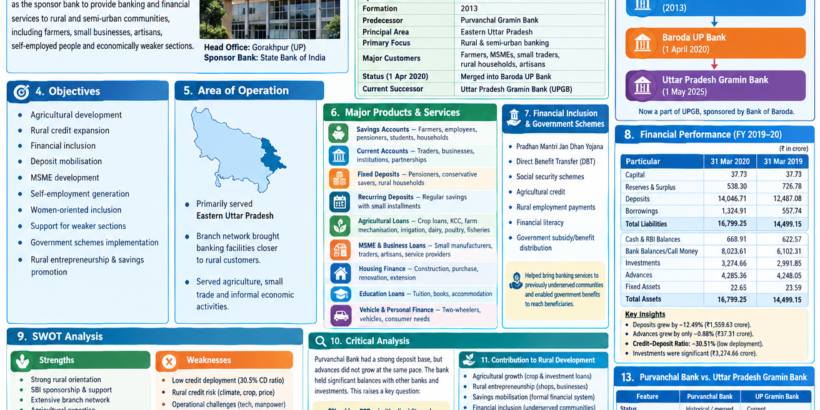
Important status note: Purvanchal Bank is no longer an independent Regional Rural Bank. It was formed in 2013 as an SBI-sponsored RRB headquartered in Gorakhpur, and on 1 April 2020 it was amalgamated with Baroda Uttar Pradesh Gramin Bank and Kashi Gomti Samyut Gramin Bank to form Baroda Uttar Pradesh Bank (Baroda UP Bank). Subsequently, on 1 May 2025, Baroda UP Bank was amalgamated with Prathama UP Gramin Bank and Aryavart Bank to form Uttar Pradesh Gramin Bank (UPGB). Therefore, current financials should be discussed under UPGB rather than as standalone Purvanchal Bank financials.
Purvanchal Bank was a Regional Rural Bank (RRB) operating primarily in eastern Uttar Pradesh. It was established to provide banking and financial services to rural and semi-urban communities, particularly farmers, agricultural workers, small entrepreneurs, artisans, self-employed people and other economically underserved sections.
The bank represented an important stage in the development of rural banking in Uttar Pradesh. Its history is closely connected with the Government of India’s RRB policy, the expansion of financial inclusion and the subsequent consolidation of RRBs.
Purvanchal Bank was headquartered in Gorakhpur, Uttar Pradesh, and was sponsored by State Bank of India (SBI). Contemporary recruitment material describes it as the successor to Purvanchal Gramin Bank.
Basic Profile of Purvanchal Bank
| Particular | Details |
|---|---|
| Bank Name | Purvanchal Bank |
| Type | Regional Rural Bank |
| Country | India |
| State | Uttar Pradesh |
| Head Office | Gorakhpur, Uttar Pradesh |
| Sponsor Bank | State Bank of India |
| Formation | 2013 |
| Predecessor | Purvanchal Gramin Bank |
| Principal Area | Eastern Uttar Pradesh |
| Primary Focus | Rural and semi-urban banking |
| Major Customers | Farmers, MSMEs, small traders, rural households, artisans |
| Status from 1 April 2020 | Merged into Baroda UP Bank |
| Current successor | Uttar Pradesh Gramin Bank |
Historical sources indicate that Purvanchal Bank had a network of approximately 571 branches across 11 districts at the time of its formation.
History and Evolution
Origin of Regional Rural Banks
Regional Rural Banks were introduced in India to address a fundamental problem: large sections of the rural population had inadequate access to formal banking.
The Regional Rural Banks Act, 1976 provided the legal framework for RRBs. Their broad objectives included:
- providing institutional credit to rural communities;
- supporting agriculture;
- financing small and marginal farmers;
- supporting agricultural labourers;
- financing artisans and small entrepreneurs;
- promoting financial inclusion;
- mobilising rural savings; and
- reducing dependence on informal moneylenders.
Purvanchal Bank emerged from this broader rural banking framework.
Formation of Purvanchal Bank
Purvanchal Bank was created in 2013, with State Bank of India as its sponsor bank. It succeeded Purvanchal Gramin Bank and operated from Gorakhpur. Historical material records its formation as effective from 1 April 2013.
Its geographical orientation was particularly important because eastern Uttar Pradesh contains a large rural population and has historically had substantial demand for agricultural and small-business finance.
Objectives of Purvanchal Bank
The bank’s objectives can be understood from the traditional mandate of Indian RRBs.
Major objectives included:
- Agricultural development
- Rural credit expansion
- Financial inclusion
- Deposit mobilisation
- MSME development
- Self-employment generation
- Women-oriented financial inclusion
- Support for weaker sections
- Government-sponsored credit schemes
- Rural entrepreneurship
- Promotion of savings
- Reduction of dependence on informal credit
The bank therefore had both a commercial objective and a developmental objective.
Mission & Vision
Purvanchal Bank’s mission revolves around financial inclusion, especially in rural and semi-urban areas. The bank aims to ensure that even the most remote households have access to basic banking services such as savings accounts, credit facilities, and government subsidy schemes. Its operational philosophy is built around empowering farmers, small entrepreneurs, and economically weaker sections of society.
The vision of the bank is to become a trusted rural financial institution that contributes significantly to socio-economic development in its operational regions. It emphasizes digital banking adoption, customer-centric services, and sustainable credit growth. Over time, the bank has also aligned itself with India’s broader financial inclusion initiatives like Pradhan Mantri Jan Dhan Yojana (PMJDY) and Direct Benefit Transfer (DBT).
From a strategic perspective, the mission and vision are not just statements but are reflected in its lending portfolio, which is heavily skewed toward agriculture, MSMEs, and self-help groups. This focus ensures that the bank remains relevant to rural development while maintaining financial stability.
History & Founder
Purvanchal Bank was established as part of the Regional Rural Bank (RRB) restructuring initiative in India. It was formed by amalgamating several regional rural banks operating in eastern Uttar Pradesh. The objective was to improve efficiency, reduce operational redundancy, and strengthen rural credit delivery systems.
Unlike private banks, Purvanchal Bank does not have a single founder in the traditional sense. Instead, it was jointly sponsored by the Government of India, the Government of Uttar Pradesh, and a sponsor bank (typically Bank of Baroda or similar institutions depending on restructuring phases). This tripartite model is standard for RRBs in India.
Historically, the bank has evolved from a manual banking system to a partially digitalized institution. Its journey reflects India’s broader banking transformation, especially in rural finance. Over the years, it has expanded its branch network, introduced core banking solutions, and improved customer service delivery.
The amalgamation that created Purvanchal Bank was aimed at strengthening capital base and improving operational efficiency. This restructuring allowed the bank to scale its operations across multiple districts in eastern Uttar Pradesh.
Head Office & Network
The head office of Purvanchal Bank is located in Gorakhpur, Uttar Pradesh. This strategic location allows the bank to efficiently manage operations across the Purvanchal region, which includes several districts in eastern Uttar Pradesh.
The head office functions as the administrative and policy-making hub of the bank. It oversees credit policy, HR decisions, compliance, IT infrastructure, and financial planning. Most strategic decisions are centralized here before being implemented across branches.
The bank operates through a wide network of branches spread across rural and semi-urban areas. These branches are typically located in districts such as Gorakhpur, Azamgarh, Deoria, Mau, and surrounding regions. Each branch serves as a critical touchpoint for farmers, small businesses, and government scheme beneficiaries.
The network structure is designed to ensure maximum penetration in underserved areas. Unlike commercial banks focused on urban markets, Purvanchal Bank prioritizes accessibility over profitability in branch expansion strategy. This makes its branch network a key driver of financial inclusion.
Key Management & Last 10 CEOs
The leadership of Purvanchal Bank typically includes a Chairman/CEO appointed under RRB governance norms. These appointments are usually made by the sponsor bank in consultation with government authorities.
While a complete verified list of the last 10 CEOs is not always publicly consolidated, the leadership has generally rotated among senior banking professionals deputed from sponsor banks and government banking services. Each CEO typically serves a tenure of 2–3 years.
The management team also includes General Managers heading credit, operations, IT, and HR departments. The governance model is structured to ensure compliance with RBI guidelines and Ministry of Finance directives.
Leadership in Purvanchal Bank focuses on rural credit expansion, NPA control, and digital banking adoption. Over time, CEOs have played a significant role in implementing government schemes and improving financial literacy among rural customers.
Products & Services Overview
Purvanchal Bank offers a wide range of banking products tailored for rural and semi-urban customers. These include savings accounts, current accounts, fixed deposits, recurring deposits, agricultural loans, MSME loans, and retail credit products.
The bank also provides government-backed schemes such as crop insurance, pension schemes, and subsidy-linked credit programs. Its services are designed to support both individual customers and small enterprises.
Digital banking services such as ATM access, mobile banking, and internet banking have also been introduced in recent years. However, adoption levels vary depending on rural connectivity and literacy levels.
The product strategy is focused on simplicity, affordability, and accessibility rather than complex financial instruments. This aligns with the bank’s rural mission.
Deposit Products
Purvanchal Bank offers several deposit schemes designed to encourage savings among rural populations. These include savings accounts with minimal balance requirements, fixed deposits with competitive interest rates, and recurring deposit schemes for disciplined savings.
Savings accounts are the most widely used product, especially under government financial inclusion schemes. Fixed deposits are preferred by middle-income rural households looking for stable returns.
The bank also offers special deposit schemes for senior citizens and women, often with slightly higher interest rates. These products help in mobilizing rural savings into the formal banking system.
Loan Products
Loan products form the backbone of Purvanchal Bank’s operations. The bank provides agricultural loans for crop production, irrigation, and equipment purchase. These loans are often subsidized or linked with government interest subvention schemes.
MSME loans are also an important segment, supporting small shops, traders, and rural entrepreneurs. Additionally, the bank offers personal loans, education loans, and housing loans in select areas.
Credit appraisal in rural banks is often based on simplified documentation, making loans accessible to farmers and small borrowers.
Retail Banking Products
Retail banking at Purvanchal Bank includes services such as debit cards, ATM facilities, mobile banking, and basic insurance products. These services are designed to improve financial accessibility in rural areas.
The bank also collaborates with insurance companies to offer life and crop insurance products. Retail offerings are continuously evolving with digital banking adoption.
Financial Performance (Revenue, Income, Profit, Assets)
Purvanchal Bank’s financial performance is influenced by rural economic conditions, agricultural output, and government policy support. Revenue primarily comes from interest income on loans and investments in government securities.
Profit margins in RRBs are generally modest due to priority sector lending obligations. However, government support helps maintain stability.
Total assets include loan portfolios, investments, and physical branch infrastructure. Exact figures vary year to year and are disclosed in annual reports.
Annual Report Insights
The annual report of Purvanchal Bank provides insights into credit growth, deposit mobilization, and NPA levels. It also highlights achievements in financial inclusion and digital banking.
Key highlights typically include expansion in loan disbursement, improvement in recovery rates, and implementation of government schemes.
SWOT Analysis
Strengths include strong rural presence and government backing. Weaknesses include limited digital penetration and higher NPAs. Opportunities lie in fintech integration and rural credit expansion. Threats include competition from private banks and economic fluctuations.
Branch Network Overview
Purvanchal Bank operates hundreds of branches across eastern Uttar Pradesh. These branches are strategically located in rural and semi-urban areas to maximize outreach.
ATM Network
The ATM network is relatively limited compared to commercial banks but is gradually expanding through shared banking networks and rural ATM installations.
Capital Adequacy Ratio & Financial Ratios
The bank maintains capital adequacy ratios as per RBI norms. Being an RRB, it is supported by sponsor banks and government capital infusion when required.
Employees & HR Structure
The workforce consists of clerical staff, officers, and field agents. Training programs are regularly conducted for skill development and digital literacy.
Key People & Governance
Governance includes board members from sponsor banks, government nominees, and RBI representatives ensuring compliance and oversight.
Challenges, Loss & Profit Analysis
Key challenges include NPAs, low digital adoption, and rural dependency on agriculture. Profitability fluctuates with economic cycles.
Future Strategy & Growth Outlook
Future strategies focus on digital transformation, credit expansion, and improved customer service.
MCQs (25 Questions with Answers & Explanations)
1. Purvanchal Bank belongs to which type of bank?
A) Private Bank
B) Commercial Bank
C) Regional Rural Bank
D) Foreign Bank
Answer: C
Explanation: Purvanchal Bank is a Regional Rural Bank (RRB) established to serve rural and semi-urban regions, primarily focusing on financial inclusion.
2. What is the primary objective of Purvanchal Bank?
A) Urban lending
B) International banking
C) Rural financial inclusion
D) Investment banking
Answer: C
Explanation: The bank focuses on providing credit and banking access to rural populations.
3. Who sponsors Purvanchal Bank?
A) RBI
B) SBI
C) Government + Sponsor Bank
D) SEBI
Answer: C
4. Where is the head office located?
A) Lucknow
B) Delhi
C) Gorakhpur
D) Varanasi
Answer: C
5. Which sector gets maximum loans?
A) IT sector
B) Agriculture
C) Export sector
D) Tourism
Answer: B
6. Which account is most common in rural banking?
A) Demat Account
B) Savings Account
C) Offshore Account
D) Forex Account
Answer: B
7. What is the key focus of RRBs like Purvanchal Bank?
A) High-risk trading
B) Priority sector lending
C) International expansion
D) Cryptocurrency
Answer: B
8. Which institution regulates Purvanchal Bank?
A) SEBI
B) RBI
C) IRDA
D) NABARD
Answer: B
9. Which scheme supports rural banking deposits?
A) PMJDY
B) Make in India
C) Startup India
D) Digital India only
Answer: A
10. What type of loans dominate Purvanchal Bank?
A) Luxury loans
B) Agricultural loans
C) Crypto loans
D) Venture capital
Answer: B
11. What does RRB stand for?
A) Rural Reserve Bank
B) Regional Rural Bank
C) Registered Rural Banking
D) Revenue Rural Branch
Answer: B
Explanation: RRB stands for Regional Rural Bank, created to serve rural financial needs.
12. Purvanchal Bank mainly serves which area?
A) Metro cities
B) International markets
C) Rural and semi-urban regions
D) Stock markets
Answer: C
Explanation: The bank focuses on rural and semi-urban populations for financial inclusion.
13. Which of the following is NOT a deposit product?
A) Savings Account
B) Fixed Deposit
C) Recurring Deposit
D) Home Loan
Answer: D
Explanation: Home loan is a credit product, not a deposit product.
14. ATM network expansion depends mainly on?
A) Weather conditions
B) Infrastructure and connectivity
C) Stock market trends
D) Foreign investments
Answer: B
Explanation: ATM growth depends on physical infrastructure and connectivity.
15. Profitability of Purvanchal Bank is mainly affected by?
A) Cryptocurrency trading
B) Agricultural risks and NPAs
C) Export revenue
D) Forex speculation
Answer: B
Explanation: Rural lending increases exposure to NPAs and agricultural risks.
16. Who regulates Regional Rural Banks like Purvanchal Bank?
A) SEBI
B) RBI
C) IRDAI
D) CCI
Answer: B
Explanation: RBI regulates banking operations in India, including RRBs.
17. Loans given by Purvanchal Bank are mainly targeted at?
A) Luxury goods
B) Priority sectors
C) Foreign trade only
D) Cryptocurrency mining
Answer: B
Explanation: Priority sectors include agriculture, MSMEs, and rural development.
18. Digital banking adoption in Purvanchal Bank is currently?
A) Fully discontinued
B) Completely advanced
C) Gradually increasing
D) Not applicable
Answer: C
Explanation: Digital services are expanding but adoption is still growing in rural areas.
19. Sponsor banks in RRBs are responsible for?
A) Only marketing
B) Operational and financial support
C) Tax collection
D) Stock trading
Answer: B
Explanation: Sponsor banks provide technical, financial, and operational support.
20. One major challenge for Purvanchal Bank is?
A) Excess urban customers
B) Rural credit risk
C) Overuse of AI
D) High export demand
Answer: B
Explanation: Rural lending carries higher credit risk due to income instability.
21. Capital adequacy ratio ensures?
A) Higher marketing reach
B) Financial stability of the bank
C) Faster ATM installation
D) Loan rejection
Answer: B
Explanation: It measures a bank’s ability to absorb losses and remain stable.
22. MSME loans are given to?
A) Large corporations only
B) Government agencies
C) Small and medium businesses
D) Foreign companies
Answer: C
Explanation: MSME loans support small and medium enterprises.
23. Insurance-linked banking products are usually offered through?
A) Direct RBI channels
B) Partner insurance companies
C) Stock exchanges
D) Government treasury only
Answer: B
Explanation: Banks collaborate with insurance firms for such products.
24. Financial inclusion means?
A) Stock market trading
B) Banking access for all citizens
C) Only corporate banking
D) Foreign investments
Answer: B
Explanation: It ensures access to affordable financial services for everyone.
25. Annual report of Purvanchal Bank shows?
A) Celebrity endorsements
B) Financial and operational performance
C) Movie production data
D) Weather analysis
Answer: B
Explanation: Annual reports include financial statements and operational details.
Conclusion
Purvanchal Bank stands as a crucial financial institution within India’s rural banking framework. Its identity is deeply tied to agricultural financing, rural development, and government-backed financial inclusion initiatives. Unlike commercial banks that prioritize profitability, this institution balances social responsibility with financial sustainability.
Its operational model reflects the realities of rural India—seasonal income, agricultural dependency, and limited digital infrastructure. Despite these challenges, the bank continues to expand its footprint through branch networks, simplified loan products, and government scheme integration. Over time, gradual digital transformation has improved service efficiency, although full-scale modernization is still in progress.
From a strategic perspective, the bank’s future depends on three pillars: digital adoption, credit risk management, and diversification of income sources. If these areas are strengthened, Purvanchal Bank can evolve into a more resilient and efficient rural financial powerhouse.
FAQs
1. Is Purvanchal Bank a government bank?
Yes, it is a Regional Rural Bank jointly owned by the Government of India, a sponsor bank, and the Government of Uttar Pradesh.
2. What is the main business of Purvanchal Bank?
Its main business is rural lending, especially agricultural and MSME loans, along with basic deposit services.
3. Where is Purvanchal Bank located?
Its head office is in Gorakhpur, Uttar Pradesh.
4. Does Purvanchal Bank provide digital banking?
Yes, it offers mobile banking, ATM services, and internet banking, though adoption is still growing.
5. What makes Purvanchal Bank important?
It plays a key role in financial inclusion by providing banking services in rural and semi-urban areas.