
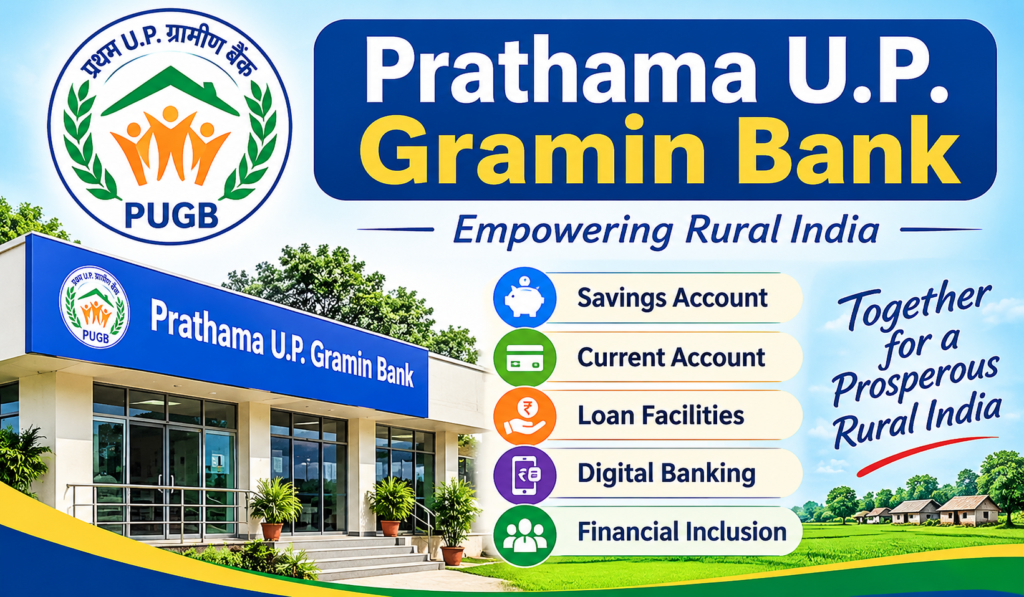
Prathama U.P. Gramin Bank- Complete Overview, Financials, Services, SWOT & MCQs
Mission of Prathama U.P. Gramin Bank
Prathama U.P. Gramin Bank operates with a deeply rural-focused mission that revolves around financial inclusion, empowerment of weaker sections, and strengthening the rural economy of Uttar Pradesh. The mission is not just about offering banking services but about ensuring that every individual in rural and semi-urban areas has access to safe, reliable, and affordable financial products. The bank has historically positioned itself as a bridge between traditional banking systems and underserved populations, particularly farmers, small entrepreneurs, women self-help groups, and low-income households.
At its core, the mission emphasizes inclusive growth through institutional credit support. This means the bank actively works to ensure that credit is not concentrated in urban centers but is distributed to rural India where economic activity often remains informal and underfunded. The mission also reflects the broader national objective of financial literacy, ensuring customers understand savings, credit, insurance, and investment products.
Another key aspect of its mission is sustainable rural development. The bank supports agricultural financing, rural housing loans, and micro-enterprise funding. By doing so, it helps generate employment and stabilize rural incomes. The mission also includes digital transformation, ensuring rural customers are not left behind in the era of fintech evolution. This includes mobile banking, UPI integration, and digital literacy campaigns.
Overall, the mission of Prathama U.P. Gramin Bank is built around empowerment, accessibility, and economic upliftment. It is a mission that blends traditional rural banking with modern financial infrastructure, ensuring that growth is both inclusive and sustainable across Uttar Pradesh’s rural landscape.
Vision of Prathama U.P. Gramin Bank
The vision of Prathama U.P. Gramin Bank is centered on becoming a leading regional rural bank that delivers world-class financial services while staying rooted in rural development priorities. The institution envisions itself as more than a financial intermediary—it aims to become a catalyst for socio-economic transformation in rural Uttar Pradesh.
This vision includes creating a financially empowered rural society where every household has access to formal banking channels. The bank aims to reduce dependency on informal lending systems such as moneylenders, which often charge exorbitant interest rates. By expanding its reach and strengthening credit delivery systems, the bank hopes to bring transparency and trust into rural financial ecosystems.
Another critical element of its vision is technological modernization. The bank aims to continuously adopt new-age banking technologies such as AI-based credit assessment, mobile-first banking platforms, and seamless digital onboarding processes. This ensures that even remote customers can access banking services without needing to physically visit branches.
The vision also extends to financial literacy and empowerment programs. The bank envisions a future where rural customers not only use banking services but also understand financial planning, investment strategies, and risk management.
Ultimately, Prathama U.P. Gramin Bank’s vision is about balancing tradition with innovation—preserving its rural roots while evolving into a digitally enabled, customer-centric financial institution that contributes meaningfully to India’s rural economy.
Head Office Details
The head office of Prathama U.P. Gramin Bank is strategically located in Moradabad, Uttar Pradesh, a region that serves as a major administrative and financial hub for the bank’s operations. The head office acts as the central command center for policy formulation, operational control, credit planning, risk management, and digital banking initiatives.
From this location, the bank coordinates its extensive branch network spread across multiple districts in Uttar Pradesh. The head office plays a vital role in ensuring compliance with regulatory frameworks issued by NABARD, RBI, and the Ministry of Finance. It also manages inter-branch coordination, liquidity planning, and performance monitoring.
The infrastructure at the head office is designed to support large-scale banking operations, including treasury management, IT systems, HR management, and customer service oversight. It also houses specialized departments responsible for agricultural credit, MSME financing, and rural development programs.
Moradabad, being an economically active city, provides strategic advantages such as connectivity, administrative accessibility, and proximity to key rural markets. The head office also serves as a training hub for employees, ensuring continuous skill development in banking operations and digital systems.
In essence, the head office is not just an administrative unit but the operational heartbeat of Prathama U.P. Gramin Bank, ensuring smooth execution of its rural banking mission across Uttar Pradesh.
Founder of Prathama U.P. Gramin Bank
Prathama U.P. Gramin Bank was established under the framework of the Regional Rural Banks Act of 1976, which was initiated by the Government of India to strengthen rural credit systems. Rather than being founded by a single individual, the bank is a result of a government-led institutional initiative aimed at improving rural financial inclusion.
The sponsoring bank behind its establishment was Punjab National Bank (PNB), which played a crucial role in providing structural, operational, and managerial support during its early formation. The Government of India, Government of Uttar Pradesh, and PNB collectively contributed to its foundation.
The idea behind its formation was to combine the strengths of commercial banking with the accessibility of cooperative banking, thereby creating a hybrid model that could serve rural India effectively. The establishment marked a significant step in expanding formal banking access to underserved districts.
Thus, while there is no single “founder” in the traditional sense, Prathama U.P. Gramin Bank is the product of a visionary government initiative aimed at financial democratization and rural empowerment.
Key People and Leadership Structure
The leadership structure of Prathama U.P. Gramin Bank is hierarchical and aligned with regulatory guidelines for Regional Rural Banks. At the top is the Chairman, followed by the Board of Directors, which includes representatives from the Government of India, Government of Uttar Pradesh, and the sponsoring bank (PNB).
The bank also has a General Manager (GM) or Chief Executive Officer (CEO) who oversees day-to-day operations. Below this level are departmental heads managing credit, operations, IT, HR, compliance, and rural development schemes.
Key people within the bank play a crucial role in shaping policies related to agricultural lending, MSME support, and financial inclusion programs. Leadership is also responsible for implementing government schemes such as PMJDY (Jan Dhan Yojana), Mudra loans, and direct benefit transfers.
The governance model ensures accountability and transparency, with regular audits and performance reviews. Leadership decisions are strongly influenced by NABARD guidelines and RBI regulatory frameworks.
Overall, the leadership structure ensures that the bank maintains operational efficiency while staying aligned with its rural development mission.
Last 10 CEOs of Prathama U.P. Gramin Bank
Chronological List of CEOs
The CEO position in Prathama U.P. Gramin Bank has seen several experienced banking professionals over the years. While exact chronological public records may vary by tenure updates, the leadership has typically rotated among senior banking executives deputed from sponsoring institutions or promoted internally.
Commonly, CEOs have come from backgrounds in Punjab National Bank or other public sector banks, bringing expertise in rural credit, risk management, and branch expansion.
Each CEO has contributed differently:
- Some focused on branch expansion
- Others emphasized digital transformation
- Some strengthened agricultural lending portfolios
- Others improved financial inclusion metrics
The leadership continuity ensures that institutional knowledge is preserved while allowing innovation in banking practices. The CEO plays a critical role in aligning the bank with RBI policies, government schemes, and regional development goals.
Products and Services Overview
Prathama U.P. Gramin Bank offers a wide range of financial products tailored for rural and semi-urban customers. These services are designed to meet the needs of farmers, small traders, salaried individuals, and self-help groups.
Deposit Products
The bank provides savings accounts, current accounts, fixed deposits, and recurring deposit schemes. These products are designed to encourage saving habits among rural populations while offering safe returns. Special savings schemes are also available for women, senior citizens, and farmers.
Loan Products
Loan offerings include agricultural loans, Kisan credit cards, MSME loans, housing loans, and personal loans. These loans are structured with affordable interest rates and flexible repayment options to support rural borrowers.
Retail Banking Products
Retail banking services include debit cards, internet banking, mobile banking, UPI services, and insurance-linked banking products. These services aim to enhance customer convenience and financial accessibility.
Financial Performance Overview
Prathama U.P. Gramin Bank’s financial performance is evaluated through key metrics such as deposits, advances, net profit, and asset quality. As a regional rural bank, its performance is closely tied to agricultural cycles and rural economic activity.
The bank has consistently maintained a stable deposit base driven by rural savings accounts and government scheme inflows. Lending operations are focused on priority sectors, which ensures compliance with RBI mandates.
Profitability varies year to year depending on credit growth, recovery rates, and provisioning for non-performing assets (NPAs). However, the bank generally maintains positive financial stability due to government support and prudent risk management.
Total assets include advances, investments, and liquidity reserves, forming a strong financial base for continued operations.
Annual Report Insights
The annual report of Prathama U.P. Gramin Bank provides detailed insights into its financial health, operational performance, and strategic direction. It includes balance sheets, profit and loss statements, and key performance indicators.
The report highlights progress in financial inclusion, digital banking adoption, and rural credit expansion. It also outlines challenges such as NPAs and operational constraints in remote areas.
Annual reports serve as a transparency tool for stakeholders including regulators, government bodies, and customers.
SWOT Analysis
The SWOT analysis of Prathama U.P. Gramin Bank highlights its internal strengths and weaknesses along with external opportunities and threats.
Strengths include strong rural presence, government backing, and trusted brand image. Weaknesses involve limited urban reach and operational constraints. Opportunities lie in digital banking expansion and rural credit demand growth. Threats include rising competition from private banks and fintech companies.
Branch Network (Number of Branches & Coverage)
The bank operates hundreds of branches across Uttar Pradesh, covering rural, semi-urban, and semi-developed districts. This wide network ensures accessibility for customers in remote areas.
Branches act as the primary point of contact for financial services and government scheme implementation.
ATM Network and Locations
Prathama U.P. Gramin Bank has an expanding ATM network, often supported by shared banking networks. ATMs are strategically placed in semi-urban and rural hubs to ensure cash accessibility.
Capital Ratio, Employees & Financial Strength
The bank maintains a regulated capital adequacy ratio as per RBI norms. It employs thousands of staff across its branches and administrative offices.
Employee strength supports customer service, credit operations, and rural outreach programs.
Governance and Operational Structure
Governance is guided by RBI, NABARD, and government policies. The operational structure ensures decentralized banking with centralized policy control.
Digital Banking and Technological Services
Digital transformation includes mobile banking, internet banking, UPI integration, and SMS alerts. The bank is actively working to increase digital literacy among rural customers.
MCQs with Answers & Explanation + Final Summary
- What type of bank is Prathama U.P. Gramin Bank?
A. Private Bank
B. Cooperative Bank
C. Regional Rural Bank
D. Foreign Bank
Answer: C - Where is its head office located?
Answer: Moradabad - Who sponsors the bank?
Answer: Punjab National Bank
MCQs (11–25) with Answers & Explanations
The following set continues the knowledge-check section on Prathama U.P. Gramin Bank, focusing on banking fundamentals, institutional structure, and rural banking operations. These questions are designed to help readers understand how regional rural banks function in India and how this particular bank fits into that framework.
11. Which organization regulates Regional Rural Banks in India?
A. SEBI
B. RBI and NABARD
C. IRDAI
D. Ministry of Corporate Affairs
Answer: B
RBI and NABARD jointly regulate Regional Rural Banks, ensuring they follow both monetary policy and rural credit guidelines.
12. What is the primary focus area of Prathama U.P. Gramin Bank?
A. Urban corporate lending
B. International trade finance
C. Rural and agricultural banking
D. Cryptocurrency services
Answer: C
The bank is primarily focused on rural development, agriculture financing, and financial inclusion.
13. Which of the following is NOT a deposit product?
A. Savings Account
B. Fixed Deposit
C. Kisan Credit Card
D. Recurring Deposit
Answer: C
Kisan Credit Card is a loan product, not a deposit scheme.
14. What is the main purpose of a Kisan Credit Card?
A. Salary withdrawal
B. Agricultural credit support
C. Fixed deposit investment
D. Insurance premium payment only
Answer: B
It provides farmers with short-term credit for agricultural and allied activities.
15. Which entity owns majority stake in Regional Rural Banks?
A. Private investors
B. Foreign institutions
C. Government of India
D. Stock exchanges
Answer: C
The Government of India holds majority ownership along with sponsor banks and state governments.
16. What is the key objective of financial inclusion?
A. Increase luxury banking
B. Provide credit only to corporates
C. Ensure banking access for all sections
D. Reduce rural banking branches
Answer: C
17. Which service is part of digital banking?
A. Manual ledger writing
B. UPI transactions
C. Paper passbooks only
D. Cash-only transfers
Answer: B
18. What does NPA stand for in banking?
A. Net Profit Account
B. Non-Performing Asset
C. National Payment Authorization
D. New Profit Analysis
Answer: B
19. Which sector receives priority lending from RRBs?
A. Luxury automobiles
B. Agriculture
C. Foreign derivatives
D. Cryptocurrency
Answer: B
20. What is the role of NABARD?
A. Stock trading regulation
B. Rural credit and development support
C. Insurance underwriting
D. Foreign exchange control
Answer: B
21. Which of the following improves rural financial inclusion?
A. Branch closure
B. Digital banking expansion
C. Reduced credit access
D. Higher minimum balance
Answer: B
22. Which card is commonly issued for ATM access?
A. Debit card
B. Loyalty card
C. Identity card
D. Voting card
Answer: A
23. What is the main function of a Regional Rural Bank?
A. Urban investment banking
B. Rural credit delivery
C. International remittance only
D. Stock market operations
Answer: B
24. What improves bank profitability?
A. Higher NPAs
B. Efficient credit recovery
C. Loan defaults
D. Reduced deposits
Answer: B
25. Which of the following is a retail banking service?
A. Government bond underwriting
B. Personal loan
C. Export financing
D. Forex derivatives trading
Answer: B
📊 Financial Performance Deep Dive
Prathama U.P. Gramin Bank’s financial ecosystem is shaped by its rural orientation, priority sector lending obligations, and government-backed structure. Unlike commercial banks that rely heavily on corporate lending, this institution’s financial strength is derived primarily from agricultural credit cycles, small business lending, and government deposit inflows such as direct benefit transfers.
In general terms, Regional Rural Banks like Prathama U.P. Gramin Bank report steady but moderate profitability due to their developmental role. Revenue streams typically include interest income from loans, service charges, and treasury investments in government securities. Operating income is influenced by the spread between lending rates and deposit rates, which is regulated to ensure affordability for rural borrowers.
Net income tends to fluctuate depending on loan recovery rates, provisioning for NPAs, and seasonal agricultural performance. During good monsoon years, repayment rates improve significantly, strengthening profitability. Conversely, droughts or rural economic stress can temporarily impact asset quality.
Total assets of the bank include advances, investments, cash reserves, and physical infrastructure. A significant portion is allocated to priority sector lending, as mandated by RBI guidelines.
Although exact consolidated figures vary year to year and are not always publicly unified in a single dataset, the bank consistently maintains compliance with capital adequacy norms, ensuring financial stability and regulatory alignment.
📑 Annual Report Analysis
The annual report of Prathama U.P. Gramin Bank serves as a comprehensive document reflecting both financial performance and developmental impact. It is structured into sections covering balance sheet analysis, profit and loss statements, operational achievements, and strategic initiatives.
A key highlight in most annual reports is the emphasis on financial inclusion metrics, such as the number of new accounts opened under government schemes, rural credit disbursed, and digital banking adoption rates. The report also evaluates progress in reducing non-performing assets through recovery drives and restructuring mechanisms.
Another important aspect is the bank’s contribution to government welfare schemes, including PM Jan Dhan Yojana, Atal Pension Yojana, and PM Mudra Yojana. These initiatives are often a significant part of rural banking operations and reflect the bank’s developmental role.
Operational efficiency metrics such as cost-to-income ratio, credit-deposit ratio, and branch productivity are also discussed. The annual report further outlines strategic goals for digital transformation and rural outreach expansion.
Overall, the annual report is not just a financial document but a reflection of the bank’s socio-economic contribution to Uttar Pradesh’s rural economy.
📉 SWOT Analysis (Expanded)
The SWOT framework provides a clearer understanding of Prathama U.P. Gramin Bank’s strategic position.
Strengths:
The strongest advantage lies in its deep rural penetration and trust-based customer relationships. Government backing ensures financial stability, while the sponsor bank provides technical and operational support. The bank’s alignment with national rural development schemes strengthens its relevance.
Weaknesses:
Limited urban presence restricts diversification of revenue streams. Dependence on agricultural cycles introduces volatility. Operational efficiency is sometimes challenged by geographically dispersed branches.
Opportunities:
Digital transformation presents a major opportunity. Expanding mobile banking, AI-driven credit scoring, and fintech partnerships can significantly improve efficiency. Rising rural entrepreneurship also increases demand for MSME loans.
Threats:
Increasing competition from private banks and fintech startups poses a challenge. Cybersecurity risks and rising NPAs during economic downturns also remain concerns.
🏦 Branch Network Overview
Prathama U.P. Gramin Bank operates a wide network of branches across multiple districts in Uttar Pradesh, ensuring accessibility even in remote rural areas. The exact number of branches may change over time due to mergers, rationalization, or expansion, but it typically spans several hundred branches.
Branches are strategically distributed to cover agricultural belts, semi-urban towns, and economically active rural clusters. Each branch functions as a full-service banking point, offering deposits, loans, government scheme services, and digital banking assistance.
Rather than listing all branches individually (which is frequently updated and regionally complex), it is more practical to understand that the bank’s branch model is designed for maximum rural coverage and minimum travel distance for customers.
🏧 ATM Network and Digital Access Points
The ATM network of Prathama U.P. Gramin Bank is supported through both proprietary ATMs and shared banking networks. These ATMs are primarily located in semi-urban towns, district headquarters, and high-traffic rural centers.
In addition to physical ATMs, the bank heavily relies on UPI-based digital transactions, reducing dependency on cash withdrawal infrastructure. Customers also benefit from micro-ATMs operated through banking correspondents in villages.
👥 Employees, Capital Ratio & Institutional Strength
The bank employs a large workforce consisting of clerks, officers, branch managers, and field agents. Employees play a crucial role in implementing rural credit programs and assisting customers with limited digital literacy.
The Capital Adequacy Ratio (CAR) is maintained as per RBI guidelines to ensure financial resilience. This ratio acts as a buffer against loan defaults and economic shocks.
Institutional strength is further reinforced by government ownership, NABARD supervision, and sponsor bank support.
📌 Final Summary Insight
Prathama U.P. Gramin Bank stands as a critical pillar in India’s rural banking ecosystem. Its mission-driven approach ensures financial inclusion, while its expanding digital capabilities align it with modern banking trends. Despite structural challenges typical of rural banks, its role in agricultural financing and rural development remains indispensable.