
How to open Current Account of a Partnership Firm
The account of Partnership Firm:
As per Partnership Act, 1932 “PARTNERSH1P’’ is the relation between persons who have agreed to share the profits of a business carried on by all or any of them acting for all.
Persons who have entered into the partnership with one another are called individually “PARTNER’’ and collectively “A FIRM” and the name under which their business is carried on is called the “FIRM NAME”.
The constitution of a partnership firm must be satisfied in respect of some conditions that are given below:
- There must be a business
- There must be an agreement to enter into by two or more persons. There cannot be, however more than twenty persons. ,
- There must be a contract/agreement between the persons who are associated with the business.
- The object of the business must be the earning of profit.
- The business must be carried on by all or by any of them on behalf of all
Note: Opening of Partnership Accounts- A Banker should not open an account in the name of a partnership unless one or more of the partners apply to him to do so.
Except where the partner, making an application for the opening of an account in the firm’s name, is deprived of the power, which fact is known to the banker, there can be no legal objection to a banker opening an account in the name of the firm at the request of any one or more its partners. Failure, however, to make proper enquiries by referring to the partnership agreement or any other record in writing which may be available before opening an account on behalf of the firm in a partner’s name may lead a banker in trouble.
Account Opening Formalities:
- Filling the prescribed Account opening form along with specimen signature card, KYC and Profile Form.
- Attested copy of valid Trade License Registered partnership Deed etc.
- Clear Resolution for opening & operating the account borrowing power authority to give security, or to sell the property owned by the firm signed by all the partners.
- In case of death, of any partner, if the a/c is operated on by other partners as well, the surviving partners shall be advised to close them and open a new A/c fresh mandate.
- Photographs of the Account holder(s).
- Introducer’s Signature.
- Filling the SBS-2 and SBS-3, Reporting form.
- National Identify Card/Card/Any valid Photo ID/ Citizenship Certificate.
- Approval of the Branch Incumbent.
- Letter of thanks to the introducer/Account opener.
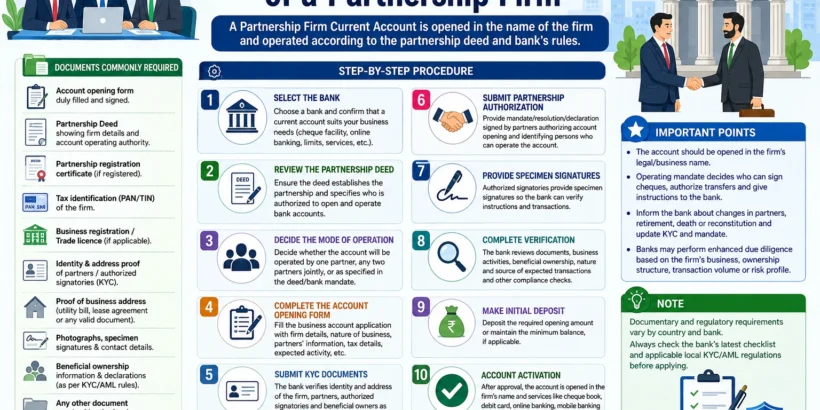
How to Open a Current Account of a Partnership Firm
A Partnership Firm Current Account is a bank account opened in the name of a partnership business and operated according to the firm’s partnership deed and the bank’s mandate. The exact requirements vary by bank and country.
Documents commonly required
Banks generally ask for documents such as:
- Account opening form completed and signed by the authorized partners.
- Partnership Deed showing the firm’s name, business activities, partners, capital contribution, profit-sharing arrangement, and account-operating authority.
- Partnership registration certificate, where registration is required or the firm is registered.
- Tax identification documents of the firm, such as PAN/TIN or the applicable local tax registration.
- Business registration or trade licence, where applicable.
- Identity and address proof of the partners and other beneficial owners/controllers as required under KYC rules.
- Proof of the firm’s business or registered address, such as a utility bill, lease agreement, or other acceptable document.
- Photographs, specimen signatures, and contact details of the partners/authorized signatories, if required by the bank.
- Beneficial ownership information and declarations required under applicable AML/KYC regulations.
- Any additional documents required for the particular type of business.
Step-by-step procedure
Step 1 – Select the bank and account type:
The partners should choose a bank and confirm that a current/business account meets the firm’s transaction requirements, including cheque facilities, online banking, payment services, and transaction limits.
Step 2 – Review the Partnership Deed:
The deed should establish the partnership and ideally specify who has authority to open and operate bank accounts on behalf of the firm.
Step 3 – Decide the mode of operation:
The partners must determine how the account will be operated. Depending on the bank’s rules and the partnership mandate, it may be operated by one authorized partner, any two partners jointly, or another specified combination.
Step 4 – Complete the account opening form:
The prescribed business-account application should be completed with the firm’s legal name, business address, nature of business, tax details, partners’ information, expected account activity, and other requested information.
Step 5 – Submit KYC documents:
The bank verifies the identity and address of the firm, partners, authorized signatories, and beneficial owners as required by applicable KYC and anti-money-laundering rules.
Step 6 – Submit the partnership authorization:
The bank may require a mandate, declaration, or resolution signed by the partners authorizing the opening of the account and identifying the persons permitted to operate it.
Step 7 – Provide specimen signatures:
Each authorized signatory may need to provide a specimen signature so the bank can verify future instructions and transactions.
Step 8 – Complete verification:
The bank reviews the partnership deed, registration information, business activities, beneficial ownership, source/nature of expected transactions, and other compliance information.
Step 9 – Make the required initial deposit:
If the selected bank or account product requires an opening deposit or minimum balance, the firm deposits the required amount.
Step 10 – Account activation:
After successful verification and approval, the bank opens the current account in the name of the partnership firm. The bank may then issue or activate facilities such as a cheque book, debit/business card, online banking, mobile banking, transaction alerts, and other services requested by the firm.
Important points
The account should normally be opened in the firm’s legal/business name rather than treated as a partner’s personal account. The operating mandate should be clear because it determines who can sign cheques, authorize transfers, and give instructions to the bank.
Banks may also conduct enhanced due diligence depending on the firm’s business, ownership structure, expected transaction volume, jurisdiction, or risk profile.
If a partner joins, retires, dies, or the partnership is otherwise reconstituted, the bank should be informed promptly and the mandate and KYC records updated as required.
Note: Documentary and regulatory requirements differ significantly between countries and banks. The bank’s current account-opening checklist and applicable local KYC/AML regulations should therefore be checked before submitting the application.
Follow us:
http://www.facebook.com/bankingallinfo
http://www.twitter.com/@bankall
https://www.linkedin.com/in/md-makhluk-hasan
https://www.pinterest.com/makhluk/
http://www.youtube.com/bankingtutorial