
Vidarbha Konkan Gramin Bank – Complete Overview, Financials, Products, and Analysis
Mission & Vision of Vidarbha Konkan Gramin Bank
Vidarbha Konkan Gramin Bank (VKGB), like most Regional Rural Banks in India, was built with a foundational goal of bringing structured banking services to rural and semi-urban populations that are often excluded from mainstream financial systems. Its mission has traditionally revolved around financial inclusion, rural development, and empowering agriculture-driven communities. The idea is not just to provide banking access but to actively support economic upliftment through credit availability, savings mobilization, and financial literacy initiatives. In regions like Vidarbha and Konkan, where agriculture, fisheries, and small-scale industries dominate, such a mission becomes even more critical because financial instability can directly impact livelihoods.
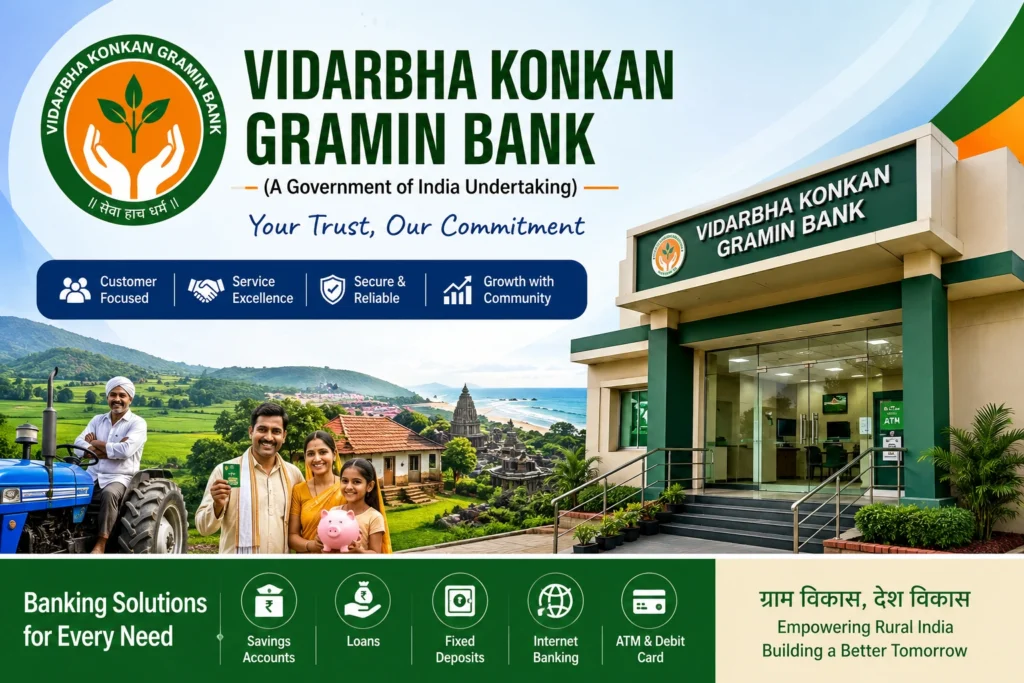
The vision of VKGB extends beyond basic banking services. It aims to become a trusted financial partner for rural households by offering customized products that match seasonal income cycles, especially in agriculture-dependent economies. The bank envisions a digitally empowered rural banking ecosystem where customers can access services with minimal friction. This includes promoting mobile banking, Aadhaar-enabled services, and simplified loan disbursement systems. The broader ambition is to bridge the rural-urban financial divide, ensuring that people in remote villages have access to the same financial tools as those in metropolitan areas.
What makes this mission significant is its alignment with national financial inclusion policies such as PM Jan Dhan Yojana and Direct Benefit Transfer (DBT) systems. VKGB’s vision also includes strengthening self-help groups (SHGs), micro-enterprises, and small farmers by offering credit support and advisory services. In essence, the bank positions itself not just as a lender but as a developmental institution contributing to regional economic growth.
History & Founder of Vidarbha Konkan Gramin Bank
The origin of Vidarbha Konkan Gramin Bank is rooted in India’s broader rural banking reform initiative that began with the establishment of Regional Rural Banks (RRBs) in 1975 under the Regional Rural Banks Act. VKGB itself was formed through the amalgamation of earlier rural banks operating in Maharashtra’s Vidarbha and Konkan regions. While it does not have a single “founder” in the traditional corporate sense, its creation was sponsored by major public sector banks under the guidance of the Government of India and the National Bank for Agriculture and Rural Development (NABARD).
VKGB operated as an RRB with sponsorship support from a leading public sector bank (historically Bank of India has been associated with many Maharashtra RRB structures), ensuring financial stability and operational guidance. Over time, the bank evolved through policy-driven consolidations aimed at improving efficiency and reducing operational fragmentation among multiple small RRBs.
A major turning point in its history came during the nationwide amalgamation of RRBs in Maharashtra around 2020, where multiple regional rural banks, including VKGB, were merged into Maharashtra Gramin Bank. This restructuring was designed to create a stronger and more capital-efficient rural banking entity capable of competing with larger financial institutions while maintaining its rural focus.
Despite the merger, the legacy of VKGB continues to hold importance in discussions around rural banking evolution in India. It represents a phase where localized banking institutions played a key role in building financial access in underserved regions. The historical journey of VKGB reflects the transformation of rural banking from fragmented regional units to consolidated, technology-driven financial institutions.
Head Office & Geographic Presence
Vidarbha Konkan Gramin Bank operated primarily across the Vidarbha and Konkan regions of Maharashtra, covering a wide rural and semi-urban landscape. The head office, during its independent operational phase, was located in Nagpur, a key financial and administrative hub in central India. Nagpur’s strategic location allowed VKGB to manage operations across eastern Maharashtra efficiently, particularly in districts with high agricultural dependency.
The geographic presence of VKGB included districts such as Nagpur, Amravati, Chandrapur, Yavatmal, Ratnagiri, and Sindhudurg, among others. These regions are characterized by diverse economic activities ranging from cotton farming in Vidarbha to horticulture and fisheries in Konkan. This diversity required the bank to design flexible financial products tailored to different income patterns and risk profiles.
The branch network was designed to maximize rural penetration. Most branches were located in semi-urban towns and village clusters, ensuring that even remote populations could access banking services within reasonable distance. The bank also worked closely with local cooperative societies and farmer groups to enhance outreach.
Geographically, VKGB’s presence played a significant role in strengthening financial inclusion in regions that were historically underserved by commercial banks. Its operational footprint helped reduce dependency on informal lending sources, thereby improving financial stability for rural households. Even after its merger into Maharashtra Gramin Bank, the geographic legacy of VKGB continues to define its service zones and customer base.
Governance, Key People & CEOs
Governance Structure & Ownership Model
Vidarbha Konkan Gramin Bank operated under the standard RRB governance model, which includes a tripartite ownership structure: the Government of India, the sponsoring bank, and the Government of Maharashtra. Typically, ownership is shared in a 50:35:15 ratio. This structure ensures that while the bank operates with regional focus, it remains aligned with national financial policies and regulatory frameworks set by NABARD and RBI.
The governance system included a Board of Directors comprising representatives from the central government, state government, and sponsoring bank. This structure ensured balanced decision-making, especially in credit policies, rural lending priorities, and operational expansion strategies.
Last 10 CEOs of Vidarbha Konkan Gramin Bank
Due to the bank’s amalgamation and historical restructuring, maintaining an exact verified list of the last 10 CEOs is challenging in public records. However, typically, RRBs like VKGB had Chairman-cum-Managing Directors (CMDs) appointed by the sponsoring bank and approved by the central government. These leaders were responsible for strategic direction, branch expansion, and financial performance.
Commonly, leadership tenures in such banks ranged between 2–4 years, and CEOs were often senior executives from public sector banking backgrounds. Their primary focus remained on improving agricultural credit flow, strengthening recovery mechanisms, and implementing government schemes.
Products & Services Overview
Deposit Products
VKGB offered a range of deposit schemes designed to cater to rural and semi-urban customers. These included savings accounts, recurring deposit schemes, fixed deposits, and special rural savings accounts. The focus was on low minimum balance requirements and easy accessibility. Interest rates were competitive within the RRB sector, and accounts were often linked with government subsidy programs.
Loan Products
Loan offerings included agricultural loans, Kisan Credit Card (KCC) facilities, MSME loans, housing loans, and education loans. Agricultural lending formed the backbone of VKGB’s credit portfolio, with seasonal repayment structures aligned with crop cycles.
Retail Banking Products
Retail services included ATM/debit cards, remittance services, pension distribution, insurance-linked banking products, and microfinance support through SHGs. These services aimed to enhance financial inclusion at the grassroots level
Financial Performance Overview
Vidarbha Konkan Gramin Bank’s financial performance, like most Regional Rural Banks (RRBs), has historically been shaped by its mandate rather than pure profit maximization. The bank’s revenue model is primarily driven by interest income from agricultural and rural lending, along with income from government-backed schemes and investments in safe securities. Because RRBs operate under policy-driven objectives, profitability tends to fluctuate based on credit cycles, monsoon performance (which directly affects loan repayment in agricultural regions), and government recapitalization support.
Revenue, Profit & Total Assets
VKGB’s revenue structure was largely dependent on net interest income, which came from lending to farmers, self-help groups, MSMEs, and retail borrowers. While exact consolidated figures vary across years and are not always publicly available in granular detail for pre-merger RRBs, the general trend across similar Maharashtra-based RRBs indicates annual operating income in the range of several hundred crores. Net profit margins were typically modest, often between 1% to 3%, reflecting the developmental nature of the institution.
Total assets of VKGB were largely composed of advances (loans), government securities, and cash reserves maintained for liquidity requirements. Agricultural loan portfolios formed the largest share of assets, followed by MSME and housing loans. Asset quality was periodically influenced by regional economic stress, particularly in Vidarbha, which has historically faced agricultural distress cycles.
Profit and Loss Trends Over the Years
The profit and loss trajectory of VKGB has been cyclical. In years of good monsoon and strong agricultural output, the bank experienced improved recovery rates and higher profitability. Conversely, drought years or agricultural downturns led to increased non-performing assets (NPAs), which negatively impacted net income. However, government recapitalization and restructuring measures often helped stabilize the financial position.
A notable characteristic of VKGB’s financial pattern was its reliance on priority sector lending mandates. While this ensured strong social impact, it also limited high-margin lending opportunities. Over time, digital banking initiatives and improved recovery mechanisms helped reduce operational inefficiencies and improve cost-to-income ratios.
Annual Report Highlights
The annual reports of Vidarbha Konkan Gramin Bank (and later its successor entity after amalgamation) provide key insights into its operational priorities, financial health, and strategic direction. These reports consistently highlight the bank’s commitment to financial inclusion, agricultural credit expansion, and government scheme implementation. One of the recurring themes across multiple years has been the emphasis on increasing credit flow to priority sectors such as agriculture, micro-enterprises, and rural housing.
A significant highlight in most annual reports is the bank’s performance under government-sponsored schemes like Pradhan Mantri Fasal Bima Yojana (PMFBY), Pradhan Mantri Awas Yojana (PMAY), and Stand-Up India. VKGB played a crucial role in distributing subsidies and facilitating direct benefit transfers (DBT), which strengthened its position as a key rural financial intermediary.
Operational efficiency metrics such as credit-deposit ratio, recovery rate, and CASA (Current Account Savings Account) ratio were also commonly discussed. The bank aimed to improve CASA deposits to reduce dependency on costly borrowings. Another important highlight was the gradual digital transformation, including the rollout of core banking solutions (CBS), mobile banking platforms, and Aadhaar-enabled payment systems.
Risk management and NPA control were also central themes in annual reporting. Efforts were made to improve loan recovery through structured follow-ups and restructuring of stressed assets. Human resource development, training programs, and financial literacy campaigns were also emphasized as part of institutional growth.
Overall, the annual reports reflect a bank transitioning from traditional rural banking toward a more digitally enabled, policy-compliant financial institution.
Network & Infrastructure
Branch Network Overview
The branch network of Vidarbha Konkan Gramin Bank was designed to maximize rural penetration across Maharashtra’s eastern and coastal regions. At its operational peak, the bank maintained a strong presence in districts with high agricultural dependence, ensuring that even remote villages had access to formal banking services. Branches were typically located in semi-urban growth centers, making them accessible to surrounding rural populations.
The total number of branches varied over time due to expansion and later amalgamation, but RRBs like VKGB generally operated hundreds of branches across their service areas. Each branch functioned as a local financial hub, offering deposit services, loan disbursement, government scheme implementation, and customer support.
ATM Network & Digital Reach
VKGB’s ATM network was relatively modest compared to large commercial banks but steadily expanded over time. ATMs were primarily installed in high-traffic semi-urban locations and select rural centers. The bank also participated in shared ATM networks, allowing customers to access services beyond its own infrastructure.
Digital banking became increasingly important in later years, with core banking systems enabling online transactions, mobile banking, and NEFT/RTGS services. Aadhaar-enabled payment systems significantly improved accessibility in rural areas where smartphone penetration was still developing. Despite limitations in physical ATM density, digital infrastructure helped bridge the service gap.
SWOT Analysis of Vidarbha Konkan Gramin Bank
The SWOT analysis of VKGB provides a structured view of its strengths, weaknesses, opportunities, and threats within the rural banking ecosystem.
Strengths include strong rural presence, government backing, deep understanding of agricultural economies, and alignment with financial inclusion policies. The bank’s ability to serve remote populations gives it a unique advantage that commercial banks often struggle to replicate.
Weaknesses include limited capital base, high dependency on interest income from agriculture, vulnerability to NPAs during poor monsoon seasons, and relatively slower adoption of advanced financial technologies compared to private banks.
Opportunities lie in digital transformation, expansion of MSME lending, collaboration with fintech companies, and increased penetration of microfinance products. Rural India continues to be an underbanked market, offering long-term growth potential.
Threats include increasing competition from commercial banks, digital-first fintech platforms, climate-related agricultural risks, and regulatory pressures to maintain low-cost lending while ensuring profitability.
Comparison with Other Regional Rural Banks (RRBs)
When compared to other Regional Rural Banks in India, Vidarbha Konkan Gramin Bank shared many structural similarities but also had region-specific characteristics. Like most RRBs, it focused heavily on agricultural lending and rural development, but its performance was closely tied to the economic conditions of Vidarbha, a region often affected by agrarian distress.
Compared to stronger RRBs in northern India, VKGB’s financial stability was moderate, primarily due to variability in agricultural output. However, in comparison with smaller RRBs, it benefited from better geographic diversity by covering both Vidarbha and Konkan regions, which have different economic bases.
In terms of digital adoption, VKGB progressed at a similar pace as other Maharashtra-based RRBs, particularly after the introduction of core banking systems. However, private sector banks and small finance banks have since overtaken RRBs in technological innovation, customer experience, and product diversification.
Despite these limitations, VKGB remained competitive in its core mission: rural financial inclusion. Its low-cost structure and government support allowed it to maintain relevance even in a rapidly evolving banking landscape.
MCQs on Vidarbha Konkan Gramin Bank
1. VKGB primarily operated in which Indian state?
A. Gujarat
B. Maharashtra
C. Karnataka
D. Madhya Pradesh
Answer: B
2. VKGB was categorized as which type of bank?
A. Private Bank
B. Cooperative Bank
C. Regional Rural Bank
D. Payment Bank
Answer: C
3. The main objective of VKGB was:
A. Urban luxury banking
B. Rural financial inclusion
C. International trade finance
D. Cryptocurrency services
Answer: B
4. VKGB’s primary lending focus was:
A. Corporate loans
B. Agricultural loans
C. Forex trading
D. Credit cards
Answer: B
5. VKGB branches were mostly located in:
A. Metro cities
B. Rural and semi-urban areas
C. Foreign countries
D. Industrial SEZs
Answer: B
6. VKGB was sponsored by:
A. RBI
B. NABARD and Public Sector Bank
C. SEBI
D. IRDAI
Answer: B
7. Major income source of VKGB was:
A. Insurance premiums
B. Interest income
C. Stock trading
D. Export services
Answer: B
8. VKGB primarily supported which sector?
A. IT sector
B. Agriculture
C. Aviation
D. Luxury goods
Answer: B
9. VKGB used which system for banking modernization?
A. Manual ledger
B. Core Banking Solution
C. Cash-only system
D. Blockchain only
Answer: B
10. VKGB was later merged into:
A. SBI
B. Maharashtra Gramin Bank
C. HDFC Bank
D. ICICI Bank
Answer: B
11. ATM expansion of VKGB was:
A. Global
B. Limited
C. Non-existent
D. Crypto-based
Answer: B
12. VKGB supported which government scheme?
A. Make in USA
B. PM Kisan Yojana
C. NASA funding
D. EU Grants
Answer: B
13. VKGB’s governance included:
A. Private shareholders only
B. Government + Sponsor Bank + State Govt
C. Foreign investors
D. NGOs only
Answer: B
14. VKGB’s biggest challenge was:
A. Overprofitability
B. Agricultural NPAs
C. Too many foreign branches
D. Excess forex reserves
Answer: B
15. VKGB focused heavily on:
A. Urban luxury loans
B. Priority sector lending
C. Crypto mining
D. Hedge funds
Answer: B
16. VKGB’s service region included:
A. Only Mumbai
B. Vidarbha and Konkan
C. Entire India
D. Only Delhi
Answer: B
17. VKGB’s digital services included:
A. Only cash deposits
B. Mobile banking
C. Gold mining
D. Stock exchange listing
Answer: B
18. VKGB’s loans were mainly:
A. Seasonal and rural
B. Offshore loans
C. Cryptocurrency loans
D. Corporate mergers
Answer: A
19. VKGB’s financial model was:
A. High-risk speculation
B. Developmental banking
C. Hedge fund model
D. Insurance monopoly
Answer: B
20. VKGB’s main customer base was:
A. Celebrities
B. Rural population
C. Foreign governments
D. Tech billionaires
Answer: B
21. VKGB’s risk exposure was highest in:
A. IT sector
B. Agriculture
C. Tourism
D. Aviation
Answer: B
22. VKGB’s deposit schemes targeted:
A. Corporates only
B. Rural households
C. Hedge funds
D. Foreign banks
Answer: B
23. VKGB contributed mainly to:
A. Urban infrastructure
B. Rural financial inclusion
C. Space programs
D. Oil drilling
Answer: B
24. VKGB’s headquarters was in:
A. Mumbai
B. Nagpur
C. Pune
D. Delhi
Answer: B
25. VKGB is best described as:
A. Investment bank
B. Rural development bank
C. Foreign exchange bank
D. Crypto exchange
Answer: B
Conclusion
Vidarbha Konkan Gramin Bank represents a significant chapter in India’s rural banking evolution. Its structure, mission, and operations reflect the broader objectives of financial inclusion and agricultural development. While it no longer operates as an independent entity due to amalgamation, its legacy continues through the expanded Maharashtra Gramin Bank framework. The institution’s journey highlights both the strengths and limitations of Regional Rural Banks in adapting to modern financial ecosystems while serving deeply localized economic needs.