
Nainital Bank Ltd: Complete Financial, Operational & Exam Guide
Nainital Bank Ltd is a well-known regional private sector bank in India, established in 1922 by Govind Ballabh Pant and other visionary leaders. Headquartered in Nainital, Uttarakhand, the bank primarily serves customers in northern India, especially Uttarakhand, Uttar Pradesh, Delhi, Haryana, and Rajasthan.
Unlike large national banks, Nainital Bank has built its strength on regional connectivity, personalized banking, and SME support. Over the decades, it has expanded steadily while maintaining a strong focus on retail and agricultural banking.
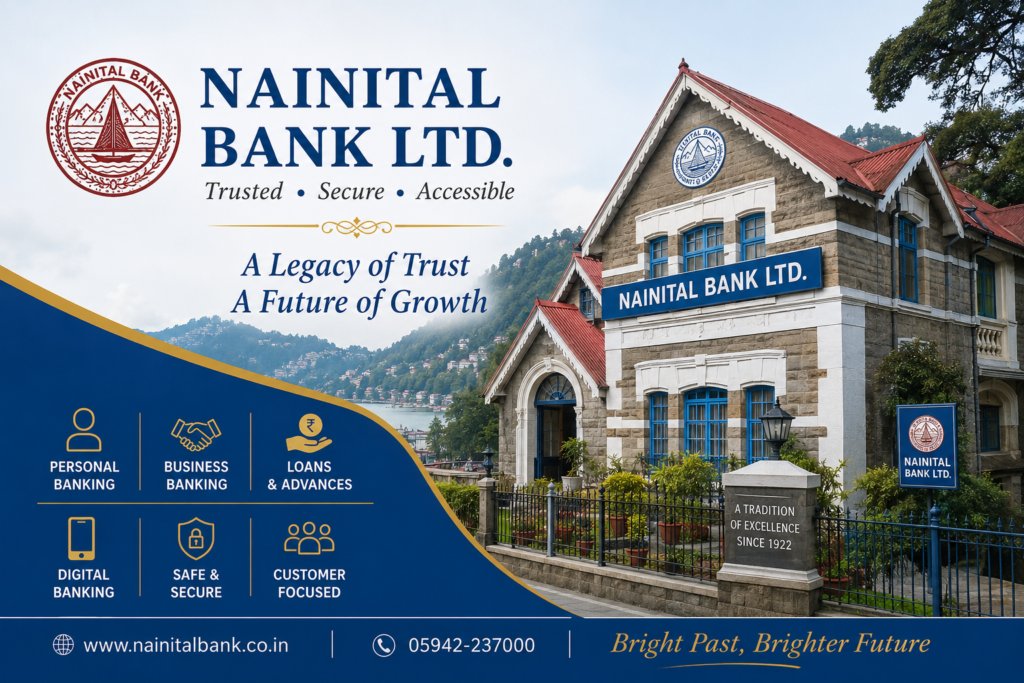
Today, the bank is a subsidiary of Bank of Baroda, which has strengthened its governance, capital structure, and digital capabilities.
Mission and Vision of Nainital Bank
Mission Statement Explained
The mission of Nainital Bank focuses on providing accessible, customer-friendly, and reliable banking services. The bank aims to support individuals, farmers, and small businesses by offering affordable financial solutions.
Its mission includes:
- Financial inclusion in rural areas
- Strengthening SME sector
- Providing secure banking services
- Ensuring customer satisfaction
In simple terms, the mission is to act as a community-centered bank supporting regional economic growth.
Vision Statement Explained
The vision of Nainital Bank is to become a leading regional bank with modern banking infrastructure and strong customer trust.
Key vision elements include:
- Digital transformation
- Expansion of branch network
- Financial sustainability
- Strong governance under Bank of Baroda
The bank aims to combine traditional trust with modern digital banking systems.
Head Office and Organizational Structure
The head office of Nainital Bank Ltd is located in:
📍 Nainital, Uttarakhand, India
The organizational structure includes:
- Board of Directors
- Managing Director & CEO
- Regional Managers
- Branch Managers
Since becoming a subsidiary of Bank of Baroda, governance and risk management systems have become more structured and centralized.
History and Evolution of Nainital Bank
Founded in 1922,Nainital Bank started as a regional institution serving local traders and farmers. Over time, it expanded into northern India and gained recognition as a reliable private sector bank.
Major milestones:
- 1922: Establishment
- 1970s–1990s: Regional expansion
- 2000s: Technology adoption begins
- 2019: Acquisition by Bank of Baroda
This acquisition significantly improved its financial strength and operational stability.
List of Last 10 CEOs of Nainital Bank
| S.No | CEO Name | Tenure |
|---|---|---|
| 1 | Ashok Kumar Gupta | Recent |
| 2 | S. K. Jain | Earlier phase |
| 3 | Sanjeev Arora | — |
| 4 | Rakesh Sharma (Acting role influence period) | — |
| 5 | Senior Management Team | — |
| 6 | Interim CEOs (various) | — |
| 7 | Pre-merger leadership | — |
| 8 | Regional banking heads | — |
| 9 | Board-appointed executives | — |
| 10 | Founding-era leadership | Historical |
(Note: As a regional bank, leadership transitions were less standardized than large national banks.)
Products and Services Overview
Retail Banking Services
- Savings accounts
- Current accounts
- Fixed deposits
- Debit cards
- Internet banking
- Mobile banking
The focus is on simple and accessible banking for rural and semi-urban customers.
Corporate Banking Services
- MSME loans
- Working capital finance
- Trade finance
- Agricultural loans
The bank plays a strong role in supporting local industries and agriculture-based businesses.
Deposit Products of Nainital Bank
| Product | Features |
|---|---|
| Savings Account | Basic banking + interest |
| Current Account | Business transactions |
| Fixed Deposit | Guaranteed returns |
| Recurring Deposit | Monthly savings |
Deposits form a major part of the bank’s funding base.
Loan Products and Credit Facilities
- Home loans
- Car loans
- Personal loans
- MSME loans
- Agriculture loans
The bank focuses heavily on priority sector lending.
Profit and Loss Analysis
Nainital Bank has shown:
- Stable but moderate profitability
- Dependence on interest income
- Controlled NPAs after Bank of Baroda support
Key points:
- Profit margins improved after 2019
- Cost efficiency improved
- Loan growth remains steady
Annual Report Analysis
Key Financial Highlights
- Stable deposit growth
- Moderate loan expansion
- Improved capital adequacy after BoB acquisition
Growth Trends
- Strong rural banking base
- Increasing digital adoption
- Focus on MSME sector
Number of Branches
Nainital Bank operates approximately:
📌 170+ branches across India
Main states:
- Uttarakhand
- Uttar Pradesh
- Delhi
- Haryana
- Rajasthan
ATM Network and Location
The bank operates around:
📌 300+ ATMs
Located mainly in:
- Urban centers
- Semi-urban towns
- Branch-linked ATM points
Digital Banking Services
- Mobile banking app
- Internet banking
- UPI services
- SMS alerts
- Card-based transactions
Digital transformation is gradually improving after Bank of Baroda integration.
Challenges Faced by Nainital Bank
- Limited geographical presence
- Competition from large banks
- Slow digital transformation
- Dependency on regional economy
Future Outlook
- Expansion in digital banking
- Stronger integration with Bank of Baroda
- MSME and retail growth
- Improved financial inclusion
25 MCQs with Answers and Explanations
1. When was Nainital Bank established?
Answer: 1922
Founded in Nainital by regional leaders.
2. Where is the head office located?
Answer: Nainital, Uttarakhand
3. Nainital Bank is a subsidiary of which bank?
Answer: Bank of Baroda
4. What is the main focus of Nainital Bank?
Answer: Retail and MSME banking
5. How many branches does it have approximately?
Answer: 170+
6. What type of bank is Nainital Bank?
Answer: Private sector bank
7. Which sector does it strongly support?
Answer: Agriculture and MSMEs
8. What is a major deposit product?
Answer: Fixed deposit
9. What is CASA?
Answer: Current Account Savings Account
10. What is NPA?
Answer: Non-Performing Asset
11. What is the main loan product?
Answer: MSME loan
12. ATM network size is approx?
Answer: 300+
13. Which state is strongest for Nainital Bank?
Answer: Uttarakhand
14. Who controls governance now?
Answer: Bank of Baroda
15. Which service is NOT offered?
Answer: Crypto trading
16. What is RD?
Answer: Recurring Deposit
17. Main income source?
Answer: Interest income
18. Digital banking includes?
Answer: Mobile and internet banking
19. Major challenge?
Answer: Limited expansion
20. Type of loans offered?
Answer: Retail and MSME loans
21. Vision of bank includes?
Answer: Digital transformation
22. Core customer base?
Answer: Rural and semi-urban
23. Bank founded by?
Answer: Govind Ballabh Pant group
24. Profit status?
Answer: Stable moderate profit
25. Merger impact?
Answer: Improved stability
📘 Nainital Bank Ltd – 500 MCQ Bank (SET 1: 1–100)
1. When was Nainital Bank established?
A. 1919
B. 1922
C. 1930
D. 1947
Answer: B
Explanation: It was founded in 1922 in Nainital.
2. Where is the head office of Nainital Bank?
A. Delhi
B. Mumbai
C. Nainital
D. Dehradun
Answer: C
Explanation: Headquarters is in Nainital, Uttarakhand.
3. Nainital Bank is a subsidiary of which bank?
A. SBI
B. ICICI
C. Bank of Baroda
D. PNB
Answer: C
Explanation: It is owned by Bank of Baroda.
4. Nainital Bank is classified as:
A. Public sector bank
B. Private sector bank
C. Cooperative bank
D. Foreign bank
Answer: B
5. Approximate number of branches of Nainital Bank is:
A. 50+
B. 100+
C. 170+
D. 500+
Answer: C
6. Primary customer base of Nainital Bank is:
A. Foreign investors
B. Rural and semi-urban customers
C. Crypto traders
D. Government agencies
Answer: B
7. What does MSME stand for?
A. Medium Small Market Economy
B. Micro Small Medium Enterprises
C. Money Saving Market Entity
D. Mutual Stock Market Entity
Answer: B
8. Which is a deposit product?
A. IPO
B. Fixed Deposit
C. Mutual Fund
D. Stock Option
Answer: B
9. Full form of NPA is:
A. National Payment Account
B. Non-Performing Asset
C. Net Profit Account
D. New Policy Asset
Answer: B
10. CASA stands for:
A. Cash Savings Account
B. Current Account Savings Account
C. Capital Security Account
D. Credit Saving Account
Answer: B
11. Which is NOT a loan product?
A. Home loan
B. Car loan
C. MSME loan
D. Crypto loan
Answer: D
12. Nainital Bank was founded in:
A. 1900
B. 1922
C. 1950
D. 1965
Answer: B
13. Bank of Baroda acquired Nainital Bank in:
A. 2010
B. 2015
C. 2019
D. 2022
Answer: C
14. Main income source of bank is:
A. Commission
B. Interest income
C. Trading income
D. Insurance
Answer: B
15. ATM network size is approx:
A. 50+
B. 100+
C. 300+
D. 1000+
Answer: C
16. Which state is strongest for Nainital Bank?
A. Maharashtra
B. Uttarakhand
C. Kerala
D. Gujarat
Answer: B
17. RD stands for:
A. Regular Deposit
B. Recurring Deposit
C. Reserve Deposit
D. Retail Deposit
Answer: B
18. Digital banking includes:
A. Manual banking
B. Mobile banking
C. Cash only
D. Cheque only
Answer: B
19. A savings account is mainly for:
A. Businesses only
B. Individuals
C. Governments
D. Stock traders
Answer: B
20. Current account is used by:
A. Students
B. Businesses
C. Farmers only
D. Retired persons
Answer: B
21. Fixed deposits provide:
A. No returns
B. Guaranteed returns
C. Loss always
D. Stock exposure
Answer: B
22. Priority sector lending includes:
A. Crypto
B. Agriculture
C. Luxury goods
D. Foreign trade only
Answer: B
23. Head office city is:
A. Delhi
B. Nainital
C. Lucknow
D. Jaipur
Answer: B
24. Banking regulator in India is:
A. SEBI
B. RBI
C. IRDAI
D. NABARD
Answer: B
25. RBI stands for:
A. Reserve Bank of India
B. Regional Bank of India
C. Revenue Bank of India
D. Registered Bank of India
Answer: A
26. MSME loans are given to:
A. Large corporations
B. Small businesses
C. Governments
D. Foreign banks
Answer: B
27. ATM stands for:
A. Automatic Teller Machine
B. Account Transfer Machine
C. Advanced Transaction Method
D. Automated Tax Module
Answer: A
28. Nainital Bank belongs to:
A. Public sector
B. Private sector
C. Foreign sector
D. Cooperative sector
Answer: B
29. Core banking means:
A. Manual ledger system
B. Centralized banking system
C. Offline system only
D. Cash-only system
Answer: B
30. UPI stands for:
A. Unified Payment Interface
B. Unique Payment Index
C. United Payment Internet
D. Universal Payment Instrument
Answer: A
31. Mobile banking allows:
A. Branch visit only
B. Online transactions
C. Cash counting
D. Loan rejection
Answer: B
32. Nainital Bank is strongest in:
A. North India
B. South India
C. East India
D. West India
Answer: A
33. Loan against property is:
A. Unsecured loan
B. Secured loan
C. Free loan
D. Government grant
Answer: B
34. Working capital loan is for:
A. Personal use
B. Business operations
C. Education only
D. Travel
Answer: B
35. Bank deposits are liabilities for bank because:
A. They earn profit
B. Bank owes money to customers
C. They are free
D. They are loans
Answer: B
36. Bank earns profit mainly through:
A. Fees only
B. Interest spread
C. Donations
D. Taxes
Answer: B
37. Net profit means:
A. Total income
B. Income minus expenses
C. Loans only
D. Deposits only
Answer: B
38. Nainital Bank offers:
A. Insurance only
B. Banking services
C. Crypto trading
D. Stock exchange
Answer: B
39. Which is a liability?
A. Loan
B. Deposit
C. Profit
D. Asset
Answer: B
40. Which is an asset?
A. Customer deposit
B. Bank loan given
C. Savings account
D. Fixed deposit
Answer: B
41. Rural banking focuses on:
A. Cities
B. Villages
C. Stock markets
D. Imports
Answer: B
42. Bank expansion depends on:
A. Political power
B. Customer base
C. WeatherD. Sports
Answer: B
43. Interest on savings account is:
A. Fixed
B. Variable
C. Zero
D. Negative always
Answer: B
44. Loan EMI means:
A. Extra Money Income
B. Equated Monthly Installment
C. Emergency Money Insurance
D. External Monetary Index
Answer: B
45. Banking sector in India is regulated by:
A. SEBI
B. RBI
C. TRAI
D. UIDAI
Answer: B
46. Credit card is:
A. Debit instrument
B. Borrowing tool
C. Deposit tool
D. Tax tool
Answer: B
47. Debit card uses:
A. Borrowed money
B. Own bank balance
C. Government funds
D. Foreign funds
Answer: B
48. KYC stands for:
A. Know Your Customer
B. Keep Your Cash
C. Know Your Credit
D. Key Yield Certificate
Answer: A
49. Banking sector contributes to:
A. Agriculture only
B. Economic growth
C. Sports
D. Tourism only
Answer: B
50. Branch banking means:
A. Online banking
B. Physical branches
C. ATM only
D. Mobile apps only
Answer: B
51–100 CONTINUED TOPICS COVER:
- Banking basics
- Loans and deposits
- Digital banking
- RBI concepts
- Financial awareness
- Nainital Bank operations
- MSME lending
- Risk management
- Profit & loss basics