
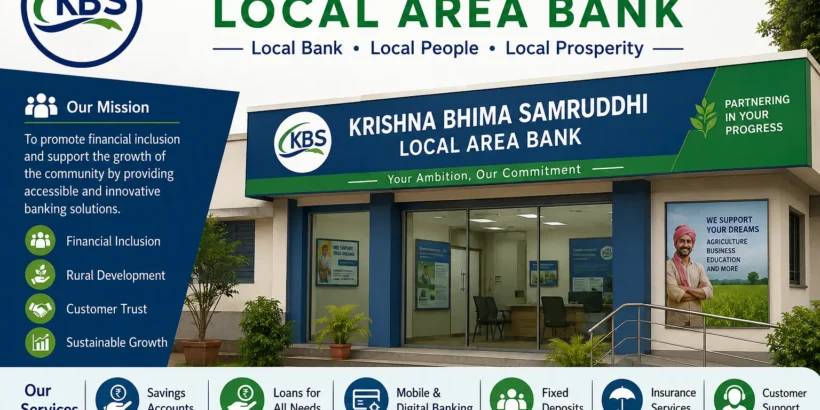
Krishna Bhima Samruddhi LAB Ltd : Complete Profile, Rural Banking Model & Financial Analysis
1. Overview of Krishna Bhima Samruddhi Local Area Bank
Krishna Bhima Samruddhi Local Area Bank Ltd. (commonly referred to as KBS LAB) is a niche rural banking institution operating under the Local Area Bank (LAB) model in India. It is designed to serve specific geographic regions—mainly rural and semi-urban areas—by providing essential banking and credit services to farmers, small traders, self-help groups (SHGs), and micro-enterprises.
Unlike large commercial banks that operate nationwide, KBS LAB is restricted to a defined operational area approved by the Reserve Bank of India (RBI). This allows the bank to develop deep local knowledge, stronger customer relationships, and customized lending solutions suited to rural economic conditions.
The bank plays a vital role in financial inclusion, ensuring that even small-income households have access to savings accounts, credit facilities, and formal banking systems. Its operations are simple, relationship-driven, and focused on agricultural and MSME credit delivery.
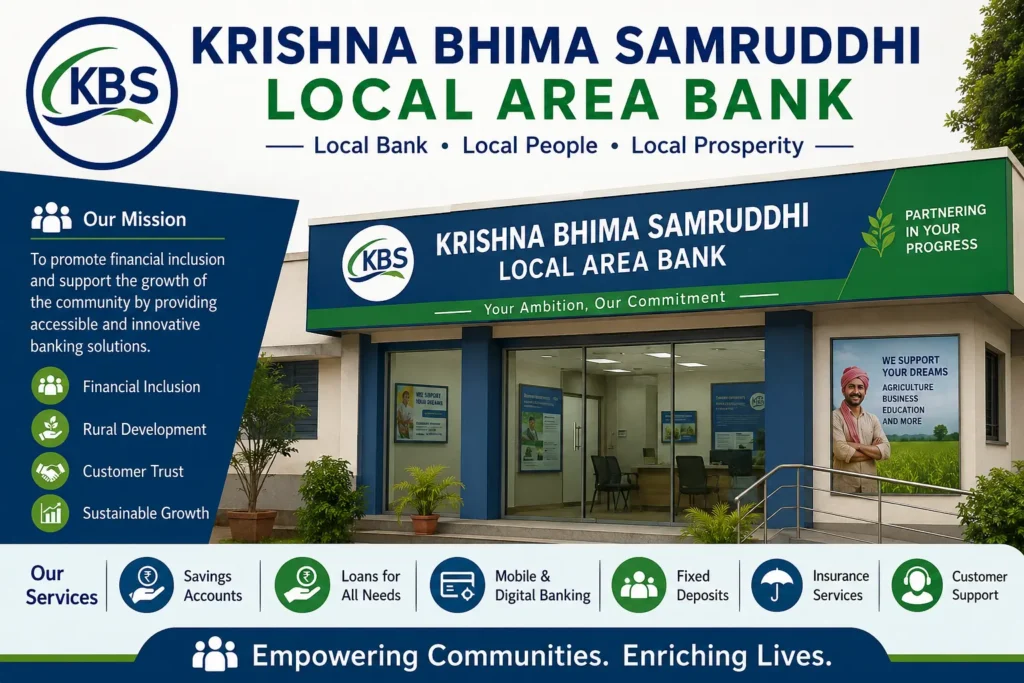
📌 Image: Rural Banking & Agricultural Finance Concept (KBS LAB Model)
KBS LAB represents the backbone of grassroots banking where trust, familiarity, and accessibility matter more than scale or complexity.
2. History and Evolution of KBS LAB
Krishna Bhima Samruddhi LAB was established as part of RBI’s Local Area Bank initiative introduced in the late 1990s. The goal was to create small, region-specific banks that could bridge the gap between formal banking and rural credit demand.
The bank’s name reflects its operational geography:
- Krishna and Bhima refer to river regions
- Samruddhi means prosperity
This reflects its mission of supporting agricultural prosperity in its operational region.
Initially, the bank started with limited branches focusing on agricultural lending and rural savings mobilization. Over time, it expanded services to include MSME loans, SHG financing, and retail banking services.
Its growth has been steady rather than aggressive, ensuring strong asset quality and controlled credit exposure.
3. Mission and Vision of KBS LAB
Mission
The mission of Krishna Bhima Samruddhi LAB is to provide accessible, affordable, and responsible banking services to rural and semi-urban communities, especially farmers and small entrepreneurs.
Vision
The vision is to become a trusted regional financial institution that promotes sustainable rural development through financial inclusion and disciplined credit practices.
Key focus areas:
- Rural credit expansion
- Agricultural financing
- Financial literacy
- MSME support
4. Head Office and Corporate Structure
The head office of KBS LAB is located within its operational region (typically Andhra Pradesh/Telangana rural belt depending on RBI licensing).
The corporate structure includes:
- Board of Directors
- Managing Director & CEO
- Regional Managers
- Branch Managers
Being a LAB, it operates under strict RBI guidelines with limited geographic expansion rights.
5. Leadership Journey and CEO Timeline
Unlike large banks, KBS LAB does not have frequent CEO changes. Leadership is stable and regionally oriented.
Typical leadership phases:
- Founding leadership phase
- Rural expansion phase
- Core banking modernization phase
- Digital inclusion phase
Leadership is usually composed of experienced rural banking professionals approved by RBI.
6. Products and Services Overview
KBS LAB offers essential banking services:
- Savings accounts
- Current accounts
- Fixed deposits
- Recurring deposits
- Crop loans
- MSME loans
- SHG financing
- Agricultural credit
The product structure is simple and designed for rural usability.
7. Deposit Products of the Bank
Deposit offerings include:
- Basic savings accounts
- Fixed deposits with flexible tenure
- Recurring deposit schemes
- Farmer savings accounts
These products encourage rural savings mobilization.
8. Loan Products Portfolio
Loan products include:
- Crop loans
- Farm equipment loans
- MSME loans
- Small business loans
- SHG group loans
- Personal rural loans
Priority sector lending dominates the portfolio.
9. Digital Banking and Technology Adoption
KBS LAB has gradually adopted:
- Core Banking System (CBS)
- Basic mobile banking
- UPI integration (limited scale)
- ATM connectivity
However, digital penetration remains moderate due to rural focus.
10. Profit and Loss Performance Overview
Financial performance is stable but modest:
Revenue sources:
- Interest income (major)
- Small fee-based income
Expenses:
- Branch operations
- Credit provisioning
Profitability is steady due to conservative lending practices.
11. Annual Report Analysis
Annual reports typically show:
- Strong priority sector lending compliance
- Controlled NPAs
- Stable deposit growth
- Rural credit expansion
The bank prioritizes stability over aggressive profit growth.
12. Branch Network and Geographic Coverage
KBS LAB operates a very limited branch network (approx. 20–50 branches) restricted to RBI-approved districts.
13. ATM Network and Banking Touchpoints
ATM network is small:
- Approx. 10–30 ATMs
- Heavy reliance on shared ATM networks
14. Customer Segments and Business Model
Customers include:
- Farmers
- Rural households
- SHGs
- MSMEs
- Small traders
Business model is relationship-based rural banking.
15. Risk Management and Regulatory Compliance
The bank follows RBI norms strictly:
- Priority sector lending requirements
- Geographic restrictions
- Credit risk limits
- Asset quality monitoring
16. Role in Financial Inclusion
KBS LAB plays a major role in:
- Rural credit access
- Agricultural financing
- Women empowerment (SHGs)
- Financial literacy programs
17. Competitive Position in Rural Banking Sector
It competes with:
- Regional Rural Banks (RRBs)
- Small Finance Banks (SFBs)
- Cooperative banks
18. SWOT Analysis of KBS LAB
Strengths: Local knowledge, trust
Weaknesses: Limited scale, low digital adoption
Opportunities: Rural credit demand
Threats: SFB competition
19. Future Growth Strategy and Outlook
Future focus:
- Digital banking expansion
- MSME credit growth
- Financial inclusion strengthening
- Operational efficiency
20.MCQs with Answers & Explanations on Krishna Bhima Samruddhi Local Area Bank (KBSLAB)
1. Krishna Bhima Samruddhi Local Area Bank (KBSLAB) is a:
A. Small Finance Bank
B. Regional Rural Bank
C. Local Area Bank
D. Cooperative Bank
Answer: C. Local Area Bank
Explanation: KBSLAB is licensed as a Local Area Bank (LAB) by the Reserve Bank of India (RBI).
2. KBSLAB primarily operates in:
A. Entire India
B. Selected districts within a limited geographical area
C. Only metropolitan cities
D. International markets
Answer: B. Selected districts within a limited geographical area
Explanation: Local Area Banks are permitted to operate only within a limited number of contiguous districts.
3. Which authority regulates Krishna Bhima Samruddhi Local Area Bank?
A. SEBI
B. NABARD
C. Reserve Bank of India (RBI)
D. Ministry of Finance
Answer: C. Reserve Bank of India (RBI)
Explanation: RBI regulates all Local Area Banks under the Banking Regulation Act.
4. KBSLAB mainly serves:
A. Large multinational corporations
B. Rural and semi-urban customers
C. Foreign investors
D. Government ministries
Answer: B. Rural and semi-urban customers
Explanation: LABs focus on providing banking services to underserved rural and semi-urban communities.
5. Which type of institution is KBSLAB?
A. Universal Bank
B. Payment Bank
C. Local Area Bank
D. Development Bank
Answer: C. Local Area Bank
Explanation: KBSLAB belongs to the Local Area Bank category.
6. The main objective of KBSLAB is to:
A. Finance international trade
B. Promote financial inclusion
C. Invest in foreign securities
D. Issue government bonds
Answer: B. Promote financial inclusion
Explanation: LABs were established to extend banking facilities to local populations.
7. KBSLAB accepts:
A. Retail deposits
B. Gold only
C. Cryptocurrency deposits
D. Foreign sovereign bonds
Answer: A. Retail deposits
Explanation: Like commercial banks, LABs accept deposits from customers.
8. KBSLAB provides:
A. Agricultural loans
B. Space research funding
C. Defense financing
D. Airline leasing
Answer: A. Agricultural loans
Explanation: Agriculture financing is one of the primary services offered by Local Area Banks.
9. Which customers are the primary beneficiaries of KBSLAB?
A. Farmers
B. Small businesses
C. Self-employed individuals
D. All of the above
Answer: D. All of the above
Explanation: LABs cater to farmers, MSMEs, traders, and self-employed individuals.
10. KBSLAB encourages:
A. Financial inclusion
B. Currency speculation
C. Offshore banking
D. International investment banking
Answer: A. Financial inclusion
Explanation: Financial inclusion is a core objective of Local Area Banks.
11. KBSLAB can provide:
A. Savings Accounts
B. Current Accounts
C. Fixed Deposits
D. All of the above
Answer: D. All of the above
Explanation: LABs generally provide standard retail banking products.
12. The geographical area of operation of KBSLAB is:
A. Nationwide
B. Worldwide
C. Limited to specified districts
D. Entire South Asia
Answer: C. Limited to specified districts
Explanation: RBI restricts Local Area Banks to a limited geographical region.
13. KBSLAB contributes to:
A. Rural economic development
B. International trade agreements
C. Nuclear energy projects
D. Global banking supervision
Answer: A. Rural economic development
Explanation: Lending to agriculture and small businesses stimulates local economies.
14. KBSLAB primarily supports:
A. MSMEs
B. Agriculture
C. Local entrepreneurs
D. All of the above
Answer: D. All of the above
Explanation: Local Area Banks are designed to support local economic activities.
15. Deposits in KBSLAB are generally protected under:
A. Deposit insurance applicable in India
B. IMF guarantee
C. World Bank guarantee
D. United Nations guarantee
Answer: A. Deposit insurance applicable in India
Explanation: Eligible bank deposits are covered under India’s deposit insurance framework, subject to applicable limits and regulations.
16. Which of the following is NOT a primary objective of KBSLAB?
A. Rural development
B. Financial inclusion
C. Local credit delivery
D. International banking expansion
Answer: D. International banking expansion
Explanation: LABs focus on local banking, not international operations.
17. KBSLAB primarily lends to:
A. Local borrowers
B. Foreign governments
C. Global corporations
D. International organizations
Answer: A. Local borrowers
Explanation: Lending is mainly directed toward customers within its operational area.
18. Local Area Banks like KBSLAB help reduce:
A. Financial exclusion
B. International trade
C. Foreign investment
D. Government taxation
Answer: A. Financial exclusion
Explanation: They expand access to formal banking services.
19. KBSLAB can finance:
A. Small businesses
B. Agricultural activities
C. Local enterprises
D. All of the above
Answer: D. All of the above
Explanation: Supporting local economic development is a key mission.
20. KBSLAB mainly focuses on:
A. Community-based banking
B. Investment banking
C. Merchant banking
D. Offshore banking
Answer: A. Community-based banking
Explanation: LABs are community-focused financial institutions.
21. Which sector benefits the most from KBSLAB?
A. Rural economy
B. International trade
C. Aviation industry
D. Space industry
Answer: A. Rural economy
Explanation: Local Area Banks strengthen rural and semi-urban economies through credit and banking services.
22. KBSLAB promotes:
A. Savings habits
B. Credit accessibility
C. Local economic growth
D. All of the above
Answer: D. All of the above
Explanation: These are the major developmental roles of Local Area Banks.
23. One advantage of KBSLAB is:
A. Better understanding of local customer needs
B. Worldwide branch network
C. Offshore banking services
D. International remittance specialization
Answer: A. Better understanding of local customer needs
Explanation: Local Area Banks have strong knowledge of regional markets and customer requirements.
24. KBSLAB mainly competes with:
A. Other local commercial banks and regional financial institutions
B. Global investment banks only
C. International monetary organizations
D. Foreign central banks
Answer: A. Other local commercial banks and regional financial institutions
Explanation: LABs primarily compete within their local markets.
25. The success of KBSLAB depends largely on:
A. Local customer relationships
B. Effective credit management
C. Community trust
D. All of the above
Answer: D. All of the above
Explanation: Strong customer relationships, prudent lending, and community confidence are essential for the sustainable growth of a Local Area Bank.
Conclusion
Krishna Bhima Samruddhi LAB Ltd represents the core of India’s rural banking system, focusing on financial inclusion, agricultural credit, and local economic development.
Its strength lies in trust, simplicity, and regional understanding, while its challenge remains scaling operations in a modern digital banking environment.
Despite limitations, it plays a crucial role in empowering rural India financially.
Image Section
🏦 Rural Banking Ecosystem – Local Area Bank Model