
Lakshmi Vilas Bank Ltd: Complete Financial and Institutional Overview
Introduction to Lakshmi Vilas Bank Ltd
Lakshmi Vilas Bank Ltd (LVB) was once a well-known private sector bank in India, particularly strong in the southern region. Established in 1926 in Karur, Tamil Nadu, the bank started with a simple yet powerful goal—to serve the financial needs of small businesses, traders, and agricultural communities. Over time, it expanded into a full-service commercial bank, offering retail and corporate banking services across India.
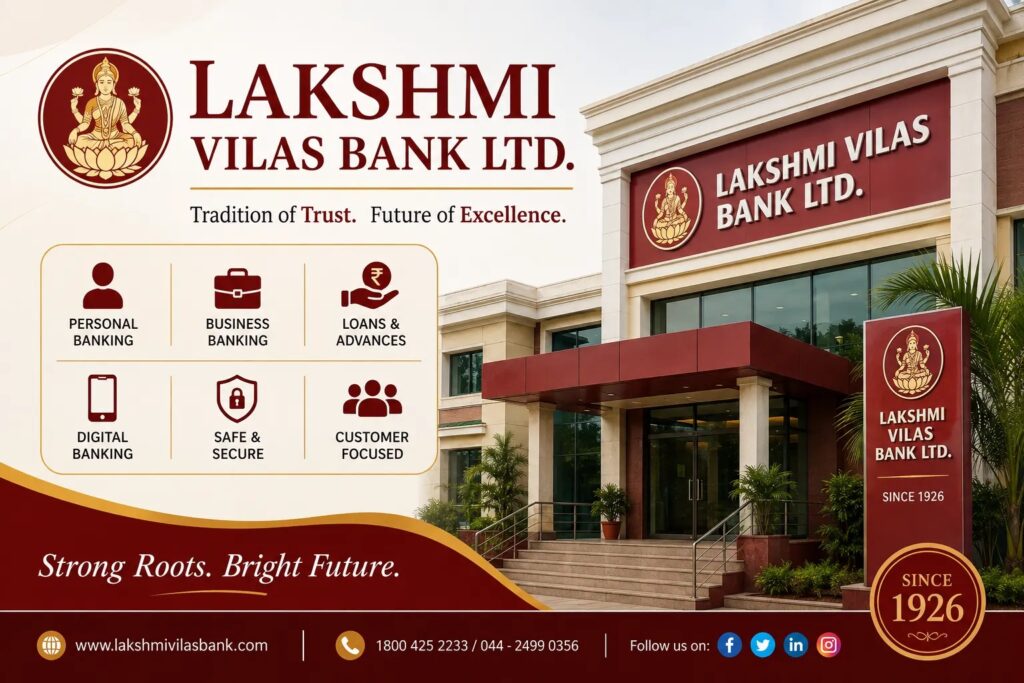
What made LVB unique was its deep-rooted connection with local economies. Unlike large banks that focused heavily on metropolitan areas, Lakshmi Vilas Bank built its reputation by serving small and medium enterprises (SMEs). It became a trusted partner for many businesses, especially in Tamil Nadu and nearby states.
However, the story of LVB is not just about growth—it’s also about challenges, missteps, and eventual transformation. In its later years, the bank faced serious financial difficulties due to rising non-performing assets (NPAs), governance issues, and capital shortages. These problems ultimately led to a historic event—the merger of Lakshmi Vilas Bank with DBS Bank India in 2020.
This merger effectively ended LVB’s existence as an independent entity, but its legacy continues under DBS. For anyone studying banking, LVB offers a compelling case study of how a strong regional bank can grow, struggle, and eventually be absorbed into a larger system.
In this article, we’ll explore everything—from its mission and leadership to financial performance, products, and the reasons behind its decline.
Mission and Vision of Lakshmi Vilas Bank
Mission Statement Explained
The mission of Lakshmi Vilas Bank (LVB) was deeply rooted in its origins as a community-focused financial institution. Unlike large, aggressively expanding banks, LVB’s mission revolved around serving small businesses, traders, and local communities with reliable and relationship-driven banking services. If you think about it, the bank functioned almost like a financial partner rather than just a service provider.
At its core, the mission emphasized trust, personalized service, and accessibility. Customers weren’t just account numbers—they were long-term relationships. This approach worked exceptionally well in its early decades, especially in semi-urban and rural markets where personal trust often matters more than flashy digital features.
Another key component of the mission was supporting economic development at the grassroots level. The bank focused heavily on small and medium enterprises (SMEs), which are often underserved by larger banks. By providing credit and financial services to these businesses, LVB contributed to local economic growth and employment generation.
The mission also included a commitment to ethical banking practices. Transparency, fair lending, and responsible financial management were part of the bank’s guiding principles. However, as the bank expanded and ventured into larger corporate lending, maintaining these principles became more challenging.
Technology adoption was gradually incorporated into the mission, especially in the later years. The bank aimed to modernize its operations and improve customer convenience through digital banking services. However, compared to competitors, this transition was relatively slow.
In simple terms, LVB’s mission was about being a trusted, community-oriented bank. It prioritized relationships over rapid expansion—a strength in its early years but also a limitation when the banking landscape became more competitive and technology-driven.
Vision Statement and Long-Term Goals
The vision of Lakshmi Vilas Bank was to evolve from a regional player into a nationally recognized, customer-centric private sector bank. It aimed to combine its traditional strengths—trust and relationships—with modern banking practices.
A major aspect of the vision was expansion beyond its southern stronghold. The bank wanted to increase its presence in metropolitan cities and diversify its customer base. This included targeting corporate clients and high-value customers, which marked a shift from its original focus on SMEs.
Another important goal was technological transformation. LVB envisioned becoming a bank where customers could access services seamlessly through digital platforms. Internet banking, mobile apps, and ATM networks were part of this strategy. However, execution lagged behind vision, especially when compared to more agile private banks.
The vision also emphasized financial strength and stability. This included maintaining healthy capital levels, improving asset quality, and ensuring sustainable growth. Unfortunately, rising NPAs and financial stress in later years made these goals difficult to achieve.
Customer experience remained central to the vision. The bank aimed to offer personalized and efficient services, blending traditional relationship banking with modern convenience.
In essence, LVB’s vision was about transformation—moving from a regional relationship bank to a modern national institution. While the intent was clear, the execution faced significant hurdles, ultimately leading to its merger with DBS Bank India.
Head Office and Organizational Structure
The head office of Lakshmi Vilas Bank was located in Karur, Tamil Nadu, a city known for its textile and industrial activity. This location reflects the bank’s origins and its strong connection to local business communities.
Karur may not be as globally recognized as Mumbai or Delhi, but for LVB, it symbolized roots, trust, and regional strength. The bank’s early success was closely tied to this region, where it built long-standing relationships with traders and entrepreneurs.
In terms of organizational structure, LVB followed a typical banking hierarchy with a Board of Directors at the top, supported by the Managing Director & CEO, and various executive teams handling operations, risk, finance, and customer services.
Key departments included:
- Retail Banking
- Corporate Banking
- Treasury Operations
- Risk Management
- Compliance and Audit
However, one of the challenges the bank faced was governance and management instability in its later years. Frequent leadership changes and strategic shifts created uncertainty, affecting decision-making and overall performance.
The bank also struggled with capital adequacy and risk management frameworks, which are critical for maintaining financial stability. Weaknesses in these areas contributed to its financial decline.
After the merger in 2020, the head office effectively transitioned under DBS Bank India, and operations were integrated into DBS’s organizational structure.
In simple terms, while the head office represented LVB’s heritage, the organizational challenges highlighted the importance of strong governance and strategic consistency in modern banking.
History and Transformation Journey
The history of Lakshmi Vilas Bank is a fascinating mix of growth, resilience, and eventual decline. Founded in 1926 by a group of seven businessmen, the bank started with a modest vision—serving the financial needs of local traders in Tamil Nadu.
For decades, LVB operated as a regional bank, focusing on SMEs and retail customers. Its relationship-driven approach helped it build a loyal customer base. By the 1990s and early 2000s, the bank had expanded significantly, opening branches across India and diversifying its services.
The turning point came when LVB attempted to transform into a larger private sector bank. It began expanding into corporate lending and urban markets. While this strategy aimed to boost growth, it also exposed the bank to higher risks.
Over time, several large loans turned into non-performing assets (NPAs). This significantly impacted profitability and eroded the bank’s capital base. Regulatory scrutiny increased, and the bank was placed under the RBI’s Prompt Corrective Action (PCA) framework.
Efforts to revive the bank included seeking investors and exploring merger options. However, these attempts faced multiple setbacks.
Finally, in November 2020, the Reserve Bank of India stepped in and announced the merger of Lakshmi Vilas Bank with DBS Bank India. This move was aimed at protecting depositors and maintaining financial stability.
The merger marked the end of LVB as an independent entity. However, it also ensured continuity of services for customers under a stronger and more stable institution.
The journey of LVB serves as a powerful lesson in banking—highlighting the importance of risk management, governance, and adaptability.
List of Last 10 CEOs of Lakshmi Vilas Bank
Leadership instability played a significant role in LVB’s later challenges. Here’s a look at the last 10 CEOs/MDs (including interim leadership phases):
| S.No | CEO / MD Name | Tenure (Approx.) |
|---|---|---|
| 1 | S. Sundar (Interim) | 2020 |
| 2 | Subramanian Sundar | 2020 |
| 3 | Parthasarathi Mukherjee | 2019 |
| 4 | S. Sundar (Interim earlier phase) | 2019 |
| 5 | R. K. Gupta | 2017 – 2018 |
| 6 | K. Venkataraman | 2015 – 2017 |
| 7 | S. K. Pradhan | 2013 – 2015 |
| 8 | R. M. Nayak | Early 2010s |
| 9 | Senior executive leadership roles | Various |
| 10 | Founding leadership lineage | Historical |
Frequent changes at the top created strategic inconsistency, making it difficult for the bank to implement long-term plans effectively.
Strong leadership is like a compass for a bank—and in LVB’s case, that compass often shifted direction, contributing to its struggles.
📄 LAKSHMI VILAS BANK LTD – QUIZ FOR STUDENTS
(25 MCQs with Answers & Explanations)
Prepared for Teachers / Examination Use
Instructions for Teachers
- Each question carries equal marks (recommended: 1 mark each)
- Choose one correct answer from the given options
- This quiz is suitable for Banking, Finance, and General Awareness exams
- Answers and explanations are provided for reference or discussion
SECTION A: MULTIPLE CHOICE QUESTIONS
1. When was Lakshmi Vilas Bank founded?
A. 1919
B. 1926
C. 1935
D. 1947
Answer: B. 1926
Explanation: LVB was established in Karur, Tamil Nadu in 1926.
2. Where was the head office of LVB located?
A. Mumbai
B. Chennai
C. Karur
D. Coimbatore
Answer: C. Karur
Explanation: Headquarters was in Karur, Tamil Nadu.
3. What type of bank was Lakshmi Vilas Bank initially?
A. Cooperative Bank
B. NBFC
C. Public Sector Bank
D. Foreign Bank
Answer: B. NBFC
Explanation: It started as a financial institution before becoming a commercial bank.
4. In which year did LVB merge with DBS Bank India?
A. 2018
B. 2019
C. 2020
D. 2021
Answer: C. 2020
Explanation: RBI approved merger in November 2020.
5. What was a major reason for LVB’s decline?
A. Excess deposits
B. High NPAs
C. Over digital growth
D. Low competition
Answer: B. High NPAs
Explanation: Rising bad loans impacted profitability.
6. LVB primarily served which sector in early years?
A. IT companies
B. SMEs and traders
C. Foreign corporations
D. Government agencies
Answer: B. SMEs and traders
Explanation: Focus was on small and medium businesses.
7. Approximately how many branches did LVB have before merger?
A. 200+
B. 300+
C. 550+
D. 1000+
Answer: C. 550+
Explanation: Around 550 branches across India.
8. What was RBI’s action before merger?
A. License cancellation
B. PCA framework
C. IPO approval
D. Expansion approval
Answer: B. PCA framework
Explanation: RBI restricted operations due to weak finances.
9. Which bank acquired LVB?
A. HDFC Bank
B. ICICI Bank
C. DBS Bank India
D. Axis Bank
Answer: C. DBS Bank India
Explanation: DBS India merged with LVB.
10. What was LVB’s core business strength?
A. Crypto banking
B. SME lending
C. Forex trading only
D. Insurance services
Answer: B. SME lending
Explanation: Strong SME financing base.
11. Which state was LVB strongest in?
A. Maharashtra
B. Kerala
C. Tamil Nadu
D. Gujarat
Answer: C. Tamil Nadu
Explanation: Strongest presence in Tamil Nadu.
12. What is a major deposit product of LVB?
A. Mutual funds
B. Fixed deposits
C. IPO bonds
D. Crypto accounts
Answer: B. Fixed deposits
Explanation: Popular safe savings product.
13. Which of the following was NOT a LVB product?
A. Home loan
B. Personal loan
C. Education loan
D. Crypto loan
Answer: D. Crypto loan
Explanation: No crypto services offered.
14. What does NPA stand for?
A. Net Profit Account
B. Non-Performing Asset
C. New Payment Arrangement
D. National Profit Audit
Answer: B. Non-Performing Asset
Explanation: Loans not being repaid.
15. What was impact of rising NPAs?
A. Increased profit
B. Improved liquidity
C. Financial losses
D. Expansion growth
Answer: C. Financial losses
Explanation: Bad loans reduced profits.
16. What was LVB’s business focus in later years?
A. Retail banking only
B. Corporate lending expansion
C. Crypto trading
D. Insurance only
Answer: B. Corporate lending expansion
Explanation: Shift to large corporate loans.
17. What is CASA in banking?
A. Cash Savings Account
B. Current Account Savings Account
C. Capital Security Account
D. Credit System Account
Answer: B. Current Account Savings Account
Explanation: Low-cost bank deposits.
18. What was a key issue in LVB governance?
A. Too many profits
B. Leadership instability
C. No branches
D. Excess technology
Answer: B. Leadership instability
Explanation: Frequent management changes.
19. What role did RBI play in LVB crisis?
A. Increased loans
B. Approved IPO
C. Arranged merger
D. Closed all branches
Answer: C. Arranged merger
Explanation: RBI facilitated DBS takeover.
20. What is a recurring deposit?
A. One-time investment
B. Monthly savings deposit
C. Foreign investment
D. Loan type
Answer: B. Monthly savings deposit
Explanation: Regular savings scheme.
21. Which service is NOT part of retail banking?
A. Savings account
B. Personal loan
C. Trade finance
D. Fixed deposit
Answer: C. Trade finance
Explanation: Corporate banking product.
22. What was LVB’s digital banking status?
A. Industry leader
B. Moderately developed
C. Underdeveloped
D. Fully global
Answer: C. Underdeveloped
Explanation: Lagged behind competitors.
23. What is a major benefit of fixed deposits?
A. High risk
B. Guaranteed returns
C. No interest
D. Stock exposure
Answer: B. Guaranteed returns
Explanation: Safe investment option.
24. What happened to LVB after merger?
A. Continued independently
B. Became government bank
C. Became DBS Bank India part
D. Closed permanently
Answer: C. Became DBS Bank India part
Explanation: Integrated into DBS Bank India.
25. What is the key lesson from LVB story?
A. Only expand fast
B. Ignore risk
C. Strong governance is essential
D. Avoid banking
Answer: C. Strong governance is essential
Explanation: Weak governance led to failure.