
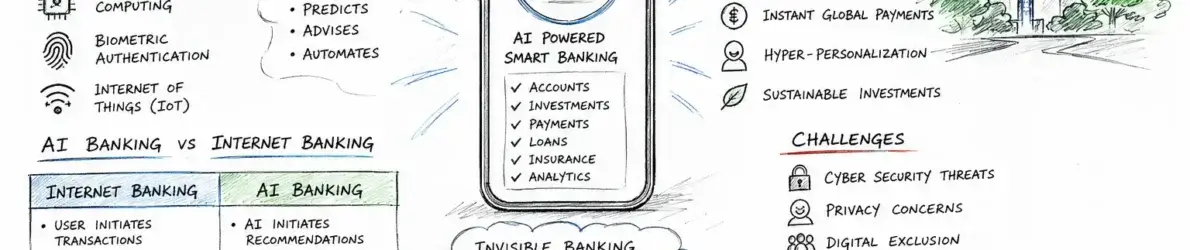
Internet Banking 2050: How Banking Will Transform the World by Mid-Century
Internet banking has revolutionized the financial sector over the past three decades. What began as a simple online platform for checking account balances and transferring funds has evolved into a sophisticated digital ecosystem offering loans, investments, insurance, and personalized financial services. As we move toward 2050, rapid advancements in Artificial Intelligence (AI), blockchain, quantum computing, the Internet of Things (IoT), biometric authentication, and decentralized finance (DeFi) are expected to reshape the future of banking in unprecedented ways.
By 2050, internet banking will not merely be a digital version of traditional banking; it will become an intelligent, autonomous, and highly personalized financial assistant integrated into every aspect of daily life.
Understanding Internet Banking
Internet banking, also known as online banking or digital banking, refers to banking services conducted through the internet without requiring physical visits to bank branches.
Current internet banking services include:
-
Fund transfers
-
Bill payments
-
Mobile banking
-
Loan applications
-
Investment management
-
Foreign exchange transactions
-
Online account opening
-
Digital customer support
The future will significantly expand these capabilities.
Evolution of Internet Banking: A Brief Timeline
| Period | Development |
|---|---|
| 1990s | Basic online banking websites |
| 2000s | Online transactions and bill payments |
| 2010s | Mobile banking revolution |
| 2020s | AI chatbots and digital wallets |
| 2030s | Hyper-personalized banking ecosystems |
| 2040s | Autonomous financial management |
| 2050 | Fully intelligent AI-powered banking networks |
Internet Banking in 2050
By 2050, internet banking is expected to become:
Invisible Banking
Financial services will operate automatically in the background without requiring active customer intervention.
Examples:
-
Bills paid automatically
-
Investments adjusted continuously
-
Savings optimized by AI
-
Taxes calculated and submitted automatically
Predictive Banking
Banks will anticipate customer needs before customers request services.
For example:
-
AI predicts upcoming expenses
-
Suggests budget adjustments
-
Offers loans before financial shortages occur
-
Recommends investments based on market trends
Real-Time Financial Intelligence
Every transaction will be analyzed instantly.
Benefits:
-
Fraud prevention
-
Financial planning
-
Personalized recommendations
-
Risk management
Key Technologies Driving Internet Banking 2050
Artificial Intelligence (AI)
AI will become the core engine of banking operations.
Applications:
-
Intelligent customer support
-
Automated lending decisions
-
Investment advisory
-
Fraud detection
-
Behavioral analytics
AI assistants may manage entire financial portfolios without human intervention.
Blockchain Technology
Blockchain will provide:
-
Transparent transactions
-
Secure record keeping
-
Smart contracts
-
Cross-border payment efficiency
Benefits include:
-
Reduced fraud
-
Faster settlements
-
Lower transaction costs
Quantum Computing
Quantum computers may solve complex financial calculations in seconds.
Potential uses:
-
Risk analysis
-
Market forecasting
-
Cybersecurity
-
Portfolio optimization
Biometric Authentication
Passwords may disappear entirely.
Authentication methods:
-
Retina scans
-
Fingerprints
-
Facial recognition
-
Voice authentication
-
Behavioral biometrics
Internet of Things (IoT)
Connected devices will perform banking activities automatically.
Examples:
-
Smart cars paying tolls
-
Smart refrigerators ordering groceries
-
Wearables managing subscriptions
AI Banking vs. Internet Banking
Traditional Internet Banking
Characteristics:
-
User initiates transactions
-
Rule-based systems
-
Limited personalization
-
Manual decision-making
Examples:
-
Logging in to transfer money
-
Paying bills online
-
Applying for loans manually
AI Banking
Characteristics:
-
AI initiates recommendations
-
Autonomous financial decisions
-
Deep personalization
-
Continuous learning
Examples:
-
AI negotiates insurance rates
-
AI shifts investments automatically
-
AI predicts cash shortages
-
AI optimizes spending habits
Comparison Table
| Feature | Internet Banking | AI Banking |
|---|---|---|
| User Involvement | High | Low |
| Decision Making | Human | AI Assisted |
| Personalization | Moderate | Extreme |
| Speed | Fast | Instant |
| Fraud Detection | Reactive | Predictive |
| Customer Support | Human/Chatbot | Intelligent AI |
| Financial Planning | Manual | Automated |
Problems and Challenges of Internet Banking 2050
Despite tremendous opportunities, several challenges remain.
Cybersecurity Threats
As banking systems become more connected, cybercriminals may develop sophisticated attacks.
Potential risks:
-
AI-powered hacking
-
Identity theft
-
Data breaches
-
Ransomware attacks
Privacy Concerns
Future banks may collect enormous amounts of personal data.
Challenges include:
-
Data misuse
-
Surveillance concerns
-
Unauthorized profiling
Balancing convenience and privacy will become critical.
Digital Exclusion
Not everyone will have equal access to advanced banking technologies.
Affected groups may include:
-
Rural populations
-
Elderly individuals
-
Low-income communities
Financial inclusion remains a major challenge.
Dependence on Technology
Heavy reliance on AI and automation may create risks.
Examples:
-
System failures
-
Software errors
-
Network outages
-
Algorithmic bias
Human oversight will remain necessary.
Regulatory Challenges
Governments and central banks must create new regulations for:
-
AI-driven decisions
-
Digital currencies
-
Data protection
-
Cross-border banking
Legal frameworks may struggle to keep pace with technological innovation.
Opportunities and Prospects of Internet Banking 2050
Financial Inclusion
Billions of previously unbanked individuals could gain access to financial services through internet connectivity.
Benefits:
-
Digital accounts
-
Microloans
-
Online savings
-
Global payments
Cost Reduction
Automation may significantly reduce operational expenses.
Banks can:
-
Eliminate paperwork
-
Reduce branch costs
-
Improve efficiency
-
Lower service fees
Personalized Banking
Every customer may receive a unique banking experience.
Examples:
-
Customized loan products
-
Individualized investment portfolios
-
Personalized financial education
Global Banking Integration
Borders will become less important in financial transactions.
Future benefits:
-
Instant international payments
-
Multi-currency accounts
-
Global investment access
Sustainable Banking
AI-driven systems may support environmentally responsible investments.
Banks could prioritize:
-
Green energy projects
-
Sustainable businesses
-
Climate-friendly investments
The Future of Internet Banking
The future internet banking ecosystem may include:
Autonomous Financial Agents
Personal AI assistants managing:
-
Spending
-
Saving
-
Investing
-
Borrowing
24 hours a day.
Embedded Banking
Banking services integrated into:
-
Social media
-
E-commerce platforms
-
Smart homes
-
Autonomous vehicles
Digital Identity Networks
Universal digital identities may simplify:
-
Account opening
-
KYC verification
-
International banking
Central Bank Digital Currencies (CBDCs)
Many countries may adopt government-backed digital currencies.
Benefits:
-
Faster transactions
-
Enhanced transparency
-
Reduced cash dependency
Human-AI Collaboration
Rather than replacing humans entirely, future banking may combine:
-
Human judgment
-
AI intelligence
This hybrid approach could deliver better outcomes than either system alone.
Future Banking Scenario: A Day in 2050
Imagine waking up in 2050:
-
Your AI banking assistant reviews your finances overnight.
-
Utility bills are automatically paid.
-
Excess funds are invested.
-
Insurance premiums are optimized.
-
Your smart vehicle pays for charging stations automatically.
-
International payments occur instantly.
-
Fraudulent activities are blocked before they happen.
-
Retirement plans adjust according to market conditions.
Most financial decisions happen seamlessly without requiring manual action.
Conclusion
Internet banking in 2050 will be far more than a digital banking platform. It will evolve into an intelligent financial ecosystem powered by AI, blockchain, quantum computing, biometrics, and interconnected devices. While challenges such as cybersecurity, privacy, regulation, and digital inequality remain significant, the opportunities for efficiency, financial inclusion, personalization, and global connectivity are enormous.
The future of banking is likely to be characterized by autonomous financial management, predictive intelligence, and seamless integration into everyday life. As AI banking gradually surpasses traditional internet banking in capability, the financial sector will move toward a world where banking becomes smarter, faster, safer, and virtually invisible—transforming not only the banking industry but also the global economy by the middle of the 21st century.
Q: What is Internet Banking?
A: Internet Banking is a tool to facilitate you to use a personal computer with an Internet connection to conduct your banking online.
Q: What can I do with Internet Banking?
A: You can view account balances and transaction history, transfer money, and download transactions to a personal financial manager and much more as when you requirement.
Q: Is any of my personal information stored in the Internet Banking product?
A: Yes, the Internet Banking product stores your User ID, password and user preferences. If you keep a stock selection, that information is also stored.
Q: How current is my banking information?
A: Your account information is updated every business day with new transactions that were posted to your account the previous business day
Q: What accounts will I be able to access through Internet Banking?
A: You can access your checking, savings, investment and loan accounts from the Internet banking service. Internet Banking Product is intended to give you as much access, security, and versatility as possible.
Q: How much account information can I view at once?
A: The system will automatically show the current month’s transactions and information. However, by selecting User Preferences, you can choose to view the current month and the previous month. Or, you can choose to view your account from the current date to same date of the previous month.
Q: Can I view my account details in more than one way?
A: Yes, you can view your accounts by date, check number, payee, amount or balance in ascending or descending order.
Q: Can I schedule future transfers?
A: Not at this time. But in the future, you will be able to schedule open, future and recurring transfers.
Q: When can I use Internet Banking services?
A: With Internet Banking, you have access to your account information 24 hours a day, 7 days a week!
Q: How many stocks can I track in my online portfolio?
A: Your online portfolio will track up to 20 stocks.
Q: How long can I be inactive before being logged out of the Internet Banking product?
A: The inactivity time out default is set for 20 minutes. However, you can define the timeout period in the User Options area for 5, 10, 20, 45 or 60 minutes.
Q: What is required to use the Internet Banking service?
A: All you need to use Internet Banking is a secure browser that supports 128 bit encryption, such as Microsoft Internet Explorer®, Netscape Navigator® or America Online®. You can use any computer that has Internet access.
Q: How do I access Internet Banking?
A: You must first complete the Internet Banking registration form and submit it to your bank. Once your registration is received we will process your request. You will need a password to access the service for the first time. You may contact your bank by telephone or wait for your password to be mailed to you. You must have an existing checking, savings or loan account before banking online.
Q: Can I create my own password that is easy for me to remember?
A: Yes, after you use your assigned password to log-in for the first time, you can go to User Options and change your password.
Q: What happens if I forget or lose my password?
A: Just call your bank and bank will take you through the steps needed to get back into the system immediately.