
Union Bank of India: Complete Guide to Mission, Vision, Financials, Products & Analysis
Introduction to Union Bank of India
Union Bank of India stands as one of the most prominent public sector banks in the Indian banking ecosystem, with a legacy that stretches back over a century. It plays a critical role in supporting India’s financial infrastructure by serving millions of customers across urban, semi-urban, and rural regions. The bank has evolved from a modest beginning into a large-scale national institution with extensive domestic and international presence.
At its core, Union Bank of India is not just a financial institution; it is a key driver of economic inclusion. It provides banking services ranging from basic savings accounts to complex corporate financing solutions. Over the decades, the bank has adapted to technological transformation, regulatory reforms, and shifting customer expectations while maintaining its foundational commitment to trust and accessibility.
The bank became even more significant after its merger with Andhra Bank and Corporation Bank in 2020, which expanded its balance sheet, customer base, and operational footprint. This merger positioned Union Bank among the largest public sector banks in India in terms of assets and branch network.
Today, Union Bank of India is known for its strong retail banking base, government-backed trust, digital banking innovations, and extensive rural outreach. It continues to play a strategic role in implementing government financial inclusion schemes such as Jan Dhan Yojana, Direct Benefit Transfer (DBT), and MSME credit programs.
The institution’s importance extends beyond banking operations-it is deeply embedded in India’s economic development story. From agriculture financing to infrastructure lending, Union Bank of India has consistently supported nation-building initiatives.
History & Founder of Union Bank of India
The history of Union Bank of India is deeply rooted in the pre-independence banking era of India. Established in 1919, the bank was founded in Mumbai (then Bombay), which was already emerging as a major financial hub of the country. The institution was incorporated with the vision of providing stable and trustworthy banking services to Indian citizens during a period when banking was still largely dominated by foreign and colonial institutions.
The founding philosophy of Union Bank of India revolved around financial independence and serving Indian businesses and individuals. At that time, access to credit and savings facilities for Indians was limited, and the bank aimed to bridge that gap. Over time, it expanded its operations steadily, building a strong reputation for reliability and customer-centric services.
The bank’s journey is marked by several important milestones, including nationalization in 1969, which brought it under government ownership along with several other major banks. This move significantly expanded its role in supporting rural development, agricultural financing, and priority sector lending.
Early History and Establishment
In its early years, Union Bank of India operated with limited branches but a strong focus on trust-based banking. The banking system in India during the early 20th century was still evolving, and financial literacy was relatively low. Despite these challenges, the bank managed to build a loyal customer base by offering transparent services and maintaining financial discipline.
Its growth was gradual but consistent. The bank expanded its footprint across western India before eventually becoming a nationwide institution. The post-independence era played a major role in accelerating its expansion, especially after banking nationalization policies were introduced.
Founder and Evolution Journey
Union Bank of India was established under the leadership of Indian business visionaries who wanted to create a stable financial institution for Indian citizens. While it was not founded by a single widely documented individual like some private banks, it was the result of collective efforts by Indian industrial and banking leaders in Mumbai.
Over the decades, the bank evolved through multiple phases:
- Pre-independence establishment (1919)
- Post-independence expansion
- Nationalization phase (1969)
- Digital transformation era (2000s onward)
- Mega merger with Andhra Bank and Corporation Bank (2020)
Each phase contributed to shaping Union Bank into a modern financial powerhouse.
Mission and Vision of Union Bank of India
The mission and vision of Union Bank of India reflect its commitment to sustainable banking, financial inclusion, and customer satisfaction. The bank aims to provide high-quality banking services that are accessible to every segment of society, with particular emphasis on reaching underserved communities.
.
Its vision is to emerge as a world-class financial services organization with a strong domestic and international presence. The bank aims to leverage technology, innovation, and human capital to provide seamless banking experiences.
Union Bank emphasizes ethical banking practices, transparency, and long-term value creation for stakeholders. It also prioritizes digital transformation as a key driver of future growth.
The mission also includes:
- Enhancing shareholder value
- Supporting MSMEs and agriculture
- Promoting digital banking adoption
- Strengthening risk management systems
The vision aligns with India’s broader economic goals, making Union Bank a crucial partner in national development.
Head Office and Corporate Structure
The head office of Union Bank of India is located in Mumbai, Maharashtra, which is the financial capital of India. From this headquarters, the bank oversees its nationwide operations, policy formulation, and strategic decision-making processes.
The corporate structure of the bank is hierarchical and well-organized, ensuring smooth functioning across thousands of branches. It includes:
- Board of Directors
- Managing Director & CEO
- Executive Directors
- Zonal Offices
- Regional Offices
- Branch-level management
This structured governance system ensures regulatory compliance, operational efficiency, and effective customer service delivery.
Key People and Last 10 CEOs of Union Bank of India
Union Bank of India has been led by several experienced banking professionals who have contributed significantly to its growth. The leadership has played a key role in modernization, merger integration, and digital transformation.
List of Last 10 CEOs and Leadership Timeline
- A. Manimekhalai (Current MD & CEO, 2023–present)
- Rajkiran Rai G. (2021–2023)
- Rajeev Kumar (Acting/Interim roles in transition phases)
- Rajkiran Rai G. (earlier tenure continuation role post-merger phase)
- M. V. Nair
- M. D. Mallya
- J. M. Garg
- H. A. C. Prasad
- V. Leeladhar
- S. H. Khan
Each CEO brought different strengths—ranging from digital banking expansion to risk restructuring and merger integration. The post-2020 leadership has been especially focused on consolidating operations after the merger with Andhra Bank and Corporation Bank.
Products and Services Overview
Union Bank of India offers a wide range of financial products designed to meet the needs of individuals, businesses, and government institutions. Its portfolio is broadly divided into retail, corporate, and digital banking services.
Deposit Products
The bank provides multiple deposit schemes including savings accounts, current accounts, fixed deposits, and recurring deposits. These products are designed to encourage savings while offering competitive interest rates and liquidity options.
Loan Products
Loan offerings include home loans, personal loans, car loans, education loans, MSME loans, and agricultural credit. These loans are structured to support both personal financial goals and economic development.
Retail Banking Products
Retail banking includes debit/credit cards, insurance-linked products, investment services, and wealth management solutions. These services are tailored for individual customers seeking convenience and financial growth.
Financial Performance Overview
Union Bank of India’s financial performance reflects its position as one of the largest public sector banks in India, especially after the merger with Andhra Bank and Corporation Bank. The bank operates at a massive scale, serving millions of customers and handling a diversified loan and deposit portfolio across retail, corporate, and agricultural segments. Its financial structure is deeply influenced by macroeconomic conditions, government policies, interest rate cycles, and credit demand trends in India.
In recent fiscal years (FY2023–FY2024 range), the bank has demonstrated steady improvement in profitability driven by stronger credit growth, improved asset quality, and higher net interest income. The merger benefits have also started reflecting in operational efficiency, as economies of scale reduce cost pressures over time. Like most large public sector banks, Union Bank’s financial statements are also shaped by provisioning requirements, especially for non-performing assets (NPAs), which remain a critical indicator of banking health in India.
A key strength in its financial performance is its expanding retail loan book, which offers relatively stable margins compared to corporate lending. Additionally, recovery from stressed assets and improved loan recovery mechanisms have contributed positively to profitability. The bank’s focus on digital banking has also helped reduce operational costs while improving transaction efficiency.
Revenue and Operating Income
Union Bank of India generates revenue primarily through interest income from loans and investments, as well as non-interest income such as fees, commissions, and treasury operations. The majority of its income comes from lending activities, particularly retail and MSME loans, which form a strong and stable base for interest earnings.
In recent years, the bank’s total income has been estimated in the range of ₹90,000 crore to ₹1,10,000 crore annually (FY2024 estimates). Operating income is driven largely by Net Interest Income (NII), which has improved due to better loan pricing and reduced cost of funds. The bank has also benefited from increased CASA (Current Account Savings Account) deposits, which are low-cost funds and help improve margins.
Non-interest income, while smaller compared to interest income, plays a growing role in diversification. This includes income from digital transactions, ATM interchange fees, insurance distribution, and third-party financial products. Treasury operations also contribute during favorable market conditions.
The operating income trend shows gradual improvement post-merger stabilization. Integration of systems and rationalization of overlapping branches has improved efficiency ratios. However, like all public sector banks, Union Bank still faces pressure from operating costs due to its vast physical network and staffing requirements.
Net Income, Total Assets, and Employee Strength
Net income (profit after tax) for Union Bank of India has shown significant improvement in recent fiscal years, reflecting better asset quality and lower provisioning requirements. The bank has reported net profits in the range of ₹10,000 crore to ₹13,000 crore annually (approx. FY2024 range), marking a strong turnaround compared to earlier stress periods in the banking sector.
Total assets of the bank are among the largest in India’s public sector banking space, estimated at over ₹12 lakh crore+, reflecting its massive lending portfolio, investment holdings, and deposit base. The asset structure is diversified across retail loans, corporate credit, government securities, and agricultural lending.
Employee strength is another key dimension of the bank’s scale. Union Bank employs approximately 75,000+ staff members, making it one of the largest employers in the Indian banking sector. This workforce is distributed across thousands of branches and administrative offices, ensuring deep penetration into rural and semi-urban markets.
The capital adequacy ratio (CAR), a critical measure of financial stability, has remained comfortably above regulatory requirements, typically in the range of 13%–15%, supported by government recapitalization and retained earnings. This ensures that the bank remains resilient against potential financial shocks.
Branch Network and ATM Coverage
Union Bank of India has one of the most extensive banking networks in the country. After the merger with Andhra Bank and Corporation Bank, the bank’s presence expanded significantly, making it a truly pan-India institution.
The bank operates more than 8,500+ branches across India, covering urban metros, tier-2 cities, semi-urban towns, and rural villages. This wide network plays a crucial role in financial inclusion, enabling access to banking services even in remote regions where private banks have limited presence.
In addition to physical branches, the bank has a strong ATM network of approximately 9,500+ ATMs and cash recyclers, ensuring convenient access to cash withdrawal, deposits, and basic banking services. The integration of digital banking services has further reduced dependency on physical branches for routine transactions.
The branch network is divided into multiple zones and regional offices for efficient administration. Each region focuses on localized banking needs, such as agricultural credit in rural zones or SME financing in industrial regions.
Union Bank’s distribution strength is one of its biggest competitive advantages. It allows the bank to mobilize deposits from rural households while simultaneously deploying credit into productive sectors of the economy. The bank’s extensive reach also supports government welfare schemes, including direct benefit transfers and subsidy distribution.
SWOT Analysis of Union Bank of India
The SWOT analysis provides a strategic overview of Union Bank of India’s internal strengths and weaknesses, as well as external opportunities and threats in the competitive banking environment.
Union Bank’s strengths lie in its large customer base, strong government backing, extensive branch network, and diversified loan portfolio. Its merger-driven scale has further enhanced operational reach and market share. The bank also benefits from trust and credibility associated with public sector institutions.
However, its weaknesses include relatively higher operating costs due to a large workforce and physical branch network. Public sector legacy systems can sometimes slow down innovation compared to private sector competitors. Asset quality pressures from legacy NPAs also remain a concern, although they have improved in recent years.
On the opportunity side, digital banking expansion offers significant growth potential. Increasing demand for retail credit, MSME financing, and rural banking services provides strong avenues for expansion. Government initiatives like infrastructure development and financial inclusion schemes also create new lending opportunities.
The threats include rising competition from private banks and fintech companies, cyber security risks, and interest rate volatility. Additionally, global economic uncertainties can impact corporate lending and trade finance.
Overall, Union Bank’s SWOT profile reflects a strong institution in transition—moving from traditional banking dominance toward a more digitally driven and efficiency-focused model.
Annual Report Highlights
The annual report of Union Bank of India provides a detailed overview of its financial health, strategic direction, and operational achievements. It highlights key developments such as balance sheet growth, digital transformation initiatives, and risk management improvements.
One of the most important highlights in recent annual reports is the improvement in asset quality, with reductions in gross and net NPAs. This reflects stronger credit underwriting and improved recovery mechanisms. The report also emphasizes growth in retail lending, which has become a key driver of profitability.
Digital banking is another major focus area. The bank has invested heavily in mobile banking, internet banking platforms, and AI-driven customer service systems. These investments aim to improve customer experience while reducing operational costs.
The annual report also discusses the impact of the merger, including branch rationalization, system integration, and workforce alignment. While integration challenges existed initially, long-term benefits are expected in terms of efficiency and scale.
Corporate social responsibility (CSR) initiatives are also highlighted, including financial literacy programs, rural development projects, and environmental sustainability efforts.
MCQs with Answers and Explanations
Below are 25 MCQs designed to test knowledge about Union Bank of India.
1. When was Union Bank of India established?
A) 1905
B) 1919
C) 1921
D) 1935
Answer: B – It was established in 1919 in Mumbai.
2. Where is the head office located?
A) Delhi
B) Kolkata
C) Mumbai
D) Chennai
Answer: C – Head office is in Mumbai.
3. Union Bank merged with which banks in 2020?
A) SBI and PNB
B) Andhra Bank and Corporation Bank
C) Bank of Baroda and Canara Bank
D) None
Answer: B
4. Union Bank is classified as:
A) Private Bank
B) Foreign Bank
C) Public Sector Bank
D) Cooperative Bank
Answer: C
5. Approximate number of branches?
A) 3000
B) 5000
C) 8500+
D) 12000
Answer: C
6. Union Bank’s main income source is:
A) Fees
B) Interest income
C) Trading
D) Insurance
Answer: B
7. What is CASA?
A) Loan type
B) Deposit type
C) Ratio of low-cost deposits
D) ATM network
Answer: C
8. Who regulates Union Bank?
A) SEBI
B) RBI
C) IRDAI
D) NABARD
Answer: B
9. Union Bank was nationalized in:
A) 1969
B) 1975
C) 1980
D) 1991
Answer: A
10. Approx total assets?
A) ₹5 lakh crore
B) ₹8 lakh crore
C) ₹12 lakh crore+
D) ₹20 lakh crore
Answer: C
11. Union Bank offers which loan?
A) Home loan
B) Car loan
C) MSME loan
D) All of the above
Answer: D
12. ATM network approx?
A) 2000
B) 5000
C) 9500+
D) 15000
Answer: C
13. Union Bank’s CEO is called:
A) Chairman
B) MD & CEO
C) Governor
D) Director
Answer: B
14. Primary sector focus includes:
A) Agriculture
B) IT
C) Aviation
D) Telecom
Answer: A
15. NPAs refer to:
A) New profit accounts
B) Non-performing assets
C) Net payable accounts
D) None
Answer: B
16. Merger year:
A) 2018
B) 2019
C) 2020
D) 2022
Answer: C
17. Largest stakeholder:
A) Private investors
B) Government of India
C) RBI
D) Foreign banks
Answer: B
18. Digital banking includes:
A) Mobile banking
B) Internet banking
C) UPI services
D) All
Answer: D
19. Employee strength approx:
A) 25,000
B) 50,000
C) 75,000+
D) 1 lakh
Answer: C
20. Union Bank belongs to:
A) Private sector
B) Public sector
C) Cooperative sector
D) Foreign sector
Answer: B
21. Main deposit type:
A) Fixed deposits
B) Savings account
C) Current account
D) All
Answer: D
22. Capital adequacy ratio is:
A) Profit measure
B) Risk buffer ratio
C) Expense ratio
D) Loan ratio
Answer: B
23. CSR means:
A) Credit service ratio
B) Corporate social responsibility
C) Customer savings rate
D) Capital support rule
Answer: B
24. Union Bank supports:
A) MSMEs
B) Agriculture
C) Infrastructure
D) All
Answer: D
25. Digital transformation focuses on:
A) Paper banking
B) Manual systems
C) Online services
D) None
Answer: C
Key People and Management Structure (Deep Dive)
Union Bank of India’s leadership structure is a critical pillar behind its large-scale operations and post-merger integration success. In a bank of this size, leadership is not just about strategic direction—it is about managing risk, maintaining regulatory compliance, driving digital transformation, and ensuring smooth coordination across thousands of branches.
At the top of the hierarchy is the Managing Director & CEO, who is responsible for overall strategic execution. Supporting this role are Executive Directors, each handling key verticals such as corporate banking, retail banking, risk management, IT systems, treasury operations, and human resources. This multi-layered leadership ensures that no single function becomes overloaded, which is essential in a bank managing assets worth over ₹12 lakh crore.
One of the most important aspects of Union Bank’s leadership model is its emphasis on committee-based governance. Decisions related to large credit exposures, investment strategies, and risk policies are typically reviewed by committees rather than individuals. This reduces operational risk and improves accountability.
The post-merger period has particularly required strong leadership coordination. Integrating three large banks—Union Bank, Andhra Bank, and Corporation Bank—meant aligning thousands of employees, merging IT systems, and unifying customer service frameworks. Leadership teams had to ensure that customers experienced minimal disruption while internal systems were being rebuilt.
Union Bank also places strong importance on regional leadership. Zonal heads and regional managers act as the bridge between corporate strategy and ground-level execution. This decentralized approach allows the bank to respond effectively to local market conditions, whether in agriculture-heavy regions or urban corporate hubs.
The leadership philosophy of Union Bank focuses on three core principles:
- Stability in governance
- Digital-first transformation
- Inclusive growth across sectors
This blend of traditional banking discipline and modern innovation has helped the bank remain competitive in India’s rapidly evolving financial ecosystem.
Revenue, Profit, and Financial Table Overview
Understanding Union Bank of India’s financial structure becomes easier when broken down into a structured format. While exact figures vary slightly year to year based on RBI reporting cycles and audited statements, the following table provides a simplified snapshot based on recent public financial trends (FY2024 estimates).
📊 Financial Snapshot of Union Bank of India
| Financial Metric | Approx Value (FY2024) | Notes |
|---|---|---|
| Total Revenue | ₹95,000 – ₹1,10,000 crore | Includes interest + non-interest income |
| Net Interest Income | ₹38,000 – ₹42,000 crore | Core banking income |
| Net Profit | ₹10,000 – ₹13,000 crore | Post-tax profit |
| Total Assets | ₹12 lakh crore+ | One of largest PSU banks |
| Deposits | ₹8.5 lakh crore+ | Strong CASA base |
| Advances (Loans) | ₹7.5 lakh crore+ | Retail + corporate lending |
| Capital Adequacy Ratio | 13% – 15% | Above RBI requirement |
| Employees | 75,000+ | Post-merger workforce |
| Branches | 8,500+ | Pan-India presence |
| ATMs | 9,500+ | Including cash recyclers |
The table highlights the sheer scale of Union Bank’s operations. One of the most notable improvements in recent years is the growth in net profit, driven by better asset quality and lower provisioning requirements for bad loans.
Another key improvement is the strengthening of CASA deposits, which are low-cost funds that significantly improve profitability. Banks with higher CASA ratios tend to enjoy better margins, and Union Bank has been steadily improving in this area.
Despite strong financial performance, the bank continues to face challenges related to legacy NPAs and operational costs. However, these are gradually being addressed through digital banking adoption and recovery mechanisms.
Digital Transformation and Banking Innovation
Union Bank of India has undergone a major digital transformation journey over the past decade, especially after the merger phase. The bank recognized early that future growth in banking would be driven not by physical expansion alone, but by technology-driven efficiency and customer convenience.
The bank’s digital ecosystem now includes:
- Mobile banking applications
- Internet banking platforms
- Unified Payments Interface (UPI) integration
- AI-based chat support systems
- Digital loan approval systems
- Paperless account opening processes
One of the most significant developments has been the adoption of core banking modernization systems, which allow seamless integration of customer data across branches. This ensures that a customer can access their account from any branch in India without discrepancies.
Union Bank has also invested heavily in cybersecurity infrastructure, recognizing the growing threat of digital fraud. Multi-factor authentication, encryption systems, and real-time fraud monitoring tools are now standard across its digital platforms.
Another key innovation is the expansion of digital lending systems, especially for MSMEs and retail borrowers. Loan approvals that once took weeks can now be processed in significantly shorter timeframes due to automated credit scoring models.
Digital transformation is not just about technology—it also involves cultural change within the organization. Employees are being trained to adopt digital tools, reduce paperwork, and improve customer experience through faster service delivery.
Risk Management and Asset Quality
Risk management is one of the most critical functions in Union Bank of India, especially given its large exposure to retail, corporate, and agricultural lending. The bank follows a structured risk management framework that includes credit risk, market risk, and operational risk monitoring.
Credit risk remains the most significant area of focus due to the possibility of loan defaults. To address this, the bank uses detailed credit appraisal systems, borrower risk profiling, and sectoral exposure limits.
Asset quality has improved significantly in recent years due to:
- Stronger recovery mechanisms
- Insolvency and Bankruptcy Code (IBC) utilization
- Better credit underwriting standards
- Write-offs of legacy stressed assets
However, like all large public sector banks, Union Bank still maintains a cautious approach toward corporate lending, especially in high-risk sectors such as infrastructure and real estate.
Market risk is managed through treasury operations, where the bank invests in government securities and other fixed-income instruments. Interest rate fluctuations are closely monitored to protect profitability.
Operational risk, including fraud and system failures, is managed through internal audits, compliance checks, and technology safeguards.
Future Outlook of Union Bank of India
The future of Union Bank of India is closely tied to India’s economic growth trajectory and digital banking evolution. As India continues to expand its financial ecosystem, banks like Union Bank are expected to play a central role in credit expansion, infrastructure financing, and financial inclusion.
Key future growth drivers include:
- Expansion of digital lending platforms
- Growth in MSME credit demand
- Increased rural banking penetration
- Government infrastructure spending
- Rising retail credit demand (housing, vehicles, personal loans)
The bank is also expected to continue improving its profitability metrics through better cost efficiency and higher CASA ratios. Digital transformation will remain a core focus area, with increased investment in AI, machine learning, and data analytics.
Another major opportunity lies in cross-selling financial products, including insurance, mutual funds, and wealth management services. This helps diversify income beyond traditional lending.
However, challenges remain. Competition from private banks and fintech companies is intensifying. Customer expectations are rising, especially in digital experience. Managing legacy systems while adopting new technologies will continue to be a balancing act.
Despite these challenges, Union Bank’s strong government backing, extensive network, and large customer base provide a stable foundation for long-term growth.
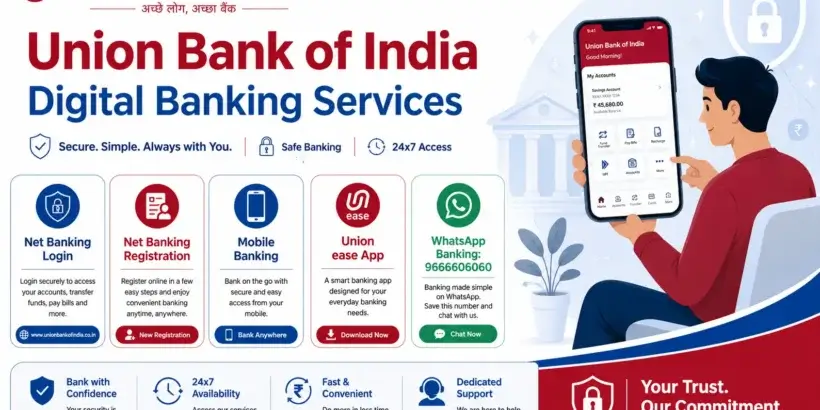
Here are the official Union Bank of India digital banking details:
Union Bank of India app / mobile banking
The official mobile banking app is now Union ease. Union Bank says the app was previously known as VYOM and has been rebranded to Union ease. It is available from the Google Play Store and Apple App Store. The bank lists minimum requirements as Android 11+ or iOS 17+. For registration, you need a smartphone, active mobile data, and either an active debit card or a branch-generated token. (Union Bank of India)
Union Bank of India Net Banking login
Use the bank’s official Internet Banking LOGIN page. The page has fields for User ID, Password, and Captcha, and includes options such as New User? Register Here, Forgot/Create Passwords, and Know your User ID. (Union Bank of India Online Banking)
Union Bank net banking registration
For new internet banking registration, choose “New User? Register Here” from the official login page. Union Bank’s registration page offers two modes: Transaction Facility for retail users with debit card and View Facility for retail users without debit card. The page also says the User ID will be created online and services can be accessed immediately. (Union Bank of India Online Banking)
Forgot / create password or know User ID
The official login page has Forgot/Create Passwords and Know your User ID. The “Know Your User ID” page asks for an operative savings/current account number and mobile number with country code. (Union Bank of India Online Banking)
Union Bank of India WhatsApp number
Union Bank’s official WhatsApp banking / Union Virtual Connect number is 9666606060. Save the number, check for the official WhatsApp blue tick, and send “Hi” to register or start using the service. Full account-related services require the mobile number registered with the bank. (Union Bank of India)
For safety, avoid login links received by SMS, WhatsApp, ads, or unknown websites. Use only the official Union Bank website/app-store listing and never share OTP, PIN, MPIN, TPIN, debit-card PIN, or internet banking password.
Conclusion
Union Bank of India represents the evolution of Indian public sector banking—from traditional branch-based services to a modern, digitally enabled financial institution. Its journey reflects India’s broader economic transformation, including nationalization, liberalization, and digitalization.
With assets exceeding ₹12 lakh crore, thousands of branches, and millions of customers, the bank plays a vital role in shaping India’s financial ecosystem. Its merger-driven scale has strengthened its competitive position, while ongoing digital transformation is redefining how it serves customers.
Although challenges such as NPAs, competition, and operational costs remain, the bank’s strategic focus on efficiency, technology, and inclusion positions it well for future growth.
Union Bank of India is not just a bank—it is a financial backbone supporting India’s development journey across industries, regions, and communities.
FAQs
1. What is Union Bank of India known for?
It is known for large-scale public sector banking, strong rural presence, and government-backed financial services.
2. When was Union Bank established?
It was established in 1919 in Mumbai.
3. Who owns Union Bank of India?
It is majority owned by the Government of India.
4. What is the total asset size of Union Bank?
Approximately ₹12 lakh crore+ (recent estimates).
5. How many branches does Union Bank have?
More than 8,500 branches across India.