
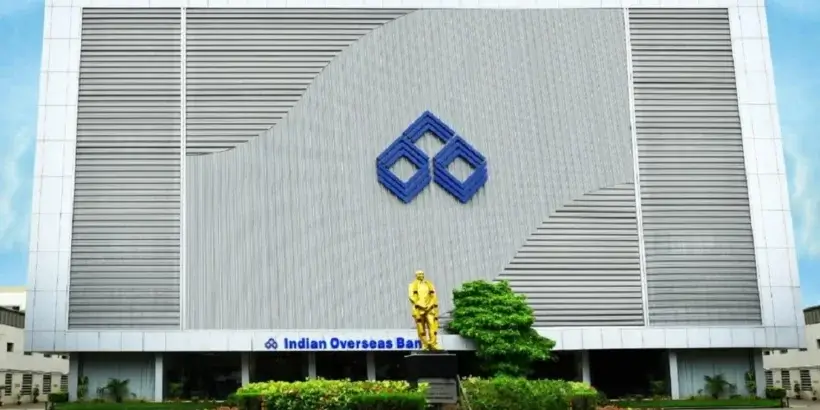
Indian Overseas Bank (IOB): 2025 Guide (History, CEO, Branches, ATMs, Products, Loans, Forex, FY25 Financials, FAQs, MCQs + Short Notes)
Indian Overseas Bank (IOB) is a Government of India–owned public sector bank with a distinctive identity: it was founded with a clear mission to specialize in foreign exchange and overseas banking—a positioning that still influences its services today. From retail deposits and loans to MSME financing and trade/forex solutions, IOB operates as a universal bank with a wide network and multiple delivery channels.
This long-form guide is written in an SEO-friendly + exam-ready format, covering: established year, present CEO/chairperson, head office, branches, ATMs, major products & services, step-by-step loan process, foreign exchange business products, deposit/retail products, FY2025 financial performance, plus FAQs, MCQs, and short notes.
1) About Indian Overseas Bank (IOB)
Indian Overseas Bank is a scheduled commercial bank and a well-known PSB headquartered in Chennai. Many students remember IOB for its unique founding purpose: it was created to serve Indians engaged in overseas trade and remittances and to build expertise in forex from the start.
Why IOB is important (exam + interview points)
-
It was founded specifically to specialize in foreign exchange business and expand overseas operations.
-
It began operations simultaneously at Karaikudi, Chennai, and Rangoon (Burma/Myanmar)—a rare historical fact often asked in banking GK.
-
Even today, it maintains “overseas presence in 4 countries” in bank profiles.
2) Established Year (Foundation) and Founder
✅ Established / Founded
Indian Overseas Bank was founded on 10 February 1937.
Founder
IOB was founded by Shri M. Ct. M. Chidambaram Chettyar.
Founding objective (most quoted line)
IOB’s official “Genesis” page states it was founded with the main objective of specializing in foreign exchange business and taking the bank “across the globe.”
SEO keyword variations you can use:
-
Indian Overseas Bank established year (1937)
-
IOB founder M. Ct. M. Chidambaram Chettyar
-
Indian Overseas Bank forex origin / foreign exchange specialization
3) Head Office / Headquarters of Indian Overseas Bank
✅ Central Office Address
IOB’s official central office address is:
763 Anna Salai, Chennai – 600002 (Tamil Nadu, India)
Exam tip: If asked “IOB Head Office,” write: 763 Anna Salai, Chennai-600002.
4) Present CEO and Chairperson (Latest leadership)
Leadership questions are very common in competitive exams. Use the bank’s official “Board of Directors” page.
✅ MD & CEO (Chief Executive)
Shri Ajay Kumar Srivastava — Managing Director & CEO.
✅ Chairman
Shri Srinivasan Sridhar — Non-Executive Chairman (joined w.e.f. 21.02.2024).
How to write in exams:
-
“CEO” → write MD & CEO: Ajay Kumar Srivastava
-
“Chairman” → write Non-Executive Chairman: Srinivasan Sridhar
5) Total Branches and ATM Network (As on 31 March 2025)
IOB’s network is often described using: branches + ATMs + BC outlets (touch points).
✅ Total branches
As on 31.03.2025, IOB reported 3,335 domestic branches.
✅ Total ATMs
As on 31.03.2025, IOB reported 3,497 ATMs.
✅ Business Correspondent (BC) points / Touch points
As on 31.03.2025, the bank reported:
-
BC points: 10,135
-
Total touch points: 16,967
Why it matters:
In rural and semi-urban banking, BC points greatly expand access without opening full branches—important for financial inclusion and outreach.
6) Indian Overseas Bank Products and Services (Complete Classification)
When writing “products and services” for SEO or exams, always present it in categories:
A) Deposit Products (IOB Deposits)
Deposit products are the backbone of any bank. In exam answers, write:
1) Savings Account (SB)
-
Designed for individuals and families
-
Offers liquidity, interest, ATM/debit access, digital banking access
2) Current Account (CA)
-
Designed for businesses, traders, institutions
-
Focus on transactions, collections, payments, cheque facilities
3) Term Deposits / Fixed Deposits (FD)
-
Lump-sum deposit for a fixed tenure
-
Interest may be paid monthly/quarterly/at maturity depending on scheme
4) Recurring Deposit (RD)
-
Monthly/periodic deposits to build savings systematically
5) NRI Deposits and Overseas-linked deposit services
Because IOB was founded with a forex focus, it is very safe and relevant to mention that IOB’s banking tradition strongly serves NRI/remittance needs—rooted in its founding objective of foreign exchange specialization.
B) Retail Products (Individual Banking)
Retail banking products typically include:
1) Accounts + Cards + Digital Banking
-
Savings accounts, current accounts, deposits
-
Debit cards, ATM services
-
Internet banking and mobile banking
-
UPI/IMPS/NEFT/RTGS for payments (standard scheduled bank services)
2) Retail Loans (common categories)
-
Home loans (purchase/construction/repair)
-
Vehicle loans (two-wheeler/four-wheeler)
-
Education loans
-
Personal loans
-
Loan against property (mortgage/LAP)
-
Gold loans (where offered through branches)
How to write for SEO:
Use headings like: “IOB Home Loan,” “IOB Personal Loan,” “IOB Education Loan,” and add step-by-step process (see Section 8).
C) MSME and Business Banking Services
IOB supports small and medium businesses through:
-
Working capital finance (Cash Credit / Overdraft)
-
Term loans for expansion and machinery
-
Bills discounting/receivables financing
-
Payment collections and cash management (commonly provided by banks at scale)
Why this matters:
MSME is a core pillar of Indian banking and a major segment for PSBs.
D) Government Business and Institutional Banking
As a PSB, IOB also participates widely in:
-
Government schemes (DBT-style benefit transfer flows)
-
Salary and pension accounts
-
Institutional banking and public sector collections
7) Retail Banking + Deposit Products (Detailed and Exam-Friendly)
To make your answer stronger (and more “complete”), present deposit products with features + who should use it.
Savings Account: best for
-
Salaried people
-
Students
-
Families
-
Anyone needing day-to-day banking with interest and digital access
Current Account: best for
-
Shops and traders
-
SMEs/MSMEs
-
Professionals (CA/doctor/law office)
-
Firms and companies with high transaction volumes
Fixed Deposit / Term Deposit: best for
-
Stable returns and capital preservation
-
Senior citizens and conservative investors
-
Short/medium-term savings goals (education, planned purchases)
Recurring Deposit: best for
-
People with regular monthly income
-
Goal-based saving (festival expenses, school fees, small investments)
8) Loan Process at Indian Overseas Bank (Step-by-Step)
This is one of the most scoring sections in exams and interviews. Write the process in numbered steps.
Step 1: Choose the loan product
Decide what you need:
-
Home loan / Vehicle loan / Personal loan / Education loan
-
MSME loan / working capital / agriculture loan
Step 2: Check eligibility
Eligibility generally depends on:
-
Age and income (or business cashflow)
-
Job stability/business vintage
-
Credit score and repayment capacity
-
Existing EMIs and debt burden
-
Collateral/security (for secured loans like home/LAP)
Step 3: Prepare required documents
Common documents include:
KYC documents
-
Aadhaar / PAN / Passport / Voter ID / Driving license
-
Address proof + photographs
Income & financial documents
-
Salary slips/Form-16 (salaried)
-
ITR + financial statements (self-employed/business)
-
Bank statements (6–12 months commonly used)
Security/collateral documents (if secured loan)
-
Property papers, title deeds, tax receipts (home/LAP)
-
Vehicle quotation/invoice (vehicle loan)
-
Admission letter/fee schedule (education loan)
Step 4: Submit the application
-
Submit at branch (or through bank’s official channels when offered)
-
Pay processing fee if applicable
-
Provide consent for credit bureau checks
Step 5: Verification and credit appraisal
The bank verifies:
-
Identity and address
-
Income/business stability
-
Credit history (bureau score)
-
Repayment capacity (FOIR/DSCR type evaluation)
For secured loans:
-
Legal checks (property title verification)
-
Technical checks (valuation, site inspection)
Step 6: Sanction letter issuance
If approved, the bank issues a sanction letter mentioning:
-
Sanctioned amount
-
Interest rate type (fixed/floating)
-
Tenure and EMI
-
Charges and special terms
-
Security/collateral details
Step 7: Documentation and disbursement
-
Execute loan agreement
-
Create mortgage/hypothecation/charge if needed
-
Disbursement:
-
Home loan: often stage-wise
-
Vehicle loan: to dealer as per invoice
-
Education loan: as per fee schedule
-
Business loans: limit setup + compliance docs
-
Step 8: Repayment and monitoring
-
EMI via NACH/standing instruction
-
Regular statements and interest certificate
-
Monitoring for delays and periodic review (especially for MSME/corporate)
Exam one-line flow:
Application → KYC/docs → Verification → Appraisal → Sanction → Documentation → Disbursement → Repayment/monitoring
9) Foreign Exchange (Forex) Business Products of IOB
Because IOB was founded with the objective of specialising in forex, your forex section should look stronger than typical bank write-ups.
A) Retail Forex Services (Individuals)
-
Currency exchange for permitted needs (travel, education, medical, maintenance, etc.)
-
Forex-related documentation as per RBI/FEMA rules
-
Remittance support services
B) NRI / Remittance Services
IOB’s legacy aligns strongly with:
-
Inward remittances (money coming into India)
-
Outward remittances (money sent abroad under permitted categories)
C) Trade Finance and International Banking (Businesses)
Typical forex/trade products offered by banks include:
-
Import remittances
-
Export bill negotiation/collection
-
Letters of Credit (LC)
-
Bank Guarantees (BG)
-
Forex risk management support (treasury-side services for eligible clients)
D) Overseas presence (exam fact)
IOB’s branch locator/profile mentions overseas presence in Singapore, Hong Kong, Thailand and Sri Lanka.
10) Financial Report of 2025 (FY ended 31 March 2025): Key Highlights
For “financial report of 2025,” use official press-release numbers from FY ended 31.03.2025.
A) Profitability (FY25)
From IOB’s FY25 press release (year ended 31.03.2025):
-
Net Interest Income (NII): ₹10,890 crore (FY25) vs ₹9,829 crore (FY24)
-
Cost-to-Income Ratio: improved to 47.14% (FY25)
-
Net Profit: ₹3,335 crore (FY25) with YoY growth mentioned in the press release summary
-
Operating Profit: ₹8,688 crore (FY25)
-
ROA: improved to 0.92% (FY25) and ROE stood at 16.28% in the press release excerpt
B) Business size (as on 31.03.2025)
-
Total Business: ₹5,61,958 crore
-
Total Deposits: ₹3,11,938 crore
-
Gross Advances: ₹2,50,019 crore
-
CASA Ratio: 43.65% (as on 31.03.2025)
C) Asset quality (NPAs) as on 31.03.2025
-
GNPA: 2.14% (improved from 3.10% a year earlier)
-
NNPA: 0.37% (improved from 0.57% a year earlier)
-
Provision Coverage Ratio (PCR): 97.30%
D) Capital adequacy (Basel III) as on 31.03.2025
-
CRAR: 19.74%
-
CET1: 17.13%
-
Tier-II: 2.61%
✅ Copy-ready FY25 summary (best for exams):
“In FY25 (year ended 31.03.2025), Indian Overseas Bank reported net profit ₹3,335 crore, improved asset quality (GNPA 2.14%, NNPA 0.37%), and strong Basel III capital (CRAR 19.74%, CET1 17.13%).”
11) FAQs about Indian Overseas Bank (SEO + Interview)
Q1. What is the established year of Indian Overseas Bank?
IOB was founded on 10 February 1937.
Q2. Who is the CEO of Indian Overseas Bank?
The MD & CEO is Shri Ajay Kumar Srivastava.
Q3. Who is the Chairman of Indian Overseas Bank?
The Non-Executive Chairman is Shri Srinivasan Sridhar (from 21.02.2024).
Q4. Where is the Head Office of IOB?
IOB’s central office is at 763 Anna Salai, Chennai–600002.
Q5. How many branches does IOB have (as on 31 March 2025)?
3,335 domestic branches.
Q6. How many ATMs does IOB have (as on 31 March 2025)?
3,497 ATMs.
Q7. Why is IOB famous historically?
It was founded specifically to specialise in foreign exchange and overseas banking, and began operations at multiple locations including Rangoon.
Q8. What was IOB’s net profit for FY ended 31.03.2025?
₹3,335 crore (FY25).
Q9. What were GNPA and NNPA as on 31.03.2025?
GNPA 2.14% and NNPA 0.37%.
Q10. What is IOB’s head office telephone (if needed in assignments)?
The official central office contact page lists a phone number along with the address.
12) Short Notes (Exam-Ready)
Short Note 1: IOB origin and forex identity
Indian Overseas Bank was founded on 10 February 1937 by M. Ct. M. Chidambaram Chettyar with the main objective of specialising in foreign exchange business and expanding globally.
Short Note 2: Head Office
IOB central office is located at 763 Anna Salai, Chennai–600002, a frequently asked banking GK question.
Short Note 3: Leadership
IOB is headed by MD & CEO Ajay Kumar Srivastava, while Srinivasan Sridhar serves as Non-Executive Chairman.
Short Note 4: FY25 financial performance
For FY ended 31.03.2025, IOB posted net profit ₹3,335 crore, improved NPAs (GNPA 2.14%, NNPA 0.37%), and maintained strong capital adequacy (CRAR 19.74%, CET1 17.13%).
Short Note 5: Network size (March 2025)
As on 31.03.2025, IOB had 3,335 branches, 3,497 ATMs, and 16,967 touch points including 10,135 BC outlets.
13) MCQs on Indian Overseas Bank (with Answers)
History & HQ
1. Indian Overseas Bank was founded on:
A) 10 Feb 1937 B) 10 Feb 1947 C) 1 Apr 1935 D) 15 Aug 1947
✅ Answer: A
2. Founder of IOB was:
A) JRD Tata B) M. Ct. M. Chidambaram Chettyar C) Lala Lajpat Rai D) C. Rajagopalachari
✅ Answer: B
3. IOB Central Office is located at:
A) Delhi B) Mumbai C) Chennai (Anna Salai) D) Kolkata
✅ Answer: C
4. IOB was founded with the objective of specialising in:
A) Insurance B) Mutual Funds C) Foreign exchange business D) Stock broking
✅ Answer: C
Leadership
5. Present MD & CEO of IOB is:
A) Srinivasan Sridhar B) Ajay Kumar Srivastava C) Urjit Patel D) Shaktikanta Das
✅ Answer: B
6. Non-Executive Chairman of IOB is:
A) Ajay Kumar Srivastava B) Srinivasan Sridhar C) Nirmala Sitharaman D) Raghuram Rajan
✅ Answer: B
Network (March 2025)
7. Domestic branches as on 31.03.2025 were:
A) 875 B) 1,610 C) 3,335 D) 2,606
✅ Answer: C
8. ATMs as on 31.03.2025 were:
A) 1,736 B) 3,497 C) 2,402 D) 1,050
✅ Answer: B
9. Total touch points as on 31.03.2025 were:
A) 10,135 B) 16,967 C) 3,335 D) 5,61,958
✅ Answer: B
FY25 Financials
10. Net profit for FY ended 31.03.2025 was:
A) ₹333.5 crore B) ₹3,335 crore C) ₹33,350 crore D) ₹2,656 crore
✅ Answer: B
11. GNPA as on 31.03.2025 was:
A) 0.37% B) 2.14% C) 19.74% D) 43.65%
✅ Answer: B
12. NNPA as on 31.03.2025 was:
A) 0.37% B) 2.14% C) 97.30% D) 47.14%
✅ Answer: A
13. CRAR as on 31.03.2025 was:
A) 17.13% B) 19.74% C) 2.61% D) 0.92%
✅ Answer: B
14. CET1 as on 31.03.2025 was:
A) 19.74% B) 17.13% C) 2.14% D) 0.37%
✅ Answer: B
15. Net Interest Income (NII) for FY ended 31.03.2025 was:
A) ₹1,089 crore B) ₹10,890 crore C) ₹9,829 crore D) ₹8,688 crore
✅ Answer: B
14) One-page “Ultra-Quick Revision” (Copy-Paste Notes)
-
Founded: 10 Feb 1937
-
Founder: M. Ct. M. Chidambaram Chettyar
-
Objective: specialise in foreign exchange business
-
Head Office: 763 Anna Salai, Chennai–600002
-
MD & CEO: Ajay Kumar Srivastava
-
Chairman: Srinivasan Sridhar (Non-Executive)
-
Branches (31.03.2025): 3,335
-
ATMs (31.03.2025): 3,497
-
FY25 Net Profit: ₹3,335 crore
-
GNPA/NNPA (31.03.2025): 2.14% / 0.37%
-
CRAR/CET1 (31.03.2025): 19.74% / 17.13%