
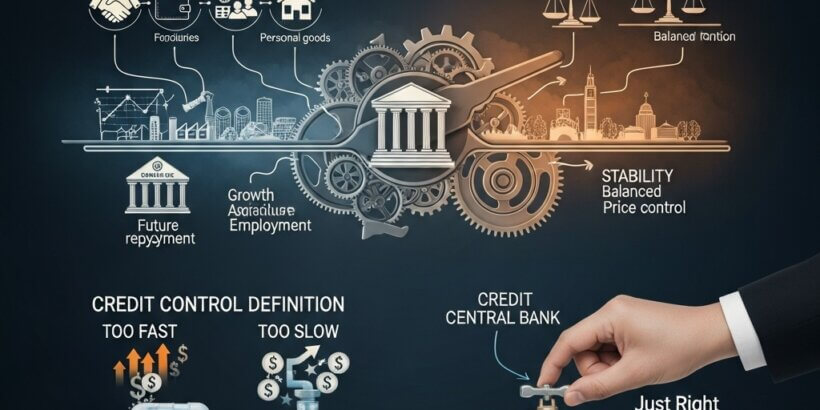
Credit Control and the Role of the Central Bank covering definitions, objectives, and methods:
1) Credit Control and the Central Bank: Meaning and Definitions
What is “credit”?
Credit generally means the ability of a person, business, or government to obtain goods, services, or money now, with a promise to repay in the future. In modern economies, credit is created and supplied mainly through the banking system (commercial banks and other financial institutions).
What is “credit control”?
Credit control refers to the set of policies and actions used to regulate the availability, cost, and direction of credit in an economy. It aims to ensure that credit expands or contracts in line with the economy’s needs—neither too fast (causing inflation and bubbles) nor too slow (causing recession and unemployment).
In simple words:
-
If credit is growing too much → central bank tries to tighten credit.
-
If credit is insufficient → central bank tries to ease credit.
Role of the central bank in credit control
A central bank (e.g., Bangladesh Bank, Reserve Bank of India, Federal Reserve, Bank of England) is the apex monetary authority of a country. One of its most important functions is to manage money and credit to promote economic stability.
In credit control, the central bank acts like:
-
a regulator of commercial banks,
-
a stabilizer of the economy,
-
a guardian of monetary stability,
-
and a lender of last resort (supporting the banking system in stress).
Definitions by economists (common textbook sense)
While wording varies, standard definitions include:
-
Credit control is the regulation of credit volume and terms (interest rate, eligibility, maturity) to influence economic activity.
-
Credit control is the central bank’s policy to influence lending and borrowing conditions to achieve macroeconomic goals like price stability.
2) Objectives of Credit Control
Central bank credit control is not an end in itself. It is used to achieve broader economic objectives. The major objectives are:
(A) Price stability (control of inflation)
One primary goal is to maintain stable prices.
-
Excess credit → people and firms spend more → demand rises faster than supply → inflation.
-
Central bank tightens credit (higher interest rates, stricter lending) to reduce spending.
Why it matters: Inflation reduces purchasing power, increases uncertainty, discourages long-term investment, and hurts fixed-income groups.
(B) Economic growth and development
Credit should expand enough to support productive investment (industry, agriculture, infrastructure, services).
-
When credit is too tight, businesses can’t invest, production slows, and employment falls.
-
When credit is too loose, it may fuel speculation and inflation rather than production.
So the central bank tries to keep credit growth consistent with real economic growth.
(C) Full employment and reduction of unemployment
During recession or slowdown:
-
demand falls → production falls → unemployment rises.
The central bank may adopt easy credit policies (lower rates, more liquidity) to encourage: -
investment,
-
production,
-
job creation.
(D) Stability of the banking and financial system
Uncontrolled credit booms can cause:
-
risky lending,
-
asset bubbles (real estate, stock markets),
-
later crashes and bank failures.
Credit control helps maintain financial stability by discouraging excessive risk-taking and ensuring banks maintain adequate liquidity and capital.
(E) Stability in exchange rate and balance of payments
Credit policy affects:
-
imports and exports,
-
capital flows,
-
exchange rate.
For example:
-
Easy credit → higher domestic demand → more imports → pressure on foreign reserves → currency depreciation risk.
-
Tight credit → may reduce imports and inflation → supports external stability.
(F) Control over speculative and unproductive activities
Credit can be used for:
-
productive purposes (factories, farming, technology),
-
or unproductive/speculative purposes (hoarding, gambling on assets, excessive luxury consumption).
Central banks often aim to direct credit away from harmful speculation and toward productive uses.
(G) Sectoral priorities (development objective)
Especially in developing economies, central banks aim to ensure credit flows to priority sectors such as:
-
agriculture,
-
SMEs,
-
exports,
-
green financing,
-
essential industries.
This is often done through selective methods like refinancing, directives, or differential risk weights.
3) Methods of Credit Control (Instruments)
Central bank tools are commonly grouped into:
-
Quantitative / General methods
These control the overall volume and cost of credit in the entire economy. -
Qualitative / Selective methods
These control the purpose and direction of credit—who gets it and for what. -
Moral suasion and other supervisory methods
These rely on persuasion, regulation, and banking supervision.
Let’s explain them in detail.
A) Quantitative (General) Methods of Credit Control
1. Bank Rate Policy (Discount Rate Policy)
Meaning
The bank rate is the interest rate at which the central bank lends to commercial banks or rediscounts eligible bills.
How it controls credit
-
If the central bank raises the bank rate: borrowing becomes costlier for banks → banks raise their lending rates → loans become more expensive → demand for credit falls → money supply growth slows → inflation pressure reduces.
-
If the central bank lowers the bank rate: borrowing becomes cheaper → banks reduce lending rates → credit demand increases → investment and spending rise.
Merits
-
Simple and widely understood signal to markets.
-
Influences overall interest rate structure.
Limitations
-
Weak if banks have ample deposits and don’t need central bank borrowing.
-
Less effective in informal credit markets.
2. Open Market Operations (OMO)
Meaning
OMO refers to the central bank’s purchase and sale of government securities in the open market.
Working mechanism
-
Selling securities: central bank takes money from banks/public → reduces bank reserves → reduces lending capacity → tightens credit.
-
Buying securities: central bank pays money into the system → increases bank reserves → expands lending capacity → easy credit.
Merits
-
Highly flexible and quickly adjustable.
-
Directly affects bank reserves and liquidity.
Limitations
-
Requires a developed and active securities market.
-
Impact may be limited if banks hold excess reserves or demand for credit is low.
3. Cash Reserve Ratio (CRR)
Meaning
CRR is the percentage of a bank’s total deposits that must be kept as cash reserve with the central bank.
How it controls credit
-
Increase CRR: banks must keep more money locked at central bank → fewer funds available to lend → credit contracts.
-
Decrease CRR: banks keep less reserve → more funds for lending → credit expands.
Merits
-
Direct and powerful impact on lending capacity.
-
Useful for controlling excessive credit in short term.
Limitations
-
Too frequent changes can create instability for banks.
-
If raised too high, it may hurt bank profitability and restrict growth.
4. Statutory Liquidity Ratio (SLR) / Liquidity Requirements
Meaning
SLR is the percentage of deposits banks must maintain in liquid assets like:
-
government securities,
-
treasury bills,
-
cash, etc.
(Names differ by country; the idea is “liquidity requirement.”)
Control effect
-
Increase SLR: banks invest more in approved liquid assets → fewer funds for private lending → credit contraction.
-
Decrease SLR: banks have more lendable resources → credit expansion.
Merits
-
Helps ensure liquidity and banking stability.
-
Encourages government securities market.
Limitations
-
High SLR may “crowd out” private sector credit.
-
May reduce profitability if securities yields are low.
5. Repo Rate and Reverse Repo Rate (Policy Corridor)
Meaning
-
Repo rate: rate at which central bank lends short-term funds to banks against securities.
-
Reverse repo rate: rate at which central bank borrows money from banks (banks park money with central bank).
How it works
-
Raise repo rate → borrowing cost for banks increases → banks raise lending rates → credit demand falls.
-
Raise reverse repo rate → banks prefer depositing funds with central bank to earn more → liquidity in market decreases → credit tightens.
Merits
-
Key modern monetary policy tool.
-
Strong signalling mechanism.
Limitations
-
Less effective when rate changes do not transmit well to bank lending rates.
-
During crisis, even low repo may not increase lending (risk aversion).
6. Quantitative Easing (QE) / Large-scale Asset Purchases (modern tool)
Meaning
When conventional tools are insufficient (e.g., rates near zero), central bank buys large amounts of securities to inject liquidity and lower long-term interest rates.
Effect
-
boosts reserves,
-
lowers borrowing costs,
-
encourages lending and investment.
Limitations
-
Risk of asset bubbles.
-
Harder to unwind without market disruptions.
(This is more common in advanced economies.)
B) Qualitative (Selective) Methods of Credit Control
Quantitative methods affect total credit. But sometimes the central bank wants to restrict credit for certain uses and encourage it for others. That is where selective tools come in.
1. Margin Requirements
Meaning
When people borrow against securities (shares, bonds) or commodities, banks require a “margin”—the difference between the value of collateral and the loan.
Example: If margin requirement is 40%, and collateral is worth 100, the maximum loan is 60.
Control effect
-
Increase margin requirement → borrowers can get less loan on same collateral → reduces speculative borrowing.
-
Decrease margin requirement → easier borrowing → encourages activity.
Use
Often used to curb stock market or commodity speculation.
2. Credit Rationing
Meaning
Central bank imposes limits on the amount of credit banks can extend.
Forms:
-
ceiling on total bank advances,
-
sector-wise credit ceilings,
-
limits on certain categories (e.g., consumer loans).
Effect
Directly restricts lending growth where needed.
Limitations
-
Can distort markets if maintained too long.
-
May encourage borrowers to shift to informal lending.
3. Regulation of Consumer Credit
Meaning
Rules on installment credit, personal loans, credit cards—terms like:
-
minimum down payment,
-
maximum repayment period,
-
eligibility criteria.
Effect
Useful to control credit-fueled consumer booms that may cause inflation and higher imports.
4. Directives and Lending Guidelines
Meaning
Central bank issues instructions to banks about:
-
priority sectors,
-
restricted sectors,
-
maximum loan sizes,
-
exposure limits,
-
risk management standards.
Example: Encourage SME and agriculture, restrict speculative real estate lending.
Effect
Channels credit toward national development goals.
5. Moral Suasion (Persuasion)
Meaning
Central bank “requests” or “advises” banks to follow desired policies—for example:
-
reduce lending to speculative sectors,
-
be cautious in risky lending,
-
support priority industries.
Strength
Works well when the central bank has credibility and banks cooperate.
Weakness
Not legally binding; less effective if banks resist.
6. Publicity / Central Bank Communication
Meaning
Central banks influence expectations by:
-
policy statements,
-
reports,
-
press conferences,
-
inflation forecasts.
How it helps credit control
If people believe rates will rise or inflation will fall, they adjust:
-
borrowing,
-
spending,
-
wage demands,
-
pricing behavior.
This “expectations channel” is crucial in modern monetary policy.
C) Other Regulatory and Supervisory Methods
1. Prudential Regulation and Supervision
Central banks (or bank regulators) control credit quality through:
-
capital adequacy requirements,
-
loan classification and provisioning rules,
-
stress testing,
-
corporate governance rules,
-
limits on large exposures.
This reduces risky lending and helps prevent banking crises.
2. Lender of Last Resort and Liquidity Support
In financial stress, central bank can provide emergency liquidity to prevent bank runs. This supports stability—but must be managed carefully to avoid encouraging reckless behavior (moral hazard).
4) How Credit Control Works in Practice (A Simple Chain)
Central bank tool → affects bank reserves / interest rates → affects bank lending → affects investment and consumption → affects output, employment, inflation, and external balance.
For example:
-
Tight policy (raise rates, raise CRR, sell securities)
→ less borrowing
→ lower spending and investment
→ lower inflation (but growth may slow) -
Easy policy (lower rates, reduce CRR, buy securities)
→ more borrowing
→ higher spending and investment
→ higher growth and employment (but inflation risk if overdone)
Thus, the central bank balances growth vs inflation and credit expansion vs stability.
5) Conclusion
Credit control is one of the most vital functions of a central bank. It means regulating the volume, cost, and direction of credit to achieve macroeconomic goals. The objectives include price stability, economic growth, employment, financial stability, and external balance. Central banks use quantitative methods like bank rate, OMO, CRR, SLR, repo/reverse repo; qualitative methods like margin requirements, credit rationing, consumer credit control, directives; and supportive approaches like moral suasion and prudential regulation.
MCQs: Credit Control & Role of Central Bank
1. Credit control refers to:
A. Control of government expenditure
B. Regulation of money supply only
C. Regulation of the volume and cost of credit
D. Control of foreign trade
Correct Answer: C
Explanation: Credit control means regulating the availability, volume, and cost of credit in an economy.
2. The main authority responsible for credit control in a country is:
A. Commercial banks
B. Ministry of Finance
C. Central bank
D. Stock exchange
Correct Answer: C
Explanation: The central bank is the apex monetary authority and designs credit control policies.
3. Which of the following is the primary objective of credit control?
A. Maximizing bank profits
B. Ensuring price stability
C. Increasing tax revenue
D. Promoting foreign trade only
Correct Answer: B
Explanation: The core objective of credit control is to maintain price stability by controlling inflation and deflation.
4. Excessive expansion of credit generally leads to:
A. Deflation
B. Unemployment
C. Inflation
D. Balance of payments surplus
Correct Answer: C
Explanation: Excess credit increases demand beyond supply, leading to inflation.
5. Credit control methods are broadly classified into:
A. Legal and illegal methods
B. Fiscal and monetary methods
C. Quantitative and qualitative methods
D. Domestic and foreign methods
Correct Answer: C
Explanation: Central banks use quantitative (general) and qualitative (selective) methods.
6. Which of the following is a quantitative method of credit control?
A. Moral suasion
B. Credit rationing
C. Open market operations
D. Margin requirements
Correct Answer: C
Explanation: Open market operations affect the overall volume of credit.
7. Open market operations involve:
A. Trading foreign currency
B. Buying and selling government securities
C. Controlling imports
D. Fixing exchange rates
Correct Answer: B
Explanation: Central banks buy or sell government securities to control liquidity.
8. When the central bank sells government securities, it:
A. Increases bank reserves
B. Decreases money supply
C. Lowers interest rates
D. Encourages borrowing
Correct Answer: B
Explanation: Selling securities withdraws money from the banking system.
9. Bank rate is:
A. Rate charged by banks to customers
B. Rate at which central bank lends to government
C. Rate at which central bank lends to commercial banks
D. Rate fixed by stock exchanges
Correct Answer: C
Explanation: Bank rate is the lending rate of the central bank to commercial banks.
10. An increase in bank rate generally results in:
A. Expansion of credit
B. Cheap borrowing
C. Contraction of credit
D. Increase in inflation
Correct Answer: C
Explanation: Higher bank rate increases borrowing cost and reduces credit demand.
11. Cash Reserve Ratio (CRR) means:
A. Cash kept by banks with customers
B. Cash kept by banks with the central bank
C. Cash kept by central bank with government
D. Cash held by households
Correct Answer: B
Explanation: CRR is the percentage of deposits banks must keep with the central bank.
12. Increase in CRR leads to:
A. Increase in bank lending
B. Increase in liquidity
C. Decrease in bank lending
D. Increase in inflation
Correct Answer: C
Explanation: Higher CRR reduces funds available for lending.
13. Statutory Liquidity Ratio (SLR) requires banks to maintain:
A. Only cash
B. Foreign currency
C. Liquid assets like government securities
D. Gold reserves only
Correct Answer: C
Explanation: SLR ensures banks maintain liquid assets for safety and stability.
14. Repo rate is the rate at which:
A. Banks lend to customers
B. Banks borrow from the central bank
C. Central bank borrows from government
D. Customers lend to banks
Correct Answer: B
Explanation: Repo rate is the short-term borrowing rate for banks from the central bank.
15. Increase in repo rate generally:
A. Encourages borrowing
B. Expands credit
C. Discourages borrowing
D. Increases inflation
Correct Answer: C
Explanation: Higher repo rate increases borrowing costs for banks.
16. Which of the following is a qualitative method of credit control?
A. Bank rate
B. Open market operations
C. Margin requirements
D. CRR
Correct Answer: C
Explanation: Margin requirements selectively control credit for speculative purposes.
17. Margin requirement refers to:
A. Difference between selling and buying price
B. Difference between loan amount and collateral value
C. Bank’s profit margin
D. Government tax margin
Correct Answer: B
Explanation: Margin determines how much loan can be taken against collateral.
18. Credit rationing means:
A. Providing unlimited loans
B. Increasing credit supply
C. Fixing a maximum limit on loans
D. Reducing interest rates
Correct Answer: C
Explanation: Credit rationing restricts the amount of credit available.
19. Moral suasion is:
A. A legal method
B. A compulsory regulation
C. Persuasion and advice by central bank
D. Punishment to banks
Correct Answer: C
Explanation: Moral suasion relies on persuasion rather than legal force.
20. Which objective of credit control aims at preventing bank failures?
A. Economic growth
B. Price stability
C. Financial stability
D. Full employment
Correct Answer: C
Explanation: Credit control helps maintain banking and financial system stability.
21. Consumer credit control mainly affects:
A. Industrial loans
B. Agricultural loans
C. Personal and installment credit
D. Government borrowing
Correct Answer: C
Explanation: It regulates consumer loans like credit cards and hire purchase.
22. Selective credit controls are mainly used to:
A. Increase money supply
B. Control inflation only
C. Direct credit to specific sectors
D. Fix exchange rates
Correct Answer: C
Explanation: Selective controls influence the direction and purpose of credit.
23. Easy credit policy is adopted during:
A. Inflation
B. Boom
C. Recession
D. Hyperinflation
Correct Answer: C
Explanation: During recession, easy credit stimulates investment and demand.
24. Tight credit policy is suitable during:
A. Deflation
B. Economic depression
C. Inflation
D. Unemployment crisis
Correct Answer: C
Explanation: Tight credit reduces excess demand and inflation.
25. The lender of last resort function of a central bank means:
A. Lending to government only
B. Lending to public directly
C. Providing emergency loans to banks
D. Lending to foreign banks
Correct Answer: C
Explanation: Central bank supports banks during liquidity crises to prevent collapse.