
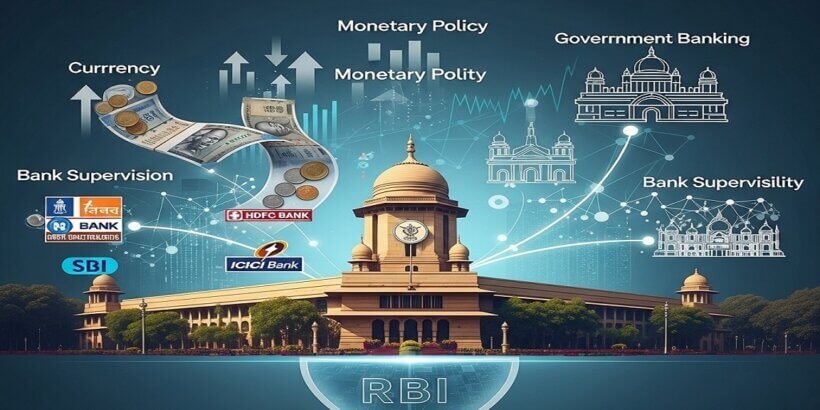
Central Banking in India
Meaning of central Bank:
A central bank is a country’s main monetary authority—the bank that sits at the center of the entire banking system.
In simple terms, a central bank:
-
Issues the country’s currency (notes and coins)
-
Controls money supply and interest rates to keep inflation in check
-
Acts as the banker to the government
-
Supervises and regulates commercial banks
-
Maintains financial stability, especially during crises
Unlike normal banks, a central bank does not deal directly with the public (no savings accounts or personal loans).
Examples
-
Reserve Bank of India (RBI) – India
-
Federal Reserve (Fed) – USA
-
European Central Bank (ECB) – Eurozone
-
Bank of England – UK
👉 One-line definition you can remember:
A central bank is the top authority that manages a country’s money and banking system.
Meaning of Central Bank in India
In India, the central bank is the Reserve Bank of India (RBI).
👉 It is the apex monetary authority that controls the currency, credit, and banking system of the country.
Simple definition (India-specific)
The central bank in India is the Reserve Bank of India, which regulates money supply, issues currency, and supervises banks.
One-line exam answer
The Reserve Bank of India is the central bank of India responsible for controlling the monetary and banking system.
In very easy words
RBI is the main bank of the country that looks after all other banks and keeps India’s economy stable.
What is a Central Bank?
A central bank is the main bank of a country that controls money and the banking system.
Think of it as the boss of all banks.
Why does a country need a central bank?
To make sure:
-
There is not too much or too little money in the country
-
Prices don’t rise too fast (control inflation)
-
Banks work safely and don’t fail easily
Main functions (easy explanation)
-
Prints money
Only the central bank has the power to issue currency. -
Controls interest rates
It increases or decreases interest rates to control spending and saving. -
Bank of banks
Commercial banks keep their money with the central bank and borrow from it when needed. -
Banker to the government
The government keeps its account with the central bank. -
Controls inflation
If prices rise too fast, the central bank reduces money supply. -
Protects the financial system
It makes rules for banks and checks whether they follow them.
Main functions:
-
Issue of currency
-
Controller of credit (bank rate, repo rate, open market operations)
-
Banker’s bank
-
Banker, agent, and advisor to the government
-
Custodian of foreign exchange reserves
-
Controller of inflation
-
Custodian of cash reserves of commercial banks
-
Regulator and supervisor of banks
Examples:
-
RBI – India
-
Federal Reserve – USA
-
Bank of England – UK
Super-easy memory trick 🧠
M I B G I
-
M – Money issue
-
I – Inflation control
-
B – Bank of banks
-
G – Government’s bank
-
I – Interest rate control
Growth of Central Banking in India
Central banking in India developed gradually to regulate money, credit, and the banking system. The process finally led to the establishment of the Reserve Bank of India (RBI).
The growth of central banking in India was a gradual process. Initially, the Presidency Banks—Bank of Calcutta, Bombay, and Madras—performed limited central banking functions. In 1921, these banks were merged to form the Imperial Bank of India, which acted as a quasi central bank but lacked full powers.
In 1926, the Hilton Young Commission recommended the establishment of a separate central bank for India. Based on this recommendation, the Reserve Bank of India was established in 1935 under the RBI Act, 1934. Initially, RBI was privately owned. After Independence, RBI was nationalized in 1949, which strengthened its role as the central monetary authority of India.
1️⃣ Early stage (Before RBI)
Presidency Banks (1806–1921)
-
Bank of Calcutta (1806)
-
Bank of Bombay (1840)
-
Bank of Madras (1843)
👉 These banks issued currency and performed limited central banking functions, but there was no single central bank.
2️⃣ Imperial Bank of India (1921)
-
Formed by merging the three Presidency Banks
-
Acted as a quasi central bank
-
Performed some central bank functions like:
-
Banker to government
-
Banker’s bank
-
❌ But it lacked full authority, especially in controlling credit and currency.
3️⃣ Hilton Young Commission (1926)
-
Also known as the Royal Commission on Indian Currency and Finance
-
Recommended the creation of a separate central bank for India
📌 This was a major step toward modern central banking in India.
4️⃣ Establishment of Reserve Bank of India (1935)
-
RBI was established under the RBI Act, 1934
-
Started functioning on 1 April 1935
-
Initially privately owned
Headquarters:
-
First: Kolkata
-
Later shifted to Mumbai
5️⃣ Nationalisation of RBI (1949)
-
RBI was nationalised on 1 January 1949
-
Came fully under government control
-
Strengthened its role in:
-
Monetary policy
-
Banking regulation
-
Economic development
-
6️⃣ RBI after Independence
RBI became a full-fledged central bank with powers to:
-
Issue currency
-
Control inflation
-
Regulate banks
-
Manage foreign exchange
-
Support economic growth
Diagram-style summary 🧠
MCQs
1. The RBI was established in:
a) 1921
b) 1926
c) 1935 ✅
d) 1949
2. Which bank acted as a quasi central bank before RBI?
a) State Bank of India
b) Imperial Bank of India ✅
c) Bank of Calcutta
d) RBI
3. The Hilton Young Commission was appointed in:
a) 1921
b) 1926 ✅
c) 1934
d) 1947
4. RBI was nationalized in:
a) 1935
b) 1947
c) 1949 ✅
d) 1951
5. RBI Act was passed in:
a) 1926
b) 1934 ✅
c) 1935
d) 1949
6) Central banking refers to:
a) Banking by private banks
b) Banking by cooperative banks
c) Control of banking system by central bank ✅
d) Banking by government
7) The apex bank of India is:
a) SBI
b) NABARD
c) RBI ✅
d) SEBI
8) Which of the following issues currency in India?
a) Government of India
b) SBI
c) RBI ✅
d) Commercial banks
9) central bank is known as:
a) Bank of customers
b) Bank of traders
c) Bank of banks ✅
d) Bank of industries
10) Which function controls inflation?
a) Accepting deposits
b) Giving loans
c) Credit control ✅
d) Agency function
11) RBI was established in:
a) 1921
b) 1926
c) 1935 ✅
d) 1949
12) RBI was nationalised in:
a) 1935
b) 1947
c) 1949 ✅
d) 1951
Case based MCQ:
1. Which bank is known as the apex bank of a country?
a) Commercial bank
b) Cooperative bank
c) Central bank ✅
d) Development bank
2. The central bank of India is:
a) SBI
b) ICICI Bank
c) Reserve Bank of India ✅
d) NABARD
3. Which bank issues currency notes in India?
a) Commercial banks
b) Government of India
c) RBI ✅
d) SBI
4. Which bank deals directly with the general public?
a) Central bank
b) Commercial bank ✅
c) RBI
d) NABARD
5. Main objective of a commercial bank is to:
a) Control inflation
b) Economic stability
c) Earn profit ✅
d) Issue currency
6. Central bank acts as:
a) Bank of customers
b) Bank of banks ✅
c) Bank of traders
d) Bank of industries
7. Which bank accepts deposits from the public?
a) Central bank
b) RBI
c) Commercial bank ✅
d) None of these
8. Credit creation is done by:
a) Central bank
b) RBI
c) Commercial banks ✅
d) Government
9. How many central banks are there in one country?
a) Many
b) Two
c) One ✅
d) Depends on population
10. Which bank controls credit in the economy?
a) Commercial banks
b) SBI
c) Central bank ✅
d) NBFCs
1️⃣ Case-Based MCQs (Application Type)
Case 1:
Due to rising inflation, the RBI increases the repo rate. As a result, loans become costly and borrowing reduces.
1. Which function of the central bank is shown here?
a) Issue of currency
b) Banker to government
c) Credit control
d) Custodian of cash reserves
2. The immediate impact of increasing repo rate is:
a) Increase in money supply
b) Increase in borrowing
c) Decrease in borrowing
d) Increase in bank profits
Case 2:
A commercial bank faces a sudden shortage of cash and approaches RBI for help.
3. RBI is acting as:
a) Banker to customers
b) Banker’s bank
c) Banker to traders
d) Development bank
4. Which facility allows banks to borrow from RBI?
a) CRR
) SLR
c) Repo rate
d) Bank draft
2️⃣ Higher-Level Banking Exam MCQs (SSC / Banking / UPSC)
5. Which of the following is NOT a function of a central bank?
a) Issue of currency
b) Credit control
c) Accepting public deposits
d) Banker to government
6. Credit creation in the economy is primarily done by:
a) Central bank
b) RBI
c) Commercial banks
d) Government
7. Open Market Operations refer to:
a) Issue of new currency
b) Control of foreign exchange
c) Buying and selling of government securities
d) Fixing bank rate
8. The ultimate goal of central banking policy is:
a) Profit maximisation
b) Expansion of banks
c) Economic and price stability
d) Increasing deposits
9. Which institution regulates commercial banks in India?
a) SEBI
b) NABARD
c) RBI
d) SBI
10. ‘Lender of Last Resort’ function means:
a) Lending to customers
b) Lending to governmentc) Lending to banks during crisis
d) Lending to industries3️⃣ Answers-Only Sheet (For Practice)
-
c
-
c
-
b
-
c
-
c
-
c
-
c
-
c
-
c
-
c
1. Which bank is known as the apex bank of a country?
a) Commercial bank
b) Cooperative bank
c) Central bank ✅
d) Development bank
2. The central bank of India is:
a) SBI
b) ICICI Bank
c) Reserve Bank of India ✅
d) NABARD
3. Which bank issues currency notes in India?
a) Commercial banks
b) Government of India
c) RBI ✅
d) SBI
4. Which bank deals directly with the general public?
a) Central bank
b) Commercial bank ✅
c) RBI
d) NABARD
5. Main objective of a commercial bank is to:
a) Control inflation
b) Economic stability
c) Earn profit ✅
d) Issue currency
6. Central bank acts as:
a) Bank of customers
b) Bank of banks ✅
c) Bank of traders
d) Bank of industries
7. Which bank accepts deposits from the public?
a) Central bank
b) RBI
c) Commercial bank ✅
d) None of these
8. Credit creation is done by:
a) Central bank
b) RBI
c) Commercial banks ✅
d) Government
9. How many central banks are there in one country?
a) Many
b) Two
c) One ✅
d) Depends on population
10. Which bank controls credit in the economy?
a) Commercial banks
b) SBI
c) Central bank ✅
d) NBFCs
Very Short Notes (Revision Points)
-
Central banking = control of money and banks
-
Central bank = apex bank of a country
-
Issues currency
-
Controls credit and interest rates
-
Banker to government
-
Banker’s bank
-
Controls inflation
-
Regulates commercial banks
-
In India: Reserve Bank of India (RBI)
Difference between Central Bank and Commercial Bank
| Basis | Central Bank | Commercial Bank |
|---|---|---|
| Meaning | Apex bank that controls the banking system | Bank that deals directly with the public |
| Main objective | Economic stability and control | Profit earning |
| Example (India) | Reserve Bank of India (RBI) | SBI, HDFC, ICICI |
| Issue of currency | Yes | No |
| Accepts deposits | No | Yes |
| Gives loans | To banks & government | To individuals & businesses |
| Customers | Government and banks | General public |
| Credit control | Controls credit | Creates credit |
| Profit motive | No | Yes |
| Number | One in a country | Many in a country |
Functions of Central Bank
1️⃣ Issue of Currency
The central bank has the sole authority to issue paper currency in the country.
2️⃣ Banker to the Government
It keeps government accounts, receives and makes payments, and manages public debt.
3️⃣ Banker’s Bank
Commercial banks keep their reserves with the central bank and borrow from it during need.
4️⃣ Controller of Credit
It controls credit in the economy using tools like:
Bank rate
Repo rate
Open Market Operations
CRR & SLR
5️⃣ Custodian of Cash Reserves
Commercial banks must keep a part of their cash reserves with the central bank.
6️⃣ Custodian of Foreign Exchange
It manages foreign exchange reserves and maintains exchange rate stability.
7️⃣ Regulator and Supervisor of Banks
The central bank makes rules for banks and ensures they follow them.
8️⃣ Lender of Last Resort
It provides emergency loans to banks during financial crises.
Central Bank as Banker, Agent and Adviser to the Government
1️⃣ Banker to the Government
The central bank acts as the bank of the government.
Functions:
-
Maintains government accounts
-
Receives and makes government payments
-
Provides short-term loans to the government
👉 In India, RBI keeps the accounts of the Central and State Governments.
2️⃣ Agent to the Government
The central bank acts as an agent while dealing with the public and financial markets.
Functions:
-
Manages public debt
-
Issues government bonds and treasury bills
-
Collects taxes and makes payments on behalf of the government
3️⃣ Adviser to the Government
The central bank advises the government on economic and financial matters.
Functions:
-
Advises on monetary policy
-
Suggests measures to control inflation
-
Guides banking and credit policies
Simple memory trick 🧠
B-A-A
-
B → Banker (accounts)
-
A → Agent (debt)
-
A → Adviser (policy)
“Central Bank as Banker, Agent and Adviser to the Government” 👍MCQs
1. The central bank acts as banker to the government by:
a) Accepting deposits from the public
b) Giving loans to industries
c) Maintaining government accounts
d) Issuing shares
2. Which function involves receiving and making payments on behalf of the government?
a) Adviser function
b) Credit control
c) Banker function
d) Custodian of foreign exchange
3. When the central bank manages public debt, it is acting as:
a) Banker
b) Agent
c) Adviser
d) Regulator
4. Issuing government bonds and treasury bills is the role of the central bank as:
a) Banker
b) Agent
c) Adviser
d) Lender of last resort
5. Advising the government on monetary policy is the function of the central bank as:
a) Banker
b) Agent
c) Adviser
d) Supervisor
6. Which of the following is NOT a function of the central bank as banker to the government?
a) Maintaining accounts
b) Making payments
c) Accepting public deposits
d) Giving temporary loans
7. The RBI performs the banker, agent and adviser functions for:
a) Only Central Government
b) Only State Governments
c) Both Central and State Governments
d) Local bodies only
8. Management of public debt is related to the central bank’s role as:
a) Banker
b) Agent
c) Adviser
d) Controller of credit
9. Giving advice on economic policy is the role of the central bank as:
a) Banker
b) Agent
c) Adviser
d) Custodian
10. Collection of taxes on behalf of the government is done by the central bank as:
a) Banker
b) Agent
c) Adviser
d) Regulator
Central Bank as Bankers’ Bank
When we say the central bank acts as the bankers’ bank, it means commercial banks treat the central bank as their own bank.
How does the central bank act as bankers’ bank?
1️⃣ Custodian of Cash Reserves
Commercial banks are required to keep a part of their cash reserves with the central bank (CRR).
👉 This helps maintain safety and stability in the banking system.
2️⃣ Lender of Last Resort
When commercial banks face a financial crisis or shortage of funds, they borrow from the central bank.
👉 This prevents bank failures.
3️⃣ Clearing House Function
The central bank settles payments between banks.
👉 Cheques drawn on different banks are cleared easily.
4️⃣ Controller and Supervisor of Banks
The central bank issues guidelines and supervises banks to ensure healthy banking practices.
Central Bank as Bankers’ Bank, fully exam-oriented 👍 MCQs
1. The central bank is called the “bankers’ bank” because:
a) It accepts deposits from the public
b) It gives loans to industries
c) Commercial banks keep their reserves with it
d) It issues shares
2. Which reserve do commercial banks maintain with the central bank?
a) SLR
b) Fixed deposit
c) CRR
d) Term deposit
3. When the central bank provides emergency loans to banks, it acts as:
a) Banker to government
b) Lender of last resort
c) Issuer of currency
d) Custodian of foreign exchange
4. Clearing of cheques between banks is done by the central bank as:
a) Banker to public
b) Credit controller
c) Clearing house
d) Adviser
5. Which function helps prevent bank failure?
a) Issue of currency
b) Credit creation
c) Lender of last resort
d) Issue of bonds
6. Commercial banks approach the central bank mainly for:
a) Accepting deposits
b) Profit sharing
c) Emergency funds
d) Issuing shares
7. Which of the following is NOT a reason for calling the central bank a bankers’ bank?
a) Custodian of bank reserves
b) Lender of last resort
c) Clearing house
d) Accepts deposits from the public
8. In India, which institution acts as bankers’ bank?
a) SBI
b) NABARD
c) Reserve Bank of India
d) SEBI
9. CRR is maintained by commercial banks with:
a) Government
b) SBI
c) Central bank
d) NABARD
10. The clearing house function mainly helps in:
a) Increasing profits
b) Reducing inflation
c) Settling inter-bank payments
d) Issuing currency
Central Bank as Custodian of Foreign Exchange Reserves
The central bank keeps and manages the country’s foreign exchange reserves on behalf of the government.
Foreign exchange reserves include:
-
Foreign currencies (USD, Euro, etc.)
-
Gold
-
Special Drawing Rights (SDRs)
-
Reserve position in IMF
How does the central bank act as custodian?
1️⃣ Safe-keeper of foreign reserves
The central bank holds foreign currency and gold safely to meet international payment needs.
2️⃣ Maintains exchange rate stability
It buys or sells foreign currency in the market to control excessive fluctuations in the exchange rate.
3️⃣ Meets international payment obligations
Foreign exchange reserves are used to pay for:
-
Imports
-
Foreign debt
-
International transactions
4️⃣ Builds confidence in the economy
Adequate reserves increase confidence among foreign investors and trading partners.
Central Bank as Controller of Credit
When the central bank acts as the controller of credit, it means it regulates the flow of credit (loans and money) in the economy to maintain price stability and economic growth.
Why is credit control needed?
-
To control inflation (too much money)
-
To prevent deflation (too little money)
-
To ensure balanced economic growth
Methods of Credit Control
A️. Quantitative Methods (General Control)
1️⃣ Bank Rate
Rate at which the central bank lends to commercial banks.
⬆️ Higher rate → borrowing decreases
⬇️ Lower rate → borrowing increases
2️⃣ Repo Rate
Interest rate at which banks borrow short-term funds from the central bank.
Used frequently to control inflation.
3️⃣ Cash Reserve Ratio (CRR)
Percentage of deposits banks must keep with the central bank.
⬆️ CRR → less lending capacity
⬇️ CRR → more lending capacity
4️⃣ Open Market Operations (OMO)
Buying and selling government securities.
-
Sale → reduces money supply
-
Purchase → increases money supply
B. Qualitative Methods (Selective Control)
1️⃣ Selective Credit Control
Restricts loans to specific sectors (e.g., luxury goods).
2️⃣ Credit Rationing
Limits the amount of credit banks can give.
3️⃣ Moral Suasion
Persuasion and guidance given to banks.
1️⃣ MCQs – Central Bank as Controller of Credit
1. Credit control refers to:
a) Accepting deposits
b) Issuing currency
c) Regulating supply of credit
d) Giving loans to public
2. Which tool is most frequently used by RBI to control inflation?
a) CRR
b) Bank rate
c) Repo rate
d) Moral suasion
3. An increase in CRR will:
a) Increase lending
b) Increase money supply
c) Decrease lending capacity
d) Increase inflation
4. Open Market Operations mean:
a) Printing money
b) Accepting deposits
c) Buying and selling government securities
d) Giving loans
5. Which of the following is a qualitative credit control method?
a) CRR
b) Repo rate
c) Bank rate
d) Moral suasion
6. Sale of government securities by RBI will:
a) Increase money supply
b) Decrease money supply
c) Not affect money supply
d) Increase inflation
When the central bank acts as the controller of credit, it regulates the flow of money and credit in the economy. Credit control is necessary to maintain price stability and economic growth. The central bank uses quantitative methods such as bank rate, repo rate, CRR, and open market operations to control overall credit. It also uses qualitative methods like selective credit control, credit rationing, and moral suasion to regulate credit to specific sectors. In India, RBI performs this function to control inflation and ensure financial stability.
4️⃣ Numerical Problems (Banking-Oriented)
Q1. A bank has deposits of ₹1,000 crore. If CRR is 4%, how much must be kept with RBI?
a) ₹20 crore
b) ₹30 crore
c) ₹40 crore
d) ₹50 crore
Q2. Deposits = ₹800 crore. CRR increased from 4% to 5%. Additional reserve to be kept with RBI = ?
a) ₹4 crore
b) ₹8 crore
c) ₹16 crore
d) ₹40 crore
Q3. If RBI sells government securities worth ₹500 crore, money supply will:
a) Increase
b) Decrease
c) Remain unchanged
d) Double
5️⃣ Comparison Chart – Credit Control Methods
| Basis | Quantitative Methods | Qualitative Methods |
|---|---|---|
| Nature | General control | Selective control |
| Objective | Control total credit | Control credit to sectors |
| Tools | Repo rate, CRR, OMO | Moral suasion, rationing |
| Impact | Whole economy | Specific sectors |
| Example | Change in repo rate | Restrict loans to luxury goods |
Explain elaborately “central bank acts as the lender of the last resort”
Central Bank as Lender of Last Resort
The function of lender of last resort refers to the central bank’s responsibility to provide emergency financial assistance to commercial banks during periods of financial stress. When banks face liquidity shortages and are unable to borrow from other banks or the market, the central bank becomes the final source of funds.
The central bank provides short-term loans, usually against approved securities, to help banks meet withdrawal demands and continue operations. This function prevents bank failures, avoids panic among depositors, and stops the spread of financial instability to the entire banking system. It also helps prevent bank runs and maintains confidence in the financial system. In India, the Reserve Bank of India performs this vital role to ensure overall economic stability.
When we say “the central bank acts as the lender of last resort”, it means:
If commercial banks cannot get money from anywhere else in an emergency, the central bank is the final institution that gives them loans to prevent failure.
In India, this role is performed by the Reserve Bank of India (RBI).
Why is it called “last resort”?
Commercial banks normally get funds from:
-
Deposits (public money)
-
Borrowing from other banks (interbank market)
-
Selling assets / securities
But during a crisis (panic withdrawals, sudden cash shortage, market crash), other banks may refuse to lend and markets may freeze.
✅ Then the central bank steps in as the last option (the “last resort”) to provide funds.
How does the central bank help banks?
The central bank provides emergency liquidity (short-term funds) to banks, usually:
-
Against approved securities/collateral (like government securities)
-
Through facilities such as repo or special emergency lending windows
This helps banks:
-
Meet sudden withdrawal demands
-
Continue day-to-day operations
-
Avoid collapse
Why is this function important?
1) Prevents bank failure
If a bank fails, depositors may lose confidence, and panic can spread to other banks.
2) Stops “bank runs”
When people fear a bank will collapse, they rush to withdraw money at the same time.
Central bank support reduces this panic.
3) Maintains trust in the banking system
It assures the public that banks will have cash when needed.
4) Protects the economy
Bank failures can stop lending to businesses and households, causing economic slowdown.
Simple real-life example (easy to remember)
Imagine a rumour spreads that Bank X is in trouble. Thousands of customers rush to withdraw cash.
-
Bank X has money, but not enough cash immediately (because most of its money is in loans and investments).
-
It tries to borrow from other banks—no one lends because everyone is scared.
-
RBI gives emergency funds so Bank X can pay depositors.
-
Panic reduces, and the bank survives.
That is lender of last resort.
MCQs (Exam-Oriented)
1. The lender of last resort function means:
a) Lending to the public
b) Lending to industries
c) Emergency lending to banks
d) Long-term lending to government
2. Which institution performs the lender of last resort function in India?
a) SBI
b) NABARD
c) RBI
d) SEBI
3. The main objective of the lender of last resort is to:
a) Increase profits of banks
b) Control inflation
c) Prevent bank failure
d) Increase money supply
4. Emergency loans by the central bank are usually:
a) Given without security
b) Long-term loans
c) Given to the public
d) Given against collateral
5. Lender of last resort helps in preventing:
a) Inflation
b) Bank runs
c) Credit creation
d) Foreign exchange crisis
Assertion–Reason Questions
Choose the correct option:
a) Both A and R are true and R explains A
b) Both A and R are true but R does not explain A
c) A is true but R is false
d) A is false but R is true
6. Assertion (A): The central bank is called the lender of last resort.
Reason (R): It provides emergency loans to banks during financial crises.
7. Assertion (A): Lender of last resort function helps maintain financial stability.
Reason (R): It prevents bank failures and panic withdrawals.
8. Assertion (A): The central bank provides emergency loans to individuals.
Reason (R): Individuals face liquidity problems during crises.
Short Comparison Chart
Lender of Last Resort vs Deposit Insurance
| Basis | Lender of Last Resort | Deposit Insurance |
|---|---|---|
| Meaning | Emergency loans to banks | Protection of depositors |
| Provided by | Central bank | Deposit insurance agency |
| Beneficiary | Banks | Depositors |
| Nature | Preventive measure | Protective measure |
| Aim | Prevent bank failure | Protect depositors’ money |
| Example (India) | RBI lending to banks | DICGC insurance |
Explain elaborately “central bank acts as a developmental and promotional function”
When we say “the central bank performs developmental and promotional functions”, it means the central bank doesn’t only control money and banks—it also helps develop the country’s financial system and promotes economic growth, especially in developing countries like India.
In India, the Reserve Bank of India (RBI) has played a big role in building and improving banking, credit, and financial institutions over time.
Meaning in simple words
-
Developmental function = building and strengthening the financial system (banks, institutions, markets).
-
Promotional function = encouraging and expanding banking and credit into new areas (rural areas, small industries, farmers, etc.).
Why are these functions needed?
In developing countries:
-
Banking facilities may not reach villages and small businesses
-
Agriculture and small industries may not get loans easily
-
Financial markets may be weak
So the central bank helps by creating institutions, guiding banks, and promoting financial inclusion.
Developmental Functions (What the central bank “builds”)
1) Development of banking system
-
Encourages opening of new branches
-
Supports stronger banking practices
-
Improves banking infrastructure and services
2) Development of financial institutions
The central bank helps in setting up/supporting institutions that provide long-term finance, such as:
-
Development banks and refinance institutions
-
Specialized institutions for agriculture, industry, housing, etc.
(India example: RBI played a role historically in supporting institutional frameworks like NABARD (agri & rural credit) and other financial development initiatives.)
3) Development of money and capital markets
-
Encourages a strong government securities market
-
Improves short-term money market instruments
-
Helps make the financial system more efficient and stable
4) Strengthening payment and settlement systems
-
Promotes safe and fast payment methods
-
Supports systems for electronic transfers and clearing
Promotional Functions (What the central bank “encourages”)
1) Promoting savings and banking habits
-
Encourages people to use banks
-
Supports deposit growth and formal financial services
2) Financial inclusion
-
Helps expand banking services to rural/remote areas
-
Encourages basic bank accounts and access to payments
3) Priority sector lending support (India context)
-
Encourages banks to lend to important sectors like:
-
Agriculture
-
Small-scale industries (SSI/MSMEs)
-
Education
-
Weaker sections
-
4) Refinance and credit support
-
Provides refinance facilities (indirect support) to increase lending in priority areas
-
Helps ensure credit flows to productive sectors
5) Training and guidance to banks
-
Issues guidelines
-
Improves management and banking skills
-
Promotes better customer service and efficiency
Central Bank as a Developmental and Promotional Institution
In a developing economy, the central bank performs not only traditional functions like issuing currency and controlling credit but also developmental and promotional functions. These functions aim at strengthening the financial system and promoting economic growth.
As a developmental institution, the central bank works to build and improve the banking and financial structure of the country. It encourages the growth of banking facilities, improves payment and settlement systems, and supports the development of money and capital markets. The central bank also helps in the establishment and functioning of specialized financial institutions that provide long-term finance to agriculture, industry, and infrastructure.
As a promotional institution, the central bank encourages savings, expands banking habits, and promotes financial inclusion, especially in rural and backward areas. It supports priority sector lending and provides refinance facilities to banks to ensure adequate flow of credit to productive sectors like agriculture and small-scale industries. Through guidance, training, and policy support, the central bank helps in achieving balanced economic development.
In India, the Reserve Bank of India has played a significant role in promoting institutional credit, strengthening financial markets, and supporting overall economic development.
MCQs (Exam-Oriented)
1. Developmental functions of the central bank are mainly important in:
a) Developed countries
b) Developing countries
c) Socialist economies
d) Closed economies
2. Promoting financial inclusion is a part of the central bank’s:
a) Issue function
b) Credit control
c) Promotional function
d) Custodian function
3. Which of the following is a developmental function of the central bank?
a) Issue of currency
b) Banker to government
c) Development of money market
d) Lender of last resort
4. Priority sector lending is encouraged to support:
a) Luxury industries
b) Agriculture and small industries
c) Foreign trade only
d) Stock markets
5. Refinance facilities are provided by the central bank mainly to:
a) Public
b) Government
c) Banks
d) NBFCs only
Assertion–Reason Questions
Choose the correct answer:
a) Both A and R are true and R explains A
b) Both A and R are true but R does not explain A
c) A is true but R is false
d) A is false but R is true
6. Assertion (A): Central banks perform developmental and promotional functions in developing countries.
Reason (R): Financial institutions and markets are often underdeveloped in such economies.
7. Assertion (A): The central bank promotes priority sector lending.
Reason (R): Priority sectors contribute to balanced economic growth.
8. Assertion (A): Developmental functions aim at profit maximization.
Reason (R): The central bank works for economic development and stability.