

Metallic Standard: Meaning, Qualities, Types, Monometallism, Bimetallism & Gresham’s Law
Before the development of modern paper currency and digital money, the value of money was directly linked to precious metals. Gold and silver were not only used as ornaments but also served as the foundation of monetary systems across civilizations. This system is known as the Metallic Standard.
The metallic standard dominated global economies for centuries and shaped the foundation of modern financial systems. It ensured stability, international trade growth, and public confidence in money. However, it also had limitations that eventually led to its replacement by fiat currency systems.
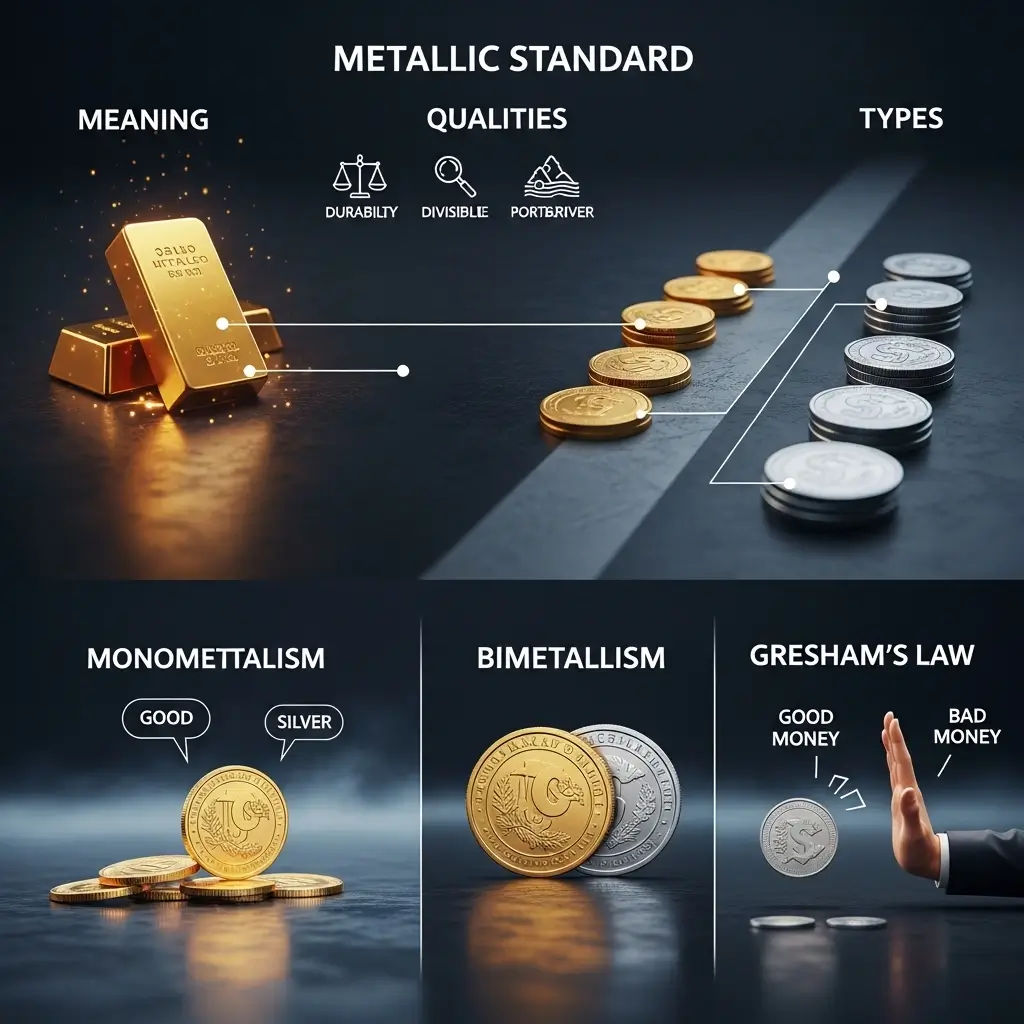
In this comprehensive 5000-word article, we will explore:
-
Meaning of Metallic Standard
-
Features and Qualities of Metallic Standard
-
Types of Metallic Standard
-
Monometallism
-
Bimetallism
-
Gresham’s Law
-
Advantages and Disadvantages
-
Historical examples and modern relevance
This article is designed for economics students, BCS candidates, university learners, and competitive exam preparation.
1. Meaning of Metallic Standard
A Metallic Standard is a monetary system in which the value of money is based on a specific quantity of metal, usually gold or silver.
Under this system:
-
The standard unit of currency is defined in terms of metal.
-
Coins made of metal circulate as money.
-
Paper currency (if issued) is convertible into metal.
-
The metal content determines the intrinsic value.
In simple words, money derives its value from the metal it contains.
Key Characteristics
-
Money made of precious metal
-
Intrinsic value equal to face value
-
Free coinage (in some systems)
-
Convertibility into metal
Historically, institutions like the Bank of England played an important role in managing metallic systems during the gold era.
2. Qualities of a Good Metallic Standard
A metallic standard must possess certain qualities to function effectively.
2.1 Stability of Value
The metal used should have relatively stable value over time.
Gold was preferred because:
-
Limited supply
-
High demand
-
Durable nature
2.2 Durability
The metal should not deteriorate quickly.
Gold and silver:
-
Do not rust
-
Do not corrode
-
Maintain quality for centuries
2.3 Divisibility
It must be easily divisible into smaller units without losing value.
Coins can be minted in different denominations.
2.4 Portability
The metal should have high value relative to weight.
Gold is more portable than silver due to higher value density.
2.5 Uniformity
Each coin must have standard weight and purity.
2.6 Recognizability
The public must easily identify genuine coins.
2.7 Limited Supply
To prevent inflation, supply should be limited.
3. Types of Metallic Standard
Metallic standards are broadly classified into:
-
Monometallism
-
Bimetallism
4. Monometallism
Meaning
Monometallism is a monetary system in which only one metal (gold or silver) is used as the standard of value.
Under monometallism:
-
Only one metal is legal tender.
-
Currency unit is defined in terms of that metal.
-
Other metals (if any) serve subsidiary roles.
Types of Monometallism
4.1 Gold Monometallism (Gold Standard)
Currency value defined in gold.
Example:
The United Kingdom adopted gold monometallism in 1821 under the supervision of the Bank of England.
4.2 Silver Monometallism (Silver Standard)
Currency based solely on silver.
Countries like India historically used silver standard before shifting to gold exchange systems.
Features of Monometallism
-
Single metallic base
-
Simplicity
-
Fixed standard
-
Clear valuation
Advantages of Monometallism
1. Simplicity
Easy to maintain one metal system.
2. Stability (Gold Standard)
Gold provided long-term price stability.
3. International Trade
Countries using gold standard had fixed exchange rates.
Disadvantages
1. Inelastic Money Supply
Money supply limited by metal production.
2. Deflation Risk
If gold supply decreases → prices fall.
3. Economic Rigidity
Difficult to manage economic crises.
5. Bimetallism
Meaning
Bimetallism is a monetary system where two metals (usually gold and silver) are used as standard money.
Under this system:
-
Both metals are legal tender.
-
Government fixes legal ratio between gold and silver.
-
Coins of both metals circulate freely.
Example
France adopted bimetallism in the 19th century.
The United States also experimented with bimetallism in early history before fully adopting gold standard under the Federal Reserve system (modern era).
Features of Bimetallism
-
Dual metallic base
-
Legal ratio fixed by government
-
Free coinage
-
Full legal tender status
Types of Bimetallism
5.1 Parallel Standard
Both metals circulate independently.
5.2 Double Standard
Fixed legal ratio maintained.
Advantages of Bimetallism
1. Greater Money Supply
Using two metals increases circulation.
2. Price Stability
Fluctuation in one metal offset by other.
3. Avoids Scarcity Problem
If gold scarce → silver compensates.
Disadvantages
1. Difficulty Maintaining Fixed Ratio
Market ratio may differ from legal ratio.
2. Leads to Gresham’s Law
Bad money drives out good money.
3. Complex Administration
Maintaining two metals costly.
6. Gresham’s Law
Meaning
Gresham’s Law states:
“Bad money drives out good money.”
Named after English financier Thomas Gresham.
Explanation
When two types of money circulate at fixed legal ratio:
-
People hoard undervalued (good) money.
-
Overvalued (bad) money remains in circulation.
Example:
If legal ratio:
1 gold = 15 silver
But market ratio:
1 gold = 16 silver
People will:
-
Use silver for payments
-
Hoard gold
Result:
Gold disappears from circulation.
Historical Example
During US bimetallic period:
When silver became overvalued legally,
Gold was hoarded and exported.
Importance of Gresham’s Law
-
Explains failure of bimetallism
-
Influences currency policy
-
Relevant in inflationary environments
7. Comparison: Monometallism vs Bimetallism
| Feature | Monometallism | Bimetallism |
|---|---|---|
| Number of metals | One | Two |
| Simplicity | High | Low |
| Money supply | Limited | Wider |
| Risk of Gresham’s Law | No | Yes |
| Stability | More stable (gold) | Unstable ratio |
8. Advantages of Metallic Standard
-
Intrinsic value
-
Public confidence
-
Inflation control
-
Automatic adjustment mechanism
-
Encourages fiscal discipline
9. Disadvantages of Metallic Standard
-
Inflexible money supply
-
Economic rigidity
-
Dependent on mining production
-
Costly coinage
-
Not suitable for growing economies
10. Metallic Standard and International Trade
Gold standard facilitated:
-
Fixed exchange rates
-
Stable international prices
-
Smooth global trade
Before 1914, global trade expanded rapidly due to metallic standard.
11. Decline of Metallic Standard
Reasons:
-
World War I
-
Economic depression
-
Gold scarcity
-
Need for flexible monetary policy
The Great Depression showed limitations of rigid gold systems.
Economists like John Maynard Keynes criticized gold standard for causing unemployment.
12. Metallic Standard vs Fiat Standard
| Feature | Metallic Standard | Fiat Standard |
|---|---|---|
| Backed by | Gold/Silver | Government authority |
| Intrinsic value | Yes | No |
| Flexibility | Low | High |
| Crisis response | Difficult | Easier |
| Inflation control | Natural | Policy-based |
Modern economies operate under fiat systems managed by central banks like the Federal Reserve and Bangladesh Bank.
13. Metallic Standard in Developing Countries
Historically:
-
India used silver standard.
-
Britain used gold standard.
Colonial economies were often tied to metallic systems imposed by imperial powers.
14. Relevance Today
Though metallic standard no longer exists officially:
-
Gold still held as reserve asset.
-
Central banks store gold for security.
-
Investors buy gold during inflation.
Gold remains a “safe haven” asset.
15. Critical Evaluation
- Metallic standard provided:
- Stability
- Trust
- International integration
But failed because:
✘ Inflexible
✘ Deflationary bias
✘ Insufficient for modern economies
Economic growth today requires elastic money supply, which metallic systems cannot provide.
16. Conclusion
The Metallic Standard was a foundational monetary system where currency derived value from precious metals like gold and silver. It provided stability, discipline, and international confidence for centuries.
We examined:
-
Meaning of metallic standard
-
Qualities of a good metallic system
-
Types: Monometallism & Bimetallism
-
Gresham’s Law
-
Advantages and disadvantages
-
Historical relevance
While metallic standards ensured price stability and public trust, their rigidity made them unsuitable for modern dynamic economies. Today, central banks such as the Federal Reserve and Bank of England manage flexible fiat systems to promote growth and stability.
However, the legacy of metallic standards continues to influence modern monetary thought, and gold remains a symbol of financial security.